
The Hidden Margin Math: How to Calculate Your Break-Even ROAS on Supplement Ads
· 11 min read · By Rocktomic Labs Team
What Is Break-Even ROAS and Why It Matters for Supplement Brands
Most supplement brands scale ads by chasing a ROAS number they heard was ‘good’ – 3x, 4x, or higher. That guesswork costs thousands. Your break-even ROAS (BEROAS) is the only number that matters. It tells you the minimum return needed to cover every cost. Below it, every ad sale loses money. Above it, every dollar scales profit. Here is the exact formula, worked with real wholesale costs.
Model your monthly revenue, repeat rate, and net profit as your supplement brand scales – using real catalog costs and fees.
Break-even ROAS (BEROAS) is the minimum revenue your ads must generate per dollar spent to cover all product and fulfillment costs, producing zero profit and zero loss. The formula: BEROAS = 1 / Gross Margin. If gross margin is 50%, BEROAS is 2.0x; if 65%, BEROAS drops to 1.54x.
For supplement brands, this number is the difference between profitable scaling and silent cash burn. Most ecommerce brands chase a generic ‘4x ROAS’ benchmark from Amazon Ads (guide, September 2025) without realizing that high-margin categories like supplements can profit at a fraction of that. Without knowing your exact BEROAS, you cannot set a rational target CPA or know whether your Meta campaigns are actually making money.
Rocktomic’s on-demand dropshipping model gives you the wholesale costs you need to calculate that margin precisely. See how Rocktomic on-demand dropshipping works and start building a brand that scales on real math, not guesses.
The Break-Even ROAS Formula: 1 / Gross Margin
You need two numbers: revenue per unit and total per-unit costs. Revenue is your MSRP. Total costs are the real stack: wholesale COGS, fulfillment, payment processing (2.9% + $0.30 typical for Stripe), and any shipping you cover.
Gross margin is (Revenue − Total Costs) / Revenue. Then break-even ROAS = 1 / Gross Margin.
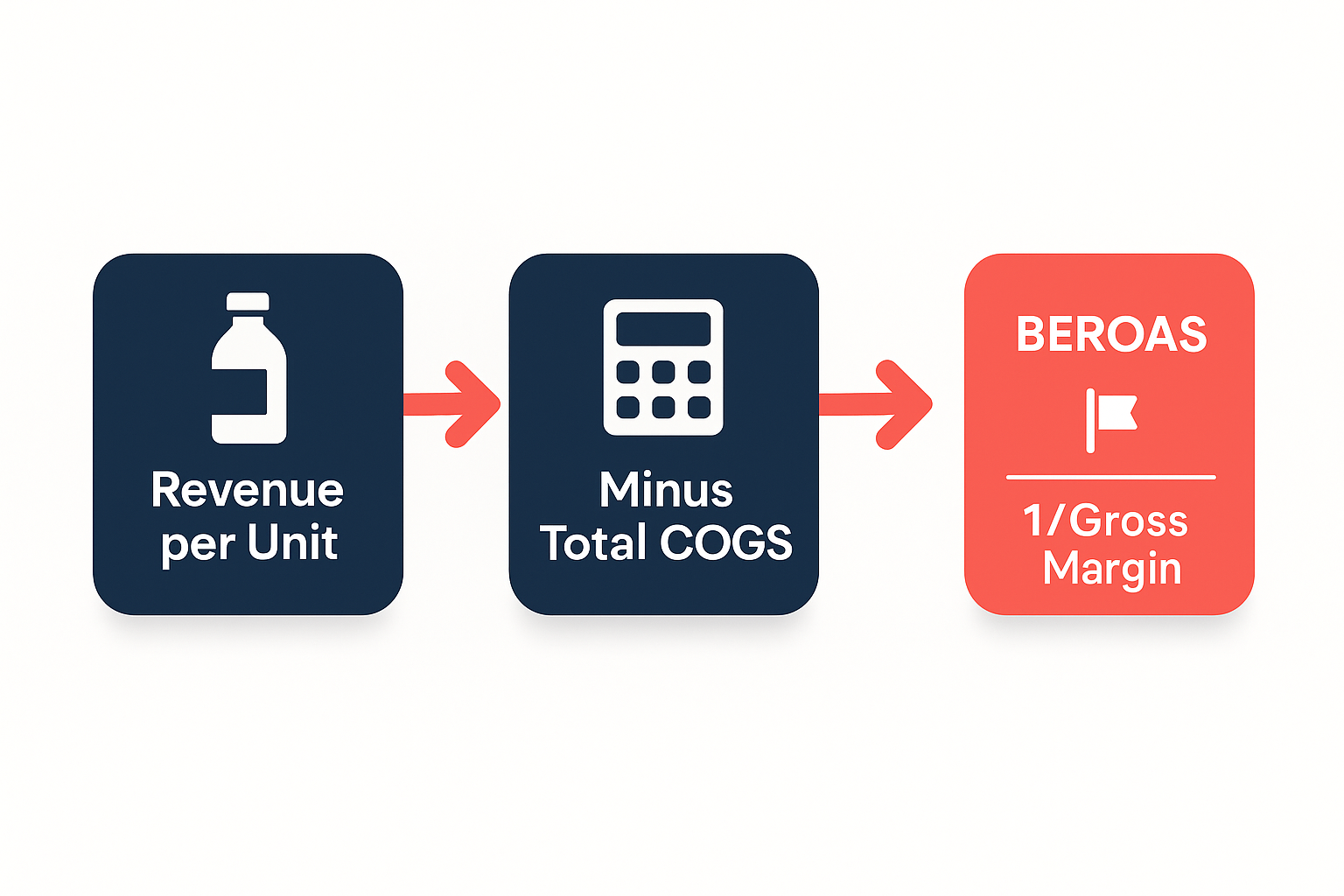
The Amazon Ads guide (September 2025) confirms it: “Start by identifying your break-even ROAS based on your profit margin.” Straightforward math, but only if you use the right inputs.
Here’s the critical mistake: brands use COGS-only margin instead of post-fulfillment margin. That 80% gross margin on COGS looks like it needs only 1.25x ROAS. After adding fulfillment, transaction fees, and shipping, real margin drops to 55 – 65%. That means 1.54x to 1.82x BEROAS. Big difference.
Triple Whale (December 2025) puts it bluntly: “Use post-fulfillment gross margin… otherwise break-even sits too low and cash burns silently.”
Get the formula right once. Use total costs, not just COGS. That one change saves you from running ads that look profitable on paper but leak cash every day.
Real Money-Math: Break-Even ROAS on a Rocktomic Product
Work one real example from the Rocktomic Scale wholesale catalog. Product: Super Creatine Gummies 1000mg (SKU ROC943). Retail price (MSRP): $29.97. Scale wholesale cost: $8.45. Flat $2 per item fulfillment covers pick, pack, and label. Payment processing runs 2.9% plus $0.30 on the $29.97 sale: $1.17. That gives you a clear per-unit cost stack.
| Line Item | Amount |
|---|---|
| MSRP (retail price) | $29.97 |
| Scale wholesale (ROC943) | $8.45 |
| Fulfillment (flat fee) | $2.00 |
| Payment processing (2.9% + $0.30) | $1.17 |
| Total per-unit cost | $11.62 |
| Gross profit per unit | $18.35 |
| Gross margin | 61.2% |
| Break-Even ROAS | 1.63x |
That 1.63x is your floor. For every dollar spent on Facebook ads, you need $1.63 in revenue just to break even. Anything above that is pure contribution margin. At a 2.5x ROAS, your contribution margin after ad costs hits 53%. At 4.0x ROAS, it jumps to 71%.
Now compare how other setups crush that math. Many suppliers charge per-order fees or force pallet buys that inflate your unit cost. Their break-even ROAS can climb above 2.5x, making profitable advertising far harder. When your wholesale cost stays low and fulfillment is a flat $2, you keep your BEROAS lean enough to scale.
For a deeper breakdown of every cost bucket beyond wholesale and fulfillment, read the complete guide to supplement COGS math.
From Break-Even ROAS to Target CPA: Your Maximum Ad Spend Per Order
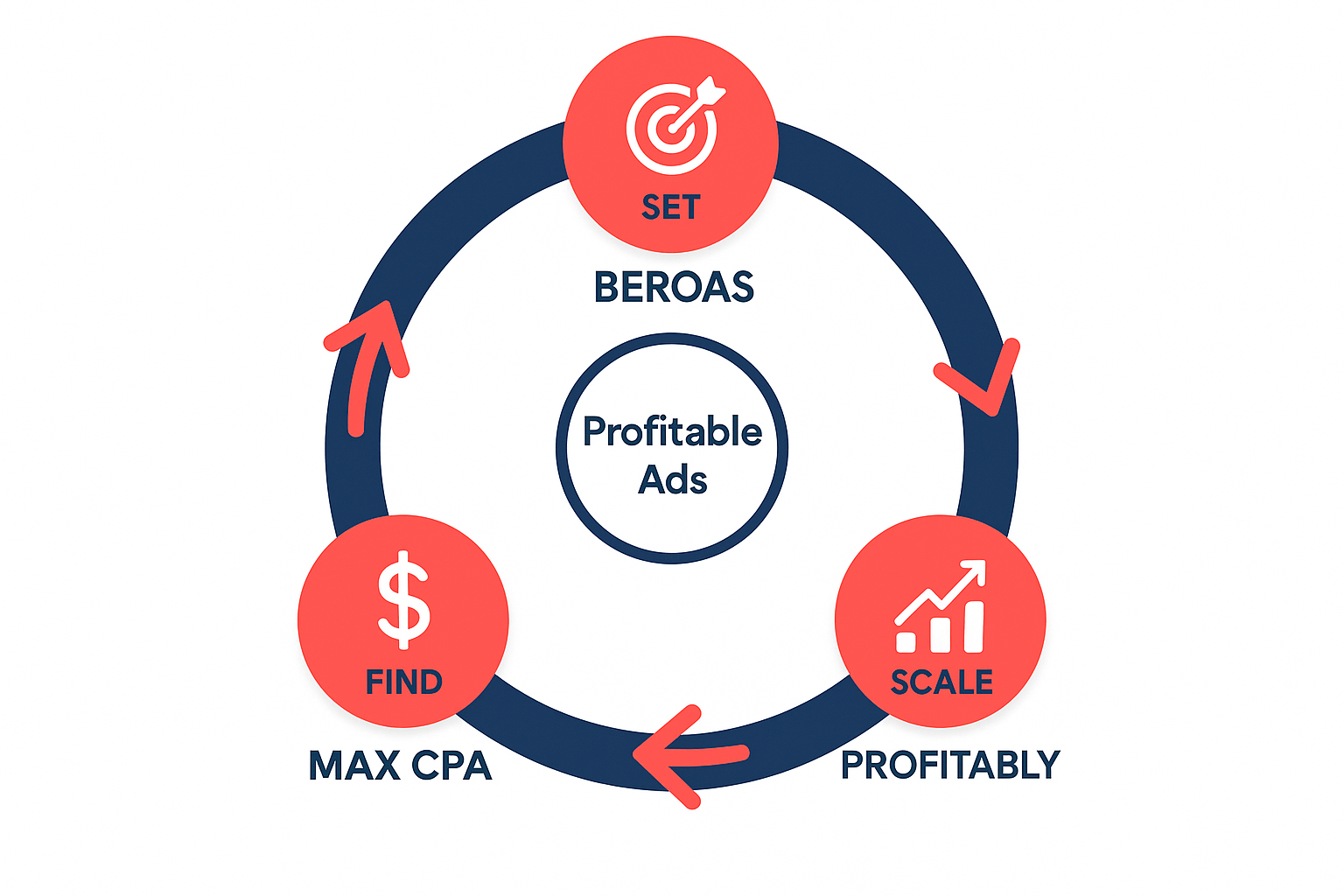
Once you know your BEROAS, the next step is simple: calculate your maximum target CPA (cost per acquisition). The formula is straightforward: Max CPA = Revenue / BEROAS.
Using the Super Creatine Gummies example: $29.97 in revenue divided by 1.63 BEROAS gives you a max CPA of $18.38. That means you can spend up to $18.38 on ads per order before you lose money. Every dollar you spend under that $18.38 threshold goes straight to your profit contribution.
Now compare that to a low-margin electronics brand with a 25% gross margin. Their BEROAS would be 4.0x, giving them a max CPA of only $7.49 on the same $29.97 price. Your supplement brand can outbid them by 145% and still break even. That is the power of high-margin white-label products.
As Mako Metrics (March 2026) notes: “Higher-margin businesses can afford higher CPAs and still profit. This is why high-margin DTC brands in beauty and supplements tend to dominate Meta Ads – they can outbid lower-margin competitors and still make money.”
Set your Meta Ads Target ROAS bid strategy at 2.0x to 2.5x minimum. That is well above your BEROAS of 1.63x. It tells the algorithm to optimize for profit, not break-even. For a deeper breakdown of scaling those ad dollars, see our Meta ad scaling formula for supplement brands.
How Supplement Margins Compare to Other Ecommerce Categories
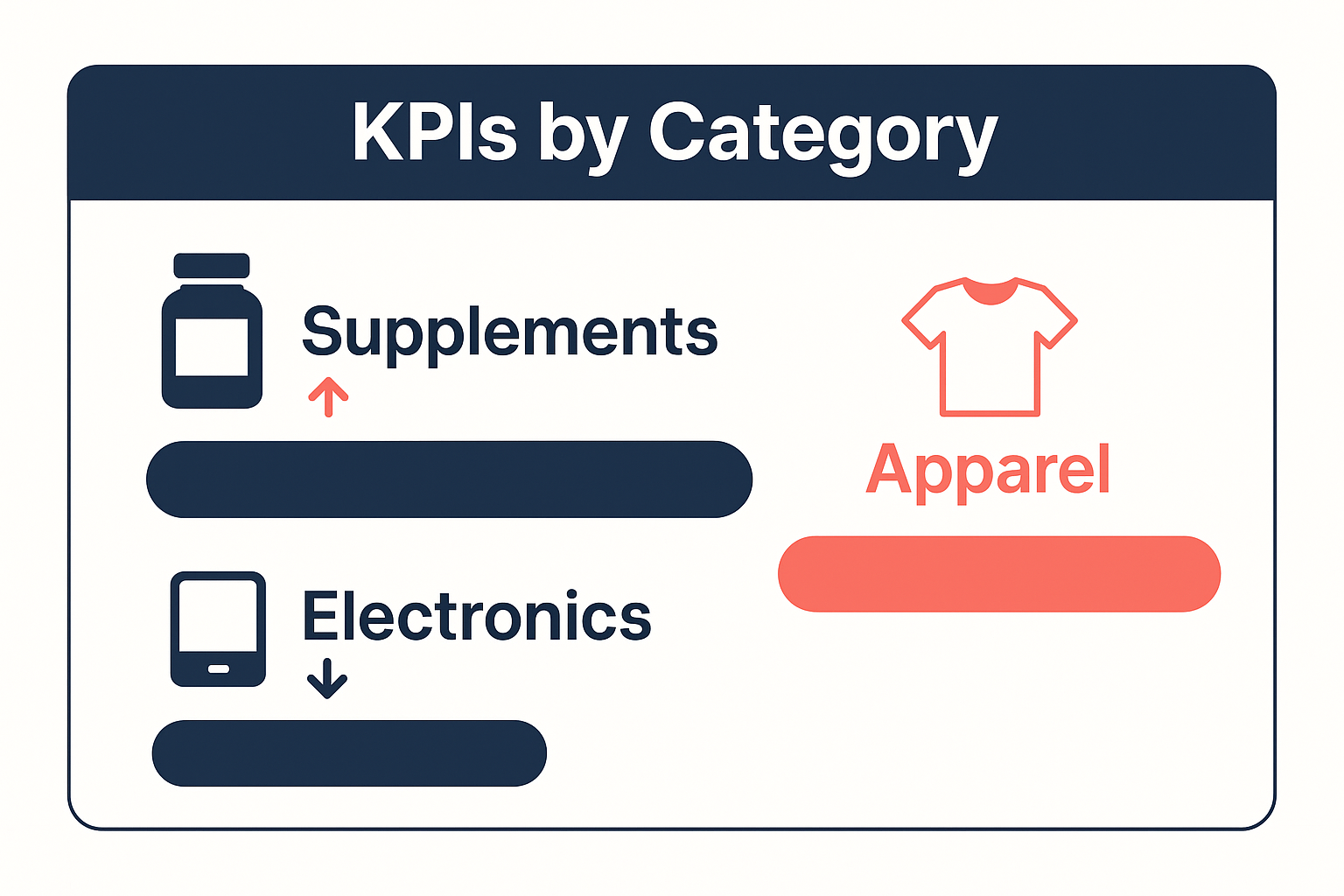
Supplements and health products consistently sit at the top of the ecommerce margin ladder. According to Eightx (June 2026), the category runs 65-78% gross margins – second only to beauty and skincare at 65-85%. Apparel lands at 50-65%. Food and beverage comes in at 40-55%. Consumer electronics struggles at 30-50%.
That margin stack directly determines your break-even ROAS. A supplement seller at 65% gross margin needs a BEROAS of only 1.54x. An electronics seller at 30% margin needs 3.33x – more than double. On a $30 average order value, the supplement brand can afford a cost-per-acquisition up to $23.44 while breaking even. The electronics brand maxes out at $9.01.
| Category | Typical Gross Margin | BEROAS | Max CPA on $30 AOV |
|---|---|---|---|
| Supplements | 65-78% | 1.28x – 1.54x | $19.48 – $23.44 |
| Beauty/Skincare | 65-85% | 1.18x – 1.54x | $19.48 – $25.42 |
| Apparel | 50-65% | 1.54x – 2.00x | $15.00 – $19.48 |
| Food & Beverage | 40-55% | 1.82x – 2.50x | $12.00 – $16.48 |
| Electronics | 30-50% | 2.00x – 3.33x | $9.01 – $15.00 |
This is the structural advantage of white-label supplements. At 1.54x BEROAS, you can profitably acquire customers at twice the CPA of an electronics brand. That means more room for testing audiences, creative, and scaling before hitting a loss.
But that advantage depends on your per-unit cost structure. Brands using a manufacturer with zero-inventory dropshipping and a flat $2-per-item fulfillment fee keep those margins intact. Platforms that add per-order fees or force bulk buys slowly eat away at them. Check why supplement brands choose Rocktomic to see how the fee structure preserves the margin math.
Three Ways to Improve Your BEROAS Without Changing Your Product
Your BEROAS is not fixed. You can pull three levers to lower it and increase your ad buying power without touching the product itself.
1. Increase AOV Through Bundles and Subscriptions
A single bottle at a $8.45 wholesale might yield a 62% margin and a 1.62x BEROAS. Bundle two bottles into a $45 offer and your effective wholesale stays the same, but margin jumps to 71%. That drops BEROAS to 1.41x, giving you roughly $2.50 more per order to spend on ads. Subscriptions lock that revenue in and raise AOV further.
2. Reduce Fulfillment Complexity
Variable per-order fees from other platforms inflate COGS and raise BEROAS. A flat $2 per item fee keeps unit costs predictable and low. That fixed cost means every dollar of AOV improvement goes straight to margin, instead of being eaten by surprise shipping or pick-pack charges.
3. Add Upsells at Checkout
A $15 add-on with a $3 wholesale cost delivers 80% margin on that line item. Blended with your core product margin, the overall order margin rises. Even a small upsell can move BEROAS meaningfully without changing how you source or manufacture.
Each improvement compounds. Pick one, and a 5-percentage-point margin gain will drop BEROAS from 1.54x to 1.43x. That raises your max CPA by roughly $1.80 per order. At 1,000 orders a month, that is $1,800 in extra room for ad spend. For a deeper breakdown of how unit economics drive these numbers, see our supplement unit economics deep dive.
Frequently Asked Questions About Break-Even ROAS for Supplement Brands
What is break-even ROAS for supplement ads?
Break-even ROAS (BEROAS) is the minimum ratio of ad revenue to ad spend required for your supplement brand to cover all product costs and fulfillment without losing money. It accounts for your wholesale cost per unit, the flat ~$2/item fulfillment fee, and any platform or transaction fees. If your BEROAS is 2.0, for example, every dollar in ad spend must return at least two dollars in revenue just to break even on that product.
How do I calculate BEROAS for my supplement brand?
Start with your total cost per unit: the Rocktomic wholesale price (for example, an example wholesale of about $8.50 on a popular item) plus the ~$2 fulfillment fee plus any payment processing or shipping costs you pass on. Divide that total cost by your selling price. Then divide 1 by that cost ratio. A $29.99 bottle with an $18.00 total cost gives a cost ratio of 0.60, so BEROAS is 1 / 0.60 = 1.67. That means you need $1.67 in revenue per ad dollar to break even.
What is a good ROAS for supplement Facebook ads?
A 2025 analysis by Focus Digital found that a 3.0x ROAS is considered strong for supplement brands on Facebook, while 2.0x is average. However, “good” depends on your margins. A brand with a 1.5 BEROAS can scale profitably at 2.0x, whereas a brand with a 2.5 BEROAS needs 3.0x just to break even. Focus on BEROAS over generic benchmarks. If your ads hold above your personal BEROAS, you can reinvest and grow.
Does the ~$2/item fulfillment fee affect my break-even ROAS?
Yes, directly. The flat ~$2 pick-pack-label fee is a fixed cost on every shipped bottle. On a $30 sale, $2 represents 6.7% of revenue. That percentage shrinks on higher-priced items but still raises your BEROAS. For example, on a $20 bottle with a $10 wholesale cost, adding the $2 fee shifts BEROAS from 2.00 to 2.50. Always include the fulfillment fee in your unit economics to set an accurate break-even target.
How does customer lifetime value change my BEROAS target?
LTV lets you accept a higher BEROAS on the first sale because you recoup margin on repeat orders. If your average customer buys three bottles over six months at $45 total gross profit, you can bid more aggressively upfront. Calculate blended BEROAS by dividing first-purchase cost by projected LTV revenue. A brand with LTV of $90 and first-purchase cost of $20 can break even at a 0.22 ROAS on the first transaction, then profit on refills.
What is the cheapest way to start a supplement brand with high margins?
Rocktomic’s Free plan at $0/month lets you sell up to 10 white-label products with zero inventory and no upfront purchasing. You pay only the ~$2/item fulfillment fee when an order ships. This eliminates the $10,000+ inventory minimums and monthly platform fees that other manufacturers require. Starting with on-demand dropshipping on the Free plan keeps your overhead near zero while you validate demand and refine your ad targeting.
How much can I profit per bottle on the Scale plan?
On the Scale plan ($297/month), you get the lowest per-unit wholesale pricing across the full 140+ product catalog. A typical greens powder example: wholesale around $8.50, sell for $39.99, subtract ~$2 fulfillment and ~$1.50 processing, leaving roughly $28 gross profit per bottle. After the $297 monthly fee, your first 11 bottles cover the plan. Every bottle after that on the same item retains the full $28 margin. Exact profit depends on your selected product and retail price.
What ROAS should I target in Meta Ads Manager for supplements?
Set your Meta Ads Manager ROAS target to your calculated BEROAS plus 20-30% margin for reinvestment and profit. If your BEROAS is 1.67, target a 2.0x-2.2x ROAS on the campaign level. Use the “Purchase” conversion event and a 7-day click attribution window. Monitor daily; if ROAS dips below BEROAS for 48 hours, pause the ad set and retest creative or audience. Scale only sets that consistently clear your target by 1.5x or more.
Start Scaling Supplement Ads With Real Margin Clarity
Most supplement brands fail at advertising not because their creatives are bad or their targeting is off, but because they never ran the margin math. They chase a 3x ROAS that would be profitable for an apparel brand while leaving money on the table. Or worse, they run at 1.4x ROAS thinking it is okay because ‘Meta says 1x is break-even,’ not realizing their true BEROAS is 1.63x. They see ad costs but miss fulfillment, shipping, and merchant fees. That gap adds up fast. Margin math is the foundation — get it right and your ad dollars work for you.
Your break-even ROAS is the single most important number in your ad account. Calculate it once per product, set your Target ROAS above it, and scale with confidence.
Use the supplement margin calculator to run your own numbers with real Rocktomic wholesale costs. Compare Rocktomic Scale plan pricing to see how low wholesale costs and flat $2 fulfillment keep your BEROAS low. Rocktomic offers a Free plan at $0 per month — you pay only the fulfillment fee when a customer orders. For serious scaling, the Scale plan at $297 per month gives you the lowest per-unit wholesale across 140+ products, unlimited sales channels, and priority fulfillment. That lower unit cost directly improves your BEROAS. When you know your real margin, you can set ad targets that actually scale profitably.
Run the numbers. Know your BEROAS. Start scaling supplement ads with real margin clarity.