
Stop Trading Time for Money: Online Coaching Revenue vs. Scalable Supplement Margins
· Updated · 15 min read · By Rocktomic Labs Team
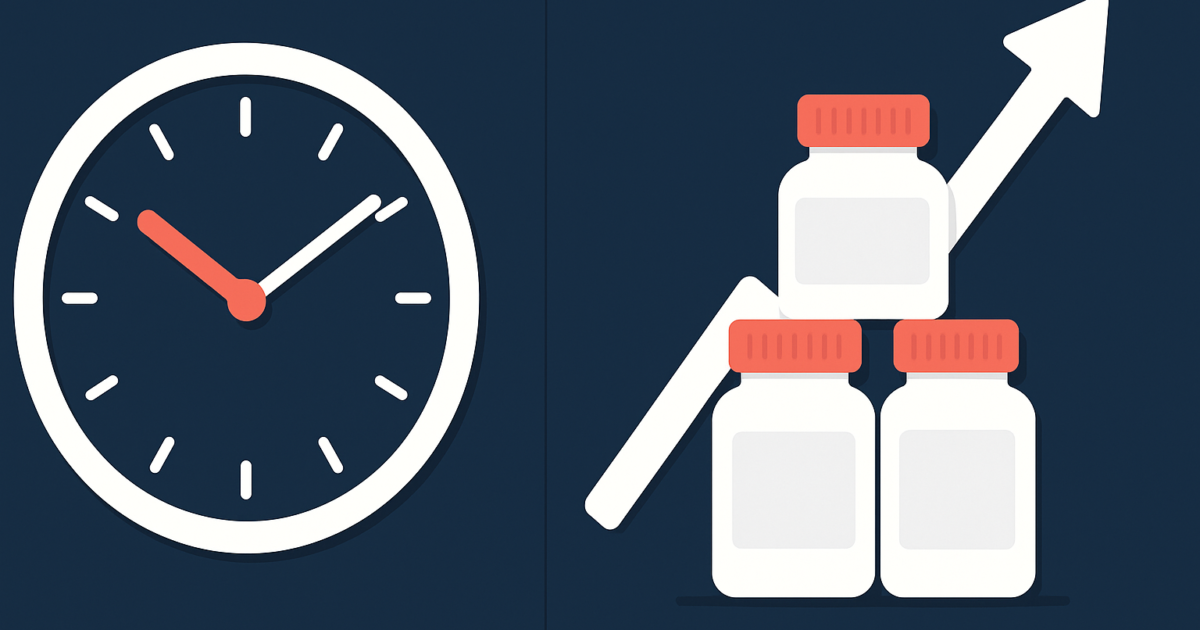
Online Coaching vs Supplement Margins in 2026
Online coaching revenue is capped by the number of hours a coach can deliver, while supplement margins scale per unit with zero extra hours. The 2025 ICF Global Coaching Study values global coaching revenue at about $5.34 billion, and Grand View Research values the global dietary supplements market at about $209.5 billion in 2025. The coaches growing fastest are not replacing coaching – they are adding a branded product line that pays the same way at 10 orders as at 1,000.
Every coaching session you sell consumes the hour you deliver it in. Every product order you ship consumes no extra time at all. That gap is why coaches, gym owners, and practitioners are adding branded supplements to businesses that already have their trust.
What Does Trading Time for Money Actually Cost a Coach?
Trading time for money means revenue equals hours worked times rate, so income stops growing at the edge of the calendar. The real cost is opportunity: every coaching hour is an hour that cannot build an asset, an audience funnel, or a product. Coaches who keep only a session model cap their upside at their own energy.
Pick any product, set your monthly volume, and see your real per-unit and monthly profit on every plan – fulfillment, card processing, and membership all included.
That trade is a one-for-one exchange. You give an hour, you get paid, and the hour is gone. Nothing compounds from a session, and nothing left on the calendar builds a brand that sells without you.
The Structural Ceiling: Why Coaching Revenue Caps at Billable Hours
Run the time math before you build another funnel. An online coach at the IBISWorld Business Coaching in the US (Sept 2025 report, retrieved 2026-06-21) average of about $150 per session hour selling 25 billable hours per week grosses roughly $15,000 per month at full capacity – before cancellations, no-shows, admin, and content time.
That number assumes 25 sold hours every week, with zero gaps. Real sessions bring cancellations and no-shows. Then add the unbillable work that keeps the business alive – sales calls, program design, check-ins, and the content that feeds the funnel. The actual hourly rate lands well below the headline number, and the gap only grows as the audience does.
The Calendar Only Has So Many Hours
To double that $15,000, a coach has two options. Add more deliverable hours, which means filling evenings and weekends until something breaks. Or hire coaches, which converts the business back into management: recruiting, training, quality control, and payroll. Most coaches who hire end up doing less coaching and more managing, and the margin per session shrinks as overhead grows.
Either path hits the same wall. The calendar only has so many hours, and every sold hour resets revenue to zero. A session delivered is a session consumed. Nothing compounds, no asset keeps paying after the work ends, and next month starts from the same blank calendar.
Two Revenue Engines, One Ceiling
Now compare that engine to a product-based one. The seller still creates content, still builds an audience, and still owns the customer relationship. The difference is the revenue unit. It stops being a block of the seller’s time and becomes a unit sold.
| Business model | Revenue unit | Marginal cost | Scaling lever | Ceiling |
|---|---|---|---|---|
| Online Coaching | session hour | the coach’s time | hire more coaches | calendar |
| Branded Supplements | unit sold | product cost plus flat ~$2/item fulfillment | more orders through the same content | effectively none |
Read the marginal cost column and the ceiling column together. A coaching session costs the coach an hour, and its ceiling is the calendar. A supplement unit costs product cost plus flat ~$2/item fulfillment, and its ceiling is effectively none. More orders flow through the same content, the same funnel, and the same brand without adding headcount. Scale stops costing time.
That structural shift is the idea behind how Rocktomic works. The creator keeps the audience, the content, and the brand, then sells units instead of hours. It is also the reason creators are shifting to high-margin physical products. The coaching ceiling doesn’t disappear. It just stops being the limit of what the business can earn.
2026 Market Data: Coaching vs Supplements
Both industries are growing. The 2026 numbers show two different growth engines at work, and the difference decides who collects the upside. One market grows by adding people. The other grows by adding volume.
Coaching grows by adding practitioners
| Metric | Value | Source |
|---|---|---|
| Global coaching revenue | ~$5.34 billion, with 122,974 practitioners, up 15% since 2023 | ICF 2025 Global Coaching Study (retrieved 2026-06-21) |
| U.S. business coaching market | ~$20.0 billion in 2026 across 72,013 businesses | IBISWorld (Sept 2025 publication, retrieved 2026-06-21) |
The driver behind those coaching numbers is headcount. Global revenue climbed 15% since 2023 because the practitioner count hit 122,974, not because each coach earns meaningfully more. A coach sells hours, a calendar has limits, and every new practitioner adds supply to the same pool of clients. The market grows by adding more sellers, and that is the only lever the model has.
Growth like that is additive. It moves when people enter the market, and it stalls when their schedules fill up. The revenue gets spread across more practitioners, so the per-coach ceiling stays in place. The shape of that growth is linear because hours do not multiply.
Supplements grow by multiplying spend and volume
| Metric | Value | Source |
|---|---|---|
| Global dietary supplements market | ~$209.5 billion in 2025, projected ~$431.7 billion by 2033 at a 9.5% CAGR | Grand View Research (retrieved 2026-06-21) |
| U.S. dietary supplements market | ~$68.74 billion in 2025, projected ~$131.08 billion by 2033 at an 8.5% CAGR | Grand View Research (retrieved 2026-06-21) |
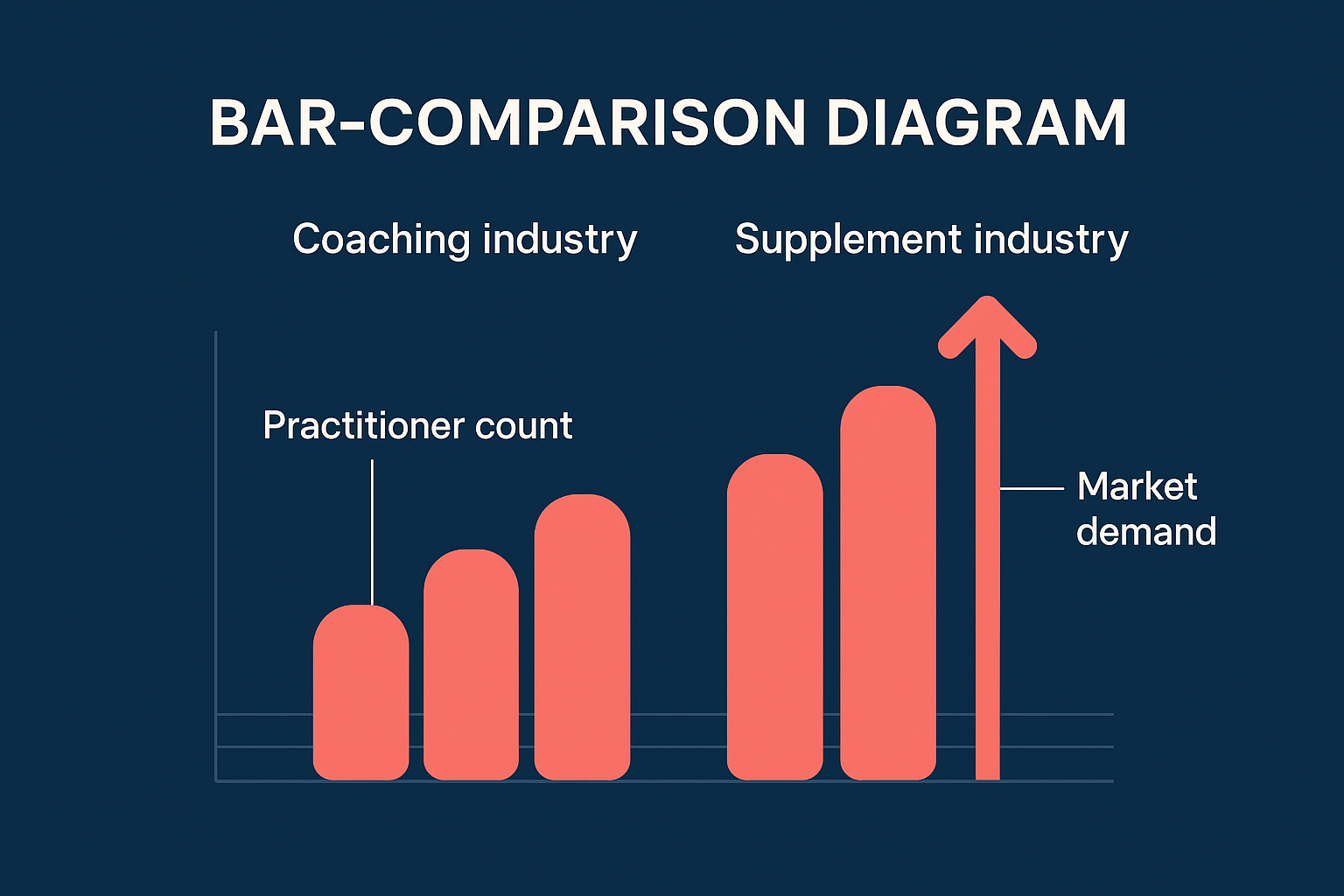
Supplements run on a different engine. The global market is projected to climb from ~$209.5 billion in 2025 to ~$431.7 billion by 2033, a 9.5% CAGR. The U.S. market follows the same curve, going from ~$68.74 billion to ~$131.08 billion at an 8.5% CAGR. That is a near-doubling in eight years.
That growth is not tied to adding sellers. It compounds from higher per-customer spend, larger order sizes, and more distribution channels moving product. Grand View Research identifies online as the fastest-growing channel, which is where an audience-owning creator already does business. A 9.5% CAGR compounds, so the gap between today’s market and the 2033 projection widens every year.
What the gap means for a coaching business
Read side by side, the tables answer the question most coaches ask: where is the volume going? The coaching market grows at a steady, people-driven pace. The supplement market compounds. The 2026 supplement market boom walks through that channel math in detail.
Supplement revenue scales with a market projected to double in eight years; coaching revenue scales with your schedule. The data says both industries are healthy. The data also says only one of them keeps growing when you stop working. That is the difference between selling your hours and owning a piece of a growing category.
Why Supplement Margins Scale Without Extra Hours
A coaching session ends when the hour ends. An order can keep producing revenue while you record, train, or sleep. The reason is structural: the product, the warehouse, and the shipping all run without your time attached. Your only job is demand.
The Free plan costs $0/month. It covers one sales channel and up to 10 white-label products, sold through on-demand dropshipping. There’s no monthly fee and no inventory to buy. You pay a flat fulfillment charge per item, and only when that item actually ships. A month with zero orders costs zero dollars.
The Scale plan is $297/month. It adds the full 140+ product catalog, unlimited sales channels, the lowest per-unit wholesale pricing, and priority fulfillment. Priority fulfillment means your orders move through the facility ahead of the standard queue, which keeps delivery times tight and reviews positive. Free removes the barrier to starting. Scale removes the ceiling on growth. These are the only two membership tiers.
| Plan | Monthly cost | Products | Sales channels | Wholesale pricing |
|---|---|---|---|---|
| Free | $0 | Up to 10 | 1 | Standard |
| Scale | $297 | Full 140+ catalog | Unlimited | Lowest per unit |
Flat ~$2 per item, paid only when it ships
Every order gets picked, packed, and labeled for a flat ~$2 per item. That fee is charged only on shipment, so your cash stays in your pocket until you have a customer. There is no minimum order quantity and no upfront inventory purchase. You can launch in days, not quarters, and test new products without betting a big chunk of cash on demand.
The launch path looks like this: pick a product, upload your label, connect your store, and start promoting. Rocktomic manufactures, warehouses, labels, and ships. You own the brand, the customer list, and the relationship. When a customer reorders, they come back to you, not to a marketplace, and the customer data stays yours.
All of that operational work runs through on-demand fulfillment. Your time goes to content, community, and sales instead of boxes and labels.
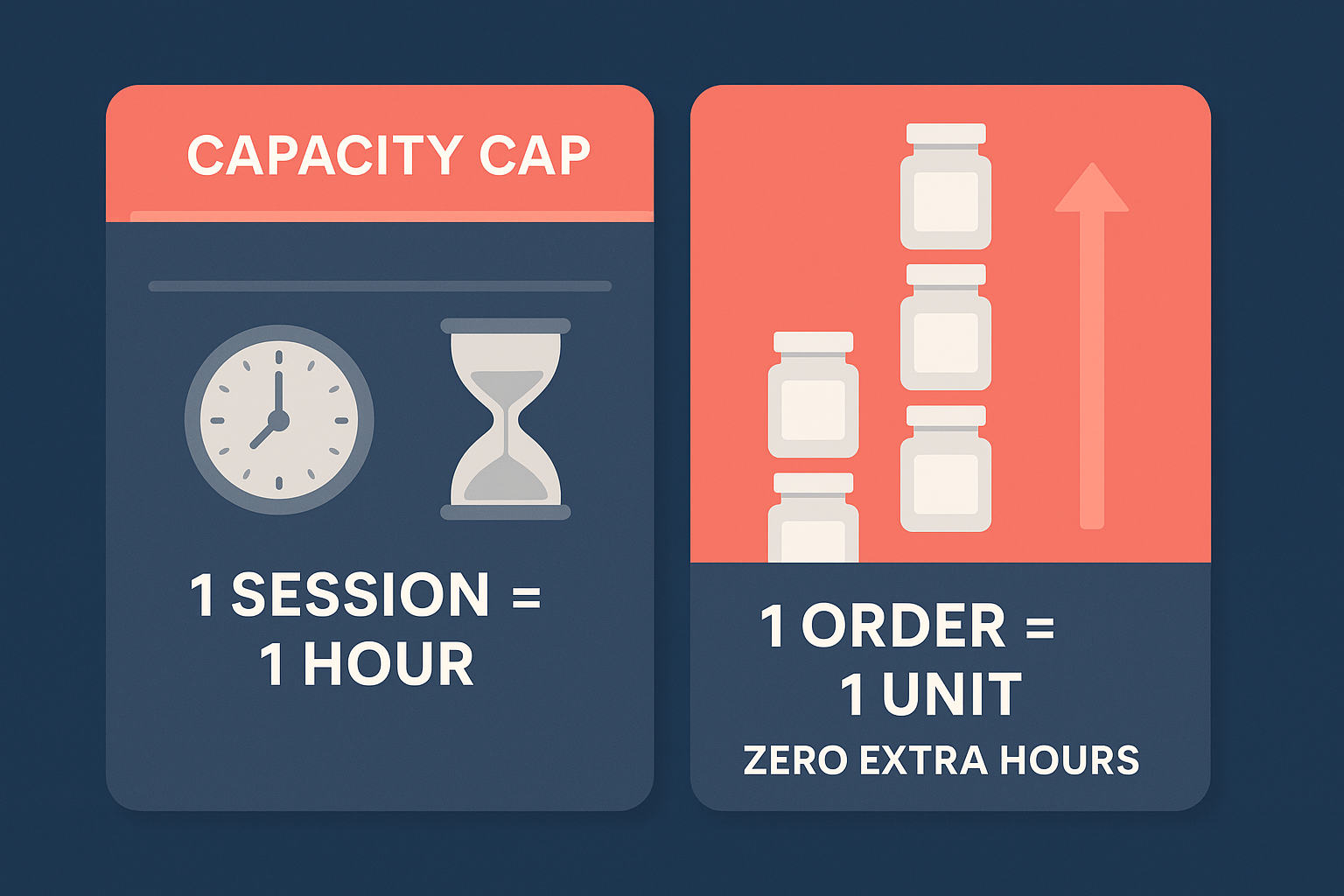
Per shipped unit, not per pallet
Compare that with the standard options. Some manufacturers force pallet buys before you sell a single unit, which means predicting demand months ahead. Predict wrong and your cash sits in a warehouse while the product gathers dust. Some platforms charge per-order fees on top of product cost, adding an extra charge to every single sale. Those fees scale with your volume, which makes your cost structure worse as you grow.
This model charges per shipped unit and nothing else. Your cost per order stays flat as revenue grows, which makes margin planning simple. That’s why Rocktomic built fulfillment this way: a brand you own, operations you do not manage, and a cost structure that scales with sales instead of hours.
How Top Coaches Duplicate Income Without Adding Clients
Coaching income stops scaling the day your calendar fills. Every new client costs hours you do not have. So top coaches do not add clients. They add a second revenue line that uses the same audience, the same expertise, and none of the same time. The system is a loop, not a side project.
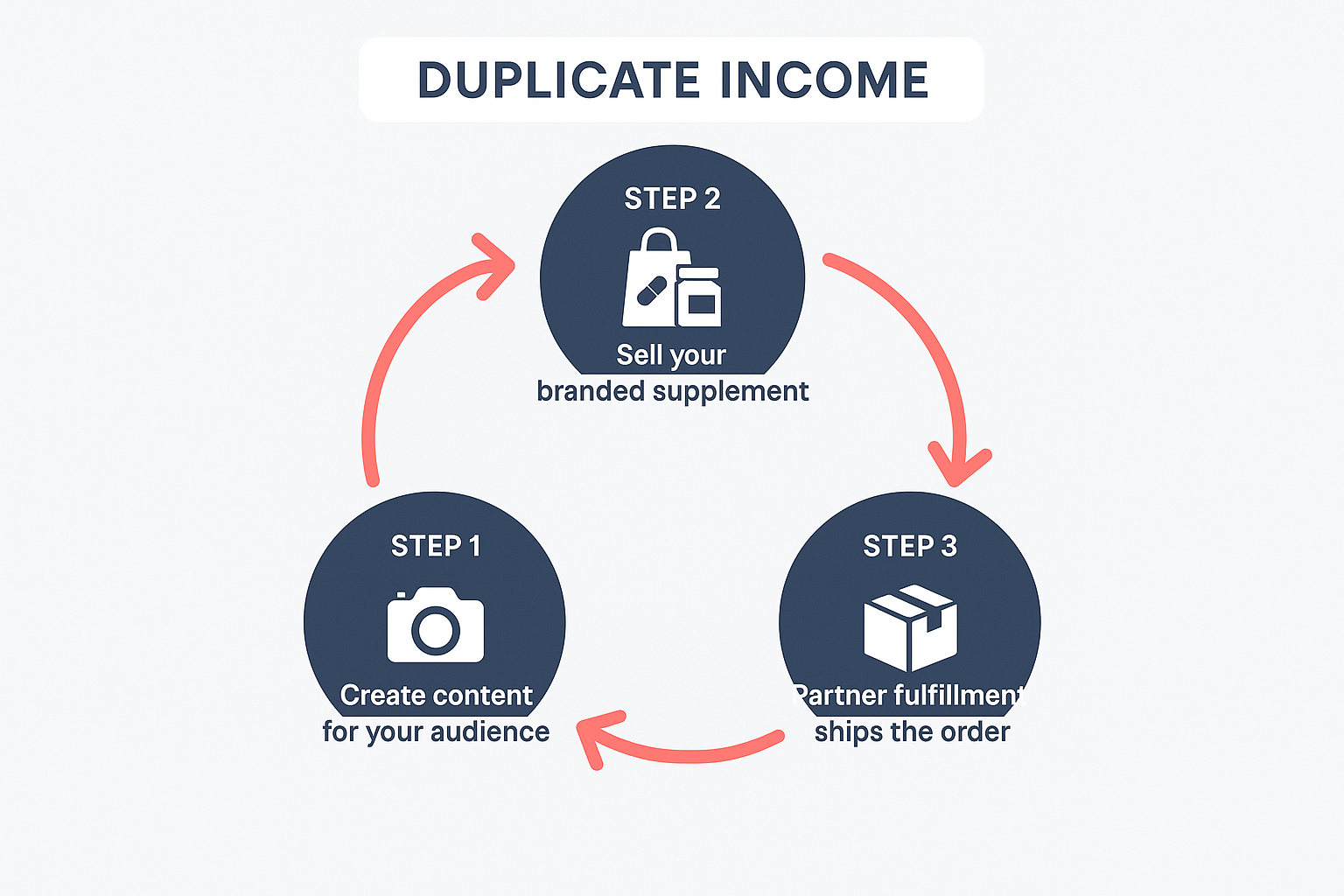
The three-step loop
- Keep coaching as the trust layer. Your coaching is not the bottleneck. It is the credibility engine. Clients trust your advice because they see you show up. That trust transfers to a product because the product is an extension of your opinion. Remove coaching and you lose the reason people buy.
- Launch a branded product the same audience already asks about. Your audience sends you DMs asking what you take, what you eat, what you recommend. That is a demand signal. For a fitness and wellness coach, the demand maps to market categories like sports nutrition, greens, recovery, and gummies. These are product markets, not medical claims. You are naming a category that already has buyers, not inventing a cure.
- Let partner fulfillment ship every order. You never see a bottle. A partner handles manufacturing, warehousing, labeling, and delivery. Your only job is telling your audience the product exists and why you made it. The order goes from a customer’s cart to their door with zero work from you.
Your content is the distribution channel
You already post workouts, tips, and Q&As every week. That content is a channel you built for free. It has an audience that trusts you. Cold traffic from ads has none of that. To sell to cold traffic, you pay to explain who you are, why you are credible, and why your product matters. Your existing feed already does that work. So the cost to acquire a customer through the same feed is a fraction of cold acquisition. No ad spend needed to explain your voice, because the voice already lives in the content. This is the structural advantage of a white label for brand builders model, where the brand is yours but the logistics are not.
The revenue result becomes predictable
Once the loop is running, the revenue result repeats without extra hours. The product sells while you coach. The order ships without you touching a box. The month closes with a number you did not trade hours for: [insert approved proof-set stat].
This is not a one-off trend. It is part of the 2026 creator economy shift where influencers launch owned supplement brands instead of renting attention. Ad revenue is volatile. A product line compounds. Your content is the moat. Your brand is the asset.
Your 90-Day Shift: From Session-Based to Product-Plus Income
Your calendar is the first place to look. Every client hour you sell has a hard ceiling: 24 hours per day, and only so many you can coach before quality drops. Product income does not respect that ceiling. Here is the four-step sequence that gets you from session-based to product-plus revenue in one quarter.
Step 1: Audit your billable-hour capacity and name the gap
Total your billable hours for a typical week. Multiply by your rate. That is your revenue ceiling today. Now write down the number you actually need. The gap between those two numbers is the exact amount of product revenue you need to build. Name it, write it down, and you have a target specific enough to plan against.
Step 2: Pick one first SKU that matches your niche
One product. Not five, not a full line. Choose the SKU your clients already ask about. A strength coach sells creatine or a recovery product. A nutrition coach sells a greens powder. A clinic sells a practitioner-grade formula. One SKU keeps your first month simple and gives you a clean read on what actually sells.
Step 3: List it on your existing channel and ship through on-demand fulfillment
You do not buy inventory to get started. List the product on the channel you already use, and Rocktomic dropships each order as it comes in. The Free plan at $0/month is the entry point. The Scale plan at $297/month is the upgrade when you want more. Either way, no pallets, no storage, no upfront purchase.
Step 4: Model unit economics before you scale ads
This is where most coaches burn money. They set a daily ad budget before they know their contribution per unit. Run your price, cost, and fees through the supplement margin calculator first. Then take those numbers into the profit projection tool and model what 50, 100, and 500 orders per month look like. If the math works at 100 orders, it will work at scale. If it does not, change the price or the SKU before you spend on traffic.
The full transition from session-based to brand income is a bigger playbook. Read about escaping the time-for-money trap as a coach and map it against these four steps.
FAQ: Online Coaching vs Supplement Margins
Why is online coaching revenue capped by time?
Coaching sells hours. A coach who charges by the session can only earn what the calendar allows, so revenue is capped by billable hours, client capacity, and energy. The 2025 ICF Global Coaching Study counts about 122,974 practitioners worldwide, which means competition for those hours keeps rising. Adding revenue requires adding deliverable time or more coaches, not more product.
What does a scalable supplement margin mean for a coach?
Scalable means the same amount of work produces more revenue as volume grows. A branded supplement sells the same way whether the coach makes one sale or one thousand, because manufacturing, warehousing, labeling, and shipping are handled by a partner like Rocktomic. The coach owns the brand and the customer relationship while paying only when an order ships. Per-unit margin stays consistent and no extra hours are added.
How big is the supplement market compared to coaching?
The global dietary supplements market was valued at about USD 209.5 billion in 2025 and is projected to reach USD 431.7 billion by 2033 at a 9.5 percent CAGR, per Grand View Research (retrieved June 21, 2026). By comparison, the 2025 ICF Global Coaching Study put global coaching revenue at about USD 5.34 billion. Both industries are growing, but the supplement market operates at a far larger scale.
Can a coach sell supplements without holding inventory?
Yes. On-demand dropship means the coach lists products, a customer orders, and the partner manufactures, warehouses, labels, and ships that single unit. There is no minimum order quantity and no upfront purchase, so a coach can test a product with zero inventory risk. Rocktomic’s Free plan starts at $0 per month, and the member owns the brand and the customer relationship throughout.
How do top coaches combine coaching with a supplement brand?
Most keep coaching as the trust layer and add supplements as the revenue layer. Content and sessions prove expertise, and the same audience buys the branded product between sessions. The Rocktomic catalog spans sports nutrition, greens, gummies, and recovery, so the product line matches the niche. This creates a second income line that does not depend on the coach being on a call.
What does it cost to start a white-label supplement brand as a coach?
A coach can start on the Free plan at $0 per month and sell up to 10 white-label products with one sales channel, paying only the flat fulfillment fee of about $2 per item when an order ships. Coaches who want the full catalog and the lowest per-unit wholesale pricing move to the Scale plan at $297 per month. There is no inventory purchase and no minimum order quantity.
How much does fulfillment cost per order on the dropship model?
Fulfillment is a flat fee of about $2 per item for pick, pack, and label on the dropship model. The coach pays it only when an order actually ships, which keeps fixed costs near zero. That predictable fee makes unit economics simple to model compared with platforms that charge per-order fees or force bulk pallet purchases.
Which membership plan gives coaches the lowest wholesale pricing?
The Rocktomic Scale plan at $297 per month provides the lowest per-unit wholesale pricing across the 140-plus product catalog, including Scale Exclusives, plus unlimited sales channels and priority fulfillment. The Free plan at $0 per month is the entry tier for testing a first product. Most coaches start Free, validate a SKU, then upgrade to Scale before scaling ads.
Own the Brand and Keep the Hours
Your content does the selling. The posts you already publish are the distribution channel, and a branded supplement line pays per unit whether you sell 10 or 1,000 while a partner handles manufacturing, warehousing, and shipping. Same audience, second revenue line, no extra hours.
The line is US-manufactured and GMP-certified, with a Certificate of Analysis (COA) on every batch.
Start on the Scale plan at $297/month to open the full 140+ catalog, lock in the lowest per-unit wholesale, and get priority fulfillment. The Free plan stays $0/month. No inventory purchase, no minimum order quantity.
Run the numbers on a first SKU and build the second revenue line. See Rocktomic membership pricing and book a call with Rocktomic.
Last updated: June 21, 2026.