
The End of the Warehouse: Zero Inventory E-commerce Growth & On-Demand Fulfillment
· 17 min read · By Rocktomic Labs Team
Zero Inventory E-Commerce: The End of the Warehouse
The warehouse is becoming dead capital for new health brands. Zero inventory e-commerce, powered by on-demand fulfillment, lets a creator sell branded supplements without buying stock or leasing space. The dated market data below shows this model taking over, and every figure carries a named source and a retrieval date.
Pick any product, set your monthly volume, and see your real per-unit and monthly profit on every plan – fulfillment, card processing, and membership all included.
What is zero inventory e-commerce?
Zero inventory e-commerce is a retail model where a brand sells products it never purchases or stores in advance. When a customer orders, a manufacturing or fulfillment partner packs, labels, and ships the item under the brand’s own label. The brand owns the customer and the margin while paying only for orders that actually ship.
The shift matters for one reason: margin control. With no pallet buys and no warehouse lease, a founder’s capital stays in the business instead of sitting on a shelf. The market data in this report shows how quickly that trade-off is winning.
How big is the on-demand fulfillment market in 2026?
The figures below carry named sources and a June 21, 2026 retrieval date. Every segment on this list is growing at a double-digit rate, which tells you where fulfillment dollars are moving.
| Segment | 2024 | 2025 | Projection | CAGR | Source |
|---|---|---|---|---|---|
| Global e-commerce fulfillment services | USD 123.69B | USD 140.07B | USD 272.14B (2030) | 14.2% (2025-2030) | Grand View Research, retrieved June 21, 2026 |
| Global dropshipping market | not stated | USD 464.4B | USD 583.5B (2026); USD 2,180.8B (2033) | 20.7% (2026-2033) | Grand View Research, retrieved June 21, 2026 |
| North America e-commerce fulfillment services | not stated | USD 47.57B | USD 53.4B (2026); USD 89.19B (2031) | 10.8% (2026-2031) | Mordor Intelligence, retrieved June 21, 2026 |
| On-demand warehousing | not stated | USD 130.92B | USD 149.47B (2026); long-term projection not stated | 14.2% | The Business Research Company, retrieved June 21, 2026 |
Fulfillment spend compounds in double digits across every major segment. The e-commerce fulfillment segment alone grows from roughly USD 124B to USD 272B in six years. That is nearly a 2.2x expansion, and it is happening while brands hold less inventory than ever. The same data points to SME spend in this market growing faster than enterprise spend, which means smaller operators are driving an outsized share of the shift.
The practical read: on-demand infrastructure is scaling faster than most brands can react. That is exactly why the zero inventory dropshipping trends 2026 point in one direction.
Why the warehouse model is becoming dead capital
A warehouse is a bill you pay before you make a dollar. You sign the lease before you have a product to sell. You hire the staff before you have an order to pick. You buy the pallet minimum before you know if anyone wants the formula. Every cost is paid in advance, and the clock never stops.
That capital sits in the building and on the balance sheet as inventory that may never sell. Dead stock is not an operational problem. It is a financial one. The money is gone either way – you just cannot see it until the product expires or the lease renewal lands.
What the warehouse model demands upfront
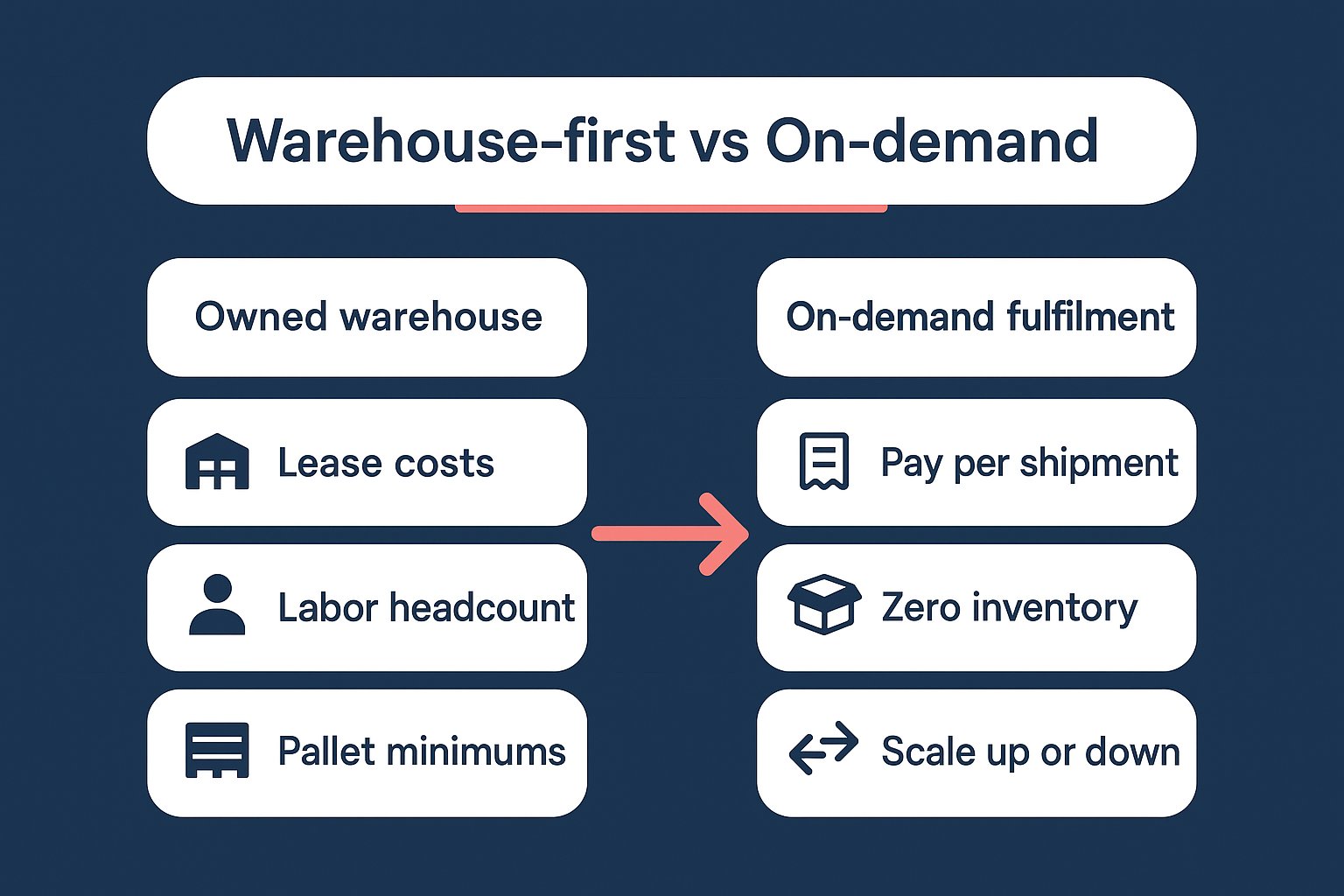
The warehouse model stacks fixed costs in four places.
- Lease payments for space you may not fill for months.
- Warehouse headcount that must be paid whether the lines are full or empty.
- Pallet minimums that force you to buy more than you can sell.
- Stock that sits on your balance sheet and ties up cash until it moves, if it moves.
Notice the pattern: every line is paid before the first sale. None of it scales down when sales are slow. A slow month does not reduce the rent. The rent, the payroll, and the insurance all arrive on the same date every month, regardless of what the sales report says. It just makes the dead capital heavier.
What on-demand fulfillment removes
On-demand fulfillment inverts the sequence. Instead of paying for capacity you hope to use, you pay for the order you actually ship. There is no lease. There is no warehousing headcount. There is no pallet minimum forcing a purchase you cannot sell through. The fulfillment cost exists only when a customer pays you first. That is the difference between capital sitting still and capital staying in motion.
A slow month costs nothing extra. A fast month costs only the orders that actually moved. Capacity scales with demand by definition, because you never paid for capacity in the first place.
Dead stock also carries a second, quieter cost: the write-down. When a product does not move, its value drops on the books and the brand eats the difference. The warehouse does not protect you from that. It just stores the problem until you are forced to face it.
The cash locked in a lease could have funded a month of paid social. The cash locked in dead stock could have funded the next product launch. The warehouse eats cash twice. It eats the money you pay, and it eats the growth that money would have bought. On-demand keeps that same cash available for product development, content, and the marketing that drives the next order. That is working capital. It moves, it compounds, and it comes back with a customer attached.
The four forces powering the on-demand fulfillment boom
On-demand fulfillment did not appear by accident. Four structural shifts in how products are sold and shipped made it the default model for new brands. Each one lowers the barrier to entry the same way: by removing the need to own physical infrastructure.
Force one: e-commerce keeps compounding order volume
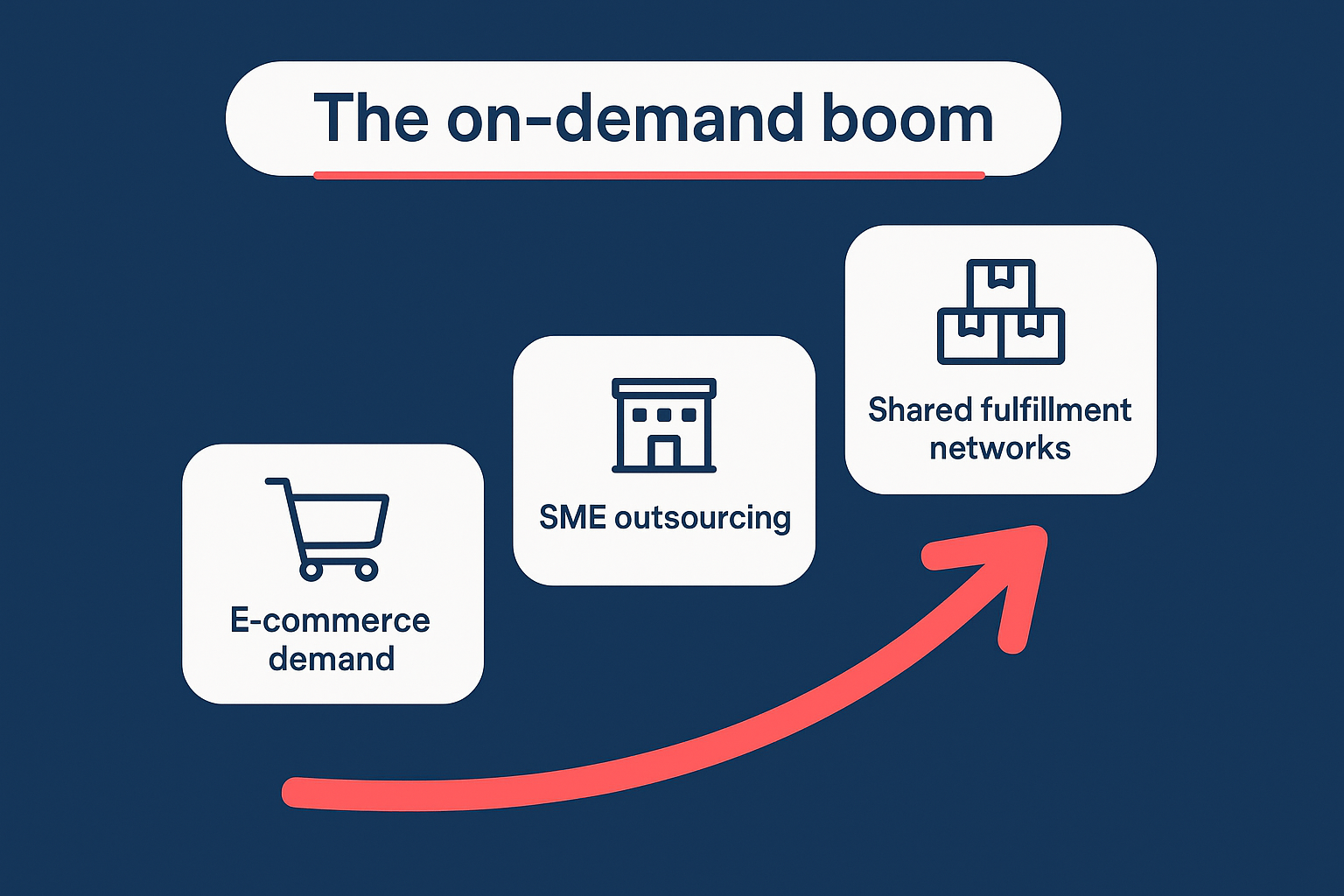
Online retail pushes more units through the supply chain every single year, and the mix of where those units originate keeps shifting. What used to sit on store shelves now sits closer to the buyer, inside shared shipping networks that dozens of brands draw from. A merchant selling direct to consumer does not need a building at all – just a product page, a supplier, and a warehouse that ships on command. The store is no longer a place; it is a checkout button.
Force two: small brands outsource logistics
Most supplement brands start with a laptop and a following, not a forklift. Outsourcing logistics turns fixed costs like rent, payroll, and insurance into a variable cost that appears only when an order appears. A one-person brand runs a national distribution operation from a phone, with the same delivery speed that used to require a regional team. The warehouse becomes a service, not an asset. That shift is what lets micro-brands compete with companies twenty times their size.
Each force reinforces the others. More order volume gives outsourced networks scale; scale lowers cost per shipment; lower cost makes selling straight from content viable.
Force three: pay only for what ships
Per-order fulfillment changes the math of scaling. The brand pays a small fee only when a customer buys, so logistics spend rises with revenue instead of demanding capital before the first sale. No pallet minimums, no warehouse commitments, no idle inventory eating cash while it waits for demand. Cost scales with success, not with hope. That is the difference between a business that grows on its own revenue and one that needs outside money just to start moving.
Force four: social commerce removes owned distribution
TikTok Shop and creator-led channels let a brand sell directly from content. The post is the storefront; the fulfillment network is the register. When distribution lives inside the platform, owning a warehouse is not an advantage at all. It is a fixed cost that slows a brand down and eats the margin that content already fought for. Products now sell where attention lives, and attention lives on screens, not shelves.
Those four forces point the same direction. Own the brand, own the customer, and let a shared fulfillment network carry the weight. The winning position is not holding inventory. It is holding relationships.
Why health and supplement brands are the fastest movers
Health and supplement brands share a structural advantage most e-commerce categories don’t: buyers already trust the person behind the brand. A fitness creator with a loyal audience doesn’t need to manufacture demand from scratch. It exists before the first product is made. The brand’s job is to convert that trust into a product customers buy again and again.
The flywheel turns on trust
An audience converts into branded product revenue with zero inventory risk. Nothing is purchased upfront, nothing sits in a warehouse, and nothing gets written off at the end of the season. That changes the economics of starting a brand entirely. Supplements are consumable, so every first order carries the probability of a second, a third, a subscription.
Category growth pulls demand forward. The 2026 supplement market boom shows how a rising tide lifts small brands that can ship fast. Content drives sales, sales produce proof, and proof fuels more content. Each cycle compounds until the brand’s own momentum does the marketing for it. There is no ad spend that can buy that loop.
The Certificate of Analysis is a sales asset
Supplements run on trust, but trust stays vague until it’s documented. A Certificate of Analysis on every batch turns third-party quality verification into a sales asset you can show a customer before checkout. It is a business feature, not a health claim: proof the product was made in a US GMP-certified facility and tested by an independent lab, batch by batch. Buyers can check it before they ever place an order.
Rocktomic quality and COA details show how that verification becomes a repeatable story across your product page, your ads, and your FAQ. A customer who sees independent test results is a customer who stops comparison shopping. That shortens the sale and defends the price you charge.
Most categories can’t offer any of this. A t-shirt brand cannot hand a buyer an independent lab report for every unit; a supplement brand can. That asymmetry is exactly why health brands are the fastest movers in the shift to zero-inventory e-commerce: lower risk on entry, faster launch, higher repeat rates, and a trust signal built into the product itself. The model that used to require a warehouse and pallet minimums now starts at $0 a month, and a new class of agile health brands is already running on it.
How a zero inventory supplement brand actually operates
Select, label, list. That is your side of the business. You pick a ready-made, US-manufactured product from the Rocktomic catalog of 140+ supplements, apply your own brand, and list it in your store. That listing is a real product with a real label, not a placeholder.
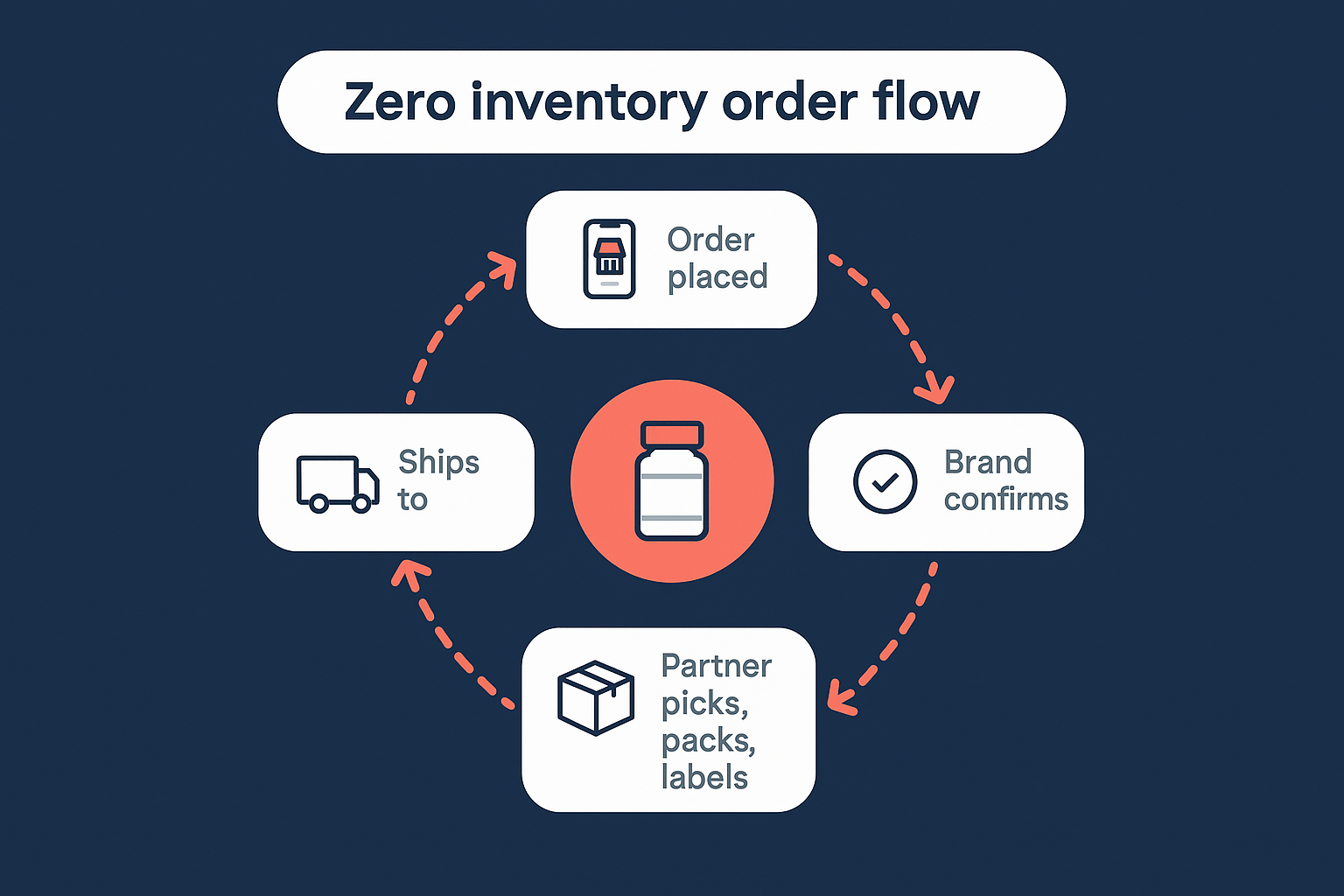
The sale happens in your store on your terms. A customer orders, and the moment that order lands, the fulfillment side starts moving. Rocktomic picks that item from the shelf, packs it, labels it with your branding, and ships it directly to the buyer. The package arrives with your name on it, your label on the bottle, and your brand in every line of the transaction. You never touch the product.
That is on-demand fulfillment in its purest form. No warehouse. No pallet buy-in. No inventory sitting around while you build an audience. Each order is handled on its own, and you pay the fulfillment fee only when that order ships. Slow mover? Cut it. Winner? Scale it. Nothing forces you to keep a product alive.
Three order models, one brand
Rocktomic gives every brand the same catalog but three different ways to move product. The right pick depends on your volume and your goals.
| Model | How it works | Best for |
|---|---|---|
| Dropship | MOQ 0, pay when an order ships, brand holds nothing | best for creators testing SKUs |
| Bulk | 24-unit MOQ per SKU, lower per-unit cost, brand receives stock | best for gyms and coaches |
| Custom formula | proprietary formula, higher MOQ per SKU | best for differentiated brands |
Most creators start on dropship because the downside is close to zero. One order ships, one fee is paid, and the product earns its place in your store or gets cut. Bulk works for gyms and coaches who move product in person, where a shelf and a rack need stock. Custom formulas are for brands that want a product built around their own proprietary formula, and the higher MOQ per SKU reflects that commitment.
What this model costs to run
The flat pick, pack, and label fee is about $2 per item. That one fee covers the labor on every order, and it stays flat whether you ship one bottle or a hundred. The entry membership is the Free plan at $0 per month, so the upfront cost of starting a supplement brand is exactly zero. You pay nothing until a customer pays you. On dropship, that means no monthly minimums, no storage bills, and no dead stock to write off.
That is the whole machine. You choose the products, build the brand, and let fulfillment run per order. The step-by-step breakdown of the platform lives on how Rocktomic works.
What the data means for creators launching health brands in 2026
The data in this article points one direction: agility beats inventory. The brands winning in 2026 are the ones that test fast, cut what fails, and scale what sells. You no longer need a warehouse, a pallet, or a big cash commitment to find out if your audience wants a product. You need a fulfillment model that moves at the speed of your content.
The old model forced a guess. You predicted demand six months out, bought the stock, and hoped the market agreed. When you guessed wrong, you owned the mistake as dead capital and expiring inventory. On-demand flips that. A sale triggers production and shipping, so the only inventory you ever pay for is the inventory a customer already bought.
Test SKUs, not theories
That changes the math for why creators launch owned supplement brands. Instead of betting your budget on one SKU, you test against a 140+ product catalog, watch the sales data come in, and double down on winners. No dead capital. No garage full of boxes nobody ordered. Just demand signals telling you what to make next.
The social commerce numbers make the urgency clear. The TikTok Shop supplement sales data shows how fast audience trust turns into orders. A viral post can exhaust a limited inventory batch in hours, and the creator with a storefront ready wins that sale. That’s why store integrations matter: your Shopify, TikTok Shop, and Instagram channels can all run off the same on-demand pipeline.
Turn one-time buyers into subscribers
Recurring revenue is the second half. Subscriptions smooth out traffic spikes and turn a one-time buyer into a monthly customer. A subscriber base keeps paying after the post stops performing. Model that math before you commit. Run scenarios through the supplement margin calculator and see what a subscription attach rate does to your monthly numbers.
None of this requires a slow, expensive launch. Brands go live in days, not quarters, and the cost structure stays variable while you test. The full Rocktomic membership pricing breaks down the entry points, but the core point is simple: you pay for fulfillment when orders ship, not before you have sales.
The risks of zero inventory and how to manage them
Zero inventory removes capital risk. It does not remove operational risk. Three problems will surface eventually, and each one has a feature-based fix: quality control, shipping speed, and margin pressure.
Quality control
When you do not hold stock, you hand the factory your reputation. That trust needs documentation, not vibes. Rocktomic manufactures in US GMP-certified facilities and runs third-party testing on every batch, with a Certificate of Analysis on file. The COA covers identity, potency, and purity for each batch, so your label claims match what is actually in the bottle. If a customer or retailer asks what is in your capsules, you send a document, not a promise. That’s the core of why Rocktomic leads with manufacturing standards instead of marketing hype.
Shipping speed
Dropshipping built a bad reputation from slow, disorganized sellers. The fix is centralized fulfillment that moves orders the day they arrive. When warehousing, labeling, and carrier handoff sit under one roof, customers cannot tell your brand apart from one with its own warehouse. Add real human support on top, and a delayed package becomes a problem solved in minutes, not a ticket that sits for a week.
Margin pressure
The third risk is the quiet one. Per-order costs and wholesale pricing eat brands that never watch the unit math. The mitigation is flexibility. Start with on-demand fulfillment to validate a product, then switch to bulk ordering once volume justifies it. Your per-unit cost falls as demand proves out, instead of forcing one big bet upfront. Run the numbers on every idea before you post, and the margin pressure mostly disappears.
The model is not risk-free, but the risks are manageable, and the payoff is a brand you own without a warehouse you pay for. If you want to pressure-test how this works for your audience and product idea, book a call and walk through the unit economics with the Rocktomic team.
Zero inventory e-commerce FAQ
What is zero inventory e-commerce?
Zero inventory e-commerce is a retail model in which a brand sells products it never purchases or stores in advance. When a customer orders, the brand’s manufacturing or fulfillment partner packs, labels, and ships the item directly under the brand’s own label. The seller owns the customer relationship and keeps the margin without leasing warehouse space or buying stock. On-demand fulfillment services are the infrastructure behind the model, and the market for them is growing at double-digit rates.
How big is the on-demand fulfillment market?
Grand View Research estimated the global e-commerce fulfillment services market at USD 123.69 billion in 2024 and projects USD 272.14 billion by 2030, a 14.2% CAGR from 2025 to 2030. Mordor Intelligence sizes North America’s e-commerce fulfillment market at USD 47.57 billion in 2025 with a 10.8% CAGR to 2031. The numbers show fulfillment capacity shifting from brand-owned warehouses to shared, on-demand networks. Retrieved June 21, 2026.
What is the difference between dropshipping and third-party fulfillment?
Both ship orders without the seller holding stock, but they differ in control. Dropshipping usually routes individual orders through a supplier catalog, often with longer transit times and less quality control. Third-party fulfillment typically stores and ships a brand’s own SKUs from dedicated facilities, giving the brand control over packaging, labeling, and delivery speed. Many supplement brands use an on-demand model that combines both: branded products manufactured, warehoused, and shipped per order by one partner.
How does on-demand fulfillment work for supplement brands?
A brand selects ready-made products, applies its label, and lists them in its online store. When a customer pays, the order routes to the manufacturing partner, which picks, packs, labels, and ships the item directly to the buyer. The brand never touches inventory and pays fulfillment costs only when an order ships. Rocktomic’s version of the model covers manufacturing, warehousing, labeling, and drop-shipping in one workflow.
Is zero inventory e-commerce profitable?
Profitability depends on unit economics, not warehouse ownership. The model removes fixed costs such as rent, labor, and dead stock, so cash stays variable and scales with sales. Health and supplement brands benefit from high perceived value and repeat purchases, which support healthy margins. Because margins vary by product and pricing strategy, brands should calculate per-unit costs and the flat fulfillment fee of about $2 per item before setting retail prices.
How much does it cost to start a zero inventory supplement brand with Rocktomic?
The Rocktomic Free plan costs $0 per month. Members pay a flat fulfillment fee of about $2 per item when an order ships, plus the wholesale cost of the product. There is no monthly charge and no minimum order quantity on dropship orders, so a brand can launch for the cost of a store setup and its first orders. Optional one-time launch packages add design or store build-out services, but the membership itself stays $0.
What does the Rocktomic Scale plan cost and include?
The Scale plan costs $297 per month and is the lowest per-unit wholesale tier. It includes access to the full 140+ product catalog including Scale Exclusives, unlimited sales channel integrations, and priority fulfillment. Brands on Scale pay the same flat per-item fulfillment fee on shipping orders. For creators scaling past a few SKUs, Scale is designed to protect margin as order volume grows.
How fast can a zero inventory health brand launch?
Because no inventory is purchased upfront, a brand can go from product selection to a live store in days rather than months. Members list ready-to-ship products, connect a store, and start selling. The fulfillment partner handles pick, pack, and label for about $2 per item, and each batch ships with a Certificate of Analysis. Compare that with a traditional launch, which requires formulation, packaging runs, and warehouse stock before the first sale.
Launch Your Zero Inventory Health Brand
The warehouse is dead capital for a new health brand. It drains cash before you sell a single bottle, locks you into inventory you might never move, and charges rent on product that just sits.
Recent market data points one direction: on-demand fulfillment is the model taking over. You can own a branded supplement line with zero inventory, no upfront purchasing, and no warehouse. The brand and the customer relationship stay yours; the manufacturing and shipping happen only when an order exists.
Launch your zero inventory health brand on the Free plan at $0 per month and move to Scale at $297 per month when volume justifies it. Check the Rocktomic membership pricing, run your numbers with the supplement margin calculator, or book a call with a fulfillment specialist.
Last updated: June 21, 2026.