
The DM Masterclass: Pitching Micro-Influencers to Shoot High-Quality Supplement UGC
· 17 min read · By Rocktomic Labs Team
Micro-influencers with 10,000 to 100,000 followers will produce usable supplement UGC for roughly $150 to $300 per video, and the best ones say yes to a well-written DM. This masterclass delivers three copy-paste outreach templates, the discovery and warm-up sequence that gets replies, the six-part brief that keeps footage compliant and on-brand, and the bottle-level math that proves a single video can pay for itself. These are the creators already posting about fitness, wellness, and the supplements they actually take. Cheap is not the goal. Cheap footage that sells is. The whole system runs without a single pallet in your garage and without a media buyer on retainer. You need a product you own and a creator pipeline.
What is supplement UGC and why do micro-influencers make it?
UGC, or user-generated content, is short-form video a creator makes for your brand to publish on your channels or run as paid ads. You pay for production quality and authenticity, not audience reach. Micro-influencers, typically 10,000 to 100,000 followers, deliver that authenticity at a fraction of macro pricing, and their footage converts because it looks like a real person, not a commercial.
Model your monthly revenue, repeat rate, and net profit as your supplement brand scales – using real catalog costs and fees.
Why Micro-Influencers Beat Macro Creators for Supplement Brands
Engagement is where the micro advantage shows up first. The Status 2025 State of Micro-Influencer Marketing report found short-form micro content averaged 11.4% engagement. That figure matters because paid social algorithms reward exactly that kind of active audience. Macro engagement typically runs lower per the same data, so the smaller account wins on attention per follower.
Cost widens the gap. Typical TikTok micro video rates run roughly $200-$800, per Influencer Marketing Hub’s July 2026 rate data. Macro creators in the 100,000-plus range command five figures for a single video. That spread is the difference between testing ten creatives and betting your whole month on one, and for a bootstrapped brand, testing wins every time.
Gifted-plus-fee deals keep costs near the UGC production benchmark of roughly $198 per deliverable (DesignRevision, 2026). For a supplement brand, that’s a paid social asset you can rotate into ads without burning your margin.
Niche trust beats raw reach in wellness. A micro creator’s audience follows for expertise, not entertainment. Their recommendation lands like a friend’s, which is exactly how supplement buyers decide. That trust is what makes a review read like proof instead of promotion.
The Rate and Engagement Spread, Side by Side
Here’s how the two tiers compare on the numbers that drive your creative budget.
| Tier | Typical TikTok video rate (Influencer Marketing Hub, July 2026) | Engagement signal (Status 2025) | Best use |
|---|---|---|---|
| Micro (10,000-100,000 followers) | $200-$800 | 11.4% average engagement on short-form micro content | Authentic UGC for paid social, product education, and demos |
| Macro (100,000+ followers) | Five figures | Engagement typically lower than micro | Wide-reach awareness campaigns |
Creators in the 10,000-100,000 band deliver authenticity at a fraction of macro pricing. Their footage reads as a real person, not a commercial. That’s the same reason the numbers on static images vs UGC video ad ROAS keep pointing to video: real faces out-convert polished product shots.
Where to find hungry micro-influencers before anyone else does
The best creators are not in influencer directories. They are already posting about supplements every week, and most brands miss them because they search the wrong places.
Mine TikTok niche hashtags
Search the tags your buyers actually watch: #supplementreview, #greenscheck, #creatine. Sort by recent, not top. Top serves the same 50 creators every brand has already pitched. Recent shows the creators who posted today, reply to comments, and still get a handful of views per video.
Those are the ones you want. A creator with a small but engaged following will answer a warm DM. A creator with 200,000 followers will not.
Mine comment sections
Open any viral wellness video in your niche and sort comments by newest. People who comment on supplement content are already adjacent to the category. Some of them make content themselves. Scroll their profiles before you move on. You will find micro-influencers who post unboxings every week and have never been pitched by a supplement brand.
Check creators running Spark Ads
Spark Ads carry a “Sponsored” tag on the creator’s video. If a creator is already running Spark Ads for another supplement brand, they know the workflow: content briefs, usage rights, deliverables. They have proven they can deliver for a brand. You skip the education phase entirely.
Scan TikTok Shop affiliate rosters
TikTok Shop exposes affiliate creators in your category. These creators are already set up to sell and already earn commissions. They have an audience that buys. That is a warm prospect list you can reach the same day.
Vet every creator before you message
Follower count is the last thing to check. Start with engagement authenticity: real comments, saves, shares. Generic fire emojis do not count. Then check audience fit. Do the commenters look like your buyers? Then judge content quality. Do they already film unboxings, gym content, or supplement shelves?
Creators who already talk about the category are cheaper to convert and need less hand-holding. They know the format, the lighting, and the hooks. They just need a product to point at. For a deeper breakdown of the search, read our guide on how to find the right TikTok influencers for your supplement niche.
The 72-hour warm-up that stops creators from ignoring you
A cold DM gets ignored at the same rate as a cold email to a buyer. The fix is a short warm sequence that makes your name familiar before you ask for anything.
Day one: follow the creator. Day two: leave one specific comment on their latest video. Day three: leave a second comment on a different video and reference a specific moment in it. Only then do you send the DM.
The DM opens with the actual content you referenced. Not “love your content.” The specific take from the video you commented on. That proves you watch instead of swipe. Keep the warm-up entirely manual. No automation, no mass DM tools, no copied greetings. Niche-specific input gets niche-specific replies.
The follow-up rule
Most creators reply late or not at all. Plan for it. Send one value-add follow-up on day 3, one case-study follow-up on day 7, and a final check-in on day 14. Then stop. A polite close beats a needy streak.
That is the whole sequence. The creators who reply to a warm, specific DM are the ones worth working with. The ones who do not were never going to.
3 Copy-Paste DM Templates That Get UGC Creators to Say Yes
The warm-up from Part 3 gets the creator reading. These templates get the yes. In every deal you send, supply four things: the product, the brief, the disclosure line, and the COA talking point. Rocktomic attaches a Certificate of Analysis to every batch, so your creator can say “third-party tested, GMP-certified” on camera and mean it. That document is what turns a random DM into a legitimate brand deal. Vague asks get ignored. Specific asks get answered.
Copy the text below exactly. Swap only the bracketed fields with your product’s details.
Template A – UGC-only offer
For creators with a portfolio who already shoot brand content. You pay per video and buy usage rights. Send this one when the creator lists rates or shows brand work in their bio.
Hey [name], your for [brand] is exactly what our supplement line needs.
We pay [fee] per video, you keep creative control, and we cover usage rights for 90 days. We send the product free, a one-page brief, and the COA, and we’d need the video by [date]. Can I send over the brief?
Template B – Gifted + paid hybrid
For creators newer to brand deals. Free product lowers the risk; a smaller fee keeps it a real partnership. Send this one when the creator has never posted a sponsored video.
Hey [name], I watched your [niche] content and you’d be a natural fit for our .
We’ll ship it to you free, and we pay a [reduced fee] for one honest review video, no re-shoots and no revisions. We include the disclosure line in the brief so the post is compliant out of the box. If you’re in, reply with your shipping address and I’ll get it out today.
Template C – Commission/affiliate hook
For creators who want recurring income. One paid video is a transaction; commission is a relationship. You can recruit a TikTok affiliate army on commission with a custom link, a rate you set, and a disclosure line in every post.
Hey [name], you clearly know how to talk about [niche].
Instead of one paid video, join our affiliate program: we give you a custom link or code, you post on your own schedule, and you earn [commission rate] on every sale. We supply the product free and handle the disclosure line. Want the invite link?
Reply rates rise when the ask is specific. Every template above asks for exactly one thing: one video, one product, one deadline. The creator knows what they’re agreeing to, and you know what you’re paying for. Keep the ask singular and your DMs stop getting ghosted. Three templates, one rule: name the product, name the deliverable, name the deadline. Creators get pitched all day; you win by making the decision easy.
The 6-part UGC brief that produces compliant, on-brand footage
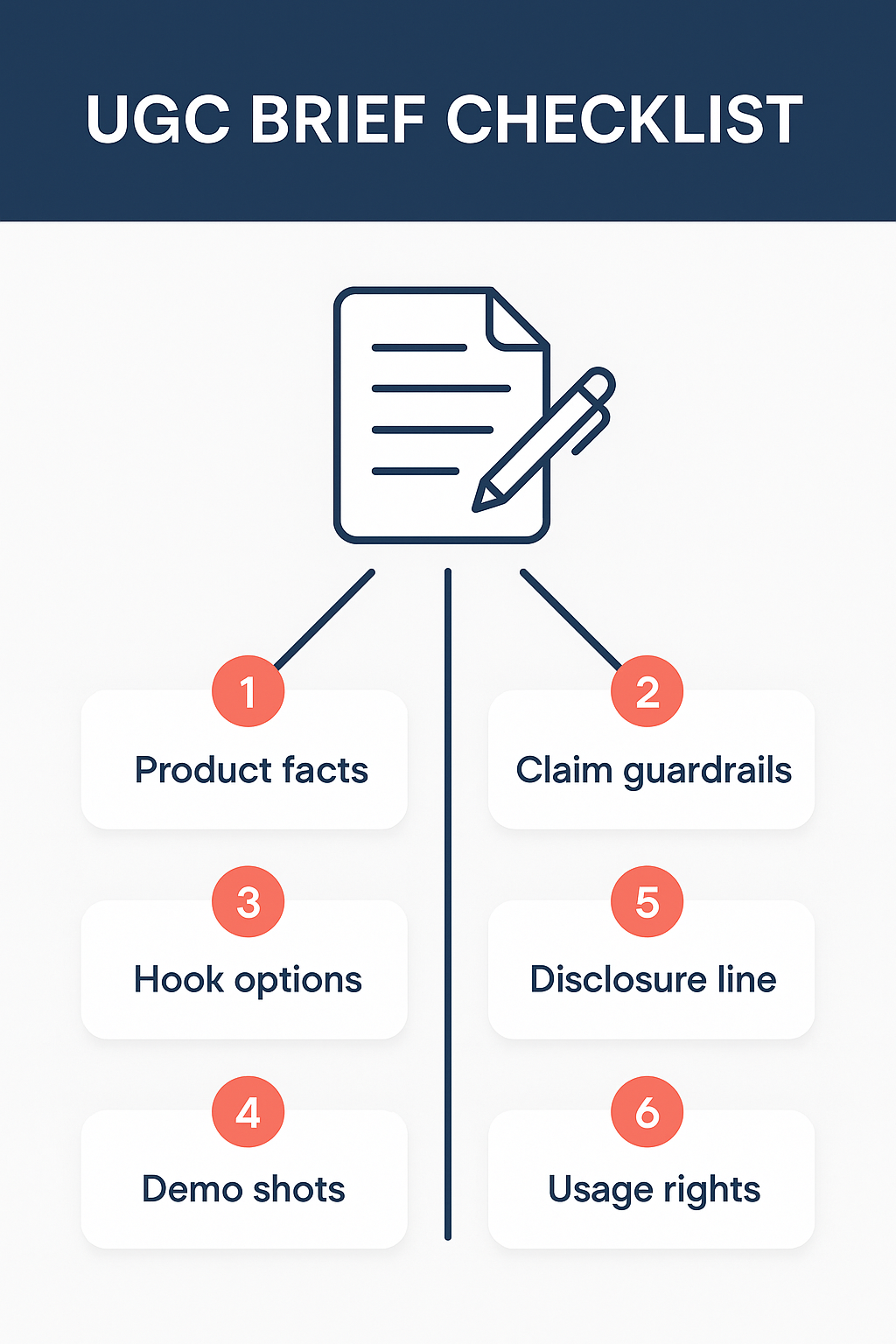
You got the yes. Now the brief decides whether that footage is usable. Here are the six parts, in order.
1. Product facts and the Supplement Facts panel
Give the creator the exact product name, serving size, and key ingredients. Attach a clean copy of the Supplement Facts panel so they read from the label, not from memory. Tell them how to say the brand name on camera. Memory drifts; labels don’t.
2. Claim guardrails
Structure/function language only. “Supports muscle recovery” is fine. “Treats muscle injuries” is a disease claim and it’s off the table. If they want a broader statement, require a hedge with attribution, like “research suggests.” Keep health claims light; lean on experience.
3. Two or three hook options
Write the opening lines yourself. For a greens product, the hook might be the taste test. For a pre-workout, the energy curve. Exact wording keeps the hook on-brand and keeps the creator from improvising into danger.
4. Required demo shots
List what you need: unboxing, scoop or pour, texture close-up, label close-up. Creators over-deliver on talking and under-deliver on b-roll. A shot checklist fixes that on the first take.
5. FTC disclosure line
A gifted product is a material connection per FTC staff guidance, so the creator must disclose. Hand them the exact line, like “#ad” or “Thanks to [Brand] for sending this.” Put the line in the brief so they copy-paste it into the caption, not paraphrase it. One sentence explains why; the penalty math lives in Part 7.
6. Usage rights, deadline, and revision limit
State how long you own the footage, when it’s due, and how many revision rounds you get. Two is standard. No deadline means the video lands whenever the creator’s feed slows down.
One line converts without a health claim: “Every batch ships with a Certificate of Analysis from third-party testing.” Put it in the brief and tell the creator to say it on camera. It’s a quality statement, not a medical one, and it signals legitimacy to the viewer.
The brief is what keeps a 10k-follower creator on-brand and squeaky clean for compliance. Skip it and you’ll reshoot.
How cheap does the UGC actually need to be?
Cheap enough that one video pays for itself inside a handful of sales. Run the worked example on a single SKU: Super Creatine Gummies (ROC943). MSRP sits at $29.97. Scale wholesale pricing lands at $8.45 per bottle, which leaves a margin of $21.52, or 71.8%. That margin is the room you have to pay for content, ads, and everything else around the sale.
Then the flat $2 per item fulfillment fee comes out of that room. It covers pick, pack, and label on every order. No pallet minimums, and no per-order platform fees stacked on top. Subtract the fee from the margin and the net lands at about $19.52 per bottle. That is the number that actually funds your content.
Now bring in the video cost. DesignRevision (2026) pegs the average UGC video at about $198. Influencer Marketing Hub (2026) prices short-form micro-influencer content in the $150 to $300 band. Compare that to the per-bottle net and break-even lands at roughly 10 bottles. One benchmark-priced video, about 10 bottles sold, and the content is paid for.
The break-even math on this SKU
| Item | Figure |
|---|---|
| MSRP | $29.97 |
| Scale wholesale | $8.45 |
| Margin | $21.52 (71.8%) |
| Fulfillment | ~$2.00 |
| Net per bottle | ~$19.52 |
| UGC benchmark video | ~$198 |
| Bottles to break even | ~10 |
Ten bottles is not a big bet. One good post can clear that in a day. Run your own SKU through the supplement margin calculator before you message a single creator. The math changes product to product.
Buy in bundles, buy the rights
Negotiate bundles of 5+ videos and buy usage rights up front. Creators price per-video work lower when they book a batch. Usage rights let you run that footage as paid ads without going back to renegotiate. One winning Spark Ad repays the whole batch. If the budget still feels tight, the shoestring budget UGC strategy shows the cheaper path to the same asset.
FTC compliance: the disclosure rules your UGC program cannot skip
FTC staff guidance is blunt: a gifted product or a payment is a material connection. The moment a creator gets either from you, they have a relationship to disclose. Free product counts. Gift cards count. A flat fee counts. And the FTC’s Endorsement Guides FAQ, retrieved 2026-07-15, is equally blunt that the disclosure must be clear and conspicuous (FTC Endorsement Guides FAQ). A platform’s built-in disclosure tool may not be enough. If that label gets buried, cut off, or formatted to blend in, the post is still non-compliant.
Clear and conspicuous means a viewer sees it without hunting. Plain language a normal person understands: “ad,” “sponsored,” “paid partnership.” Placement where the eye lands first, not in a stack of hashtags at the bottom of the caption. The FTC looks at the whole context: the format, the platform, and how an average viewer would read the post. And in video content, the disclosure belongs in the video itself, spoken or overlaid on screen. A line in the description box doesn’t protect you.
The price of getting this wrong is not a warning letter. Civil penalty exposure runs up to $53,088 per violation under 16 CFR 1.98, per the Federal Register adjustment effective January 17, 2025 (Federal Register). Per violation. A campaign with 30 undisclosed posts is not one fine.
So the rules you hand every creator, in writing, before the first video:
- Disclosure in the post itself, in plain language. “#ad” or “Sponsored” at the start of the caption, not in a hashtag dump.
- No buried hashtags. If a viewer has to tap “more” to find it, it is not clear and conspicuous.
- No vague labels. “Thanks to” or “in partnership with” doesn’t do the job.
- No disease claims. No fabricated experience. No unsubstantiated science.
The 6-part brief from Part 5 carries these rules into every video. Compliance gets built in before footage exists, not patched in after.
Scale from one video to a UGC engine
One-off deals are a side project. A UGC engine is a system. The move: put your best creators on monthly retainers, rotate 5-10 of them so fresh content flows constantly, and test every clip before you spend a dollar on distribution.
A retainer buys you more than a video. It buys usage rights, revisions, and a creator who already knows your product, your audience, and your disclosure rules. You stop re-explaining your brand every month. You start stacking content that works. A retainer also makes your calendar predictable. You know what is coming in and when, so you stop chasing creators for single videos.
Top programs run more creators than that. Status 2025 data shows top programs run about 30 micro-influencers per campaign (Status Micro-Influencer Report 2025). You start with 5. Five creators on retainer costs less than one bad paid campaign and produces enough volume to surface a winner.
When a video wins, scale it through the creator’s handle, not your own. The fastest path is whitelisting creators to halve CPA. Run winners through Spark Ads and whitelisted handles to keep the native feel that makes UGC convert.
Then reuse every clip that performs. TikTok. Meta. Email. Product pages. Post organically first, let the algorithm vote, then put paid behind the winners. One strong video working in paid placements and on your storefront pays for the whole rotation. Cut different hooks for different platforms. Repost with fresh captions. A single winning clip can run for months.
Your customers can feed the engine too. You can build a UGC engine from customers to compound output without paying per post.
Retainer. Rotate. Test. Whitelist. Reuse. That is the engine. Compliance is the filter everything passes through before it ships.
Frequently Asked Questions About Pitching Micro-Influencers for Supplement UGC
What is supplement UGC and how is it different from a sponsored post?
UGC (user-generated content) is video a creator makes for your brand to publish on your own channels or run as ads. You pay for production quality and authenticity, not audience reach. A sponsored post, by contrast, is posted on the creator’s own account, so the fee includes access to their followers. For supplement brands, the highest-value deal is usually deliverables-only UGC with usage rights, because you own the creative and can reuse it across ads, landing pages, and TikTok Shop.
Why do micro-influencers produce better supplement UGC than big creators?
Micro-influencers (roughly 10,000 to 100,000 followers) combine authenticity with lower fees. The Status 2025 State of Micro-Influencer Marketing report found short-form micro content averaged 11.4% engagement across industries, and 81% of brands rated micro-influencer content as meeting or exceeding expectations. Influencer Marketing Hub’s 2026 rate data puts typical TikTok micro videos near $200 to $800, a fraction of macro pricing. Smaller creators also reply faster and follow briefs more closely, which matters when your product has compliance guardrails.
How much does one supplement UGC video cost in 2026?
Plan around $150 to $300 for a single 15 to 60 second short-form video from an intermediate creator, with roughly $198 the commonly cited average benchmark (DesignRevision, 2026). Beginners run $50 to $150, established creators $500 and up. Usage rights add 30% to 50% on top of the base rate, and whitelisting for Spark Ads can add another 50% to 100%. Buying bundles of 5 or more videos typically cuts the per-video cost by 10% to 20%.
What must a supplement UGC brief include?
A brief that produces usable footage covers six things: the product and its Supplement Facts panel, allowed structure/function language with a hard no on disease claims, 2 to 3 hook options, required demo shots (unboxing, scoop, texture, label close-up), the FTC disclosure line for any posting, and the exact usage rights, deadline, and revision limit you are paying for. Give creators the Certificate of Analysis talking point so they can mention third-party testing – it converts without risking a compliance violation.
Where do you find micro-influencers who actually shoot good supplement UGC?
Search TikTok for niche hashtags like #supplementreview, #greenscheck, or #creatine, then filter to accounts in the 10,000 to 100,000 follower range. Check comment sections under competitor ads and viral supplement videos – creators who already talk about the category are cheaper to convert. Review engagement quality: real comments, saves, and shares beat raw follower counts. A creator who already films unboxings or gym content needs less hand-holding and delivers faster.
How many bottles must one UGC video sell to pay for itself?
Take Super Creatine Gummies (ROC943) as an example: Scale wholesale is $8.45, the MSRP is $29.97, leaving a $21.52 margin (71.8%). After the flat ~$2 per item fulfillment fee, net is about $19.52 a bottle. A $198 UGC video therefore breaks even at roughly 10 bottles sold. Run that creative as a paid ad or Spark Ad and one winner can clear the cost many times over.
What does it cost to launch the supplement brand behind the UGC?
Rocktomic’s Free plan is $0 per month; members pay only the flat ~$2 per item fulfillment fee when an order ships. The Scale plan at $297 per month includes the lowest per-unit wholesale pricing, the full catalog, and unlimited sales channels. With no inventory and no MOQ on dropship, the creator budget goes to content – not warehousing. Optional done-for-you launch packages start at $497 if you want branding handled for you.
How do you keep UGC costs from eating your supplement margins?
Structure deals around bundles and usage rights instead of single videos, rotate creators on retainer, and run the best clips through Spark Ads or whitelisted creator handles so one shoot produces months of ad creative. Use the Scale plan wholesale price to keep COGS low, and run every new SKU through a margin calculator before you approve a content budget. At $8.45 wholesale on a $29.97 MSRP bottle, the product economics do the heavy lifting.
Run the Numbers and Own Your Supplement Brand
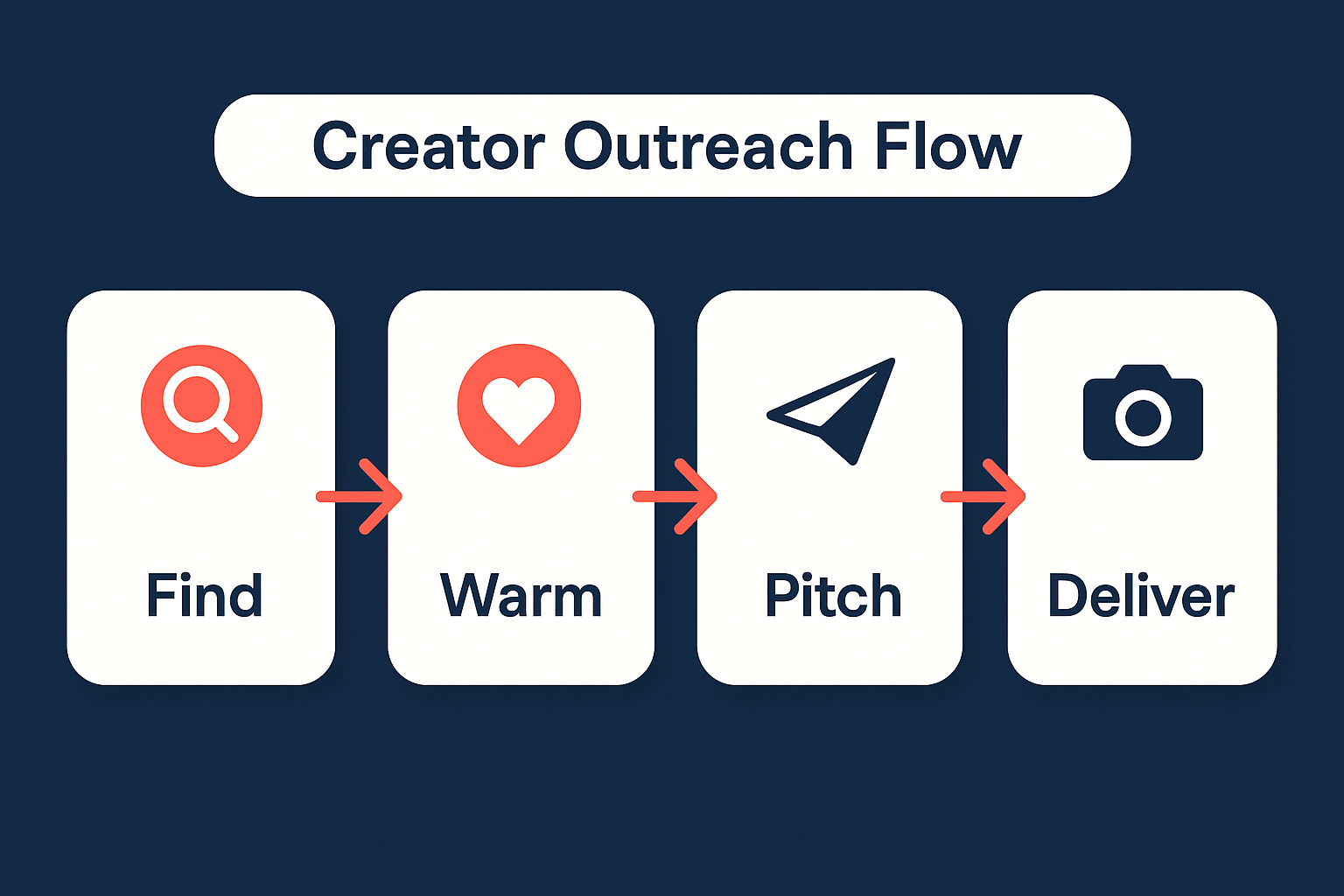
One strong UGC video can pay for itself in about 10 bottles. The pipeline is simple: find, warm, pitch, deliver. You own the brand, the customer relationship, and the creative.
Run your own SKU through the supplement margin calculator from Part 6, compare plans on the Rocktomic Scale plan pricing page, and book a call with Rocktomic for launch support. On Scale at $297/month, you start with zero inventory and no upfront purchasing; the Free plan stays $0. See how Rocktomic on-demand fulfillment works and the brand builder program for creators.
Last updated: June 21, 2026