
The 24-Hour Shopify Playbook: Launching Your Pre-Workout Brand
· 15 min read · By Rocktomic Labs Team
Yes: a white-label pre-workout brand can go live on Shopify in a single day with zero inventory and no minimum order. Rocktomic manufactures, labels, and drop-ships on demand; you own the brand and the customer list. See how Rocktomic works, then weigh the numbers: entry costs $0 per month with a flat ~$2 per item fulfillment fee, and the Scale plan at $297 per month includes the lowest per-unit wholesale.
Can You Really Launch a Pre-Workout Brand on Shopify in 24 Hours?
Yes. Because the slow parts already exist. Rocktomic carries a 140+ product catalog, compliant labels, and US GMP manufacturing with a COA on every batch. The 24 hours go to Shopify configuration, product import, compliance pages, and a test order, not to formulation, artwork, or pallet purchasing. Platforms that force bulk buys or per-order fees add days and dollars to a launch. Rocktomic’s dropship model removes both. That is what makes a one-day launch possible.
Pick any product, set your monthly volume, and see your real per-unit and monthly profit on every plan – fulfillment, card processing, and membership all included.
Why Pre-Workout Is a Strong First SKU for a Shopify Store
Pre-workout is a business decision before it is anything else. The demand numbers are public: the Shopify supplement dropshipping guide, retrieved 2026-06-21, cites Grand View Research sizing the global dietary supplements market at about $213.86 billion in revenue in 2025, with a projected 5.6% compound annual growth rate from 2025 to 2033. Pre-workout sits inside sports nutrition, so a creator entering this category starts with tailwind, not a gamble.
That growth matters less than the buying pattern underneath it. Pre-workout is a repeat-buy product: customers finish a container and reorder on a predictable cycle. That makes subscription boxes and bundle mechanics natural revenue drivers instead of awkward add-ons. A subscribe-and-save offer reads as convenience, and a two-tub bundle lifts average order value without starting a price war. A predictable repurchase cycle also makes revenue forecasting simpler for a young brand.
One Hero SKU Tests the Whole Funnel
For a fitness creator, one hero pre-workout SKU is enough to test audience demand before a second flavor launches. Your followers already watch your training content and trust your recommendations, so the store sells to a warm audience. That shortens the sales cycle.
The data from that first launch (conversion rate, repeat rate, cost per acquisition) tells you exactly what to build next. If the numbers work, scale the line. If they do not, you lost a weekend, not a warehouse; orders drop-ship when they are placed, so no leftover stock gathers dust. The same catalog that carries pre-workout also carries greens, nootropics, and general health, so a hero SKU is a doorway to a full line, not a dead end.
The 24-Hour Launch Timeline: What Happens in Each Block
Twenty-four hours is enough to go from an empty Shopify account to a live pre-workout brand. Each block below has exactly one job, and most blocks are under four hours. Do that one job, move to the next, and don’t polish ahead of schedule. The order is the plan.
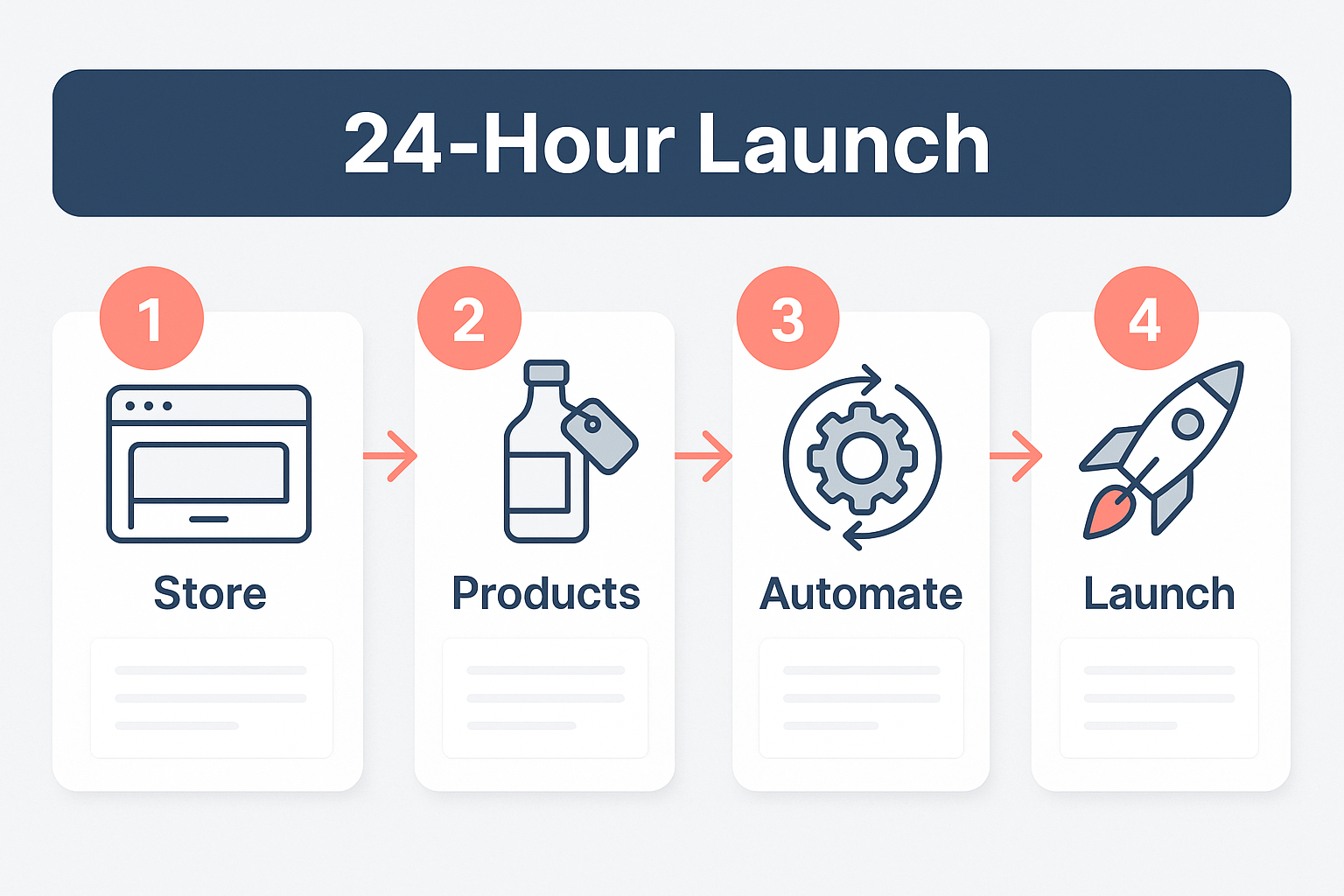
| Time block | Action |
|---|---|
| Hours 0-2 | Create your Shopify store and choose the Rocktomic plan. Free $0 covers up to 10 white-label products; Scale $297 per month opens the full pre-workout catalog. |
| Hours 2-6 | Install a theme and build three pages: home, shop, and pre-workout collection. Keep the layout simple so products load fast. |
| Hours 6-8 | Import the pre-workout SKUs and set the MSRP on each. Rocktomic handles labels and packaging, so you set the price and go. |
| Hours 8-10 | Publish the compliance pages: terms of service, refund policy, privacy policy, and the FDA disclaimer. Keep the disclaimer in the footer. |
| Hours 10-12 | Upload your logo, label files, and 3D mockups to the product pages. These are the first visuals a buyer sees. |
| Hours 12-14 | Connect the Shopify integration and run a test order. Confirm the order reaches Rocktomic and the flat about $2 per item fulfillment fee matches the pricing page. |
| Hours 14-18 | Write product copy for each pre-workout SKU and add trust sections that point to the Certificate of Analysis and US GMP manufacturing. |
| Hours 18-24 | Run the final checks: payments, shipping rates, tracking emails, and the pixel. Fix anything broken now, before traffic shows up. |
Where launches stall
Two blocks will tempt you to overthink: the theme at hours 2 to 6 and the copy at hours 14 to 18. Keep both functional. A clean store that passes a test order beats a pretty one that leaks orders at the payment step.
The timeline is sequential for a reason. The test order at hours 12 to 14 catches integration problems while you still have time to fix them. If you fall behind, protect the compliance and test-order blocks and cut copy polish first. Hit hour 24 with a store that takes money, confirms shipment, and looks trustworthy, and the launch is done.
What You Actually Need to Sell Supplements on Shopify
Compliance is the first business equation you solve, because it decides whether your store stays live. One missing document can freeze a payout or pull a product page. The requirements are fixed, public, and mostly paperwork. Treat them as launch steps, not legal gray areas.
Shopify sets its own gate. Its dropshipping and compliance expectations require accurate product descriptions, reliable suppliers, and truthful claims. The Acceptable Use Policy bars products that violate law or mislead buyers, so every supplement listing sits under the same rules the FDA and FTC enforce.
The FDA regulates supplements under DSHEA. The FDA Dietary Supplements hub (retrieved 2026-06-21) covers labeling, ingredient safety, and postmarket enforcement after a product launches. Your label needs a Supplement Facts panel, an ingredient list, and no claims that position the product as treating or diagnosing disease.
Manufacturing follows 21 CFR Part 111, the current good manufacturing practice (GMP) rule. It governs how products are made, tested, and documented. That is why Rocktomic manufactures in a U.S. GMP-certified facility and attaches a Certificate of Analysis to every batch.
Claims need evidence before they go live, not after. The FTC Health Products Compliance Guidance (December 20, 2022, retrieved 2026-06-21) requires substantiation before publication. You line up the science first, then write the marketing copy from it.
The four documents every store needs
- Certificate of Analysis (COA): batch-level proof of potency and purity. See how third-party testing and COA work at Rocktomic.
- GMP proof: certification or audit documentation from your manufacturer.
- Supplement Facts label: the FDA-required panel shown on every product page.
- FDA disclaimer: the standard statement that the product is not intended to diagnose, treat, cure, or prevent any disease.
Keep prohibited words off every page: treats, cures, prevents, heals, reverses, fights, and any drug comparison. No guarantee language like “clinically proven to melt fat.” For the full line between permitted structure-function claims and banned disease claims, read what you can say on a pre-workout label.
Gather those four documents, write claims from substantiated sources, and your store meets the same bar the biggest brands operate under.
Per-Tub Economics: Real Wholesale and Margin for a White-Label Pre-Workout
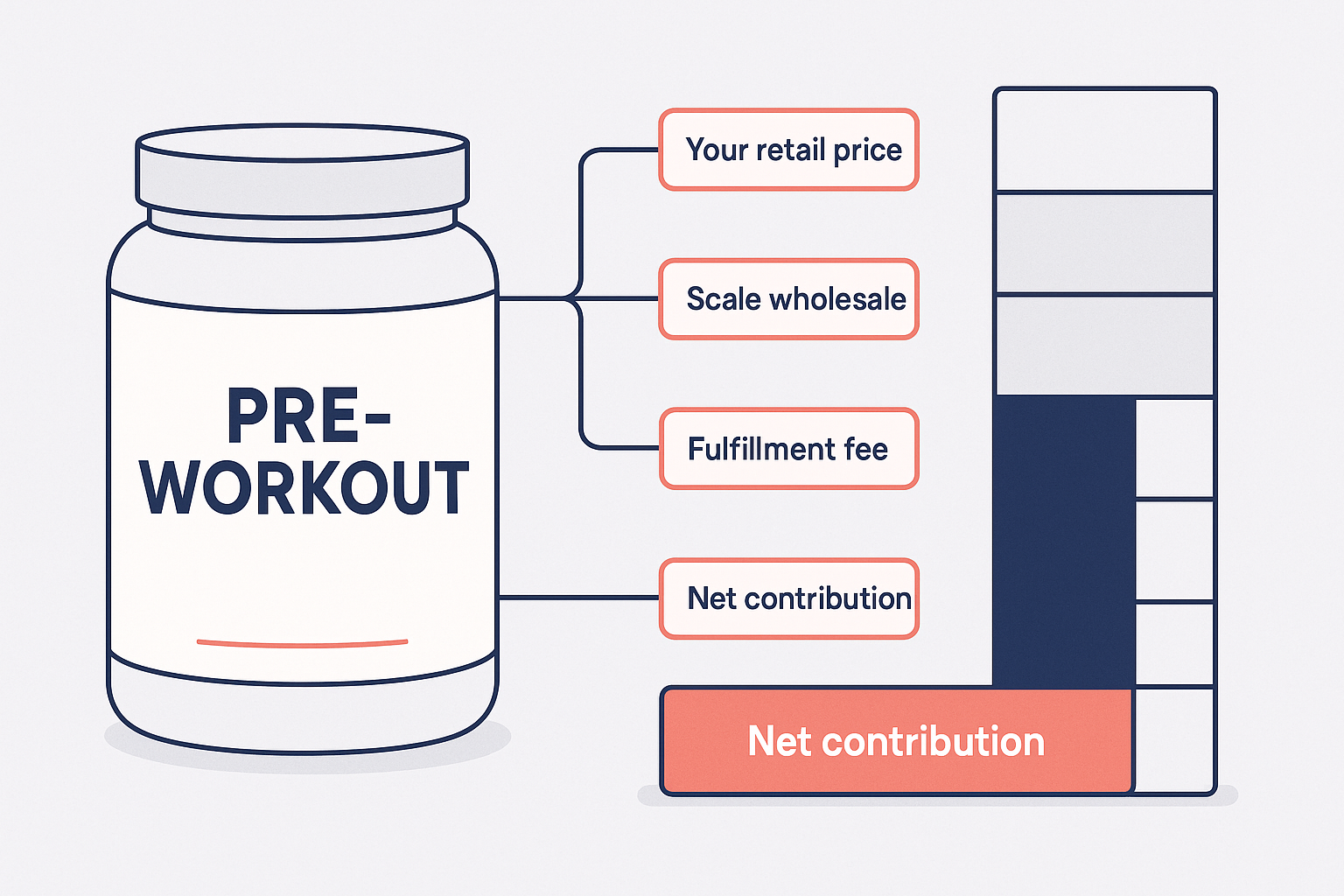
Every number in your Shopify store points back to this one: your per-tub contribution. Here is the worked math for ROC605 Pre-Workout Fruit Punch on the Scale plan. No rounding, no optimistic assumptions. Just the real wholesale price and what is left after fulfillment. This is the unit economics behind a $39.97 tub sold through your own store.
| Line item | Amount | Notes |
|---|---|---|
| MSRP | $39.97 | Member-set retail, not a Rocktomic price |
| Scale wholesale | $12.63 | ROC605 Pre-Workout Fruit Punch |
| Gross margin | $27.34 | 68.4% |
| Flat fulfillment | $2 | Per item |
| Net contribution | About $25.34 | Per tub, before payment processing and ads |
Read the table top to bottom and the whole business model shows up in one glance. The $39.97 MSRP is yours to set; it is not a Rocktomic price. Pick a different retail number and every line below it shifts. The $12.63 wholesale figure is the Scale plan price for this SKU. Subtract it from retail and you get the $27.34 gross margin, a 68.4% spread that funds ads, payment processing, and the hours you put into content.
The table’s last row is the one that matters most. About $25.34 per tub lands as net contribution before payment processing and ads. That is the number you plan ads against, and it decides what your store can afford to spend to acquire a customer. Your product cost is locked at wholesale, so contribution only moves when you change retail, ads, or processing cost.
Other flavors, same formula
The same formula ships in other variants at different wholesale points: watermelon ROC606 at $12.92 per tub and tropical sunrise ROC611 at $14.87. This worked example stays locked to ROC605 so the mechanics stay clean and the math stays auditable. Members running this playbook have reported [insert approved proof-set stat].
Run your own retail price through the supplement margin calculator before you commit to a number. It shows exactly how contribution moves when you adjust MSRP or wholesale, and it runs on the same logic as this table. For a deeper look at how this margin plays out across the full catalog, read the white-label pre-workout margin breakdown.
Automating Fulfillment So Orders Ship Without You
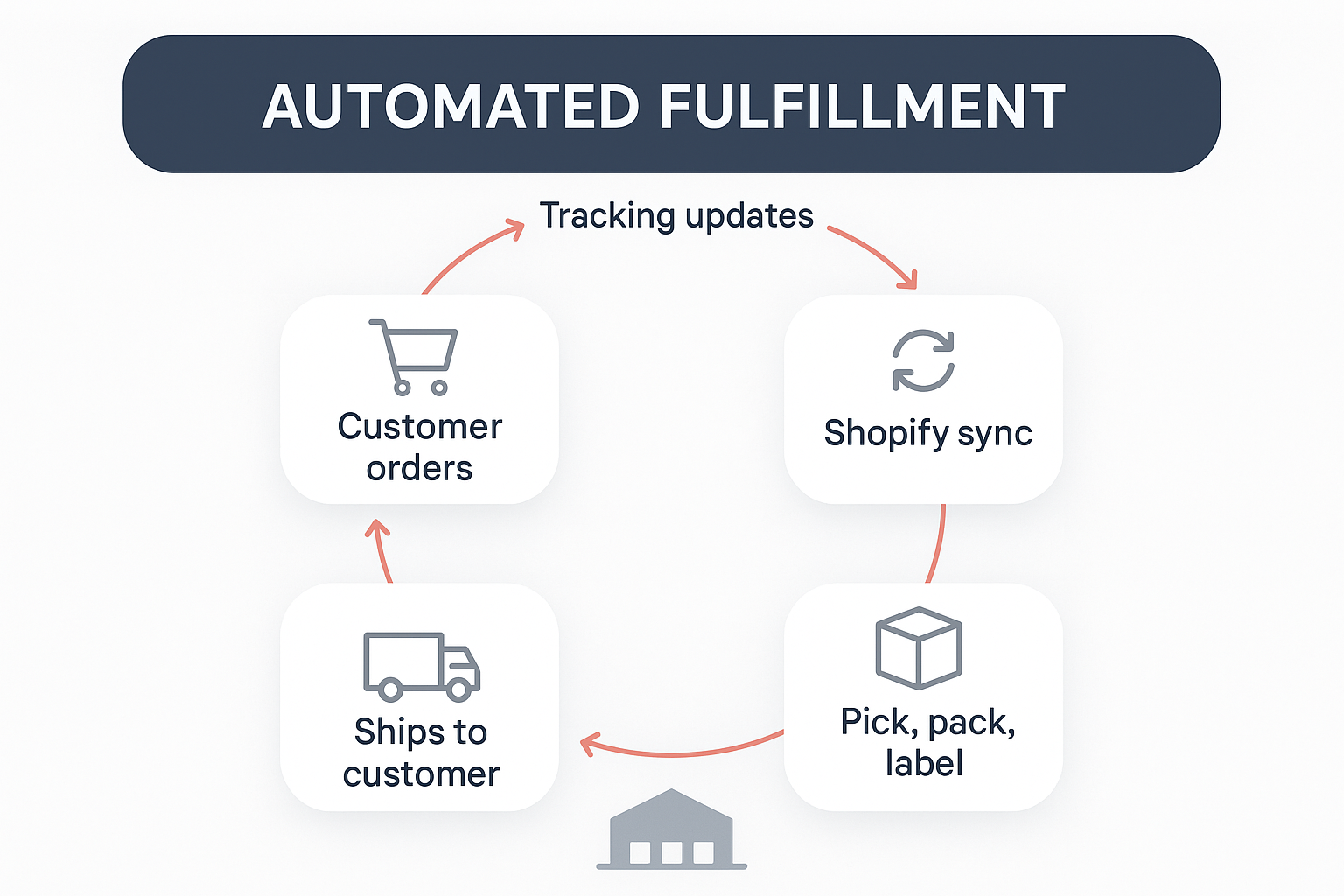
A customer checks out on your Shopify store at 2:14 PM. Two minutes later the order is sitting in Rocktomic’s fulfillment system and the product is already being picked off the shelf. You haven’t touched anything.
The loop has five steps:
- Customer pays on your Shopify store.
- Store integrations sync the order to Rocktomic in real time, so there is no manual re-keying and no spreadsheet.
- Rocktomic picks, packs, and labels the product with your brand at a flat ~$2 per item.
- The carrier picks up, and the tracking number flows back into Shopify automatically.
- Your customer gets a shipping notification and can follow the package end to end.
No inventory warehouse. No pallet in your garage. No minimum order quantity on the dropship model. Orders that come in today go out the same way every day, whether you sell one bottle or a hundred.
What the old models force on you
Most white-label setups make you choose between two bad deals. Platforms that charge per-order fees on top of fulfillment costs eat your margin on every single sale. Manufacturers that force pallet commitments tie up cash in inventory that can sit for months before it moves. Both add work: someone has to babysit stock levels, chase tracking numbers, and manually update customers.
Rocktomic’s on-demand fulfillment model sidesteps both. You pay the flat ~$2 per item when an order ships, and not before. The stock sits in Rocktomic’s warehouse, not yours, and every order goes out under your label. No phone calls to a fulfillment rep. No reconciling orders at the end of the month.
That arrangement keeps your cost per order predictable and your margin intact. The brand owns the customer relationship, the data, and the revenue. Rocktomic handles the logistics. The loop runs itself.
Building a Store That Converts Your Audience
Your content earns the click. Your store has to close the sale. For a creator-operator that funnel runs on autopilot once the page is built right: a TikTok or Reel drives traffic, the product page answers every objection, and checkout turns a viewer into a paying customer.
One catalog can feed multiple storefronts. The same pre-workout SKU sells on your main store and on a niche micro-brand store, with no extra inventory to buy. You test angles, keep what works, and kill what does not.
Product Page Anatomy
Every converting pre-workout page hits the same notes. Lead with a hero image that shows the label plus a scoop or mix shot. That single visual outsells any paragraph you write. Put the Supplement Facts panel in plain view, not behind a tab. Offer the Certificate of Analysis as a download. Few brands do, and it defuses the “is this legit?” question before it forms.
Place reviews next to the buy button, not at the page bottom. Then add a bundle option and a subscribe-and-save toggle. Both lift average order value without asking the buyer to think hard.
Trust Signals That Make a Creator Brand Look Legit
New brands lose sales on doubt, not desire. US manufacturing, GMP certification, and third-party testing belong right next to the price. A visible COA link signals the same rigor a retail giant shows. Add support contact details and a clear shipping policy, and the remaining objections collapse.
Plan limits stay out of the customer’s way. The Free plan, $0 a month, supports one sales channel. Scale, $297 a month, gives you unlimited channels to grow past store number one.
For the full brand-builder playbook, start with white label for creators. When you are ready to run the same sprint on a different product, the 48-hour creatine Shopify playbook shows the repeatable version. The payoff is measurable. [insert approved proof-set stat]
Free vs Scale: Which Plan Fits a 24-Hour Launch?
Two plans exist. No third tier, no hidden upgrade path. The choice comes down to how many products you sell and how many channels you run.
Free keeps your monthly cost at $0. You get up to 10 white-label products, one sales channel integration, and on-demand dropshipping. It’s the plan for testing demand before you commit.
Scale costs $297 per month. It includes the full 140+ catalog, Scale Exclusives, unlimited sales channels, lowest per-unit wholesale, and priority fulfillment. Lower per-unit wholesale matters when you plan to buy in bulk.
| Plan | Monthly cost | What you get |
|---|---|---|
| Free | $0 per month | Up to 10 white-label products, one sales channel integration, on-demand dropshipping, flat ~$2 per item fulfillment |
| Scale | $297 per month | Full 140+ catalog including Scale Exclusives, unlimited sales channels, lowest per-unit wholesale, priority fulfillment |
Optional one-time launch packages
These add-ons do not change the Free plan’s $0 monthly cost. They are one-time, done-for-you options. Starter Branding Package: $497. Starter Online Store Build-Out: $1,497. Business-in-a-Box: $997, which bundles both.
A 24-hour launch does not need the biggest plan. It needs the right one. Compare Rocktomic membership plans to see what fits, and read the true cost of dropshipping pre-workout before you commit.
Frequently Asked Questions
Can I sell a white-label pre-workout on Shopify?
Yes. Shopify permits dietary supplements as long as the store follows the platform’s Acceptable Use Policy and the manufacturer and labels meet FDA rules under DSHEA and 21 CFR Part 111. Brands can sell pre-workout powders, capsules, and gummies through Rocktomic’s white-label catalog. The storefront owner keeps the brand and the customer relationship while Rocktomic handles manufacturing, labeling, and shipping. The practical limit is compliance: product pages must avoid disease claims and carry the standard FDA disclaimer.
What pre-workout products can I white-label for a Shopify store?
Rocktomic’s catalog includes multiple pre-workout formats, from stim pre-workout powders in flavors like fruit punch and watermelon to stim-free pump formulas and pre-workouts with creatine. Each SKU is US-manufactured, GMP-certified, and third-party tested with a Certificate of Analysis on every batch. Dropship members can list up to 10 products on the Free plan, while Scale members access the full 140-plus product catalog, including Scale Exclusives.
How does automated fulfillment work for a Shopify pre-workout store?
Orders placed in Shopify flow automatically to Rocktomic through the store integration, so no order is entered by hand. Rocktomic picks, packs, and labels each item under the member’s brand for a flat fee of about $2 per item, then ships directly to the customer with tracking. The member never touches inventory, buys a pallet, or pays for product up front. On the Scale plan, fulfillment is prioritized.
What compliance documents do I need before launching a pre-workout store on Shopify?
The essentials are a Certificate of Analysis for each batch, proof of GMP-compliant US manufacturing, a compliant Supplement Facts label, and the FDA disclaimer on product pages. Shopify’s Acceptable Use Policy also requires that marketing avoid unsubstantiated health claims. The FTC requires that any claim be supported before it is published. Rocktomic provides a COA with every product so members can publish lab evidence instead of inventing claims.
How long does it actually take to launch a pre-workout brand on Shopify?
A store can be live in roughly 24 hours when the product catalog and labels already exist, as they do with Rocktomic’s white-label dropship model. The time goes to Shopify setup, product import, compliance pages, and a test order. Brands that add custom branding or a done-for-you store build-out should budget extra days for design and review. The 24-hour timeline assumes a ready-to-brand catalog rather than a custom formula.
What does it cost to launch a pre-workout brand on Shopify?
The entry path costs $0 per month on the Free plan, with a flat fulfillment fee of about $2 per item charged only when an order ships. A Scale plan at $297 per month adds the full catalog, unlimited sales channels, and the lowest per-unit wholesale pricing. Optional one-time launch packages start at $497 for branding and $1,497 for a built-out Shopify store. Shopify itself charges its own standard subscription and payment fees.
How much profit can I make per pre-workout tub?
Using a real Scale wholesale example, Pre-Workout Fruit Punch (ROC605) carries a $12.63 wholesale cost against a $39.97 MSRP, a $27.34 gross margin of 68.4 percent. After the flat $2 per item fulfillment fee, the net contribution before payment processing and ads is about $25.34 per tub. Members set their own retail price, so margin changes with the price they choose.
Should I start on the Free or Scale plan for a Shopify launch?
The Free plan at $0 per month is a valid start: up to 10 white-label products, one sales channel integration, and the same flat $2 per item fulfillment. Scale at $297 per month is the primary conversion target because it adds the full 140-plus catalog, unlimited channels, lowest per-unit wholesale, and priority fulfillment. Most creators who plan to sell on Shopify plus TikTok Shop or Instagram move to Scale before scaling ad spend.
Own Your Brand: Launch Your Pre-Workout Store Today
Your brand. Your customer list. Your margin. All of it stays yours. Rocktomic manufactures, warehouses, labels, and drop-ships your pre-workout. You own the storefront, the email list, and every relationship that comes with it.
There is no inventory to buy and no pallet to store. The Free plan starts at $0 per month, and you pay only a flat fulfillment fee per item when an order ships. No minimum order quantities. No upfront purchasing. Every product is US GMP manufactured and ships with a Certificate of Analysis on the batch, so your store looks legit from order one.
Run your own numbers in the supplement margin calculator. Then compare Rocktomic membership plans side by side. Free is $0. Scale is $297 per month, and it brings the lowest per-unit wholesale pricing across the full 140-plus product catalog.
If you want a person to walk the setup with you, book a call with Rocktomic.
Last updated: June 21, 2026.