
The Hybrid Retail Model: Mastering Inventory Management for Gym Supplement Sales
· 18 min read · By Rocktomic Labs Team
Gym Supplement Inventory Management: The Hybrid Retail Model
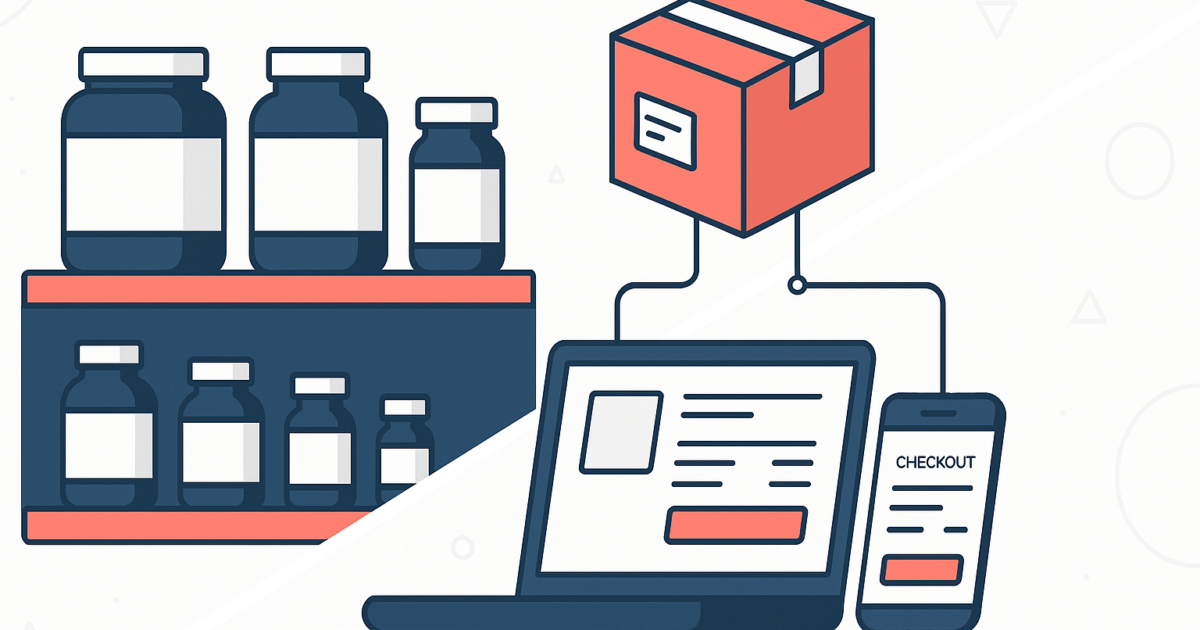
Stop guessing your stock levels. The hybrid model pairs bulk in-house retail stocking for proven fast movers with zero-inventory online dropshipping for the long tail, so shelves carry only what turns fast and the rest ships per order. It runs on a $0/month entry with a flat $2-per-item fulfillment fee, so gyms launch with zero prepaid stock and zero dead inventory.
What Is the Hybrid Retail Model for Gym Supplements?
The hybrid retail model splits a gym’s supplement line into two fulfillment paths. Fast-moving SKUs are bought in bulk at wholesale, stocked on an in-house shelf, and sold at the front desk for impulse and membership-driven sales. Everything else is listed online and dropshipped on demand by the manufacturer, so no cash sits in boxes. Both paths sell under one gym-owned brand, one price strategy, and one customer relationship.
Answer three quick questions and get pointed to the supplement niche that fits your audience and your margins.
Why Does Guessing Stock Levels Fail Gyms?
Most gym owners order supplements the same way they order protein powder for the front desk: on gut feel. That instinct costs real money. Cases sit on shelves past their expiration dates. Cash that could fund payroll or new equipment gets frozen in slow-moving stock. The guess is the problem, and the numbers show exactly how expensive it gets.
Seventy Billion Dollars and Growing
Supplements aren’t a side hustle anymore. Nutrition Business Journal estimates the US supplement market reached $69.3 billion in 2024 on 5.2% growth, with e-commerce returning as the strongest-growing channel at +10.7% and a 23.2% share (Nutraceuticals World, March 18, 2026, retrieved June 21, 2026). Demand is there. The problem isn’t whether members will buy, it’s whether your shelf stock will still be sellable when they do.
Write-Offs Eat Your Margin
Industry estimates suggest 10 to 18 percent of supplement inventory is written off due to expiration (Inventory Ready, May 19, 2026, retrieved June 21, 2026). Look at that against what a gym actually makes on retail. IHRSA Profiles of Success data shows gym pro-shop and retail categories yield a median margin of 16.5% for all clubs and 20% for fitness-only clubs (Health & Fitness Association, retrieved June 21, 2026). Write off one in ten bottles and the category’s entire advantage is gone. That’s exactly how hidden costs of wholesale supplement inventory quietly destroy a gym’s retail profitability.
On-Demand Is the Structural Shift
Guessing stops being necessary when fulfillment moves on demand. This isn’t a fringe experiment: the global dropshipping market was estimated at $464.4 billion in 2025 and is projected to reach $583.5 billion in 2026 (Grand View Research, June 12, 2026, retrieved June 21, 2026).
Bulk cases for the shelf still make sense for fast movers. But the rest of the catalog no longer needs to sit in your store room at all. Ring-fence the stock you know will sell and let a zero-inventory model carry everything else. Fast movers earn their shelf space; everything else earns nothing until it leaves the building. That’s the hybrid.
Bulk vs Dropship: What Each Model Does for a Gym
Bulk prepays wholesale cash and earns the highest per-unit margin on every unit you sell off the shelf. Dropship pays wholesale plus a flat $2-per-item fulfillment fee per shipped order, with zero prepaid stock. The two paths are complements, not rivals.
Bulk is the retail model. You own the inventory, you face the customer, and the spread between wholesale and your shelf price is yours to keep. Dropship is the catalog model. The manufacturer ships under your label, and your only cost on top of wholesale is the flat per-item fee.
Both paths carry your label and your price. The difference is where the inventory sleeps.
The feature-by-feature breakdown
Run your eye down these six rows before you commit cash to a single SKU. They cover the costs that actually decide whether a supplement line makes money: what you pay up front, what you risk if sales stall, what each sale nets, who does the work, how deep your catalog can go, and how low you can start.
| Bulk in-house | Zero-inventory dropship | |
|---|---|---|
| Upfront cash | Prepaid wholesale cash | $0 upfront |
| Dead-stock risk | Expiration write-off risk | No inventory risk |
| Per-unit margin | Highest per-unit margin | Wholesale plus flat fee per order |
| Fulfillment labor | Gym stores and faces stock | None (manufacturer ships) |
| Catalog depth | Limited to shelf space | Full catalog |
| Minimum order | 24-unit MOQ per SKU | MOQ 0 |
That 24-unit MOQ per SKU is the line between the two models. If you can turn 24 units before the stock loses value, bulk rewards you with the better margin. If you cannot, MOQ 0 dropship keeps the same product in your catalog with no prepaid cash and no shelf space.
Run bulk on fast movers and dropship on the long tail. For the full walkthrough on the stock side of the business, read our guide to profitable bulk supplement ordering for gyms.
Which Supplements Belong on Your Shelf and Which Belong Online
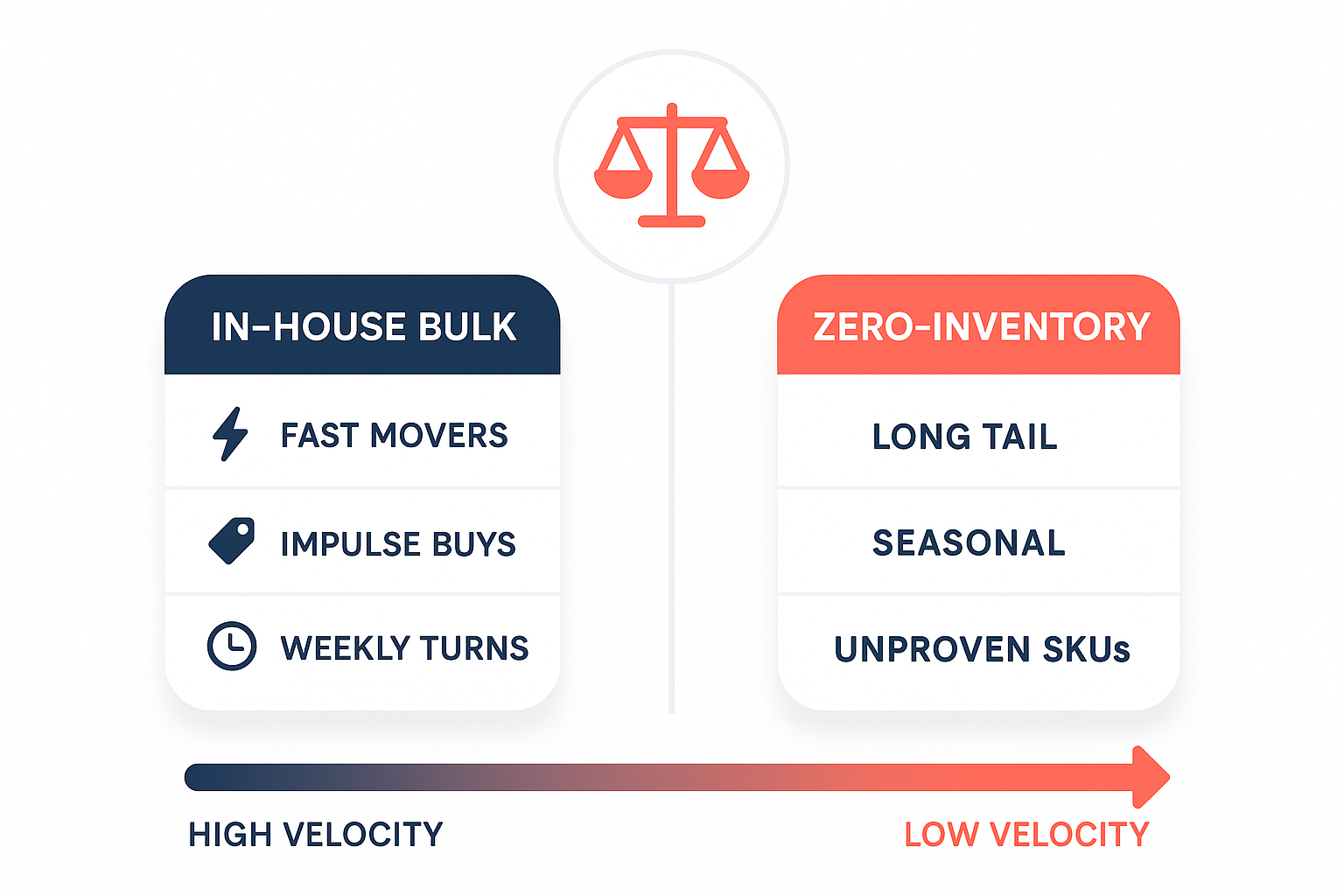
Sales velocity and shelf life decide where a product lives. Not category prestige, not how the label looks. If it turns weekly and sells on impulse, it earns floor space in your gym. If it turns monthly or seasonal, it belongs in online dropship, where a warehouse holds stock until a customer orders. The rule is simple: your shelf holds what moves, and your dropship catalog holds everything else.
SKUs That Earn Your Shelf
Your in-house shelf should carry what members grab without planning: Super Creatine Gummies, pre-workout single serves, hydration powders, and protein samples. These are impulse-friendly and high-margin, priced low enough that the decision feels painless. They turn fast, which keeps the shelf fresh and the cash cycle short.
SKUs That Stay Online
Larger protein tubs, greens and reds, recovery products, and specialty formulas go the other way. They are planned purchases with slower velocity, which means the cash sits in inventory longer. Seasonal or unproven SKUs follow the same path: let dropship absorb the risk while you measure demand. Supplement shelf life runs 18 to 36 months, and expiration write-offs are the exact risk this model avoids.
SKU Decision Table
Use this table when you allocate any new product. It takes seconds to categorize and it keeps dead stock off your shelves.
| Product type | Velocity signal | Fulfillment path | Reason |
|---|---|---|---|
| Super Creatine Gummies | Weekly turns, impulse | In-house shelf | High margin, front-desk impulse buy |
| Pre-workout single serves | Weekly turns, impulse | In-house shelf | Low unit cost, easy to face |
| Hydration powders | Weekly turns | In-house shelf | Everyday repeat purchase |
| Protein samples | Weekly turns | In-house shelf | Trial-size impulse, drives tub upsell |
| Larger protein tubs | Monthly turns, planned buy | Online dropship | Bulky, slower, longer cash cycle |
| Greens and reds | Monthly or seasonal | Online dropship | Specialty, subscription-driven |
| Recovery and specialty formulas | Slow or seasonal | Online dropship | Not impulse-driven |
| Unproven or seasonal SKUs | No proven velocity | Online dropship | Test without dead-stock risk |
Run this allocation every time you add a product. The shelf list keeps cash turning and floor space productive. The online list keeps your catalog broad without packing your gym with boxes. For a complete build-out of the hybrid model for your facility, see the gym owner supplement program.
The Money Math: One Case of Creatine Gummies, Two Paths
Everything in this article runs on one SKU: Super Creatine Gummies 1000mg (ROC943). Scale wholesale is $8.45 per unit. Retail is $29.97. That puts gross margin at $21.52 per unit, or 71.8%. Same product, same shelf price, two very different ways to carry it.
Bulk In-House: Cash Up Front, Profit at the End
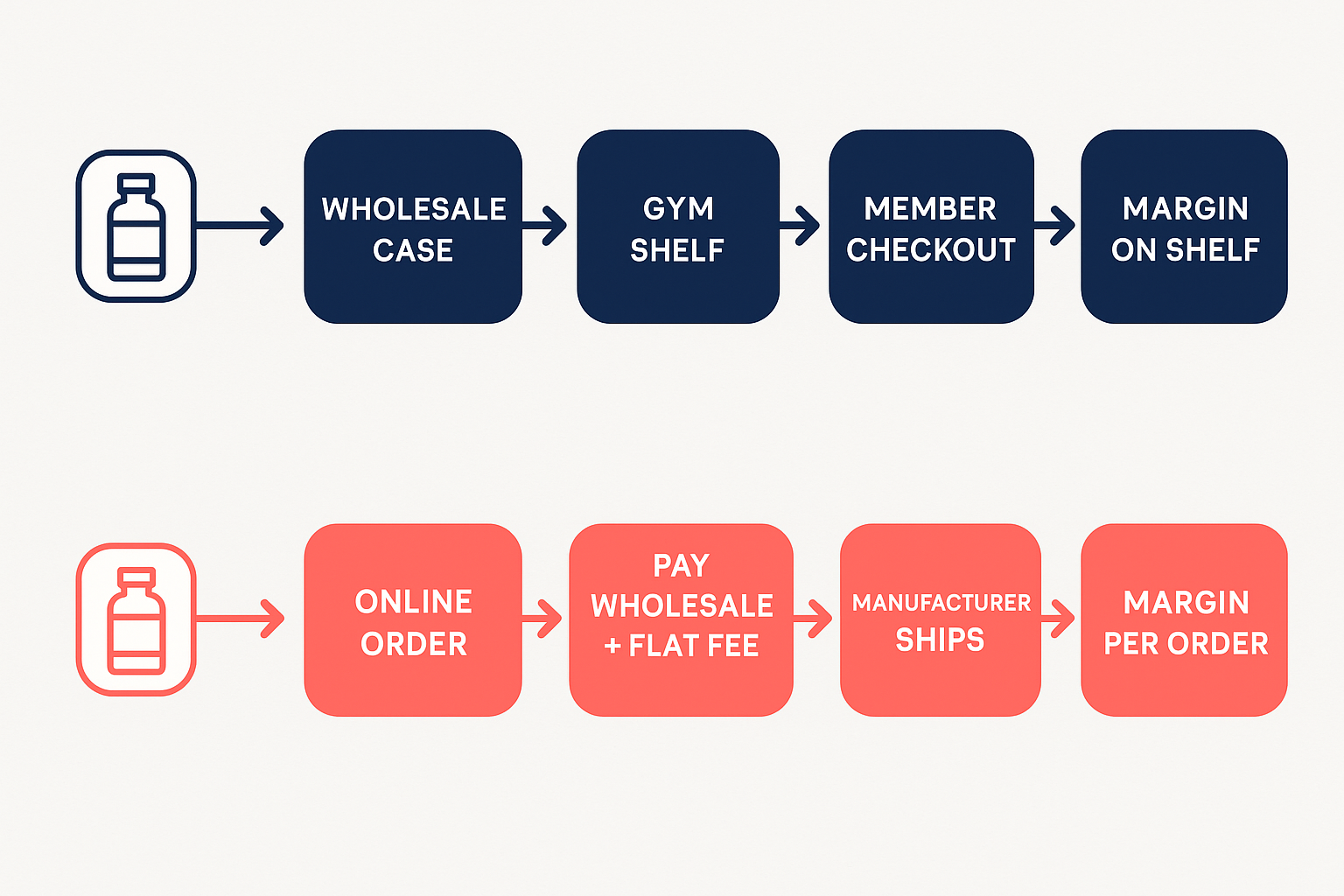
One 24-unit case runs 24 x $8.45, or $202.80, paid before the first jar sells. Full sell-through at $29.97 brings in $719.28 in revenue and $516.48 in gross profit. Strong on paper. But that $202.80 is cash you cannot use for payroll, equipment, or the next protein order. Bulk converts cash into inventory and hopes sell-through converts it back.
Zero-Inventory Dropship: Pay Per Order, Not Per Case
The dropship path changes the timing. You pay the same $8.45 wholesale plus the flat $2-per-item fulfillment fee, and you pay it only when an order ships. On a $29.97 sale, that nets $19.52 per order. No prepaid cash. No case gathering dust in the back office. That $2 fee covers pick, pack, and label, and it is charged only on units that actually move.
The $2 fulfillment fee is the entire gap between the two per-unit margins. That is the price of zero inventory risk, and for most gyms it beats a dead SKU. The side-by-side makes it obvious.
| Bulk in-house | Zero-inventory dropship | |
|---|---|---|
| Wholesale per unit (ROC943) | $8.45 | $8.45 |
| Fulfillment fee | $0 | $2 per item |
| Retail price | $29.97 | $29.97 |
| Net margin per unit | $21.52 (71.8%) | $19.52 |
| Upfront cash for 24 units | $202.80 | $0 |
Notice what the table leaves unchanged. Same wholesale cost, same retail price, same SKU. What shifts is who carries the risk while units sit unsold. Bulk pays for a full case today; dropship pays per order as the money comes in.
Which Path Wins Depends on Your Floor
Neither path is wrong. Bulk rewards full sell-through with the higher per-unit margin. Dropship keeps your cash free and turns inventory risk into a per-order cost. The right mix comes down to foot traffic and how much cash you can afford to park on a shelf. Run your own prices through the supplement margin calculator, then compare Rocktomic membership plans to see where the $8.45 Scale wholesale rate fits. For the full spread across a whole catalog, the bulk vs dropship profit math breaks it down.
How to Size In-House Stock Levels Without Guessing
Stockouts cost you a sale and overstock locks up your cash. Stop guessing. The reorder point formula is: (average weekly sales x lead time in weeks) + safety stock. That single number tells you exactly when to place the next bulk order.
Here is the concrete version. If a gym sells 4 units of ROC943 per week and lead time is 2 weeks, the reorder point is 8 units plus a safety buffer of 2 units. When the shelf count hits 10, you order. The buffer covers a late shipment, a staff restock error, or a member who buys three tubs at once.
Most operators get the lead time wrong. They count supplier ship time but forget their own ordering lag. Put both in the formula or the number lies to you.
Hold 4 to 6 Weeks of Cover and Rotate FEFO
Give every in-house SKU a cover target of 4 to 6 weeks of sales. That window keeps cash working instead of piled on a shelf, and it protects a bestseller from running dry mid-promotion. The hybrid model makes this easier: fast movers earn the shelf, slow movers live online and ship on demand.
Supplements typically carry an 18 to 36 month shelf life range. That is plenty of room to sell through a case, but only if you rotate stock with FEFO: first expired, first out. New cases go behind old ones. Members always pull from the front.
Earn Shelf Space by Clearing a 24-Unit Case
Rocktomic’s bulk minimum is 24 units per SKU. That is the case you buy, so a SKU only earns shelf space when it can clear a full case inside the cover window. If 24 units take 10 weeks to sell, it fails the test. You buy the case either way, so the only question is where it sells: from your shelf or straight from the warehouse via drop-ship.
When a SKU does earn the shelf, sell it with confidence. Every Rocktomic batch ships with its own Certificate of Analysis, and the Rocktomic quality and COA page shows exactly what that certificate covers. Hand a member proof, not promises.
How Zero-Inventory Dropshipping Fits a Gym Operation
The dropship path starts at your checkout page, not your loading dock. Your gym lists white-label products on its own storefront at the retail price you choose. When a customer orders, Rocktomic’s on-demand fulfillment team picks, packs, labels, and ships the order under your gym’s brand. At ship time you pay the wholesale cost plus the flat $2-per-item fulfillment fee. Part 6 covered the fee mechanics in detail; the operating takeaway is that your cash stays in your account until a real order moves.
The online path also removes the minimum-order pressure that sinks most gym retail experiments. Dropship runs at MOQ 0, so you can test a single unit of any product without committing to case quantities. Part 4 covered that fully; what matters here is that your shelf can hold the entire catalog and cost you nothing until something sells.
Two plans run the dropship path
There are exactly two, and they map cleanly onto gyms at different stages. The Free plan costs $0 per month and supports up to 10 white-label products with one sales-channel integration. Connect your Shopify store through the store integrations and you can take orders the same week. The Scale plan costs $297 per month and opens the full 140+ product catalog, including Scale Exclusives, unlimited sales channels, the lowest per-unit wholesale pricing, and priority fulfillment. Free gets you live. Scale gets you the wholesale numbers that make a supplement line worth running.
Who the online store actually serves
Most gym owners picture the front-desk customer. The dropship storefront serves three groups instead. Current members reorder without hauling a tub to their car. Former members keep buying your brand after they move gyms or train at home. And local shoppers who find your gym through search or social can buy without ever walking in. That last group is pure new revenue, with zero inventory risk and zero floor space. Before you launch, trace the loop end to end so you know exactly what happens at each step: see how Rocktomic works.
The strongest play is the hybrid: bulk stock for the front-desk impulse buy, dropship for everything else. You keep the margin on in-person sales while the online catalog stays effectively infinite. For the full playbook on that second stream, read selling supplements to former members online.
How do you stock a gym shelf in 90 days?
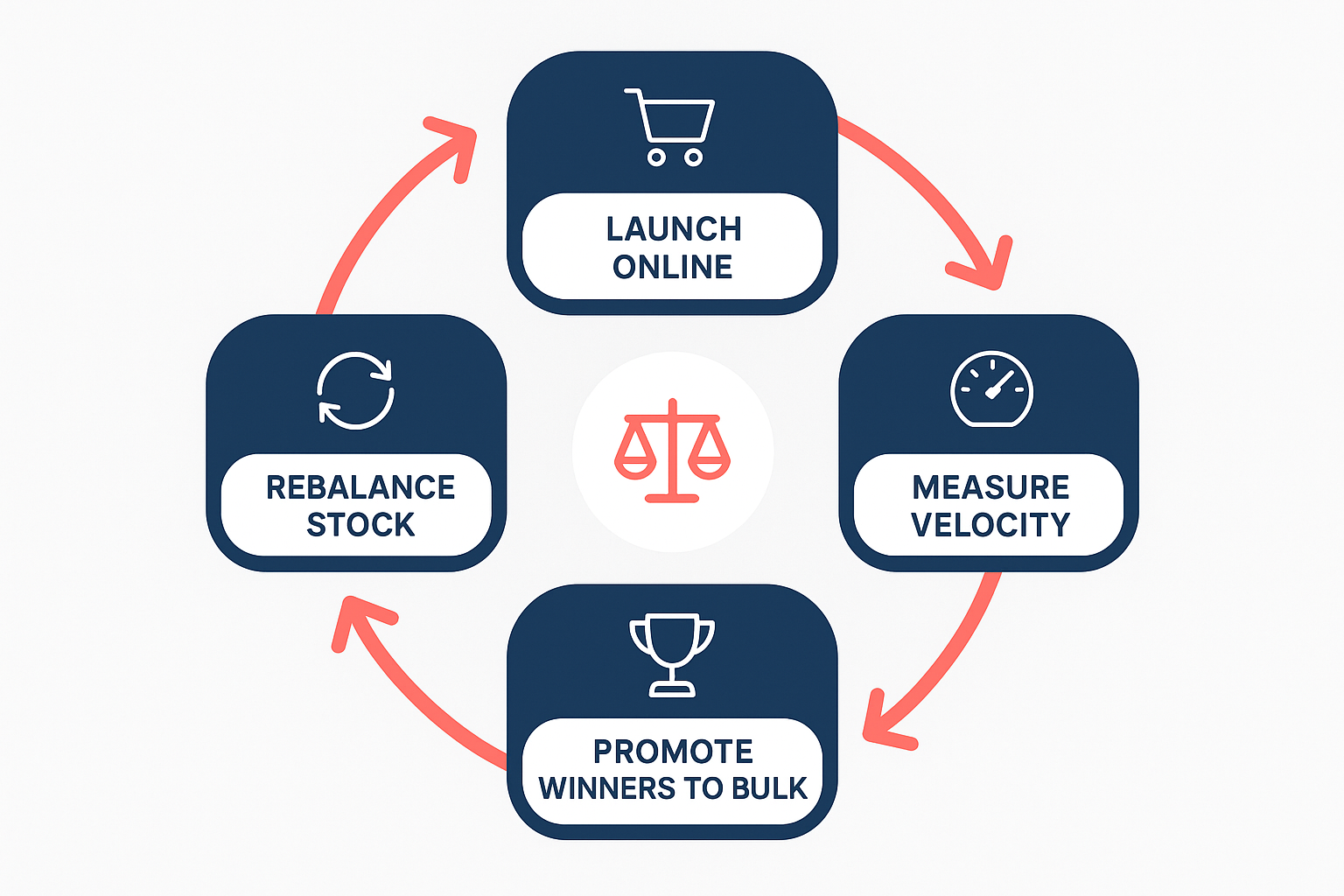
Launch with zero prepaid inventory. Let sales data pick the shelf winners. Then commit cash only to proven movers. That’s the hybrid model in one sentence, and it’s exactly how a gym should roll out supplements.
Day 1, you sell online through dropship. Day 90, your in-house shelf stocks only the products your members already bought. No guessing, no pallet buys on unproven SKUs, no dead stock piling up in the back room. The shelf becomes the reward, not the starting point.
| Phase | Timeline | Actions | Inventory risk |
|---|---|---|---|
| Launch online | Days 1-30 | Build the storefront, list up to 10 white-label products on the Free plan, connect store integrations, promote to members and social channels | Zero prepaid inventory |
| Measure velocity | Days 31-60 | Track weekly sales per SKU, use the supplement margin calculator to confirm net margins, identify 2-4 fast movers | Zero prepaid inventory |
| Add bulk | Days 61-90 | Order 24-unit bulk cases of the proven movers only, place on the in-house shelf, set the reorder point from the sizing method, keep the rest on dropship | Cash committed only on proven movers |
The plan is sequenced on purpose. You build the storefront first, watch what sells, then spend cash only on what the market confirmed. Two of the three phases carry zero prepaid inventory risk.
Phase one: launch, don’t stock
Days 1-30 are about building the machine. The Free plan keeps your monthly cost at zero while you list up to 10 white-label products, connect your store integrations, and promote to members and social channels. You’re testing demand on your own gym floor and social feed, not betting warehouse space on it. Every order ships under your label without you touching a box.
Phase two: let the data pick winners
Velocity is the truth-teller. Track weekly sales per SKU and run each candidate through the supplement margin calculator to confirm net margins hold. Inside this window, 2-4 fast movers usually separate themselves from the long tail. Keep everything on dropship until they do.
Phase three: commit cash only to proof
Now you order 24-unit bulk cases of the proven movers only. They earn the in-house shelf slot, and the reorder point comes from the sizing method you already set. Everything else stays on dropship until the data says otherwise. This is the phase where the hybrid model starts paying for itself, because you’re stocking what members already proved they’ll buy.
The 4 Numbers That Tell You When to Rebalance
Rebalancing is a monthly habit, not a yearly event. Inventory drifts, sales shift, and your mix of bulk stock and dropship SKUs needs the same monthly checkup. Skip it and you will wake up with pallets of slow movers and empty shelves on your best sellers.
- Sell-through rate. A SKU that sells through less than 60% of its stock is sitting. Move it from bulk back to dropship, where you pay nothing until an order ships.
- Inventory turns. Slow turns mean cash is parked in boxes instead of working for you. Promote that SKU to the front desk, bundle it, or drop it entirely.
- Weeks of cover. Six weeks or more on hand is a stop sign. Stop reordering that SKU until the number falls back under it.
- Net margin after the $2-per-item fulfillment fee. When this dips below your target, reprice or reallocate. The fee mechanics from Part 6 apply here: that $2 hits every shipped item, so low-ticket SKUs feel it first.
The goal is a shelf that turns weekly and a catalog that never expires. Four numbers, once a month, and you rebalance before your cash gets locked in a box.
Frequently Asked Questions
What is the hybrid retail model for gym supplement sales?
The hybrid retail model runs two inventory paths under one gym-owned brand. Fast-moving supplements are bought in bulk and stocked on an in-house shelf for impulse and front-desk sales. Slower, seasonal, or unproven SKUs are listed online and fulfilled on demand by the manufacturer. The gym keeps one brand, one price strategy, and one customer relationship across both paths.
Which supplements should a gym stock in-house vs dropship?
Stock in-house the impulse, high-margin SKUs that turn weekly: creatine gummies, pre-workout, protein single serves, and hydration. Dropship the long tail instead: larger tubs, specialty formulas, greens, recovery, and seasonal items. The rule is simple. If a product turns weekly, bulk it. If it moves monthly or only in certain seasons, dropship it and let the manufacturer hold the stock.
How much supplement inventory should a gym keep on the shelf?
Keep 4 to 6 weeks of cover on the shelf. Calculate the reorder point as average weekly sales multiplied by lead time, plus a safety buffer. Rocktomic’s bulk minimum is a 24-unit case per SKU. Most supplements carry 18 to 36 month shelf lives, but slower movers still risk write-offs, so the reorder point matters more than the expiration date.
How does zero-inventory dropshipping work for gyms?
The gym lists white-label products on its own storefront at a retail price it chooses. When a member places an order, Rocktomic picks, packs, labels, and ships it under the gym’s brand. The gym pays a flat $2-per-item fulfillment fee plus wholesale cost. There is no minimum order. The gym owns the customer relationship and the brand, not the inventory.
What are the hidden costs of bulk supplement inventory?
The visible cost of bulk is the wholesale price. The hidden costs are write-offs, storage, and lost opportunity. Industry estimates suggest 10 to 18 percent of supplement inventory is written off due to expiration. Dead stock ties up cash and erodes margins. Dropshipping eliminates that risk category entirely, because inventory is purchased only after a customer pays.
How much does it cost to stock a bulk case of supplements?
A 24-unit bulk case of Super Creatine Gummies (ROC943) costs $202.80 at the Scale wholesale price of $8.45 per unit. At the $29.97 MSRP, the case returns $719.28 in revenue if it sells through, leaving $21.52 per unit in gross margin.
| Item | Amount |
|---|---|
| Case size | 24 units |
| Wholesale per unit | $8.45 |
| Case cost | $202.80 |
| Retail per unit (MSRP) | $29.97 |
| Case revenue at MSRP | $719.28 |
| Gross margin per unit | $21.52 (71.8%) |
That money is committed before the first sale, so bulk belongs on proven, weekly-turning SKUs only.
What is the per-order cost of dropshipping supplements?
Gyms on the Dropship model pay a flat $2-per-item fulfillment fee on each shipped order, and wholesale cost is charged only when an order ships. With ROC943 at $8.45 wholesale and $29.97 retail, the gym nets $19.52 per order. The Free plan costs $0 per month and supports up to 10 products. The Scale plan at $297 per month adds unlimited channels and lower per-unit wholesale.
How do gym owners calculate margin on dropshipped supplements?
Margin equals retail price minus wholesale cost minus the $2-per-item fulfillment fee. For ROC943 at $8.45 wholesale and $29.97 retail, the dropship net is $19.52 per order. On bulk, the same SKU nets $21.52 per unit, or 71.8 percent, because there is no fulfillment fee, but cash sits tied up in a 24-unit case. Bulk wins on margin per unit. Dropship wins on cash flow and risk.
Stop Guessing Stock Levels
Stop guessing your stock levels. You already know which SKUs turn fast on the gym floor and which ones collect dust. Carry shelf inventory only for the movers. Dropship the rest through Rocktomic and you never write off dead product again.
You keep the in-person sales. Rocktomic handles the warehouse, labels, and shipping on every online order. Start on the Free plan at $0 a month, or compare membership plans for the Scale tier at $297 and the lowest per-unit wholesale pricing.
Map the hybrid model to your operation and book a call with Rocktomic to size your first bulk order and set up dropship fulfillment.
Last updated: June 21, 2026.