
The Hidden Startup Costs of a Private Label Pre-Workout Empire
· 18 min read · By Rocktomic Labs Team

The real startup costs of a private label pre-workout brand are rarely the powder. They are the inventory minimums, label runs, warehouse bills, freight contracts, and dead stock that traditional manufacturing quietly stacks on top of the first order. A zero-inventory dropship model removes nearly all of them: $0/month entry, a flat ~$2/item fulfillment fee paid only when an order ships, and a published margin of $27.34 on a $39.97 tub at Scale wholesale (ROC605). Speed to market drops from months to days.
What Is a Private Label Pre-Workout Brand?
A private label pre-workout brand is a supplement line a company owns and names, manufactured by a third-party facility that puts its label on a proven formula. Rocktomic manufactures, labels, warehouses, and drop-ships on demand, so the brand owner never touches inventory. The member owns the brand, the pricing, and the customer relationship, while Rocktomic handles production, quality documentation, and fulfillment. This definition anchors every cost comparison in the article.
Pick any product, set your monthly volume, and see your real per-unit and monthly profit on every plan – fulfillment, card processing, and membership all included.

Here is the full terrain this article covers. Each piece feeds the next.
- The six hidden costs that quietly gut first-order margins
- Shipping realities: freight quotes, landed costs, and the fees most calculators ignore
- Zero-inventory mechanics: how an order moves from checkout to the customer’s door
- Unit economics on a real tub, with real published numbers
- The startup costs that remain after you skip inventory
- Market data on category growth and buyer demand
- The first 30 days of a private label pre-workout launch
Knowing the real price before you start is the difference between a brand that clears margins and a pallet of dead stock. That is the point of the breakdown.
The 6 Hidden Costs in a Traditional Pre-Workout Launch
The wholesale quote shows one number. The real cost of launching a pre-workout brand is a stack of numbers that never make it onto that quote. Manufacturers that force pallet buys and platforms that charge per-order fees push six cost buckets onto you before your first sale. Add them all up and that attractive per-tub price looks a lot less attractive. Here is where those costs hide.
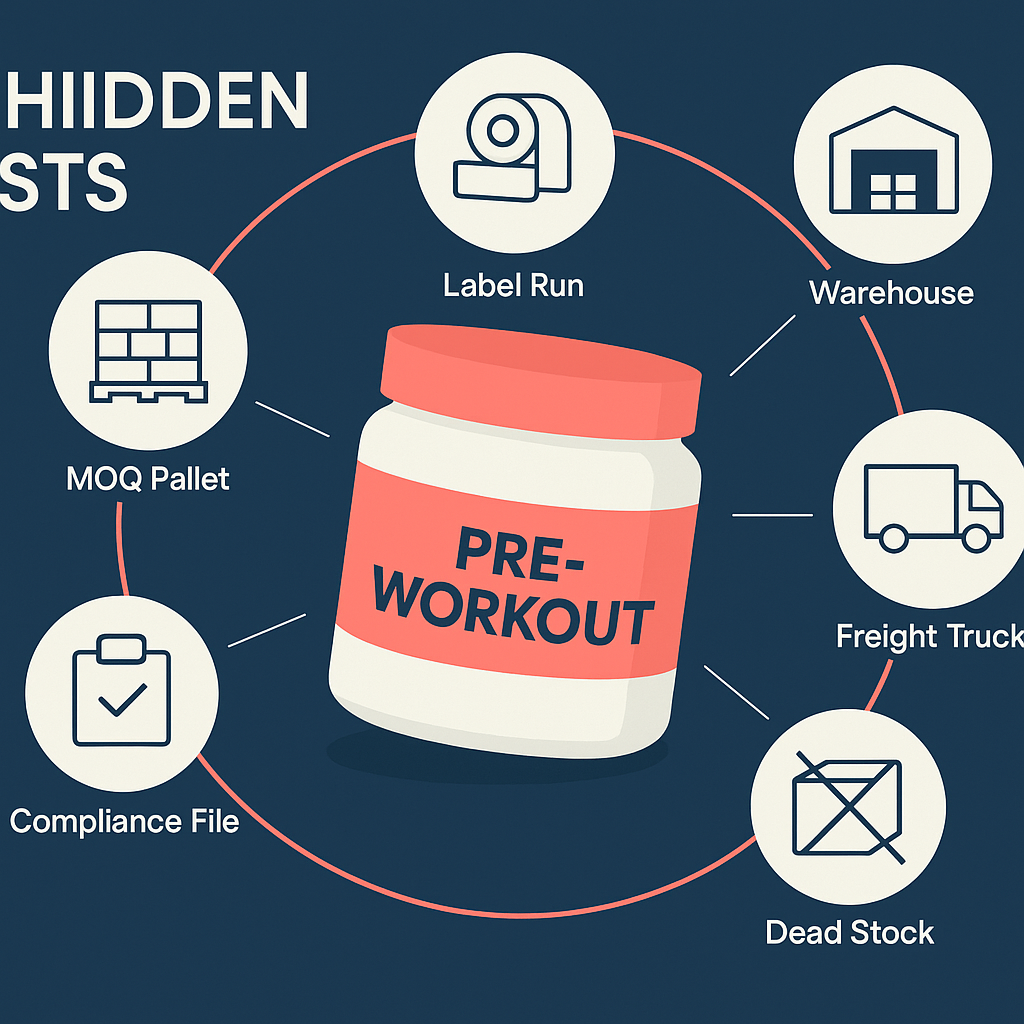
The six buckets that never show up on a per-tub quote
- MOQ and pallet minimums. A low per-tub price looks great until the manufacturer requires a full pallet to start. You are not buying product. You are buying a storage problem.
- Custom label runs with minimum print quantities. Your label is your brand, but most print shops require bulk runs. You pay for thousands of labels when you only need hundreds.
- Warehousing or self-storage for finished tubs. Every pallet needs floor space. That floor costs monthly rent, plus insurance and handling. You pay for it whether you sell one tub or one thousand.
- Freight and carrier contracts. Freight rates shift with fuel prices and demand. Committing to a carrier contract for palletized goods locks in another fixed cost before you have any revenue to cover it.
- Dead inventory that expires or goes stale. Pre-workout has a shelf life. A tub that sits unsold past its expiration date is cash you never get back. New brands over-order on the first run more often than they under-order.
- Compliance documentation. COAs, GMP audit paperwork, and claim substantiation cost real money to produce. Most brands discover this after the first order lands, not before.
Your cash sits idle until every tub sells
Manufacturers that force pallet buys require cash to sit idle in a warehouse until every tub sells. Your money is frozen in shrink-wrapped plastic instead of funding content, ads, or your next product. A zero-inventory structure flips the order: the customer pays first, then the product is made and shipped. Your cash stays in your account, and that is the real price difference.
Compliance is an after-the-fact cost in the traditional model
Every label claim needs evidence. The FTC Health Products Compliance Guidance (December 2022) requires competent and reliable scientific evidence for any dietary supplement claim: https://www.ftc.gov/business-guidance/resources/health-products-compliance-guidance. That standard applies to every label, every product page, and every ad you run. It turns COAs, GMP audit paperwork, and claim substantiation into a real line item. Suppliers that handle compliance as standard practice keep that cost off your plate. Check how Rocktomic quality and COA documentation is managed before you pick a partner. If the manufacturer issues a COA on every batch and keeps audit trails current, you get the paperwork instead of the project.
Why Pre-Workout Is a Heavyweight for Shipping and Storage
Pre-workout is a dense powder in a bulky tub. That combination triggers dimensional-weight billing, where carriers charge for the space a package takes up in the truck, not just what it reads on the scale. A tub of powder is mostly air around the product, so it bills heavier than its physical weight suggests.
Low-volume brands take the worst of it. They do not ship enough volume to negotiate contract rates, so every order runs at standard retail rates, and the tub’s bulk pushes those rates up. A brand doing a few hundred orders a month cannot absorb that cost the way a distributor with warehouse contracts can. It hits the smallest operators hardest, on every single sale.
This is a category-wide problem, not an edge case. Grand View Research (2026-07-24) reports that powder held an 88.6% share of the pre-workout market in 2025. The dominant format is also the most expensive one to ship. Every pre-workout brand is working against the same physics.
Capsules ship lighter, but powder is where demand sits
Capsules are lighter, pack tighter, and cost less to store per unit. That is a real operational advantage. It just does not match buying behavior. Buyers want powder, and the shipping weight comes with the category.
A flat ~$2/item fulfillment fee for pick, pack, and label removes weight-based surprises for the brand owner. No dimensional-weight math on your end, no per-pound carrier surcharges leaking into your margin. A five-pound tub costs the same to fulfill as a light bottle of capsules, so the heaviest SKU in your catalog stops being a pricing hazard. You know the fulfillment number before you set the retail price.
That predictability is the whole point of on-demand fulfillment. The carrier invoice never reaches you, and the weight of the order never changes the fee. Heavy tub in, same flat rate out.
How Zero-Inventory Dropshipping Removes the Overhead
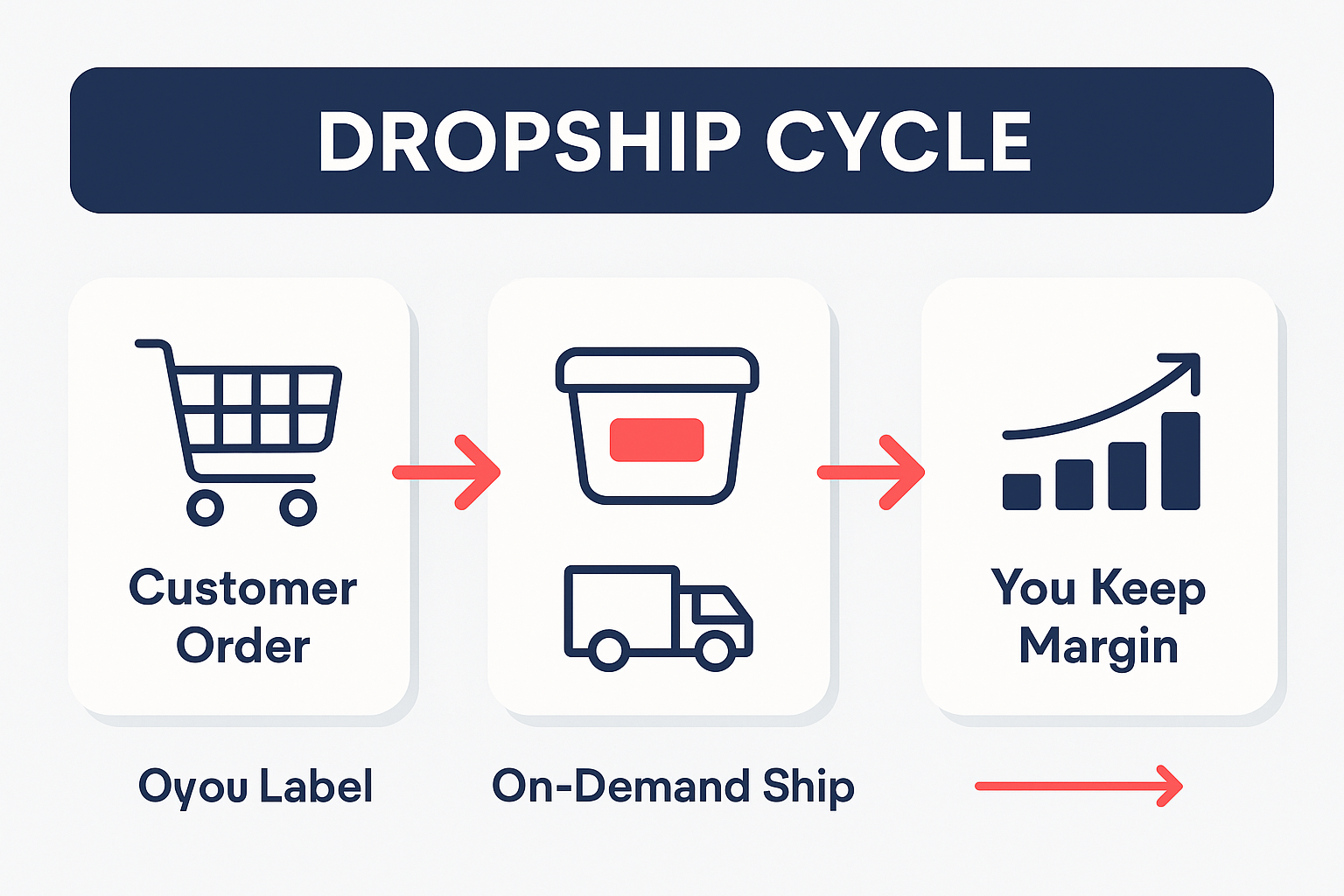
Most pre-workout launches start with the same bad math: buy a pallet, rent storage, sign a freight contract, then pray it sells. Rocktomic’s zero-inventory dropship model removes all of it. There is a $0 MOQ on the dropship model. You carry no warehouse. You sign no freight contract. And you never sit on dead stock while your cash is frozen in boxes.
Here is the mechanism. You build the brand and put your label on a formula. Rocktomic manufactures, warehouses, labels, and ships for you. When a customer order arrives, a flat fee of about $2 per item covers pick, pack, and label. That’s the entire fulfillment cost. No sale, no fee. The whole transaction happens under your label, so the customer relationship stays with you.
That pay-per-ship structure protects cash flow exactly when new brands need it most. In the first weeks, revenue is lumpy. Orders trickle in before they spike. Because you pay only after each sale arrives, you never tie up thousands in inventory or storage just to test a product. You can validate your pre-workout against real demand before you ever commit to a bulk order.
Contrast that with models that force pallet buys. Those demand a big check upfront, then charge storage fees while the boxes gather dust. Other platforms stack per-order fees on top of storage, so you pay twice for every shipment. Rocktomic charges neither. One flat fulfillment fee per item, paid only when a product ships.
Two Plans, One Zero-Inventory Core
Both plans run on the same pay-per-ship core. Free is $0/month: one sales-channel integration, up to 10 white-label products, and the about $2 per item fulfillment fee paid only when orders ship. Scale is $297/month: lowest per-unit wholesale pricing, unlimited sales channels, the full 140+ product catalog, and priority fulfillment. No inventory to buy. No monthly storage bill.
See how on-demand fulfillment works to trace the full order flow from your customer’s checkout to the doorstep.
Private Label Pre-Workout Unit Economics, Line by Line
One SKU tells you everything. Pre-Workout Fruit Punch (ROC605) is the cleanest example of what a private label pre-workout brand nets per tub, because every cost that touches it is on the table below. No percentage rounding, no hidden line items. Read it once and you can price any SKU in the catalog.
Per-Unit Margin for Pre-Workout Fruit Punch (ROC605)
The Scale plan carries the lowest per-unit wholesale pricing in the Rocktomic catalog, so this is the best-case cost structure available. Retail stays your choice; the margin percentages are already computed.
| Line item | Amount |
|---|---|
| Suggested retail (your choice) | $39.97 |
| Scale wholesale cost (ROC605) | $12.63 |
| Published margin | $27.34 (68.4%) |
| Fulfillment fee | ~$2.00/item |
| Net margin after fulfillment | ~$25.34 (63.4%) |
COGS equals the wholesale value. The $12.63 per tub is the cost of goods, and the $39.97 retail price is the seller’s choice, not a Rocktomic price. The published margin of $27.34 is 68.4% of retail, and net margin lands at ~$25.34, or 63.4%. Those two percentages are what you use to set sale prices and bundles.
Week One: 10 Orders of ROC605
Per-unit math is clean, but cash flow decides whether a brand survives its first week. Ten orders keeps every line visible without cluttering the table, and keeps the arithmetic simple enough to verify by hand. Here’s the same SKU across a 10-order first week, using the exact same wholesale cost and retail price.
| Line item | Amount |
|---|---|
| COGS: 10 tubs x $12.63 | $126.30 |
| Fulfillment: 10 x ~$2.00 | ~$20.00 |
| Total product spend | ~$146.30 |
| Revenue at MSRP | ~$399.70 |
| Note: the Free plan charges $0/month on top. | |
Total product spend lands at ~$146.30 against ~$399.70 in revenue at MSRP. Revenue at MSRP assumes every tub sells at the full $39.97 retail price. The Free plan adds $0/month on top of that spend.
The same math plays out across the catalog. For the wider margin picture, see the white label pre-workout profit margins breakdown. For the fee-by-fee version of this cost structure, read the true cost of dropshipping pre-workout. The SKUs there differ, but the cost logic is the same.
Run the numbers on your own price point before you commit. The supplement margin calculator rebuilds this table for any retail price in seconds. Margin changes fast when retail moves, so test before you launch. The startup cost comparison tool shows what week one looks like if you buy bulk inventory instead of drop-shipping on demand.
The Startup Costs That Still Exist (and How to Keep Them Lean)
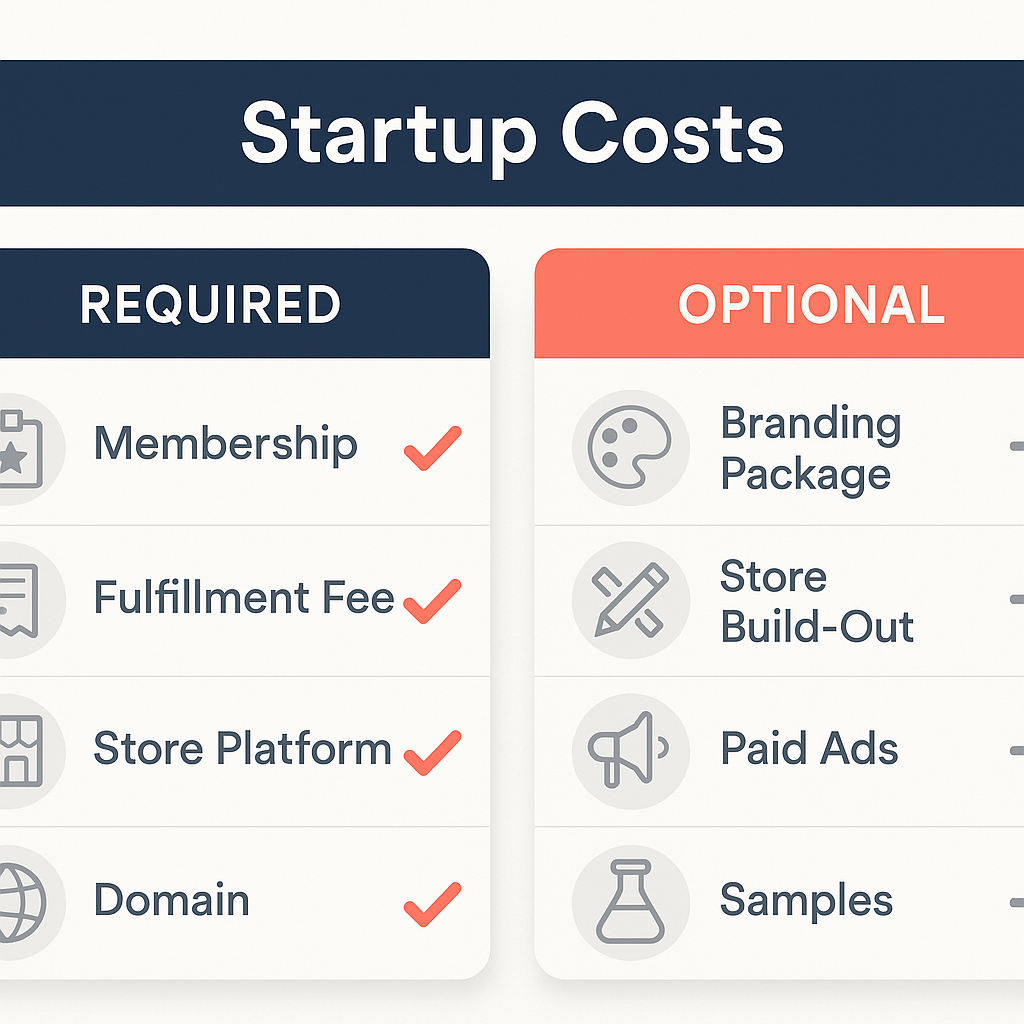
Dropshipping doesn’t make the whole launch free. It removes the inventory line, which is the biggest and riskiest cost in this business. Everything else stays on the table: your store platform, your domain, your labels, your marketing, and the samples you order before you commit.
That inventory cost was the wall that kept most creators out of supplements. Dropshipping tears it down. What remains is the standard cost of running any e-commerce brand.
None of these should scare you. Each cost below has a lean version that gets you to launch without burning cash.
Five Costs That Stay, and How to Keep Them Lean
Store platform subscription. Start with the basic tier and a free theme. Paid apps and custom design work can wait until you have revenue to fund them.
Domain name. Buy a simple, clean domain that matches your brand name. You can always upgrade to a shorter or catchier domain once the brand grows.
Label design. Your label does a lot of selling, but it doesn’t need a big budget on day one. Start with clean, simple artwork, then refine it after real orders start moving.
Marketing budget. Small and consistent beats big and sporadic. Put a modest daily budget on one platform, measure what converts, and scale only the winners.
Product samples. Order one sample before you commit to anything. Check the taste, the mixability, and the label in your hands. One sample costs far less than a launch built on a product you never tested.
Those five costs are real. Kept lean, none of them should stop you from launching.
Optional Done-for-You Launch Packages
If you are short on time or design skills, Rocktomic offers optional one-time launch packages. These are add-ons, not requirements, and your membership plan stays exactly what you choose.
- Starter Branding Package: $497 one-time. Includes 1 logo, 10 labels, and 10 3D mockups.
- Starter Online Store Build-Out: $1,497 one-time. A fully built Shopify store with up to 10 products.
- Business-in-a-Box: $997 one-time. Both packages bundled, best value.
Every package is optional. You can stay on the Free plan at $0 per month and build the store, labels, and brand yourself. The packages exist for speed and polish, not as a gate to entry.
If you want to hire the work out, the packages above cover the two biggest time sinks: branding and store setup. If you want to do it yourself, the Free plan holds nothing back.
To see how the two membership tiers differ, compare Rocktomic membership plans.
2026 Pre-Workout Market Data: Demand That Justifies the Launch
Demand is the first filter on any brand idea. If the category is shrinking, the best margins in the world will not save you. Pre-workout is not shrinking. Three independent research firms all put the category on a growth curve that runs past 2030. That timing matters when you are making a launch decision this year.
| Source | Published | Market size | Projection | CAGR |
|---|---|---|---|---|
| Grand View Research | 2026-07-24 | $22.4B (2026) | $32.2B by 2033 | 5.3% |
| Mordor Intelligence | 2026-08-06 | USD 22.48B (2026) | USD 31.53B by 2031 | 6.99% |
| Verified Market Reports | 2026-05-20 | $19.58B (2024) | $31.49B by 2032 | 6.12% |
Three firms, three different modeling approaches, one direction. Every projection lands in the same band: a pre-workout market between $31.5B and $32.2B by the early 2030s. Even when the base year shifts, the growth rate holds in the 5 to 7 percent range. That is a category adding buyers every year, not a static pool fighting for attention. It supports a new brand entering now, because the demand curve is still climbing.
Grand View Research also pegs powder at an 88.6 percent share of pre-workout sales as of 2025. That number matters on your cost sheet, not just the trend chart. Powder is the heavy format that drives shipping weight and fulfillment cost. You know the dimensional weight mechanics from Part 3 and the full unit economics from Part 5. The market data confirms the format customers reach for is exactly the format that hits your logistics line hardest. Plan your pricing around that from day one.
Format choice also shapes your product lineup and your margin story. The stim vs stim-free pre-workout profit showdown breaks down which direction pulls better margins and which one your buyers actually reorder.
Your First 30 Days: Launch Sequence and Speed to Market
Thirty days is enough to go from zero to shipped orders. No inventory buys, no warehouse contracts, no label minimums. Each step below takes one week and builds on the last. Follow the sequence and you will have a live brand with real revenue before month two.
- Week 1: Join the Free plan and pick your pre-workout SKU. Sign up at $0/month and choose your product from the catalog. The zero-dollar pre-workout launch playbook walks through the whole no-capital path.
- Week 2: Upload labels and connect your first sales channel. Load your label files into the Rocktomic dashboard and hook up your first channel. Do both in the same week so nothing stalls on the launch clock.
- Week 3: Publish your store and post launch content. Get the storefront live and start feeding it content. Need it faster? The optional branding and store packages compress logo, label, and mockup work into days. The 24-hour pre-workout Shopify launch playbook shows the compressed store path.
- Week 4: Ship first orders and review unit economics. Orders drop-ship as they come in. Rocktomic picks, packs, and labels each one for the flat fulfillment fee. Run the numbers on real order data, not projections. When volume grows, moving to Scale at $297/month lowers wholesale cost per unit and widens your margin.
If you want help deciding between the launch packages, or which plan fits your growth curve, book a call and get a straight answer on the fastest path for your timeline.
Frequently Asked Questions About Private Label Pre-Workout Startup Costs
What are the hidden startup costs of a private label pre-workout brand?
Most hidden costs sit outside the per-tub price: inventory minimums, custom label runs, warehousing, freight, and dead stock that never sells. Traditional suppliers often quote a low wholesale price and add these charges after contract signing, which is how a cheap quote becomes an expensive first order. A zero-inventory model avoids most of them. Rocktomic’s Free plan costs $0/month with no MOQ, and members pay only the flat ~$2/item fulfillment fee when an order ships.
How much does it cost to start a private label pre-workout brand with no inventory?
On the Rocktomic Free plan the membership is $0/month and there is no minimum order, so a brand can start with no inventory spend at all. The only product-linked cost is the flat ~$2/item fulfillment fee charged when an order ships. Optional one-time launch packages exist for brands that want done-for-you work, including a $497 Starter Branding Package and a $1,497 Starter Online Store Build-Out, but neither is required to sell.
What is the minimum order quantity for private label pre-workout?
Minimums vary by supplier. Some manufacturers force a full pallet of one SKU before they will print a label, locking thousands of dollars into inventory before the first sale happens. Rocktomic’s dropship model carries a $0 MOQ, and the Free plan supports up to 10 white-label products, so a brand can test demand without buying stock. Brands that want lower per-unit costs can switch to bulk ordering at a 24-unit MOQ per SKU, which is the trade-off for better wholesale pricing.
How long does it take to launch a private label pre-workout brand?
A traditional launch can take months because of formula development, label proofs, pallet production, and warehouse setup. A zero-inventory launch takes days: pick a ready SKU from the catalog, apply a label, connect a sales channel, and publish the store. Rocktomic manufactures, labels, warehouses, and drop-ships on demand, so the brand owner skips production and fulfillment entirely. The Free plan costs $0/month, and the flat ~$2/item fulfillment fee only appears when an order ships.
Why is pre-workout more expensive to ship than other supplements?
Pre-workout is a dense powder in a heavy tub, so freight carriers often charge by dimensional weight, and low-volume brands pay premium per-order rates. Grand View Research reports that powder held an 88.6% share of the pre-workout market in 2025, which makes heavy shipping a category-wide issue rather than a niche problem. Flat-rate fulfillment solves it: Rocktomic charges a flat ~$2/item fee for pick, pack, and label regardless of tub weight.
What is the per-unit profit margin on a private label pre-workout?
Using the Scale plan, the Pre-Workout Fruit Punch (ROC605) carries a $39.97 MSRP and a $12.63 wholesale cost, producing a published margin of $27.34 (68.4%) per tub. After the flat ~$2/item fulfillment fee, the net margin is roughly $25.34 (63.4%). The Scale plan costs $297/month and provides the lowest per-unit wholesale pricing in the catalog, which is where those margins come from.
What does Rocktomic charge to launch a pre-workout brand?
Rocktomic offers two membership plans. The Free plan is $0/month with one sales-channel integration and up to 10 white-label products. The Scale plan is $297/month and adds lowest per-unit wholesale pricing, unlimited sales channels, the full catalog, and priority fulfillment. Fulfillment stays a flat ~$2/item on both plans. Optional one-time launch packages start at $497 for branding and $1,497 for a store build-out, for brands that want done-for-you work.
How do dropshipping and bulk ordering change pre-workout startup costs?
Dropshipping removes upfront inventory: there is no MOQ, and members pay only when a customer order ships, which protects cash flow for a first SKU and keeps capital free for marketing. Bulk ordering lowers the per-unit wholesale cost but requires a 24-unit MOQ per SKU plus storage and freight management. Most first-time brands start on the Free plan at $0/month, then move to the $297/month Scale plan as order volume grows and per-unit pricing matters more.
Own Your Pre-Workout Brand Without the Inventory Risk
The inventory costs disappear. The brand ownership stays with you. The launch is measured in days, not months. That is the model Rocktomic built: you sell pre-workout under your own name while Rocktomic handles manufacturing, warehousing, labeling, and drop-shipping on demand. No pallets in your garage. No minimum order to test demand. You pay only when an order ships.
That structure changes the math for creators. Your content builds the audience, and your branded pre-workout captures the revenue that used to flow to someone else’s label. The barrier to entry is a $0/month account, and every batch is US GMP manufactured with a COA on file. You are not asking customers to trust a faceless store. You are selling a product with your name on it and the paperwork to back it up.
If you are ready to map your first SKU, book a call with Rocktomic and walk through the launch plan. Want to see how the plans stack up? Compare Rocktomic membership plans. And do not guess at the numbers: run your own figures in the supplement margin calculator and the startup cost comparison tool before you commit a dollar.
Your audience already trusts you. Give them a product that looks as serious as you are.
Last updated: August 8, 2026.