
The True Cost of Dropshipping Pre-Workout (And How to Stay Profitable)
· 12 min read · By Rocktomic Labs Team
The True Cost of Dropshipping Pre-Workout
A pre-workout tub that retails at $39.97 carries a $12.64 wholesale cost (ROC605) before a flat ~$2 fulfillment fee, payment processing, and ad spend. The true cost of dropshipping pre-workout is a five-layer stack, and this guide prices every layer so you can calculate and protect real net profit.
What Is the Real Cost of Dropshipping Pre-Workout?
The real cost is the full stack between retail price and payout – wholesale COGS, a flat ~$2 per item fulfillment fee, payment processing, platform subscriptions, and ad spend. On a $39.97 pre-workout (ROC605) at $12.64 Scale wholesale, the layers leave roughly $23.87 per bottle before ads. Every brand that only tracks the wholesale price is overestimating profit.
Pick any product, set your monthly volume, and see your real per-unit and monthly profit on every plan – fulfillment, card processing, and membership all included.
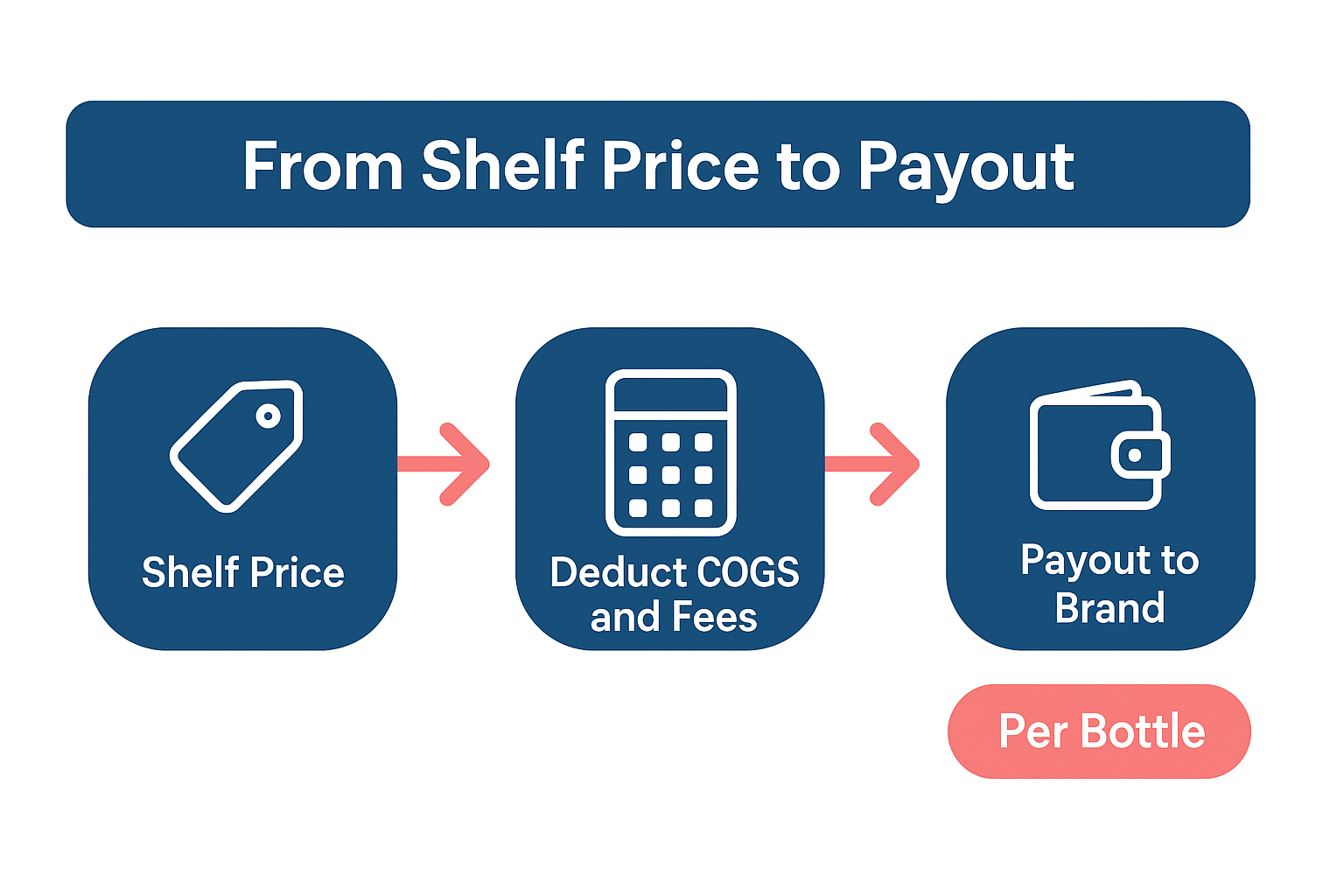
Retail price is the top line. Payout is what lands after every layer takes its cut. Between them sit the costs most first-time sellers never write down. The wholesale bottle, the per-item fee, processing, subscriptions, and ads.
That makes $23.87 the contribution before ads, and the ceiling for what a brand can spend to acquire a customer. Rocktomic prices its catalog so those layers stay visible from day one.
Why Pre-Workout Is a Heavy, Fee-Sensitive Category
Pre-workout is a heavy product, and the fee structure around it decides your margin. A Grand View Research report dated July 24, 2026 values the global pre-workout market at USD 21.0 billion in 2025 and projects USD 32.2 billion by 2033. Powder holds 88.6% of that market.
That powder share is the business story. Powder ships in big tubs, and big tubs cost more to store, pick, pack, and ship than capsules or gummies. Fulfillment becomes a bigger slice of every sale. The real margin variable is the fee structure, not the wholesale price alone.
Some partners force pallet buys or stack on per-order fees that grow as tubs get heavier. A flat per-item fulfillment fee keeps heavy tubs predictable. You know the cost of each order before it ships, and margin stays a calculation instead of a guess.
Run the numbers on the tub size you plan to stock before you commit. If you sell powder, the product is heavy. The fee model decides whether that weight works for you. Compare fee models the way you compare wholesale costs. Over a year of orders, the fee structure moves your net more than the unit price does.
The Cost Stack: Five Layers Between Retail Price and Net Profit
Your $39.97 retail price is not your money. Five layers sit between that price and net profit, and a sixth can hit after the sale closes. Here is each one, priced.
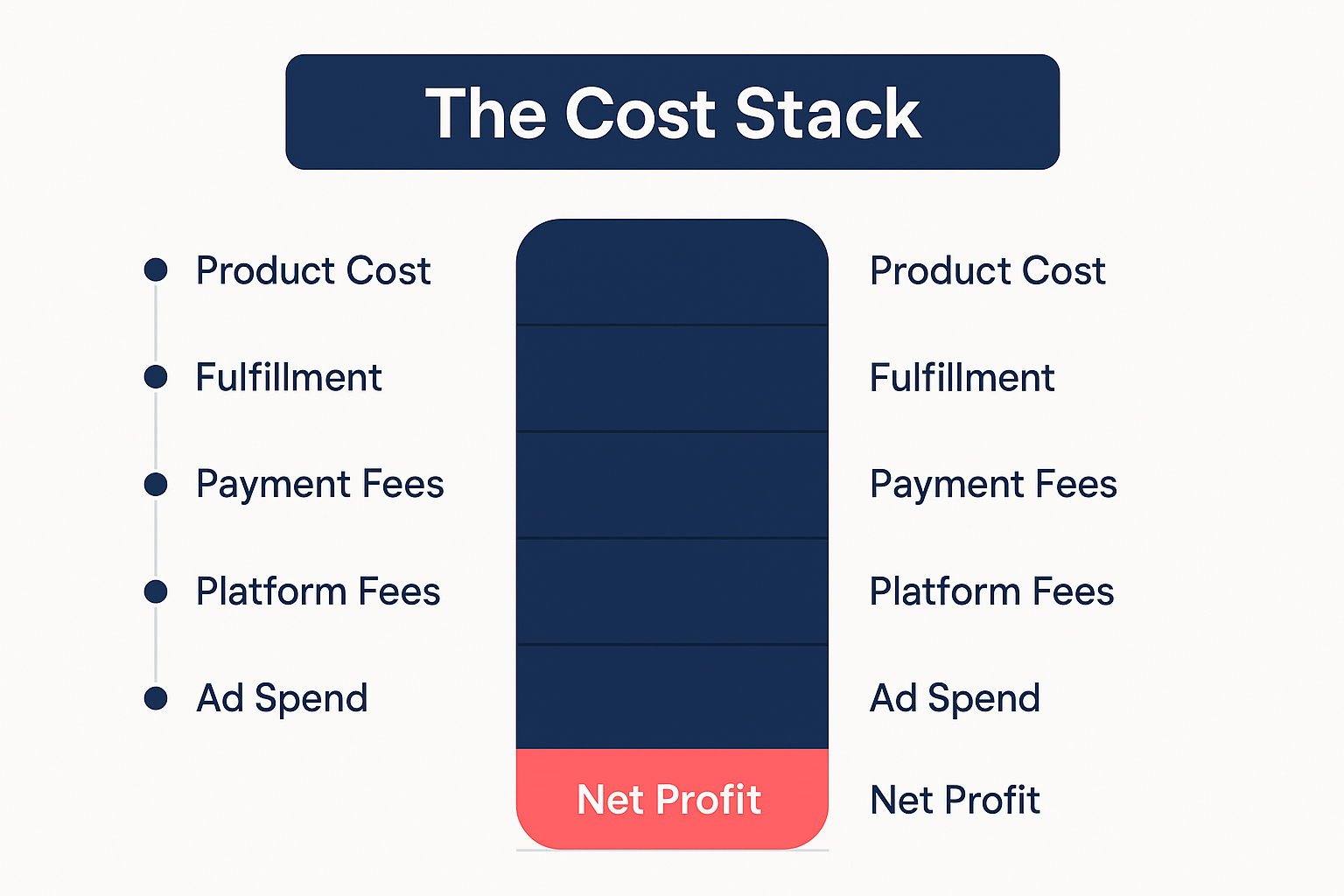
- Wholesale COGS. $12.64 for ROC605, the pre-workout SKU in this stack. Rocktomic charges wholesale only when a unit ships, so you never tie up cash in inventory.
- Fulfillment. The flat ~$2 per item fulfillment fee covers pick, pack, and label. That is the entire fulfillment cost per order.
- Payment processing. Roughly $1.46 on a $39.97 order at a standard blended rate, before any chargeback fee lands.
- Platform subscriptions and channel fees. Your Shopify plan, plus any TikTok Shop or marketplace commission on each sale.
- Ad spend. The variable that decides whether a winning product stays winning. You can cut or scale it week to week, which makes it the most controllable layer in the stack.
Chargebacks and returns are the sixth layer, and they hit heavy tubs harder than light SKUs. A 30-serving tub costs more to ship back than a capsule bottle, and a single return can erase more than the profit from the original sale. Factor a return rate into every projection before you commit to a heavy product.
For the full per-unit freight math on heavy powders, read unit economics on heavy powders before you lock a price. Part 5 runs the dollar math; this is the map.
Money-Math: The Real Unit Economics of One Pre-Workout Bottle
Every number here is locked to one SKU: ROC605, a 30-serving pre-workout tub at a $39.97 retail price. One product, one cost stack. No averages, and no swapping in a friendlier SKU to make the math look better.
| Cost Layer | Amount |
|---|---|
| Retail price (MSRP) | $39.97 |
| Wholesale cost (COGS, Scale plan, ROC605) | $12.64 |
| Fulfillment fee (flat, pick/pack/label) | ~$2.00 |
| Payment processing (Shopify Payments, Basic plan: 2.9% + $0.30) | ~$1.46 |
| Contribution before ads | $23.87 |
| Ad spend at 30% of revenue | ~$11.99 |
| True net per bottle | ~$11.88 |
Read the stack top to bottom
Your list margin on ROC605 is $27.33, or 68.4% of retail. That is the number most suppliers quote, and it is the one most sellers misunderstand. It only counts the gap between retail and wholesale. Fulfillment, payment processing, and ad spend all come out of it. The list margin is the headline. The contribution is the story.
Contribution before ads is where the real operation starts. Take $39.97, subtract the $12.64 wholesale cost on the Scale plan, subtract the ~$2.00 flat fulfillment fee, subtract ~$1.46 in Shopify Payments processing at 2.9% plus $0.30. That leaves $23.87 per bottle before you spend a cent on traffic.
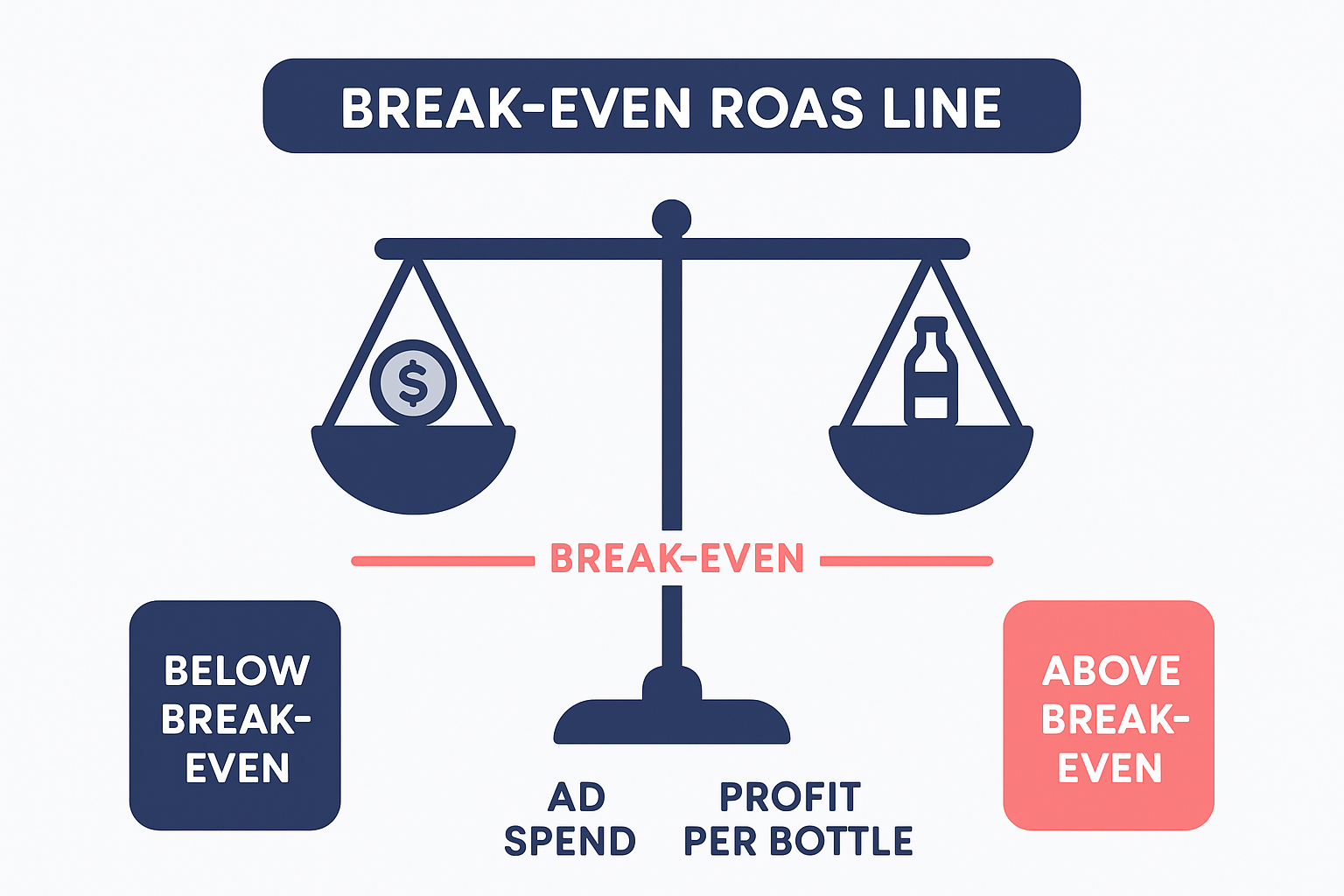
Break-even ROAS drops straight out of that number. Divide revenue by contribution: $39.97 / $23.87 = ~1.7x. Hit 1.7x on ad spend and the order covers the product, the pick and pack, and the payment fees. Every point above that line is profit. Below it, every sale quietly drains the account.
Run ads at 30% of revenue and you are paying ~$11.99 to sell each bottle. Subtract it from the $23.87 contribution and the true net lands at ~$11.88 per bottle. That is the number that hits your account after the customer checks out, the platform takes its cut, and the ad platform bills you.
Run your own SKU through the supplement margin calculator before you commit to a product, and read the full breakdown of white label pre-workout profit margins to see why per-unit wholesale pricing changes the outcome.
Shopify and Channel Fees: The Cuts Most Brands Miss
Your $39.97 tub clears checkout, and the platform layer takes its cut before you see a cent. Shopify publishes those rates in the open, and they hit harder on a low-ticket product. The Shopify pricing page and the pricing overview, both retrieved 2026-06-21, are the source for this fee schedule.
| Platform cost | Amount |
|---|---|
| Shopify Basic plan | $39/month |
| Shopify Payments (online transaction) | 2.9% + $0.30 |
| Third-party gateway surcharge (Basic plan) | 2% |
| Setup fees | None (Shopify’s published note) |
Why a $39.97 tub feels every cut
The per-order cut matters more at this price point than on a $99 SKU. The percentage is nearly identical, but the flat $0.30 is a bigger share of a $39.97 order. Add the 2% gateway surcharge and each transaction carries a heavier proportional load than the same sale at a higher ticket. That’s cash out of every sale, before a single tub ships.
That compounds with volume. Every percentage point is real margin gone before you pay for packaging or fulfillment. Higher-priced products absorb those cuts inside a bigger number. Pre-workout sits where the platform layer is a line item you can actually feel.
Marketplace cuts and the rest of the tech tax
TikTok Shop and Instagram Shop take their own additional cuts on top of your store fees. The exact rates shift by category, region, and promotion, so treat them as a line item instead of a footnote. The store integrations you pick decide how much of that fee stack you can route cleanly, and our post on budgeting for e-commerce and hosting fees maps the rest of the hidden costs that follow a launch.
Ad Spend Math: Break-Even ROAS and the 30% Rule
Ads are the layer where most pre-workout dropshippers lose the margin they fought for in COGS and platform fees. Treat ad spend as a cost layer to engineer, not a guess. With the ROC605 numbers locked, you can do exactly that.
Here’s the math that matters. Contribution lands at $23.87 per bottle. To break even on ad spend, you need a return on ad spend (ROAS) of roughly 1.7x. That break-even already bakes in your cost of goods, fulfillment, and platform fees. Spend above 1.7x and every ad dollar earns margin. Spend below it and you’re funding the ad platform with your own profit.
The 30% rule gives you a cleaner operating target. If ads eat 30% of revenue, that’s about $11.99 per bottle on ROC605. That leaves roughly $11.88 net per bottle after the ad layer. That’s the number that pays your bills and funds your next product.
Creators with organic audiences hold the strongest hand here. You can spend well below the 30% line on paid traffic and compound margin on every order. Paid scaling only works when you stay above the ~1.7x break-even. Push traffic that converts under that line and you’re buying sales, not building profit.
Know your break-even before you launch a single campaign. The break-even ROAS math walks through the full formula with real numbers so you can set your targets before you spend a dollar.
Five Levers to Stay Profitable on Pre-Workout
The cost layers above are only half the fight. The other half is what you do with them. These five levers, in rough order of impact, keep your pre-workout margin healthy after launch.
- Hold the $39.97 price point. Discounting is the fastest way to erase your contribution margin. Cold traffic doesn’t convert because a tub is $5 cheaper; it converts because the brand looks trustworthy. Hold the price and spend your energy on the trust signals below.
- Bundle or push subscriptions to raise average order value. A single tub carries the ~$2/item fulfillment fee fine. A bundle or subscribe-and-save order spreads that same fee across a bigger ticket, so the fee shrinks as a percentage of every sale.
- Move to the Scale plan at volume. At $297/month you lock the $12.64 wholesale cost on pre-workout. The spread between that cost and your $39.97 retail price is your profit room, and it only widens as order volume climbs.
- Keep ROAS above ~1.7x before scaling spend. Below that line, every ad dollar is buying sales at a loss. Let a campaign prove it can hold that return at small spend, then scale it, not before.
- Publish your COA and look legit. A pre-workout that is third-party tested with a COA on every batch answers the objection cold traffic always has: “is this real?” The certificate is public proof, it converts skeptical visitors, and it lowers refund pressure because buyers already saw the evidence before they paid.
FAQ: Dropshipping Pre-Workout Costs and Unit Economics
What does it cost to dropship pre-workout?
A dropship order for one bottle of pre-workout carries three variable costs: wholesale product cost, a fulfillment fee, and payment processing. Using a Rocktomic pre-workout (ROC605) at $39.97 MSRP, the Scale wholesale cost is $12.64, fulfillment is a flat ~$2 per item, and Shopify Payments on Shopify’s Basic plan takes 2.9% plus $0.30 (about $1.46). That leaves roughly $23.87 per bottle before ad spend.
How much profit can a pre-workout brand keep per bottle?
On paper, the pre-workout (ROC605) carries a $27.33 margin, about 68.4% of the $39.97 MSRP. After the flat ~$2 fulfillment fee and roughly $1.46 in payment processing, contribution drops to about $23.87 per unit. If ads run at 30% of revenue, that is about $11.99 per bottle, leaving roughly $11.88 in true net profit before fixed monthly costs such as the Shopify plan.
Why is pre-workout more expensive to dropship than capsules?
Pre-workout is sold mostly as powder, and powder means heavy, bulky tubs. Grand View Research reports that powder held 88.6% of the pre-workout market in 2025. Heavier items raise fulfillment and shipping exposure, so per-item fee structures matter more. A flat ~$2 per item fulfillment fee keeps heavy tubs predictable, which is why brands compare fee structures before choosing a partner.
Which fees eat pre-workout dropshipping profits?
The biggest cuts are product cost, payment processing, platform fees, and ad spend. Shopify Payments on Shopify’s Basic plan charges 2.9% plus $0.30 per online transaction, and a third-party gateway adds a surcharge on top of the processor’s own fee. Platform subscriptions, apps, and chargebacks add smaller recurring costs. Brands that track every layer, not just wholesale, keep the real net number visible.
Do you need inventory to dropship pre-workout?
No. On-demand dropshipping means the manufacturer warehouses, labels, and ships each order, and the brand pays only when an order ships. Rocktomic’s Free plan is $0 per month with on-demand dropshipping, so a pre-workout brand can launch without buying a single tub. Bulk ordering is an option later for a lower per-unit cost, but it is never required to start.
How do membership plans change pre-workout unit economics?
The Free plan is $0 per month and carries a flat ~$2 per item fulfillment fee, which suits a first pre-workout SKU. The Scale plan is $297 per month and unlocks the lowest per-unit wholesale pricing, such as $12.64 for the pre-workout (ROC605) that retails at $39.97. At volume, the wholesale savings on every tub can outweigh the monthly fee.
What is the break-even ROAS for pre-workout ads?
Break-even ROAS is the point where ad spend equals the per-unit contribution after product cost and fees. With a $39.97 pre-workout, $12.64 wholesale cost (ROC605), ~$2 fulfillment, and ~$1.46 payment processing, contribution is about $23.87, so break-even ROAS is roughly 1.7x. Any ROAS above that generates profit per order; below it, ads quietly consume margin.
Should you dropship or bulk-order pre-workout?
Dropshipping has no minimum order and a flat ~$2 per item fulfillment fee, so a creator can test a pre-workout SKU with zero inventory. Bulk ordering lowers per-unit cost but requires 24 units per SKU and upfront capital. The choice depends on volume: test with dropship, then shift to bulk once a SKU proves demand.
Model Your Own Pre-Workout SKU
Run the numbers on any tub you sell with the supplement margin calculator, then apply the five-layer cost stack from this guide to your own SKU. It works the same whether you sell a $40 pre-workout or a $25 greens powder.
Rocktomic keeps the math clean: zero inventory, a $0/month Free plan to start, and US GMP quality with a COA on every batch. When you are ready to scale, Rocktomic Scale plan pricing starts at $297/month for the lowest per-unit wholesale.
Run the numbers. Then start on Scale.
Last updated: June 21, 2026.