
The Front Desk Sales Machine: Training Your Gym Staff to Upsell Supplements
· 19 min read · By Rocktomic Labs Team
The Front Desk Sales Machine: The Bottom Line
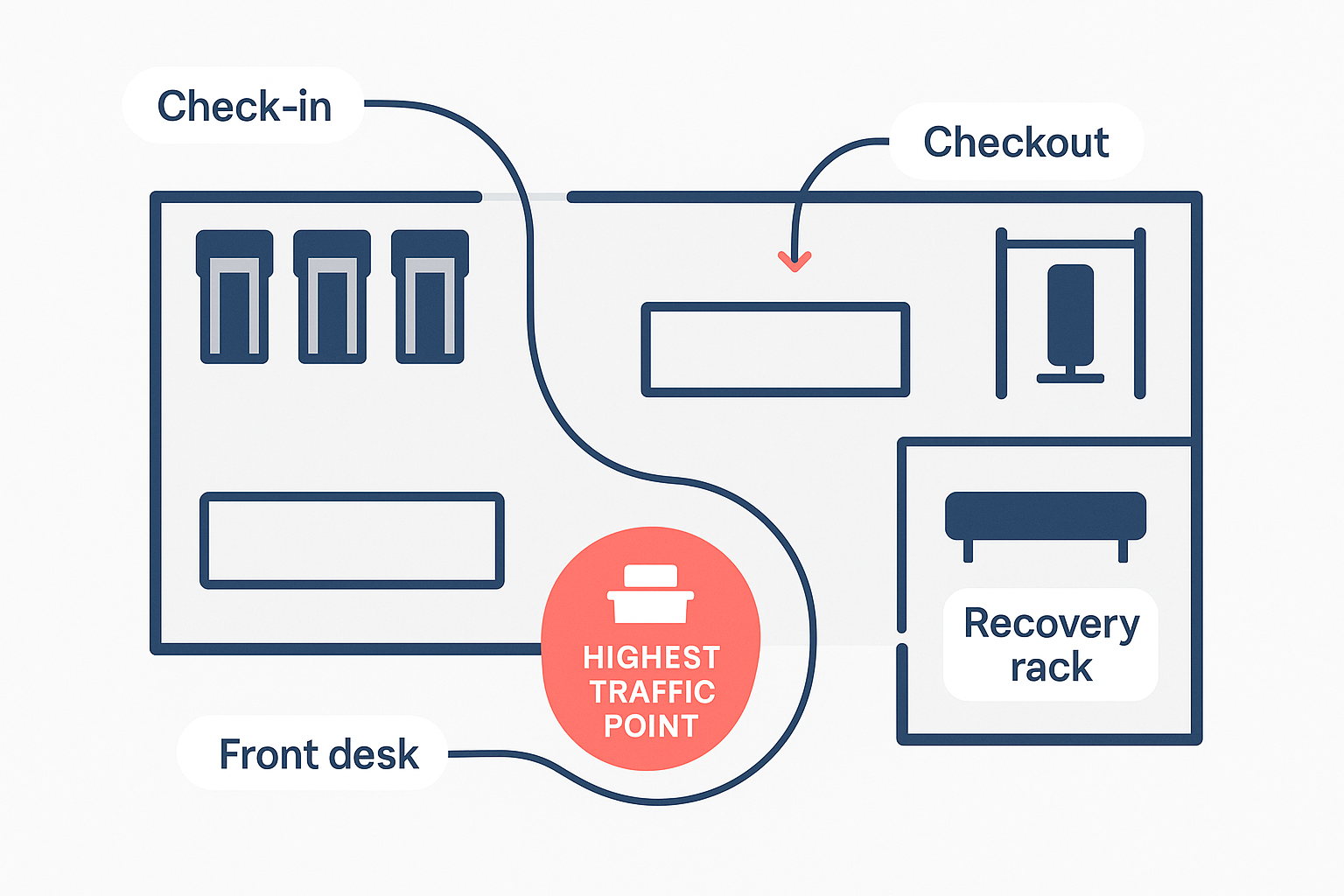
The front desk is the highest-traffic retail point in your gym, and it can sell supplements without a single ad. Most operators leave that foot traffic on the table. This system fixes it: train your staff with a 30-day cycle of daily huddles, weekly role-play, and monthly product certification, and pay a flat per-unit commission that protects margin. The math is simple. On one SKU, a single front-desk sale a day is worth about $819.90 in gross margin per month.
Answer three quick questions and get pointed to the supplement niche that fits your audience and your margins.
What Is Front Desk Supplement Upselling?
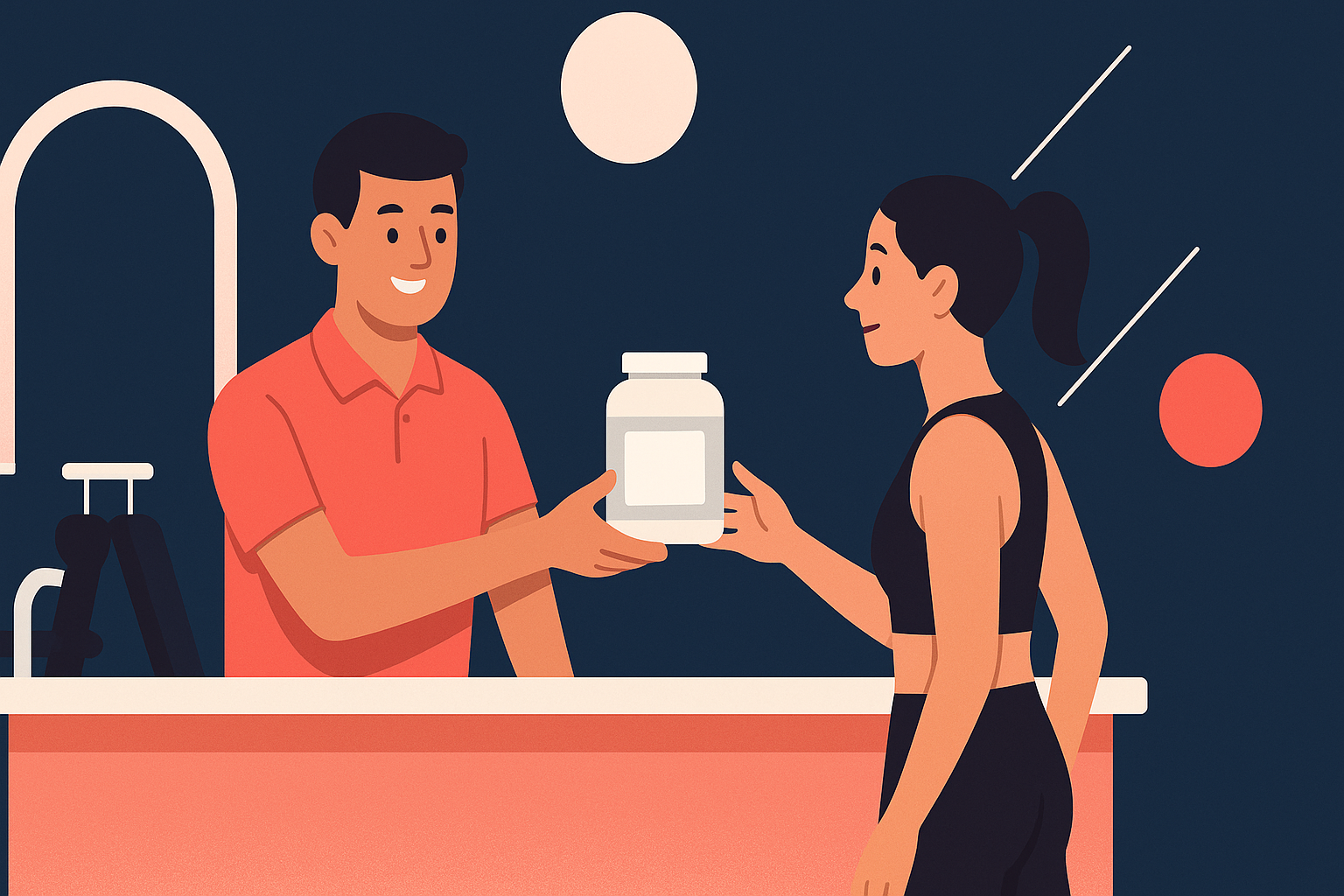
Front desk supplement upselling is a short consultative recommendation made at check-in, checkout, or a goal review. The desk sees every member twice per visit, making it the highest-traffic retail point in the gym. Done well, it is a coaching conversation, not a pitch.
Desk staff already know who showed up and whose goal review is due. That context turns a one-line suggestion into a useful one. The member says yes at the desk, and Rocktomic ships the product under your label. That is how Rocktomic works.
Why the Front Desk Is Your Highest-Traffic Retail Channel
Your rent buys foot traffic. Every check-in, every membership scan, every shake handed across the counter is a shopper you already paid to bring through the door. And every one of those visits includes at least one pass by the desk. Most gym owners pay for that traffic monthly, then spend again on ads to chase people who are not even in the building. The front desk flips the logic: it monetizes the people already inside.
The market context lines up in your favor. Here are the numbers and the sources, dated:
| Metric | Number | Source |
|---|---|---|
| U.S. supplement sales, 2025 | $68.74 billion | Grand View Research, Dec 26 2025 |
| Offline share of U.S. sales | 77.1% | Grand View Research, Dec 26 2025 |
| Annual growth in the gym channel | 6-7% since at least 2019 | New Hope Network, May 1 2025 |
| Upselling contribution to revenue | 21% average; 91% of salespeople use it | HubSpot Sales Blog, updated Feb 24 2026 |
| Global market projection by 2033 | $414.5 billion, 8.9% CAGR | Grand View Research via PR Newswire, 2025 |
Read that table as a retail thesis. Offline channels still win, which means physical counters move product. The gym channel is compounding while most retail foot traffic is flat. Upselling is standard practice, not pressure-selling. And the global category keeps expanding. Every number points the same direction: buyers walk past your front desk every single day, and they are already spending money on supplements somewhere. Gyms that treat the counter as retail real estate capture spend that would otherwise go to grocery stores, big-box retailers, and online shops.
Now drop the ad-spend framing entirely. The desk is a zero-ad retail channel. It runs during every staffed hour, it is operated by people you already pay, and it sits directly in the path of every member. A display within arm’s reach of the register turns a check-in into a sale with no acquisition cost. Rent bought that foot traffic. You might as well collect on it.
The margin difference is the point
Resell a national brand and you keep a thin wholesale spread while the manufacturer owns the brand, the price, and the loyalty. Build your own line of private label supplements for gym owners and the full retail margin lands in your P&L. Same counter, same traffic, completely different economics. This is not a new channel. It is finally collecting the margin on traffic you already rent.
What Are the Three Sales Moments That Actually Convert?
Timing beats pitch. Your front desk staff can know every product in the case and still lose the sale if they talk at the wrong second. The desk converts at three moments. Each one needs a different opening line and a different product type.
Moment 1: Check-In
Member walks in. Staff scans them in. That is a 10-second window, not a lecture. Ask one question tied to the goal for that session: “Training for anything this month?” If they answer yes, or even hesitate, you have a reason to talk pre-workout before they hit the floor.
Moment 2: Checkout
The workout is done. Energy is up, confidence is up, and the member is already standing at the desk. Match one product to the session they just finished and keep it a small first purchase. A single-serve or travel size near the register makes that easy. Recovery products fit this moment best.
Moment 3: Milestone
Thirty days in, or at the goal review, the front desk should not be the one selling. A coach or manager hands the recommendation off. That authority changes the conversation. Protein and creatine carry a milestone conversation because they tie to measurable progress, not a single workout.
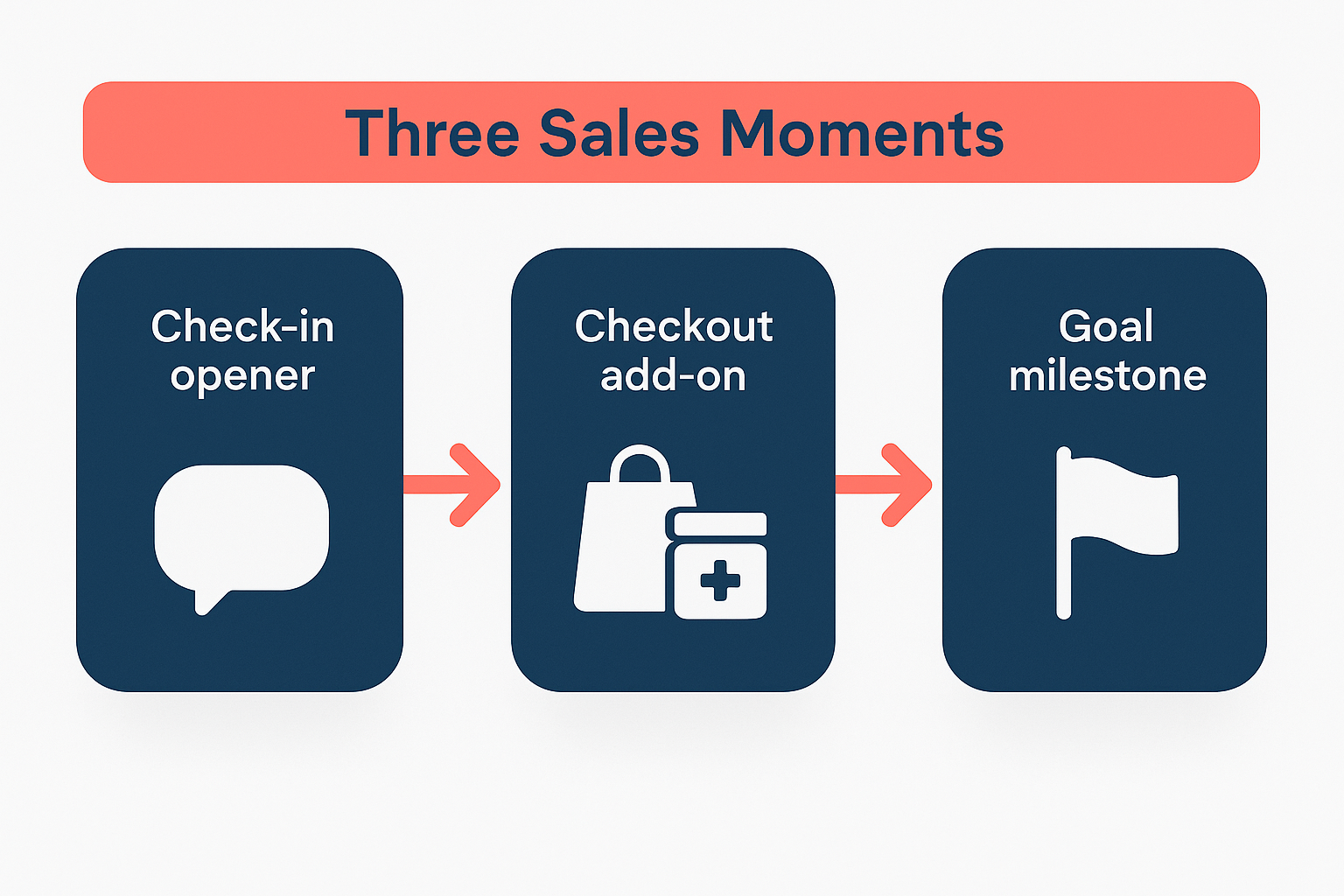
| Sales moment | Sample opening line | Product type that fits |
|---|---|---|
| Check-in | “Training for anything this month?” | Pre-workout |
| Checkout | One product matched to the session just finished | Recovery |
| Milestone | 30-day or goal-review handoff from coach or manager | Protein or creatine |
Notice what none of these moments share: a pitch. They share timing. Once the moment passes, a recommendation sounds like pressure instead of help. Train staff to spot the moment, open with one line, and let the product sit where the member can see it. The desk layout has to do its part too – merchandising your supplements for maximum sales is what makes the checkout moment physically possible. And if you want that spend to stay in your building, the same staff needs to keep member supplement spend inside your gym.
Scripts That Sound Like Coaching, Not Selling
The best supplement conversation at your front desk starts with a question, not a pitch. “What are you training for this month?” gets a real answer. “How did your recovery feel after the last session?” gets another. Both sound like coaching, because they are.
A question invites the member to talk about their own training. A pitch invites them to tune out. Staff who open with a question read the room before they recommend anything.
Two questions before any recommendation
Staff ask two things before they recommend anything. First: what is the member training for? A strength goal, a sport season, a first 5K, a comeback after time off. Second: how did the last session or the recovery feel?
The answers decide the one product matched to the stated goal. One product, not three. A member chasing a PR gets a different recommendation than one fighting soreness.
The compliant phrasing rule
Every recommendation stays attached to the member’s stated goal. Describe how the product fits that goal. Never promise an outcome. “This is made to support recovery after heavy sessions” is coaching. “This will fix your soreness” is a promise you cannot keep, and a promise like that can get a gym into trouble.
The full say-versus-never-say table comes later in this guide. For now, one rule covers every conversation: match the goal, skip the guarantee.
Objection handling: four one-liners
Objections are checkpoints, not refusals. The member is still deciding, and the staff member’s tone decides whether the conversation stays open. Staff give one honest response, then hand off. Here is the full four-row playbook.
| Objection | One-line honest response | Handoff move |
|---|---|---|
| “Too expensive” | “That price is fair. The single-serve size is a low-risk way to start.” | Hand over a sample. |
| “Already use a brand” | “Respect the loyalty. This label is tested with a Certificate of Analysis on every batch. Compare the two.” | Hand over the label. |
| “Not sure it works” | “It fits the goal you named, and I won’t promise more than that. Judge it yourself.” | Hand over a sample or label. |
| “Need to ask my coach” | “Good call. Ask, and bring it up at your next session.” | Refer to the coach by name. |
The handoff matters as much as the line. A sample or a label puts something physical in the member’s hand and keeps the door open without asking for a yes.
The rule: one response, then handoff
One honest response, then handoff. That is the whole system. If the member still says no, staff say “No problem, see you next session” and move on. No closing pressure, no “are you sure”, no discount theater. The front desk that sounds like a coach outsells the front desk that sounds like a salesperson. Members notice the difference and come back.
The 30-Day Training Cadence for Desk Staff
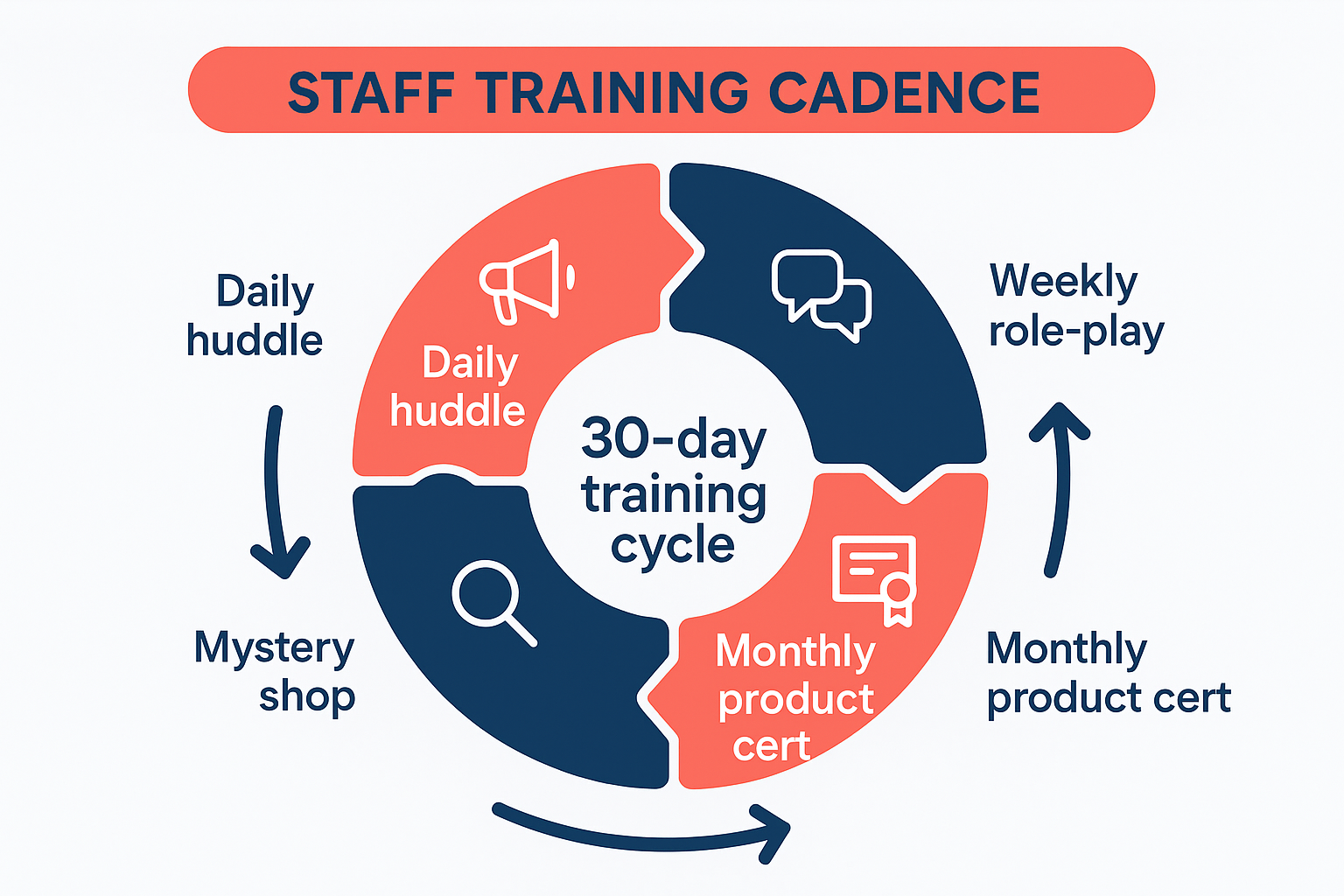
Training is a repeating 30-day cycle, not a one-time onboarding. Hand a new hire a binder and you get a staff member who rattles off a memorized pitch, then freezes when a member pushes back. Run the cycle and you get a desk that sells your private label supplements on its own.
The cadence: daily huddles, weekly role-play, monthly certification, quarterly mystery shops. Each piece reinforces the last. None takes more than 20 minutes.
The 10-Minute Daily Huddle
Every day before the doors open, gather the desk staff for 10 minutes. Cover one product per week. Five shifts on a single SKU, and by Friday the whole team knows it cold.
Hit three things per product: ingredients, timing (before or after training), and the one member goal it matches. That last part matters most. A member who wants more energy doesn’t care about a proprietary blend; they care that this product pairs with their 6 a.m. workout. One product, one goal, one week. Repeat.
The 20-Minute Weekly Role-Play
Run a 20-minute role-play once a week. Drill the objection table from Part 5 live. You play the member, your staff plays the closer, then you swap. The goal is not reciting a script. It is hearing the objection, pausing, and answering without losing the sale.
Role-play is where hesitation dies. Staff who fumble in front of you on Tuesday will not fumble in front of a member on Saturday.
Monthly Product Certification
Run a product certification quiz once a month. Pass it, and the staff member earns selling privileges for the new SKU. Fail it, and no selling until they retake and pass. That gate keeps product knowledge honest and makes the quiz mean something.
The Quarterly Mystery Shop
Every quarter, send someone in to shop your own front desk. Score them against the scripts. Did they ask the opening question? Did they recommend a product? Did they close?
Mystery shops show what the huddles and role-plays actually produced. If the score dips, the cycle slipped. Tighten it back up.
The Benchmark That Separates This From Generic Sales Training
Here’s the benchmark: staff who can explain what a product contains and when to take it outsell staff who memorize a pitch. Generic sales training teaches talking points. This cycle teaches understanding. A memorized pitch breaks the moment a member asks a question. Understanding survives the question, and the sale follows.
That is the differentiator. Any gym can hand staff a script. The 30-day cycle turns a front desk into a sales machine that keeps producing month after month.
How Do You Pay Commission Without Eroding Your Margin?
Lock the numbers first. One SKU: Pre-Workout Fruit Punch (ROC605). It retails at $39.97. On the Scale plan, wholesale cost is $12.64 per bottle. That leaves a gross margin of $27.33, or 68.4% per bottle. Hold those figures. Every commission decision below starts from them, and they stay fixed no matter how many units you move.
| Retail price | Scale wholesale cost | Gross margin per bottle | Margin % |
|---|---|---|---|
| $39.97 | $12.64 | $27.33 | 68.4% |
A One-Sale-a-Day Target
Hand your front desk one number to hit: one bottle a day. That is 30 bottles per month. Multiply 30 by the $27.33 margin and you get $819.90 in gross margin per month from a single SKU. No online store, no ad spend, no second product. Just one transaction a day at the desk.
That $819.90 is the pool you pay commission from. The margin is the starting point. What reaches your account depends entirely on the payout structure you set, which means the person who designs that structure is the one who keeps the difference. Show the front desk this math once, and the conversation stops being about abstract percentages and starts being about real dollars per bottle.
Two Commission Scenarios, One Owner Decision
A $5 per-unit commission leaves $22.33 per bottle. A $7 per-unit commission leaves $20.33. Both numbers pay your staff a clean, explainable amount, and both keep you far above your cost of goods. Pick the one that fits your labor budget, then stick to it.
The structure is your choice, never a Rocktomic price. Rocktomic manufactures, warehouses, and labels. You own the brand, the customer, and the commission plan. Staff sell harder when the payout is simple enough to repeat to a coworker, and both scenarios pass that test.
Set the commission before you run the training. Change it later and you are renegotiating with your own staff mid-season, which is the one conversation you never want to have.
Order models stay simple: dropship orders carry a flat fulfillment fee of about $2 per item, and bulk uses a 24-unit minimum per SKU. The flat fee keeps the math predictable at any order volume.
Model Your Own SKUs Before Training Starts
Run every product through the same math before you put a script in front of staff. Use the supplement margin calculator to test your own prices, and review how wholesale and retail pricing interact in the guide to wholesale vs retail supplement pricing.
You can start on the Free plan at $0 per month and add on-demand fulfillment with no inventory, then move to Scale at $297 per month when you want the lower wholesale cost behind margins like these. Full details are on the Rocktomic membership pricing page.
What Can Desk Staff Actually Say About Supplements?
The rule fits in one sentence: staff can talk about what a supplement does to support normal body function, and they cannot talk about diagnosing, treating, curing, or preventing anything. That is the line between structure/function phrasing and a disease claim, and it comes straight from the DSHEA and the FTC.
Structure/function language is permitted: “supports muscle recovery,” “supports strength and power output.” Disease claims are never permitted: treats, cures, prevents, heals, reverses. Guaranteed outcomes are never permitted. And no staff member, under any circumstance, compares a product to a prescription drug. A single violation on a recorded call, a social clip, or a member text is how brands draw regulatory scrutiny.
Compliant phrasing still sells. Members trust a front desk that sounds like a coach instead of a late-night infomercial, and the products still get sold. The guardrails do not slow down the pitch; they make it sound credible.
The Say / Never Say Table
Print this table, put it by the register, and run it in every new-hire training session.
| Say this | Never say this |
|---|---|
| This pre-workout contains caffeine and beta-alanine, and it is timed for before training. | This will cure your injury. |
| This protein supports muscle recovery after a session. | It prevents [disease]. |
| This creatine supports strength and power output in training. | You are guaranteed to gain X pounds. |
| Every batch is tested and has a Certificate of Analysis you can review. | It works like a prescription drug. |
The Certificate of Analysis Is Your Trust Tool
When a skeptical member pushes back, do not argue. Hand them the proof. Rocktomic manufactures in US GMP-certified facilities and provides a Certificate of Analysis on every batch. Your staff can show a member exactly what is in the product, what was tested, and what came back clean. That document settles more objections than any scripted comeback.
Train your team to present the COA as a standard part of the sale, not a defensive afterthought. The Rocktomic quality and COA page explains the testing process in full. Forward it to any member who asks how a product is verified, and let the paperwork do the closing.
What Should You Stock at the Front Desk?
The training is half the machine. The shelf is the other half. You can script every word your front desk staff says, but if the product in front of the member does not convert on impulse, the pitch dies at the counter. The right shelf starts selling before your staff opens their mouth.
Stock what converts. That means four proven SKUs to start, priced so your staff can close without doing math in their heads.
The Four-SKU Starter Shelf
| Product (SKU) | MSRP | Scale wholesale | Gross margin per unit | Margin % |
|---|---|---|---|---|
| Pre-Workout Fruit Punch (ROC605) | $39.97 | $12.64 | $27.33 | 68.4% |
| Super Creatine Gummies 1000mg (ROC943) | $29.97 | $8.45 | $21.52 | 71.8% |
| Protein Whey 2lb Chocolate (ROC607) | $59.97 | $27.25 | $32.72 | 54.6% |
| BCAA Fruit Punch (ROC603) | $34.97 | $15.36 | $19.61 | 56.1% |
Every unit in that table clears a 54% gross margin, and the two lowest wholesale prices carry the two highest margin percentages. That is the mix you want on a front desk shelf: numbers your staff can quote from memory and margin that makes the square footage pay.
Stock in Impulse Order
Category order matters as much as the product mix. First shelf position goes to pre-workout. It is the highest-impulse category you sell. A member just finished a hard session and is already thinking about the next one, and there it is at eye level.
Second position goes to recovery: the BCAA and the creatine gummies. Third, the everyday staple: whey protein. It will not fly off the shelf as fast, but it is the reorder item that keeps the shelf from looking stale and gives returning members a reason to look.
Keep single-serve sizes near the check-in point so members grab one while they swipe their key fob. That is a small play that adds up, and it is covered in depth in Part 4.
For the full menu of products that earn their shelf space, see the top high-margin supplements to sell on your shelves.
KPIs to Track
What gets measured gets managed. Review three numbers every week. Not twenty. Three numbers that tell you if the front desk sales machine is actually selling.
Attach Rate
Retail units per 100 check-ins. Math: (retail units sold / check-ins) x 100. If the front desk sells 6 bottles and you log 300 check-ins, that is 2 units per 100. Low attach rate means staff are not asking.
Upsell Conversion
Recommendations made vs bottles sold. Math: bottles sold / recommendations made. If staff recommend 10 times and sell 5, conversion is 50%. This number exposes who is closing and who is just going through the motion.
Retail Revenue Per Member Per Month
Math: total retail revenue / active members. This is the revenue number that matters for the business, not just the counter.
| Metric | Formula | Weekly target suggestion |
|---|---|---|
| Attach rate | (retail units / check-ins) x 100 | Owner-set starting point, e.g., 2-3 units per 100 check-ins |
| Upsell conversion | Bottles sold vs recommendations made | Owner-set starting point, e.g., 50% of recommendations become a sale |
| Retail revenue per member per month | Total retail revenue / active members | Owner-set starting point in dollars |
Every target in that table is owner-set. No industry body sets the right attach rate for your floor. Pick a starting point, review it weekly, and raise it when the number stops moving.
One move turns tracking into growth: bundling supplement subscriptions with monthly dues converts one-off sales into recurring revenue.
FAQ: Front Desk Supplement Upselling
What is front desk supplement upselling?
Front desk supplement upselling is a short, consultative recommendation a staff member makes during check-in, checkout, or a goal review. The desk sees every member twice per visit, which makes it the highest-traffic retail point in a gym. Done well, it is a coaching conversation, not a sales pitch: the staff member matches one product to the member’s stated goal. Done consistently, it turns retail into recurring revenue without ads or extra foot traffic.
How do you train front desk staff to sell supplements?
Gyms train front desk staff in a repeating 30-day cycle: a ten-minute daily huddle on the product of the week, a twenty-minute weekly role-play with live objection drills, a monthly product certification quiz, and a quarterly mystery shop. Product knowledge comes first, scripts second, and closing pressure never. Staff who can explain what a pre-workout contains and when to take it will outsell staff who memorize a pitch.
What should gym staff say when recommending supplements?
The best gym scripts open with a question, not a pitch. Examples: ‘What are you training for this month?’ and ‘How did your recovery feel after the last session?’ The staff member then matches one product to the answer, names the timing (before or after training), and hands over a label or a sample. Objections get one honest response and a handoff to a coach, never pressure.
What supplements sell best at a gym front desk?
Pre-workout is the highest-impulse category, followed by protein powder, creatine, and recovery products such as BCAAs and electrolytes. Single-serve sizes near the check-in point convert best for first-time buyers. Gyms that carry private label versions keep the full retail margin instead of reselling a national brand at a thin spread.
What can gym staff legally say about supplements?
Desk staff can describe how a product fits a training goal using structure/function language, such as ‘supports muscle recovery’ or ‘supports energy for training.’ They cannot claim a product treats, cures, or prevents any disease, and they cannot promise guaranteed outcomes. A Certificate of Analysis, which Rocktomic provides on every batch, is the safest trust tool a staff member can point to.
How much revenue can supplement upselling add to a gym?
One worked example: a pre-workout with an MSRP of $39.97 has a Scale plan wholesale cost of $12.64 (SKU ROC605), leaving $27.33 in gross margin per bottle at 68.4%. If the front desk sells one bottle per day, that is roughly 30 bottles a month and about $819.90 in gross margin on a single SKU before commission.
How should gym owners pay staff for supplement sales?
Most gyms pay a flat commission per unit so staff can track their own earnings. Using the same $27.33 margin example, a $5 per-unit commission still leaves $22.33 per bottle for the gym. The Scale plan at $297 per month covers the lowest wholesale pricing, and on-demand dropship orders carry a flat fee of about $2 per item, so owners pay only when a sale ships.
What does it cost to launch a private label supplement line at a gym?
Gyms can start on the Free plan at $0 per month and pay a flat fulfillment fee of about $2 per item when a dropship order ships. The Scale plan at $297 per month includes the lowest per-unit wholesale pricing and the full 140-plus product catalog. Bulk orders use a 24-unit minimum per SKU, and optional done-for-you launch packages start at $497 one-time.
Train the Desk, Own the Margin: Start Your Branded Line
All that training pays off only when the margin is real. Sell someone else’s wholesale bottles and you keep a thin spread. Stock your own private label line and you keep the full retail margin on every sale.
Rocktomic starts that branded line with zero inventory risk. Dropship or bulk, whichever matches your gym’s traffic. The Free plan costs $0/month. The Scale plan costs $297/month for the full catalog at the lowest per-unit wholesale pricing.
Compare the Free and Scale plans side by side, then book a call with Rocktomic to map a bulk or dropship program to your gym’s traffic.