
Native Checkout vs Owned Website: The Million-Dollar Supplement Debate
· 19 min read · By Rocktomic Labs Team
Meta has already decided this debate. It began phasing out native checkout on Facebook and Instagram Shops in June 2025, and most shops now send buyers to a website to complete payment (BigCommerce, July 30, 2025). For supplement brands, the owned website is the checkout standard; Meta Shops stays the discovery layer. This guide compares fees, data, and customer lifetime value. Brands that keep Meta for tagging and use their own storefront for checkout capture the email, the retargeting pool, and the repeat orders.
What Is Native Checkout vs an Owned Website?
Native checkout lets a customer pay inside Facebook or Instagram without leaving the app, with Commerce Manager acting as the payment processor. An owned website, such as a Shopify storefront, routes the same customer to the brand’s own domain for checkout. The two differ in who captures the customer: native checkout returns a payout and transaction data to the platform, while owned checkout returns the email, the click history, and the buyer relationship to the brand. That ownership gap is the entire debate.
Model your monthly revenue, repeat rate, and net profit as your supplement brand scales – using real catalog costs and fees.
Three comparison lenses decide the choice: platform fees and the real numbers (Part 5), the owned-website data case (Part 4), and customer lifetime value (Part 6).
What Changed: Meta’s Native Checkout Timeline
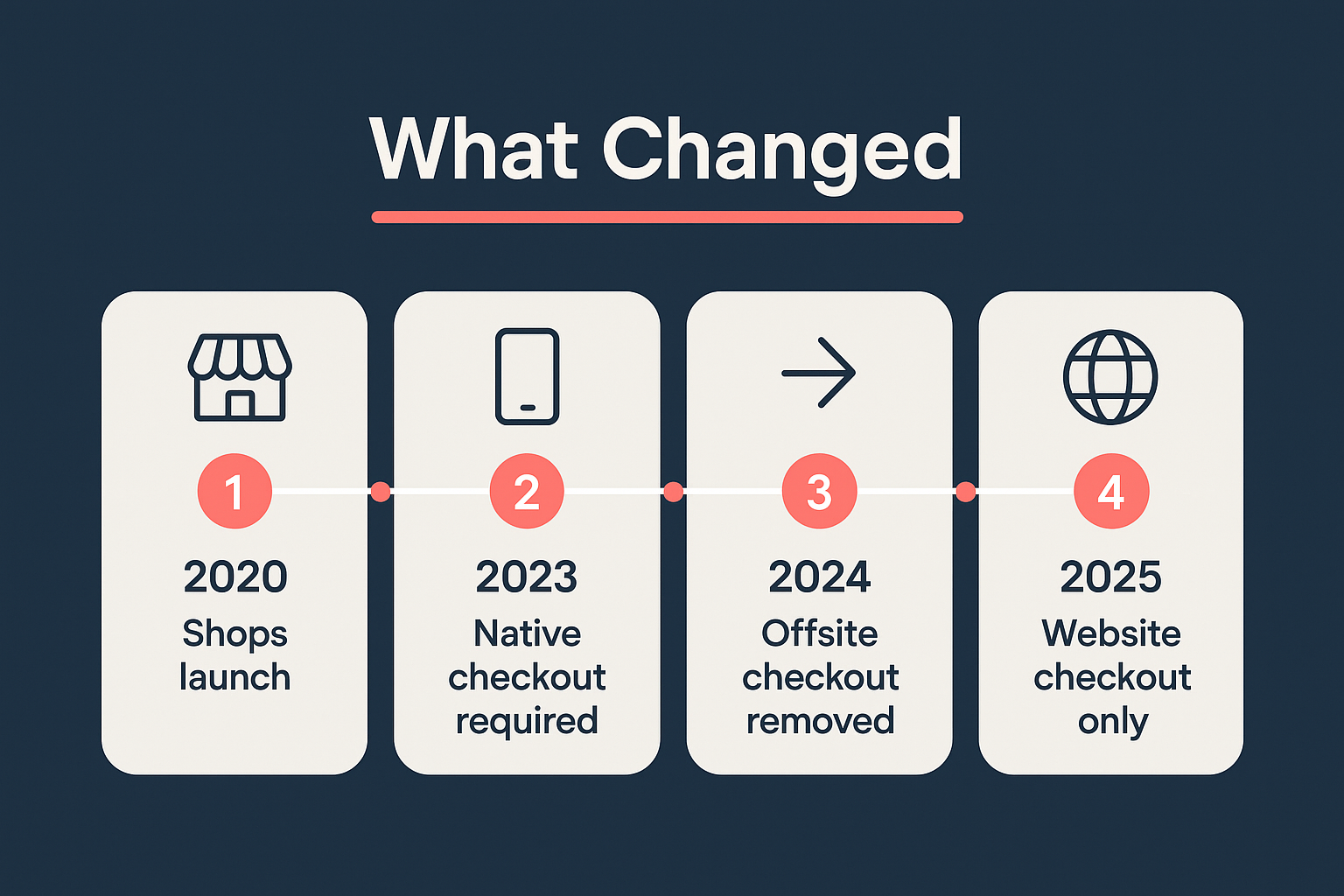
Meta’s in-app commerce experiment has been wound down in stages, and the timeline below is the factual record of that retreat.
| Date | Change | Source |
|---|---|---|
| May 2020 | Facebook Shops launches; in-app commerce experiment begins | PPC Land (June 29, 2025) |
| June 5, 2023 | New US shops onboarded through Commerce Manager or Shopify must enable native checkout | Retail TouchPoints (April 27, 2023) |
| June 30, 2023 | Selling-fee waiver ends | Value Added Resource (May 1, 2023) |
| April 24, 2024 | Shops without native checkout become inaccessible | Sell Online help centre (April 18, 2024) |
| June 5, 2025 | Phase-out begins | Feedonomics (July 8, 2025) |
| By end of August 2025 | Most shops moved to website checkout | BigCommerce (July 30, 2025) |
| September 4, 2025 | Native checkout discontinued | Feedonomics (July 8, 2025) |
Why Meta Made the Shift
Read the dates in order and the strategy is clear. Meta tested, then forced, then retired native checkout. Every step moved sellers closer to their own websites and further from Meta’s payment rails.
The arc spans five years. Facebook Shops arrived in May 2020 as a way for brands to sell directly inside the app. By June 2023, Meta forced new US shops to enable native checkout. By September 2025, the feature was gone.
The reason is a business-model change, not a product failure. Meta shifted from taking a cut of transactions to selling ads that route buyers to merchant websites. In-app conversion data stayed locked in the platform, and the model did not scale (GoDataFeed, 2025).
For a supplement brand, the timeline answers a practical question. Native checkout was a rental, not an asset. Meta held the checkout flow, the payment data, and the buyer relationship. When native checkout was discontinued on September 4, 2025, brands built on it had to rebuild their purchase path on their own domains. The ones with an owned website simply switched the traffic destination.
The brands that moved early kept the customer file and the reorder channel. That’s the difference between renting an audience and owning one.
The Case for Native Checkout: Friction That Sold
Native checkout had real selling points while it existed. The model was not wrong about friction. It was wrong about ownership. The in-app buy button solved a genuine problem: the gap between seeing a product and paying for it. Every extra step in that gap is a sale lost to a notification, a text, or a cat video. Put payment where the impulse happens, and more impulses become orders.
What native checkout got right
- Fewer steps between impulse and payment. A follower taps a post, taps a product tag, and pays inside the app. No site to load, no login to remember, no card re-entry on a mobile keyboard.
- No domain exit. The buyer never leaves the platform, so the platform never loses the session, and you never lose the sale to a slow load time or a forgotten password.
- In-app trust. Platform-native checkout carries the platform’s payment reputation. That matters for cold traffic that does not know your brand yet.
- Shoppable posts. Product tags turned every post into a storefront. Organic content became a sales channel by default.
The market behind the model
The market context was real. The US social commerce market was valued at $89.11 billion in 2022 and is forecast to grow at a 29.2% compound annual growth rate to $659.41 billion by 2030, according to Grand View Research (2023). Facebook and Instagram remain the two largest US social commerce platforms (Oberlo, 2024). The demand was there. The behavior was there.
What native checkout never gave you
What native checkout did not give you matters more. No customer email. No list to retarget. No pixel events on the transaction itself, which means you could not measure what actually produced revenue. And a processing fee sat on every order, quietly taxing the margin you were trying to build. The platform owned the buyer data, the remarketing list, and the relationship.
Native checkout shortened the path to a single sale and lengthened the path to a brand. The first sale is a transaction. The email list is the business. That distinction is the whole debate.
The Case for the Owned Website: Data, Fees, and LTV
The platform now requires website checkout. That settles the debate before it starts: you operate an owned storefront, or you do not sell there at all. The mandate is not a burden. Treat it as a forcing function, because the payoff is in what the owned site hands back to you.
The six structural advantages of owning your storefront
First-party data is the entire game. Every sale completed on a hosted checkout builds the audience of the platform, not yours. The owned storefront flips that ownership back to your brand.
- Email capture at checkout. The checkout collects a verified email address with consent. That contact is yours to message after the sale, across campaigns, launches, and follow-ups.
- Full-funnel pixel data for Meta retargeting. Your Meta pixel records every visit, add-to-cart, and purchase event. Those signals build retargeting audiences that convert, because they saw your product on your page, not a marketplace thumbnail.
- Subscriptions and bundles that raise average order value. A subscribe-and-save toggle at checkout or a greens-plus-shaker bundle changes the per-order math. A hosted checkout serves its own suggested items instead, and takes the margin with it.
- Search traffic and SEO. Product pages, comparison posts, and customer reviews compound over months. A year from now, a query like “best pre-workout for [your niche]” can land on your domain rather than a listing page you do not control.
- Brand control over pricing and page experience. You set the price, the offer sequencing, and the upsell flow. No algorithm will display a cheaper alternative directly beside your checkout button.
- Trust assets on your own terms. Your Certificate of Analysis, label disclosures, and FTC-compliant claim language live on pages you own and update. With Rocktomic, every batch ships with its own COA, and the owned site is where that proof belongs.
Read the Shopify supplement store conversion benchmarks before you design the checkout flow. The numbers show what a properly built supplement storefront achieves when the page experience is yours to control.
Where the hosted checkout gives ground
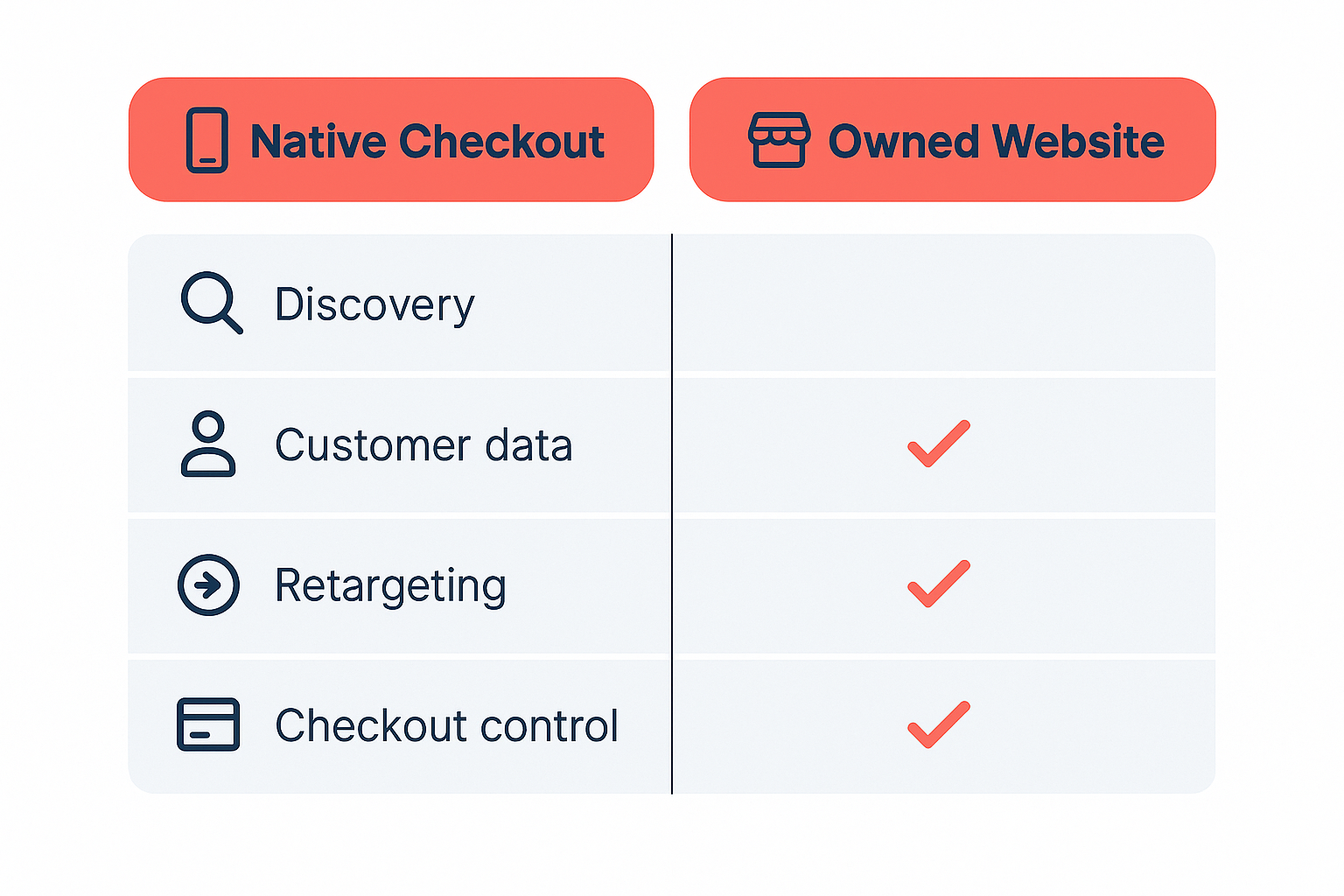
Feature by feature, the in-app model loses. Run the same checklist against any hosted storefront and the gaps show up fast.
- Email ownership: the platform keeps the buyer’s email address. You rent access to it through campaign tools.
- Pixel events: you receive sales reports, not full-funnel behavioral events that feed retargeting.
- Repeat-purchase tools: no real subscription engine, no bundle logic, no post-purchase upsell at the hosted checkout.
- Brand control: the platform sets the layout and can surface competing products at the exact moment of purchase.
None of this is free. The owned store carries subscription and processing costs, and Part 5 prices those out. Count it as a business expense with data attached, not a sunk cost. Every advantage listed above feeds directly into the lifetime value math, which Part 6 walks through.
Platform Fees Compared: The Real Numbers
Fee schedules are where checkout decisions go to hide. Headline rates get the attention while fixed cents, gateway surcharges, and monthly subscriptions quietly rewrite your margin. This table puts both checkout paths side by side, source attached, so nothing sits in a footnote.
Treat each column as part of a stack. Percentage, fixed fee, subscription, and fulfillment all hit the same order. Comparing only the headline rate misses most of the cost.
| Channel | Fee type | Cost | Source |
|---|---|---|---|
| Meta native checkout | Card processing | ~2.9% of transaction | Meta Business Help; LitCommerce (May 2026) |
| Meta native checkout | PayPal | ~3.49% | Send It Rising (August 2023) |
| Shopify entry plan | Subscription | about $29-$39 per month depending on billing | Shopify pricing page; Taxomate (March 2026) |
| Shopify entry plan (Shopify Payments) | Online card rate | 2.9% + $0.30 | Taxomate (March 2026); Eightx (June 2026) |
| Shopify entry plan (third-party gateway) | Surcharge | +2% per transaction | Merchant Insiders (March 2026) |
| Rocktomic dropship fulfillment | Pick, pack, label | flat about $2 per item | Rocktomic fulfillment page |
The monthly subscription is the cost people forget. Shopify’s entry plan runs about $29-$39 per month depending on billing, which means it starts charging before the first order ships. The per-order math is what separates the two checkout paths, and the subscription pays for the infrastructure underneath.
The $39.97 worked example
Lock the comparison to one SKU so both channels face the same test. A $39.97 order of Pre-Workout (Fruit Punch, ROC605) gives the math a fixed anchor.
Shopify’s entry plan with Shopify Payments charges an online card rate of 2.9% plus $0.30. That is $1.16 in percentage fees and $0.30 in fixed fees, or $1.46 per order. Meta native checkout, when active, runs a flat 2.9%. The same $39.97 order costs $1.16, with no fixed fee on top.
| Checkout path | Fee math | Total card cost |
|---|---|---|
| Shopify entry plan (Shopify Payments) | 2.9% of $39.97 = $1.16, plus $0.30 | $1.46 per order |
| Meta native checkout | flat 2.9% of $39.97 | $1.16 per order |
| Shopify entry plan (third-party gateway) | 2% surcharge on $39.97 = about $0.80 extra | near $2.26 before processor fee |
Add a third-party gateway on Shopify’s entry plan and the stack grows. The 2% surcharge adds about $0.80, pushing the total near $2.26 before the processor’s own fee. The gateway’s own processing charge lands on top of that, so the real number usually runs higher, not lower. Compare that stack against Meta’s flat $1.16 on the same order.
Two figures stay with you for the rest of this article: $1.46 and $1.16. The FAQ repeats them verbatim, so every later comparison uses the same locked math instead of a fresh estimate.
What the fees mean for your margin
Your catalog will not stay inside one worked example. Prices shift, and custom formulas carry their own costs. Feed your actual numbers into the supplement margin calculator before you pick a channel.
Then stack every fee this section covered: the subscription, the card rate, the gateway surcharge, and the flat about $2 per item on-demand fulfillment fee. On Rocktomic, a Free membership costs $0 per month and Scale runs $297 per month with the lowest per-unit wholesale pricing. Membership cost is another line in the same math.
If Meta Shops is your primary storefront, the Instagram checkout fees exposed breakdown covers the fees this table leaves out.
Why Does Lifetime Value Decide the Debate?
Lifetime value is the number that settles the native checkout versus owned website argument. LTV is not first-order revenue. It is the total gross profit a single customer produces across every order they place with your brand.
A first sale is mostly a customer acquisition cost recovery event. The profit lives in the second, third, and twelfth order. That distinction rewrites the money mechanics of each checkout.
Native checkout pays you once, then makes you pay again
Native checkout returned a payout. One sale, one payout. The buyer’s email stayed on the platform, and the pixel event stayed there too. To sell to that same person again, you had to spend again: new ad spend, new creative, a new auction.
Every repeat order started from zero. That stacks your full customer acquisition cost onto every single order instead of spreading it across the customer’s lifetime.
An owned checkout changes the sequence. It captures the email and the pixel event at the point of sale, which enables post-purchase flows, win-back offers, and subscription programs. Now one order starts a relationship instead of ending a transaction.
You can reach the buyer at day 7, day 21, and day 45 without paying the platform a second time for the introduction.
The 3:1 rule gives you the target
That is where the 3:1 LTV-to-CAC rule comes in. It is the floor for a healthy brand, not a stretch goal. The rule says a customer’s lifetime value should be at least three times what you spend to acquire them.
Hit that ratio and the brand funds its own growth. Miss it and each new order only covers the cost of finding the buyer again.
Subscription revenue is where supplement brands compound margin. A monthly subscription repeats the sale without repeating the acquisition cost. The ratio improves with every fulfilled cycle, cash flow becomes predictable, and the brand itself becomes worth more. That compounding is the structural reason the owned site wins the debate: native checkout optimizes for one transaction, and an owned checkout optimizes for the customer’s whole buying life.
Meta Shops vs Shopify Store: What Does the Setup Actually Require?
Setup friction decides which storefront you actually launch. Meta Shops looks like a one-click win until you hit the catalog requirements; Shopify looks like an admin maze until you realize it replaces three tools you’d otherwise run by hand. Both are doable in a weekend. Neither runs itself.
Meta Shops setup requirements
Meta’s help center lists four baseline requirements: an active business page, a product catalog, a checkout method, and a catalog sync. The list is short. The devil is in the details.
| Requirement | Detail |
|---|---|
| Active business page | Required to run Shops |
| Product catalog in Commerce Manager | Catalog must be created or synced |
| Checkout method | Website checkout, required after the 2025 phase-out |
| Catalog sync from the store | Keeps inventory and pricing current |
The checkout row is the one that changes your build. On-app checkout is being phased out, so a website storefront is no longer optional for Meta Shops. You end up building a store either way. The real question is whether that store also feeds your social channels.
Once the requirements are in place, the live setup takes three steps:
- Connect your catalog in Commerce Manager.
- Set checkout to your website.
- Tag products in posts.
That third step is the business. Tagged posts turn content you already publish into product pages, no ad spend required.
Shopify store setup requirements
Shopify’s help center sets a similar floor: a plan, a payment processor, a domain, and a theme. Four decisions before your first product goes live.
| Requirement | Detail |
|---|---|
| Plan subscription | Entry plan or higher |
| Payment processor | Shopify Payments avoids the third-party gateway surcharge |
| Custom domain | Required for a branded storefront |
| Theme | Choose and configure a store theme |
The plan and domain are recurring costs. The theme and payment processor are one-time configuration choices. Pick a theme once, and it becomes the visual identity of your supplement brand.
Setup flow:
- Create the store.
- Add products and payments.
- Install the Meta channel app and map the catalog.
Step three is where the two setups converge. The Meta channel app syncs your Shopify catalog into Commerce Manager, so Meta Shops stays current without extra work. One catalog, two storefronts.
If you’re choosing between storefronts, the decision that matters most for supplement sellers is Shopify vs TikTok Shop for supplements. These requirements are the entry cost. The platform choice decides where your customers actually buy.
The Hybrid Strategy That Wins in 2026
Stop picking sides. The brands that win in 2026 run two layers: Meta Shops for discovery and tagging, an owned website for checkout and data. Each layer does one job. Social drives attention where your buyers already scroll. Your domain closes the sale and keeps the records that make the business valuable.
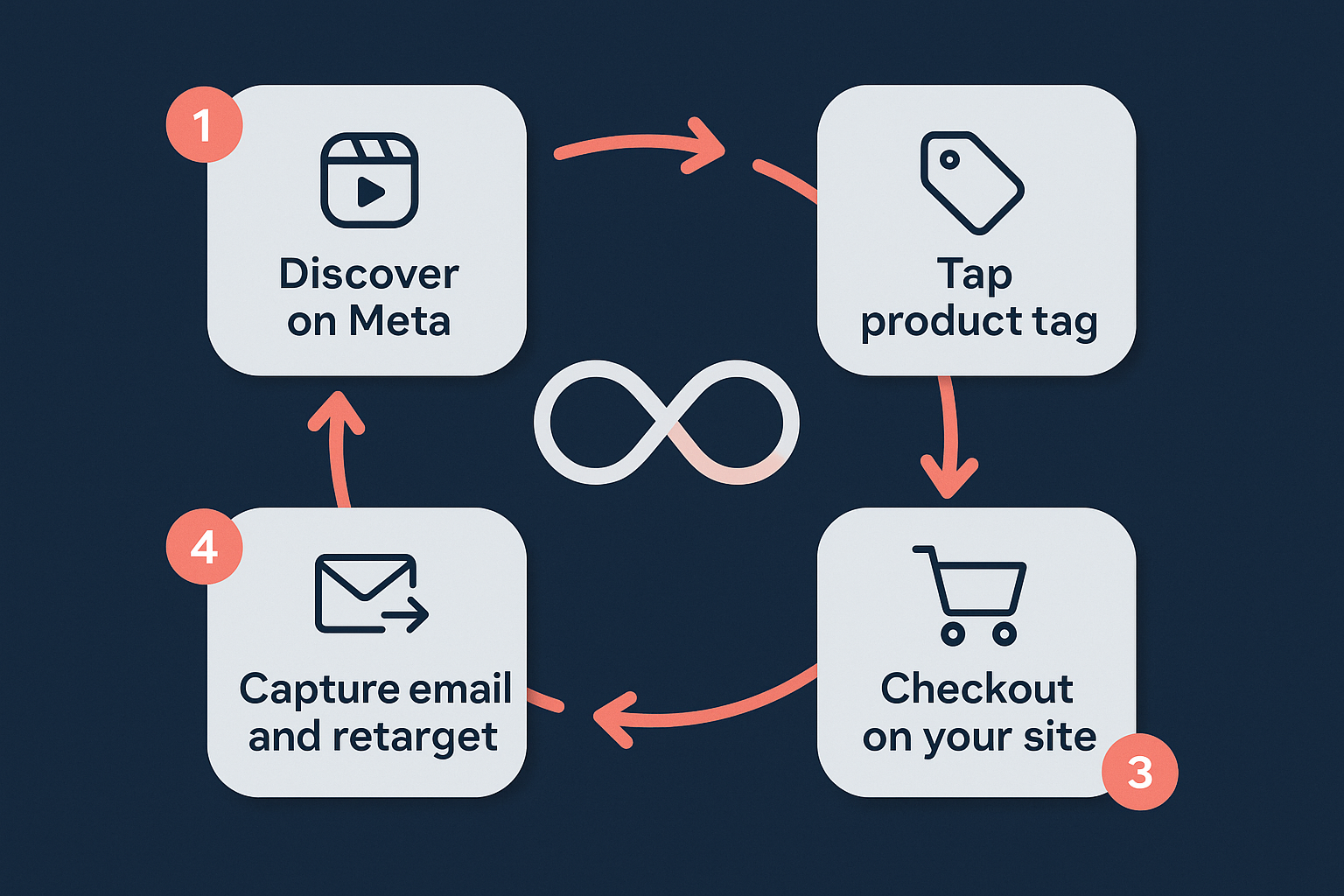
The Four-Step Loop
Run this loop on repeat. It works because every step feeds the next one.
- Publish tagged content on Facebook and Instagram. Your posts and reels carry product tags, so viewers browse your lineup without ever leaving the app.
- Buyers tap through to your store. The tag opens a product view inside Meta, but the real destination is your Shopify domain.
- Checkout happens on your domain with email capture. You collect the customer, not a one-off order, and that email list becomes a channel you fully control.
- Retarget the buyer with pixel-based ads and subscription offers. Your pixel learns from the visit. Your email list costs nothing per send and brings repeat orders.
Every cycle adds names to a list you own. Every cycle sharpens the pixel data you control. That compounding is the whole point.
Why This Survives Platform Changes
Platforms rework the rules every few quarters. Tagged shopping gets buried. Feeds get reordered. Ad costs spike without warning. That’s fine when your discovery layer can rotate to the next channel. The checkout and the customer list stay yours. A brand that only sells inside a platform rents its entire business. A hybrid brand owns the asset that matters most: the direct customer relationship.
How Rocktomic Fits
Rocktomic members own the brand and the customer relationship while Rocktomic manufactures, labels, and drop-ships on demand with zero inventory. You never front money for pallets or warehouse space. You publish tagged content, capture emails on your domain, and let Rocktomic handle the fulfillment.
The free plan costs $0 a month, so this hybrid model costs nothing to start. Store integrations connect your Shopify checkout straight to production, and the flat ~$2 per-item fulfillment fee keeps your per-order math simple. For the full playbook on selling across multiple platforms at once, read our guide to omnichannel supplement selling.
What Compliance Notes Do Supplement Sellers Need on Social Channels?
Social platforms gate health products, so your storefront copy has to pass review before it ever reaches a customer. Keep label claims at structure/function level. “Supports joint health” passes. Disease claims get flagged. It is easier to fix claims before you publish than after a platform pulls your product page.
Build these display rules into your workflow:
- Keep every product claim on owned pages and tagged posts at structure/function level. No disease language, no guaranteed outcomes.
- Follow FTC disclosure rules on tagged posts. If a post is paid or you have a material connection, say so clearly.
- Show third-party test documentation where a platform requires it. That paperwork doubles as a trust asset on your own storefront.
Every Rocktomic batch ships with a Certificate of Analysis, so your product pages can point buyers to documented quality. That makes Rocktomic quality and COA a concrete storefront trust asset, not a marketing phrase. Get the display basics right and your store stays live while you scale.
FAQ: Native Checkout vs Owned Website
What is native checkout on Facebook and Instagram Shops?
Native checkout is the in-app payment flow that lets buyers finish a purchase without leaving Facebook or Instagram. Product tags, shop tabs, and shoppable posts routed customers through Commerce Manager, where the platform collected the payment and held the transaction data. Merchants received a payout, but not the customer’s email address. That missing data capped follow-up selling. Meta began retiring native checkout in June 2025, pushing brands toward checkout on their own websites.
Is Meta phasing out native checkout?
Yes. The phase-out began in June 2025, and most shops moved to website checkout by the end of August 2025. Discovery still happens through Shops, product tags, and shoppable posts, but the transaction itself now lands on the brand’s own site. Shops connected to third-party order management systems were updated later in the rollout. The practical result is that brands need their own website checkout to capture the sale after the transition window closes.
What fees did Meta native checkout charge?
Meta native checkout charged a transaction fee of roughly 2.9% on card payments, while PayPal transactions ran about 3.49%. Shops connected to Shopify paid Shopify’s standard processing rates instead. A selling-fee waiver covered the early period and ended June 30, 2023. In-app fees now apply only during the transition window, as Meta retires the model and shops move checkout to their own websites.
What are the hidden costs of selling on your own website?
Shopify’s entry plan runs about $29 to $39 per month. Online card transactions cost 2.9% plus $0.30, and a third-party gateway adds about 2% on top. The fixed $0.30 matters more on low-priced orders, where it takes a bigger slice of each sale. Hosting, theme, app, and domain costs pile on from there. These charges are predictable, but the per-transaction fees are what quietly eat into margin.
Which builds more customer lifetime value: native checkout or an owned website?
The owned website wins because checkout is where customer data gets captured. Email opt-ins, tracking pixels, post-purchase retargeting, subscriptions, bundles, and repeat-order discounts all flow from that single transaction. Native checkout returned only a payout and capped repeat purchases, so a $39.97 order stayed a one-time sale. On an owned site, that same first order becomes a subscription stream that compounds into recurring revenue.
How much do platform fees cost on a typical supplement order?
On a $39.97 order, the Shopify entry-plan rate of 2.9% plus $0.30 equals $1.16 plus $0.30, or $1.46 total. Meta native checkout charged a flat 2.9%, or $1.16. Rocktomic members pay about $2 per item for pick, pack, and label on dropship orders.
| Fee type | Rate | Total |
|---|---|---|
| Shopify entry-plan rate | 2.9% plus $0.30 | $1.46 |
| Meta native checkout | Flat 2.9% | $1.16 |
| Rocktomic dropship fulfillment | Flat per item | About $2 |
$1.46 plus about $2 leaves most of the retail price as gross margin.
Can I sell on Instagram and Facebook without my own website?
After the 2025 phase-out, effectively no. Discovery can still happen on Instagram and Facebook, but the checkout has to live on a website the brand controls. Rocktomic’s Free plan costs $0 per month, and members pay only the flat fulfillment fee of about $2 per item when an order ships. A branded store can be live in days, with zero inventory and no minimum order to start.
What is the lowest-cost way to sell supplements across multiple channels?
The Rocktomic Scale plan costs $297 per month and includes unlimited sales channels, the full 140+ product catalog, and the lowest per-unit wholesale pricing. The Free plan supports one sales-channel integration and up to 10 white-label products at $0 per month. For brands selling across more than one platform, Scale removes per-channel limits at a flat monthly rate, which is why the lowest wholesale cost sits on that tier.
Keep Meta for Discovery, Own the Checkout
The verdict is simple: keep Meta for discovery and own the checkout. Native checkout wins on speed. It loses on ownership. Meta converts a browser into a one-time buyer; your store converts that buyer into a brand customer. Every order that lands on your own site is an email address, a repeat buyer, and a margin you control. The orders that stay on Meta are transactions you rent.
You do not have to choose sides. Use Meta for reach, use your site for revenue, and let your offers pull one into the other.
Compare Rocktomic membership pricing to see the Free $0 and Scale $297 plans, run your own order through the supplement margin calculator, or book a call with Rocktomic to map your store setup.
Own your brand. Hold zero inventory. Start at $0/month. Ship US GMP quality with a COA on every batch. Meta brings the traffic; your store keeps the value.
Last updated: June 21, 2026.