
The Ultimate Beginner’s Guide: Choosing Your First Social Commerce Platform
· 16 min read · By Rocktomic Labs Team

For a first supplement brand, TikTok Shop is the fastest path because it pairs in-app checkout with no monthly seller fee and a 6% referral fee (per the Fit Small Business review, verified October 20, 2025), while Instagram and a Shopify storefront handle brand building and repeat purchases. This guide compares the three main platform paths, shows exactly what each charges in 2026 with dated sources, and explains how a zero-inventory model removes the inventory risk that stalls most creators. The right pick comes down to one factor: where your audience already spends time.
What is a social commerce platform?
A social commerce platform is a social media app or connected storefront that lets buyers discover and purchase products without leaving the experience. TikTok Shop, Instagram and Facebook Shops, and Shopify storefronts linked to social channels are the main options for supplement creators. The category is large and growing: Grand View Research valued the global social commerce market at USD 1,484.5 billion in 2025 (report dated June 2026).
Model your monthly revenue, repeat rate, and net profit as your supplement brand scales – using real catalog costs and fees.
Why creators are moving supplement sales onto social commerce.
Buyers already live inside social apps. They scroll, watch, and now buy without ever leaving the feed. In-app checkout removed the friction that used to kill impulse purchases. A few years ago, a creator had to drive followers to a link-in-bio store and hope they finished checkout. Today, the buy button sits in the same thumb movement as the scroll.
Supply moved just as fast. On-demand white-label manufacturing means a supplement brand can start with zero inventory. No pallet minimums. No warehouse. No upfront purchase. A creator with an audience can list a branded product within days of deciding to start. The storefront travels with the audience, and the audience already spends its time in the feed. That combination turned social commerce into a revenue channel, not an experiment.
| Market | Period | Value or growth | Source and date |
|---|---|---|---|
| Global social commerce market | 2025 | USD 1,484.5 billion | Grand View Research (June 2026) |
| Global social commerce market | 2026 projection | USD 1,925.3 billion | Grand View Research (June 2026) |
| Global social commerce market | CAGR 2026-2033 | 37.4% | Grand View Research (June 2026) |
| US social commerce market | 2025 | USD 167,952.8 million | Grand View Research US outlook (May 2026) |
That growth is the demand side of the opportunity. Categories moving at this pace reward sellers who act early, and the storefront is already where the audience spends its time.
The 3 platform paths for a first supplement brand
You do not need to be on every platform to launch. You need one path that matches how your audience buys. For a first supplement brand, three realistic paths exist.
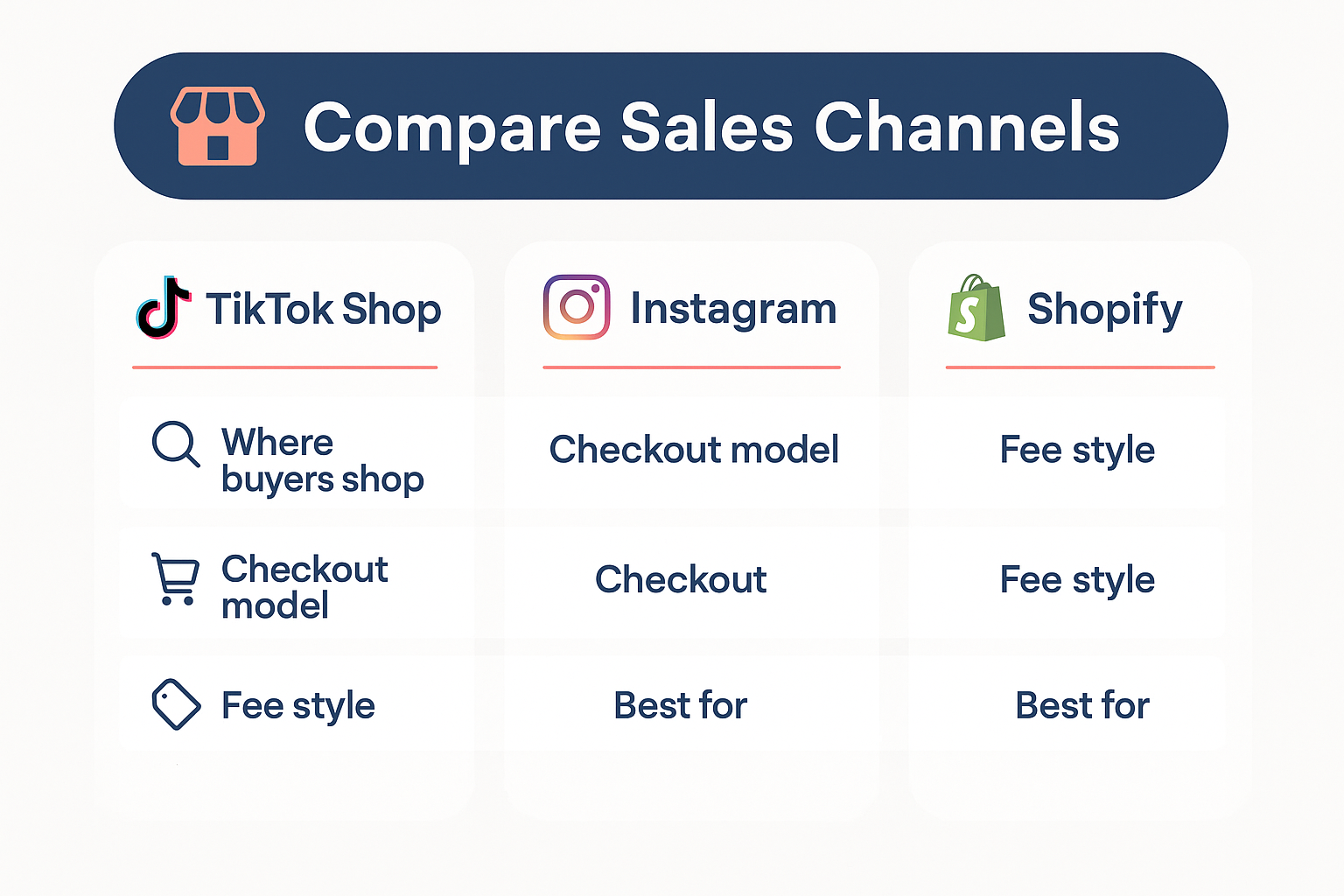
TikTok Shop: impulse, video-driven sales
TikTok Shop turns a short video into a sale before the scroll stops. Checkout happens inside the app, so the buyer never leaves the feed. There is no monthly seller fee, and first-sale speed is the fastest of the three paths.
This path rewards creators who can demo a product in 30 seconds: texture shots, scoop shots, a quick before-and-after of the jar. If your content is built for impulse, this is your starting line.
Instagram and Facebook Shops: audience monetization
If your audience already follows you on Instagram, a connected storefront turns that trust into checkout. Instagram and Facebook Shops do not charge a monthly seller fee, and you can tag products in posts, Stories, and Reels. First sale speed lands after you connect a storefront and get approved.
The catch: checkout routes to your website, so you own the transaction data. That extra step matters, and the TikTok Shop vs Instagram Shop showdown breaks down which one converts faster for supplement buyers.
Shopify storefront: the owned home base
Shopify is not a discovery engine. It is the place you own: subscriptions, email capture, repeat orders, and customer data. It costs from $39/month on the Basic plan, with fee details covered in Part 4. First sale speed depends entirely on the traffic you send through social posts.
For supplement brands, this is the long-game path because the customer list is yours. Compare the two launch points in our Shopify vs TikTok Shop for supplements guide.
| Path | Best for | Checkout model | Monthly fee | First sale speed |
|---|---|---|---|---|
| TikTok Shop | Impulse, video-driven sales | In-app checkout | No monthly seller fee | Fastest – checkout happens inside the app |
| Instagram and Facebook Shops | Audience monetization with a connected storefront | Website checkout (details in Part 5) | No monthly seller fee | After you connect a storefront and get approved |
| Shopify storefront | Owned home base for subscriptions and email | Your own storefront checkout | From $39/month on Basic (fee details in Part 4) | Depends on traffic you send through social posts |
What each platform actually charges in 2026
Platform fees are the first cut out of every order. Here is the dated math for the channels a first supplement brand will actually sell on.
| Platform | Fee | Amount | Source and date |
|---|---|---|---|
| TikTok Shop | US standard referral fee | 6% (5-6% by category) | Fit Small Business (verified October 20, 2025) |
| TikTok Shop | New-seller promo rate | 3% for 30 days after a first sale made within 60 days of onboarding | Fit Small Business (verified October 20, 2025) |
| TikTok Shop | Refund administration fee | 20% of the referral fee, capped at $5 per SKU, effective May 15, 2025 | Fit Small Business (verified October 20, 2025) |
| Meta (Instagram and Facebook native checkout) | Selling fee | 5% per shipment, or flat $0.40 on shipments of $8.00 or less. Note: native checkout is being phased out, with details in the next section. | Meta Business Help Center (retrieved June 2026) |
| Shopify Basic | Monthly plan and card rates | $39/month; online card rate 2.9% + $0.30 via Shopify Payments; 2% transaction fee with third-party gateways | Shopify Help Center (retrieved June 2026) |
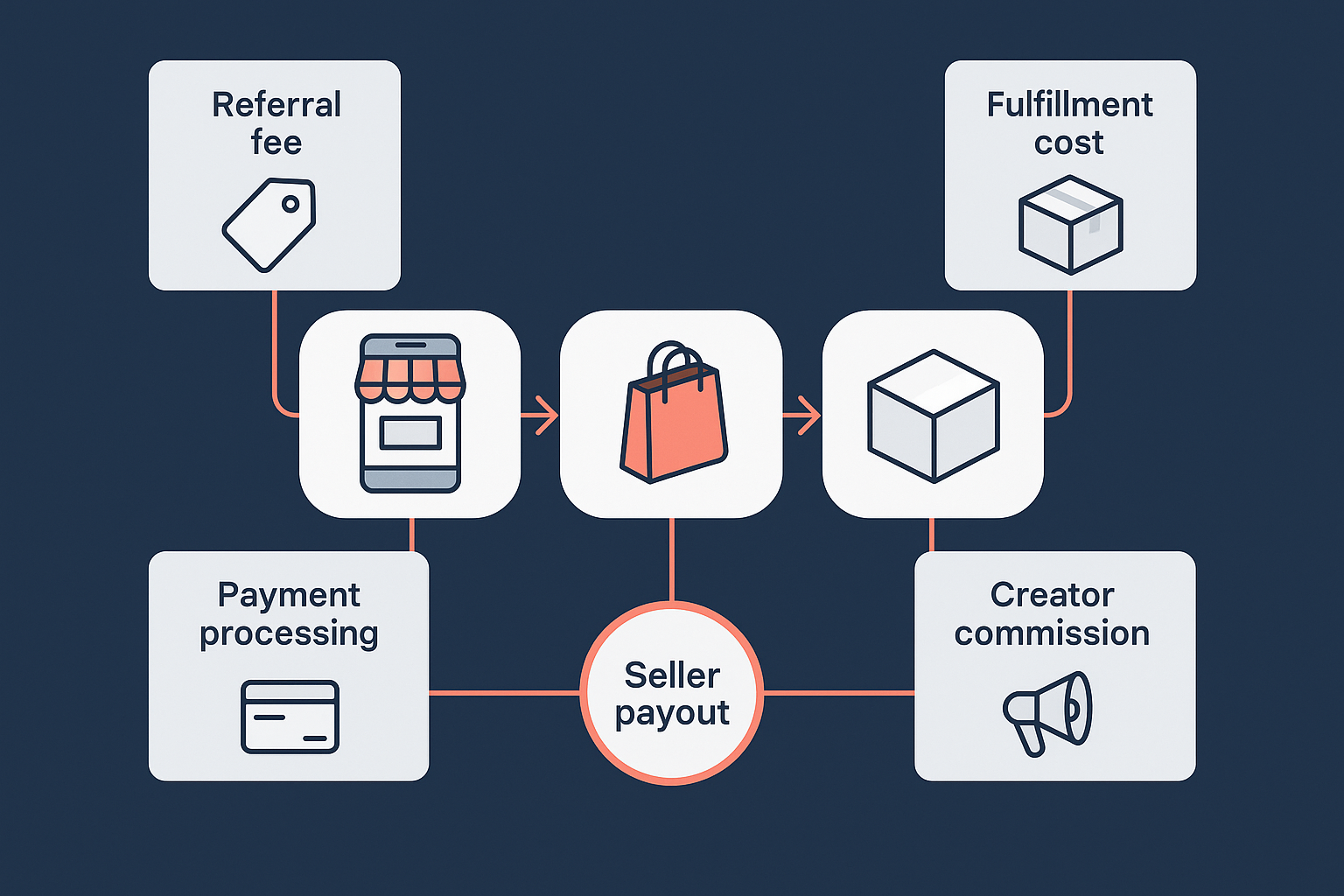
For a first supplement brand, the 6% TikTok referral fee is the baseline. The 3% promo rate only helps if you land that first sale inside 60 days of onboarding. And the refund fee is easy to miss: when a buyer returns an item, TikTok takes back 20% of the referral fee, capped at $5 per SKU. Return-heavy dropshippers feel that one fast.
Meta’s 5% native checkout fee disappears when you route buyers to your own storefront, and the phase-out pushes most Meta sellers there anyway. That puts Shopify Basic at the center. It’s $39/month before any order ships, then 2.9% plus $0.30 per card transaction, and another 2% if you use a third-party gateway.
None of this covers payment processor reserves or creator affiliate commissions. Those are separate line items. Platform fees are only the base case.
Run your product price, wholesale cost, and fulfillment fee through the supplement margin calculator to model your net after platform fees before committing to a channel.
The Meta checkout change every creator must know
Meta ended native checkout for Facebook and Instagram Shops. The phase-out began in June 2025, when Meta started moving shops from in-app checkout to website checkout. By September 4, 2025, native checkout was discontinued entirely (BigCommerce, July 30, 2025).
Buyers still discover products inside the apps. What changed is where the sale closes. Instead of checking out inside Facebook or Instagram, shoppers finish the purchase on your own storefront. That makes pairing an Instagram Shop with Shopify the standard setup for supplement creators.
The shift works in your favor. Meta handles discovery and traffic while your store captures the order data, the customer email, and the retargeting audience. You own the relationship instead of renting it.
If you already run your store on Shopify, the change barely registers. Your catalog syncs to Instagram, shoppers tap through products, and checkout routes back to your domain.
For supplement sellers, the stakes are higher. Approval teams look at the whole purchase path, not just the product page. A connected storefront gives them less to flag. Set it up through supported store integrations. Sync your catalog, and Meta routes shoppers to your store to finish the sale.
What you need before any platform will approve your supplement shop
Platforms review supplement shops harder than almost any other category. Gather these six items before you submit a single application.
| Required item | What platforms check | Why it matters |
|---|---|---|
| Registered business and EIN | Seller identity and tax reporting | Platforms need a legal seller on file |
| Product listing documentation | Product names, specs, and claims | Listings must match what ships |
| GMP-certified manufacturer proof | Manufacturing quality controls | Confirms the product is made in a certified facility |
| Third-party Certificate of Analysis per batch | Ingredient identity and purity | The document that most often speeds up approval |
| Compliant label and Supplement Facts panel | Labeling and serving accuracy | Matches the listing to the physical bottle |
| FTC-compliant disclosures for creators and affiliates | Paid promotion transparency | Protects the shop from enforcement actions |
The six items map to one question: can this shop prove it is legitimate? Platforms check the business entity first, then the product, then the manufacturing chain, then the marketing. Work the list in order and approvals move faster.
The Certificate of Analysis deserves special attention. It is the document that most often speeds up approval because it proves ingredient identity and purity for that batch. Rocktomic publishes one for every batch, and the Rocktomic quality and COA hub shows what that documentation looks like before you apply.
Your registered business and EIN sit at the top because platforms need a legal seller on file. The tax identity on your account has to match your manufacturer agreement and your labels. Sort this out first.
Product listing documentation covers names, specs, and claims. Platforms check that what you advertise matches what ships. A supplement that arrives with a different label than the listing is a fast way to lose approval.
GMP-certified manufacturer proof confirms the product comes from a certified facility. A compliant label with an accurate Supplement Facts panel matches the listing to the physical bottle. Both come straight from your manufacturer when you request batch records.
The FTC row trips up creators. If you promote your own products or pay affiliates, paid promotion needs clear, visible disclosure. Platforms check for it, and enforcement follows when it is missing. A simple disclosure policy protects the entire shop.
Gather all six before you apply. Most supplement shop rejections come back for missing paperwork, not missing demand.
How Zero-Inventory Fulfillment Removes the Biggest Beginner Risk
The first brand you launch is a test. It should cost you almost nothing to run. The cheapest way to test a social commerce platform is to sell a product you never bought upfront.
Traditional manufacturing doesn’t work that way. Most manufacturers force pallet buys: you commit to a full run before you’ve sold a single bottle. That’s cash tied up in inventory that might not move.
Platforms that charge per-order fees stack charges on top of the product cost, so every sale gets thinner. Either way, the creator carries the risk: you pay for the stock, you pay for the mistakes, and you eat the leftovers.
An on-demand model flips that. The supplier holds the inventory; you hold the brand. You test a product with a single order instead of a pallet. If you want to see how that changes the math, compare white-label supplement partners side by side.
Pay only when an order ships
Rocktomic warehouses, labels, and drop-ships every order. You never touch inventory, and you never buy it. The Free plan costs $0/month and lets you sell up to 10 white-label products.
You pay the flat $2-per-item fulfillment fee only when an order ships. No order, no fee. That’s how on-demand fulfillment works: you launch a brand, connect a storefront, and Rocktomic handles everything after checkout.
This is what makes testing a platform cheap. You put a product in front of your audience, measure real demand, and scale only what sells. If a platform flops, you’re out a fulfillment fee, not a warehouse full of bottles. The risk difference shows up fast.
Your first month sets the routine you will repeat for a year. The goal is not a perfect launch. It is one channel live, a few videos published, and clean numbers on what each order cost to get there.
Most sellers fail month one by trying to be everywhere. One platform gets you inventory-free distribution faster than five half-built storefronts.
Your first 30 days: a simple launch sequence
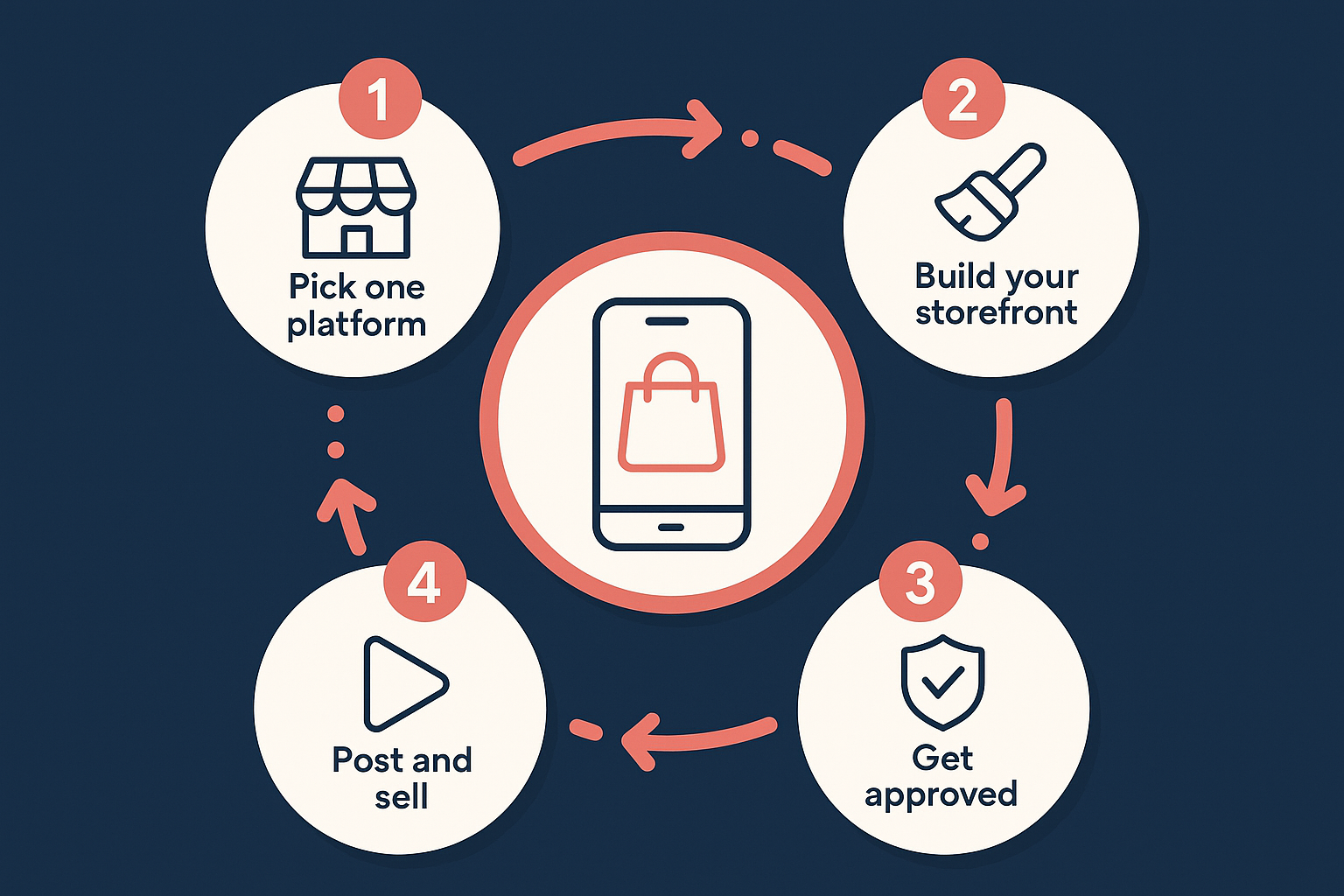
Run these five steps in order. Skipping around usually means redoing setup after you have already started paying platform fees.
- Pick ONE platform. Use the decision rules below. If you cannot decide yet, default to the platform where you already have an audience. You can add the rest after the first orders.
- Build the storefront or connect your catalog. Rocktomic handles inventory, labeling, and shipping on demand, so this step is mostly product pages and payout setup. When you are ready to expand, you can sell across TikTok, Instagram, and Pinterest from one dashboard. Not on day one.
- Apply for platform approval with your COA and business docs ready. Keep your Certificate of Analysis, LLC or EIN paperwork, and product images in one folder. Rocktomic provides a COA with every batch, so the document you need is part of production before you need it.
- Publish 5 short video formats: demo, routine, education, testimonial, behind the scenes. One product, five angles, three weeks. You are testing which angle the algorithm pushes, not producing a brand film.
- Go live, track fees, and reinvest in the format that converts. Log the referral fee, the roughly $2 fulfillment fee, and any affiliate commission on the first ten orders. The format with the lowest cost per order wins next month’s content budget.
Track the numbers in a simple spreadsheet. After 30 days you should know three things: your cost per order, your conversion rate by video format, and which platform fee caught you off guard.
Which platform should you pick?
Every platform has a moment where it is the right first platform. Match the choice to your existing audience and the purchase behavior you want to create. Audience size beats platform reputation in month one.
- Choose TikTok Shop if your audience discovers you through short video and you want impulse purchases with no monthly fee. Video drives the sale, and checkout happens inside the app.
- Choose Instagram plus Shopify if you monetize an existing audience and want owned repeat-purchase funnels. You keep the customer relationship and can retarget them to buy again.
- Choose Shopify first if you plan subscriptions and email from day one. An owned email list is worth more than rented algorithm reach, but it needs a storefront to send people to.
Honest trade-off: TikTok Shop’s referral fee and affiliate commissions are visible costs, while Instagram now requires a website checkout. Neither is free, and both hit different parts of your margin. A platform that feels free on the surface can cost more per order once affiliate payouts and checkout flow are included.
That is why you should compare before you commit. YouTube Shopping vs TikTok Shop economics walks through the fee math side by side, so you can pick the platform that keeps the most margin on the first ten orders. Then reinvest that margin into the format that made the sale repeatable.
FAQ
What is the easiest social commerce platform for a first-time supplement brand?
TikTok Shop is the fastest starting point for a first-time supplement brand because it has no monthly seller fee and an audience that already shops in the app. Shopify is the better long-term home for repeat purchases and email. Start on one platform, prove demand, then add a second channel once orders are consistent.
Does TikTok Shop charge fees for selling supplements?
Yes. TikTok Shop charges a referral fee of 6% on most supplement sales, with rates of 5-6% by category, as documented by Fit Small Business in a review verified October 20, 2025. New sellers get a 3% promotional rate for 30 days after their first sale, if that sale happens within 60 days of onboarding. A refund administration fee of 20% of the referral fee applies, capped at $5 per SKU.
Can you sell supplements on Instagram or Facebook Shops?
Yes, but checkout changed in 2025. Meta began moving Instagram and Facebook Shops to website checkout in June 2025, with most shops expected to finish by the end of August 2025. Buyers discover products in-app but purchase on the brand’s own website. Supplement brands typically pair an Instagram Shop with a Shopify storefront to keep checkout smooth and capture customer data.
Do I need my own website to sell on social platforms?
Not for TikTok Shop, where checkout happens inside the app. For Instagram and Facebook, Meta’s 2025 shift to website checkout makes a storefront such as Shopify effectively required. Even on TikTok, a simple website supports email lists, subscriptions, and repeat-purchase funnels. Rocktomic members can connect their store through supported sales-channel integrations.
What documents do I need to sell supplements on social commerce platforms?
Platforms typically ask for a business license, product documentation, and proof of GMP manufacturing. A third-party lab Certificate of Analysis for each batch is the document that most often speeds up approval, because it shows the product matches its label. Rocktomic provides a COA for every batch of its US-made products, and its quality hub explains what platforms look for.
How much does it cost to start selling supplements on social commerce?
Membership on the Rocktomic Free plan costs $0 per month, with no monthly fee and no minimum order. Members pay only the flat fulfillment fee of about $2 per item when an order ships. The main first-month costs are the storefront and the ad spend a creator chooses. The Scale plan at $297 per month adds the lowest per-unit wholesale pricing and the full product catalog.
How much profit can a creator keep from social commerce supplement sales?
Profit depends on wholesale cost, platform fees, fulfillment, and any creator commissions. The Scale plan at $297 per month provides the lowest per-unit wholesale pricing, the biggest lever on gross margin. After a platform referral fee such as TikTok Shop’s 6% and the flat fulfillment fee of about $2 per item, most creators keep the majority of the margin on each order. Rocktomic’s margin calculator helps model a specific SKU before launch.
What is the cheapest way to test a supplement product on social media?
A no-minimum, on-demand model is the cheapest option, because no inventory is purchased before a sale. The Rocktomic Free plan costs $0 per month, requires no upfront purchase, and charges the flat fulfillment fee of about $2 per item only when an order ships. Members can list up to 10 products, test which formats convert, and scale the winners without unsold inventory. Brands that find a winner move to Scale at $297 per month for the lowest wholesale pricing and the full catalog.
Start Selling on Social Commerce Without Inventory
The risk that stalls most creators is inventory. Zero-inventory dropshipping removes it. Start on the Free plan at $0/month, model your net after platform fees with the supplement margin calculator, then compare Rocktomic membership plans to upgrade to Scale at $297/month for the lowest per-unit wholesale pricing and the full catalog.
Want a guided setup? book a call with Rocktomic.
Last updated June 2026. Platform fee figures were verified against dated sources in June 2026 and may change.