
The Death of DIY: Why Packing Your Own Supplements Will Destroy Your Creator Brand
· 15 min read · By Rocktomic Labs Team
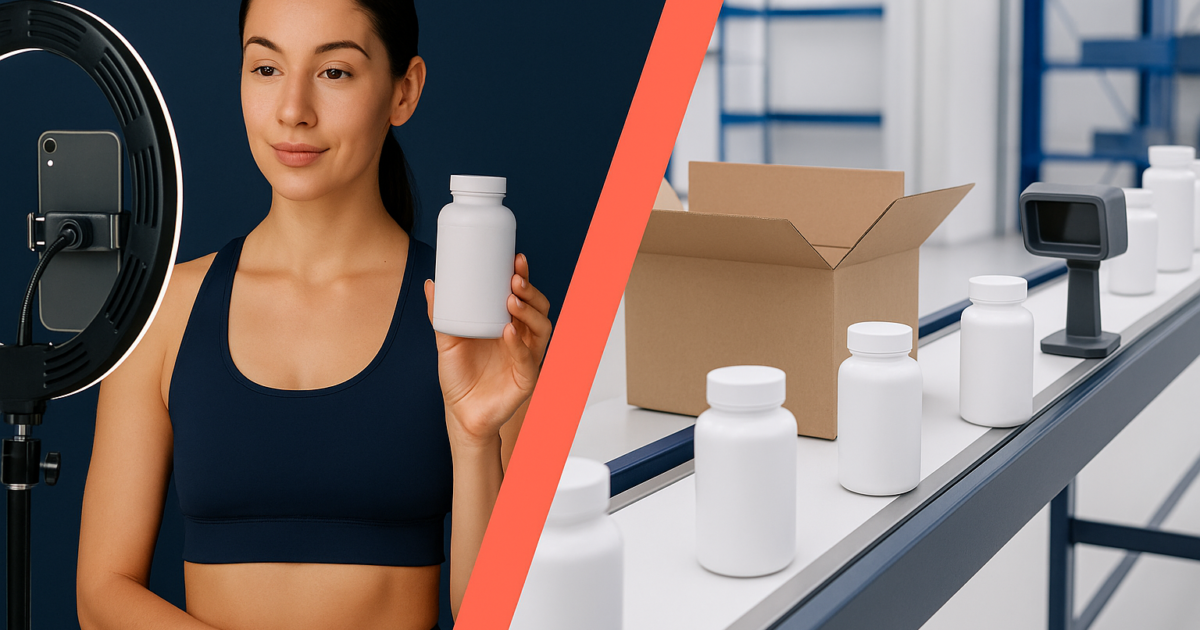
Supplement Fulfillment for Creators: Why DIY Fails
Manual supplement fulfillment is a time tax, and it caps creator revenue at whatever one person can pack. A 30-order packing day burns hours that monetize at zero. Spend those same hours on content, and they compound.
Automated, on-demand dropshipping removes the packing desk entirely, so a solo creator can sell 10 orders or 10,000 without touching a box. Every box you tape is a video you never published. Every label you print is a comment you never answered. DIY fails because it turns your highest-value hours into unpaid warehouse labor.

What Is DIY Supplement Fulfillment and Why Do Creators Try It?
DIY supplement fulfillment is when you, the creator, manage every physical step of an order: buying stock, storing bottles, printing shipping labels, packing boxes, and handling carrier drop-offs. Your brand handles the product from shelf to front porch.
Model your monthly revenue, repeat rate, and net profit as your supplement brand scales – using real catalog costs and fees.
Creators try it because it feels free and controllable. No supplier to coordinate. No pallet minimums. You control packaging and shipping. That appeal disappears on the first viral video.
One order is easy. A hundred orders becomes a full-time operation. A thousand orders becomes a missed deadline. The cost never shows up as a line item. It shows up as late nights, delayed content, and a growing pile of boxes in your hallway.
Some manufacturer models make this worse by forcing pallet buys and self-packed orders. They shift inventory risk and fulfillment labor onto you, then call that saving money. The real price is paid in calendar hours, not checkout totals.
The packing desk is the bottleneck. Every scaling problem flows through it. The rest of this article follows that bottleneck and shows exactly what it does to your time, your revenue, and your viral moments.
The Hidden Time Cost of Packing Orders Yourself
Manual fulfillment runs on a stopwatch, and the stopwatch never stops. Before a single order ships, you are already behind on the content that brought that order in. The table below is an illustrative estimate of per-order time for a small creator brand packing from home. Treat it as a planning exercise, not measured data from a fulfillment audit. The point is to see how fast small tasks compound across a sales week.

Here is the realistic shape of one order:
| Task | Assumed Time |
|---|---|
| Order review and label printing | 1-2 min per order |
| Pick and verify | 1-2 min per order |
| Pack, tape, and weigh | 2-3 min per order |
| Carrier drop-off and queue | 5-15 min per trip |
| Plus unmeasured support DMs about late packages | Unmeasured |
Stack it into a week and the drain shows up. Take an illustrative 30-order week. At the low end, each order eats about 4 minutes across review, picking, and packing. That is about 2 hours. At the high end, roughly 7 minutes per order, it is closer to 3.5 hours. Then add carrier drop-offs: one trip a day at 5 to 15 minutes is another 25 to 75 minutes a week. Multiply that across a real launch month and you have lost the better part of a workday every single week, and the only asset you produced was boxes.
None of that math counts the support DMs. Every late shipment lands in your inbox, and every reply is a task that never made it into the table. The unmeasured work is usually the most expensive work.
Creators are already out of time
Here is where manual fulfillment really hurts. Per Epidemic Sound (May 23, 2024), 49% of monetizing creators already spend 20 or more hours per week on content creation.
Almost half of monetizing creators have zero spare bandwidth. Every hour you move to packing comes straight out of the content pipeline, not out of your free time, because the free time does not exist. That makes DIY fulfillment a demand killer in disguise. The orders you pack today are the orders that stop coming next month when your posting rhythm breaks.
Keep the one idea that matters: each box packed is a video not filmed. Videos are the only asset that creates demand, and demand is the only reason orders exist in the first place. Manual fulfillment spends your demand engine to save a fulfillment fee.
What Is a Creator’s Packing Hour Really Worth?
Model this as an illustrative assumption, not a measured stat: your content time has a real hourly value. Your packing time pays nothing. When you film, edit, and answer comments, you’re building an asset that earns. When you tape boxes, you’re doing a job with no wage and no upside.
Now run the volume. Assume packing takes about 1 hour per 10-15 orders. A 300-order month sounds like a milestone until you do the math: 20-30 hours a month on work that generates zero revenue. Those are not a few stray evenings. That’s your content pipeline going dark right when the brand needs momentum. The more orders you sell, the heavier that tax gets, because order volume grows faster than your free hours do.
Modeling a 300-order month
| Line item | Assumed basis | Implied drain |
|---|---|---|
| Packing time in a 300-order month | about 1 hour per 10-15 orders | roughly 20-30 hours |
| Content days lost | about 7-8 productive content hours per day | roughly three to four full content days |
Every number above is an illustrative assumption for modeling your own operation. None of it is a measured industry statistic. Your packing speed will differ, and so will your content hours. The point is the shape of the trade: every order you pack is a content asset you did not create.
The $20 fulfillment bill you pay in time
Now add the industry context. Fulfillment and logistics normally cost a brand about $20 for every $100 a shopper spends online, per Flowspace’s ecommerce fulfillment benchmarks (updated November 25, 2025). That’s the plain cost of getting product out the door.
That $20 does not vanish when you pack orders yourself. It changes form. It becomes unpaid labor, shipping supplies, and content days your audience never sees. The creator ends up subsidizing the logistics line with their own calendar, then mistakes the sacrifice for savings.
Outsourcing fulfillment at a flat per-item fee flips that arrangement. You give up a negative hourly job and pick up a predictable cost, one you can price into your margin before launch and forget after launch. That’s what a fulfillment partner actually sells: your calendar, returned.
Why a Viral Moment Destroys Manual Fulfillment
One video goes live at 9 p.m. By 2 a.m., the order count passes 300. That spike is the whole point of building a brand. It is also the fastest way to break a manual fulfillment setup, because TikTok Shop starts its shipping clock the second those orders land.
TikTok’s seller-fulfilled rules do not bend for a solo packer. The platform’s official Fulfillment Policy and Seller Shipping guidance, both retrieved June 21, 2026, set deadlines that apply equally to a 100,000-order warehouse and a creator packing in a spare bedroom.

What TikTok requires from seller-fulfilled orders
The core requirements for standard orders are spelled out in the Seller Center policy.
| Requirement | Rule | Source |
|---|---|---|
| Dispatch SLA | About 2 business days for seller-fulfilled standard orders | TikTok Seller Center Fulfillment Policy (retrieved June 21, 2026) |
| Delivery SLA | About 6 business days for seller-fulfilled standard orders | TikTok Seller Center Fulfillment Policy (retrieved June 21, 2026) |
| Auto-cancellation | Orders not marked dispatched within the window are canceled automatically | TikTok Seller Center Fulfillment Policy (retrieved June 21, 2026) |
| Performance impact | Sellers must keep a 95% on-time delivery rate for express options; late dispatch above thresholds reduces visibility and shipping options | TikTok Seller Center Seller Shipping guidance (retrieved June 21, 2026) |
The spike becomes canceled orders
A few hundred orders is a full day of labor for one person. That is the optimistic case, when every order is clean, every label prints, and no customer needs support. Now check the calendar. Those orders arrive at the exact moment the creator should be posting follow-up content to ride the wave. Instead they are printing labels and hunting for boxes. Days one and two of a viral moment get spent in the shipping queue, and the content engine that caused the spike goes dark.
Miss the dispatch window and the platform cancels the order automatically. The customer gets a refund, the sale disappears, and the creator still eats the product cost and the labor. Worse, the 95% on-time delivery rate for express options means every late dispatch drags on account health. Sellers whose late-dispatch rates climb lose visibility and shipping options, which chokes organic reach for weeks. The full picture of those windows and the ways sellers survive them is covered in our breakdown of how to survive TikTok Shop shipping SLAs.
Run the momentum math. A viral moment only pays off when follow-up content lands while attention is still hot. Canceled orders and score hits arrive at exactly that moment. The spike becomes a liability instead of an asset, and the creator’s own tape gun is what turned it into one.
Automated Dropshipping Is the Only Fulfillment Model That Scales
Automated dropshipping is a fulfillment model where the creator owns the brand and the store, and the manufacturer warehouses, labels, packs, and ships each order on demand. Rocktomic runs this model from US-based, GMP-certified facilities across a 140+ product catalog, with a Certificate of Analysis on every batch.
Four steps, zero boxes in your garage
The whole flow works like this. Step one: a customer buys on your store. That is the only manual action in the entire chain.
Step two: the order routes into the manufacturer’s system through one of the sales channel integrations. Your Shopify store, TikTok Shop, or another channel syncs the details automatically, so nothing gets retyped and no order slips through.
Step three: the manufacturer prints and applies your label, picks the product from in-stock US inventory, packs it, and ships it. That sequence repeats on every order as described in how on-demand fulfillment works: order in, label printed, product picked, box shipped. Every unit moves through Rocktomic’s flat-rate on-demand fulfillment process, so the branded experience stays consistent whether you sold one bottle or one hundred. Sellers on TikTok Shop can keep the same flow moving when platform deadlines hit by using zero-touch order routing for TikTok Shop.
Step four: the customer receives a branded order. You keep the relationship, the customer data, and the margin. The split is clean: your job is demand, and the manufacturer’s job is the operational work that used to eat your evenings. No warehouse walk, no shipping label scanned by you, no support ticket about a missing box.
Why bulk and DIY both miss
Bulk fulfillment locks your cash into inventory before you have customers. It means a pallet in storage and a minimum order quantity on every SKU. DIY fulfillment trades that pallet for a packing table, which adds its own drag: tape, boxes, labels, label printers, and the hours to run them.
On-demand dropshipping starts with neither. The Free plan carries no minimums, and Scale opens the full catalog. That removes the risk of dead stock and the cost of your time.
Here is the payoff: this model removes the packing ceiling, so ten orders and ten thousand orders run through the same system. The system never waits on how fast you can tape a box, and volume stops costing you time. That is what scaling actually means.
What Does Each Fulfillment Model Actually Cost?
Product margin does not matter until the fulfillment line is transparent. So this table puts markup and retail price aside. It compares one thing only: what each model charges to get an order out the door. Every other number on your P&L builds on that line.

Fee transparency is the only fair way to compare models. The base rate is never the whole cost in any column.
| DIY self-fulfillment | Traditional 3PL | Flat-fee on-demand dropship |
|---|---|---|
| Upfront stock purchase, packing supplies, carrier fees, plus the unpaid creator labor that quietly becomes the biggest line item. Flowspace’s ecommerce fulfillment benchmarks, updated November 25, 2025, put fulfillment and logistics at about $20 per $100 spent online. In a garage operation, most of that $20 is invisible because it is charged in time, not dollars. | Per-order pick-and-pack fees plus storage fees and integration line items that add up quietly across a catalog. The headline rate looks small until the monthly statement arrives. Across a 10-product catalog, those per-order and storage lines compound. | Rocktomic Free plan: $0 per month plus a flat about $2 per item fulfillment fee, charged only when an order ships. A zero-order month on the Free plan costs $0. Scale plan: $297 per month for the lowest per-unit wholesale pricing and the full 140+ product catalog. |
Selling-platform referral and processing fees exist on every channel regardless of fulfillment model. The channel-level math of how TikTok Shop fees eat supplement margins is a separate problem: the platform takes its cut before revenue clears, and that cut scales with sales, not with your fulfillment model. The fulfillment fee, by contrast, is the one variable the creator actually controls.
If you are weighing a traditional 3PL against an on-demand model, compare white-label dropship platforms side by side before you sign. A 3PL quote only makes sense at volume when every line item is visible up front. The quote and the invoice are two different documents; read both.
Unpaid labor sits in the DIY column because those hours carry the opportunity cost covered earlier. None of this table includes product cost; that is margin math. Run your real numbers through the supplement margin calculator before you commit to a model. Then apply the rule: if the fulfillment line is opaque or paid in unpaid hours, the model is the problem.
Frequently Asked Questions
How long does manual supplement fulfillment actually take per order?
A solo creator realistically spends several minutes of hands-on work per order. That work spans order review, label printing, picking, packing, taping, and carrier hand-off. Post-office trips add time that never scales. Every one of those minutes multiplies with each new sale, and no shortcut makes a single pair of hands faster. The pattern is consistent: manual fulfillment grows linearly with sales, while a creator’s available hours do not.
Which fulfillment tasks steal time beyond the actual packing?
Inventory counts and restocking, box and label supply runs, carrier queues, address corrections, and customer-support messages about late packages all land on the same desk. These are pure operations, not content. Each of these tasks taxes the limited hours a creator should spend on content. Automated dropshipping removes most of them because a partner owns the warehouse, the stock, and the shipping workflow.
Can a solo creator keep up with TikTok Shop order spikes?
Not reliably. TikTok Shop auto-cancels seller-fulfilled orders that miss dispatch deadlines. A burst of orders from one video can outrun a solo packer within hours. A few hundred orders is a full day of labor for one person, arriving at the exact moment the creator should be posting follow-up content. Missing that window costs the sale, the performance score, and the momentum. For a creator selling on social, momentum is the real asset.
What are TikTok Shop’s fulfillment SLA requirements for supplement sellers?
Per TikTok Shop’s official Seller Center Fulfillment Policy, retrieved June 2026, seller-fulfilled standard orders must be dispatched within about two business days and delivered within roughly six. Orders that miss the auto-cancellation window are canceled automatically. Sellers below on-time delivery thresholds lose visibility and premium shipping options. A partner that ships from in-stock US inventory removes most of that risk.
What is automated supplement dropshipping?
Automated supplement dropshipping is a zero-inventory fulfillment model. The creator owns the brand and the store, and a US manufacturer applies the brand label, picks, packs, and ships each order from its own stocked facility. The creator pays a per-item fulfillment fee only when a sale happens. There is no warehouse, no pallet of goods, and no packing table. The manufacturer holds the stock, so the creator holds none. Rocktomic calls this on-demand fulfillment.
What does outsourced supplement fulfillment cost on Rocktomic?
Membership starts at $0 per month on the Free plan, where members pay only the flat about $2 per item fulfillment fee when an order ships. The Scale plan costs $297 per month and adds the lowest per-unit wholesale pricing, the full 140-plus product catalog, unlimited sales channels, and priority fulfillment. The flat per-item fee covers pick, pack, and label. No minimum purchase is required to start.
Why do creators abandon self-packing for a dropship fulfillment model?
Because packing is a low-wage job stapled onto a creator business. Every hour spent taping boxes is an hour not spent filming, editing, or shipping content. Manual operations cap revenue at whatever one person can physically ship. Automated dropshipping removes the ceiling and the inventory risk. It also frees the cash tied up in boxes, labels, and stock. Creators keep the customer relationship while the manufacturer handles logistics.
How does a creator start selling supplements without touching inventory?
A creator can start on the Free plan at $0 per month, connect one sales channel, and list up to 10 white-label products with zero minimums. When an order ships, the member pays the flat about $2 per item fulfillment fee, and Rocktomic prints, packs, and drop-ships under the creator’s label. Scaling to the full catalog and unlimited channels happens on the Scale plan at $297 per month.
Own the Brand, Skip the Packing Desk
Your job is building demand, not running a packing desk. Rocktomic handles the warehouse, the labeling, and the shipping line. The brand, the customer relationship, and the margin stay with you on every order. Your customers buy from your brand, not from a fulfillment center.
That model starts with zero inventory and a $0 per month entry point on the Free plan. Every product is manufactured in the US to GMP standards, and every batch ships with a Certificate of Analysis. You create. Rocktomic packs.
Start on the Free plan at $0 per month when you compare Rocktomic membership plans, or book a call to map your first SKU and channel setup with the Rocktomic team.
Last updated: June 21, 2026.