
The Psychology of the Tap: Why Native Social Checkout Skyrockets Supplement Conversions
· 14 min read · By Rocktomic Labs Team
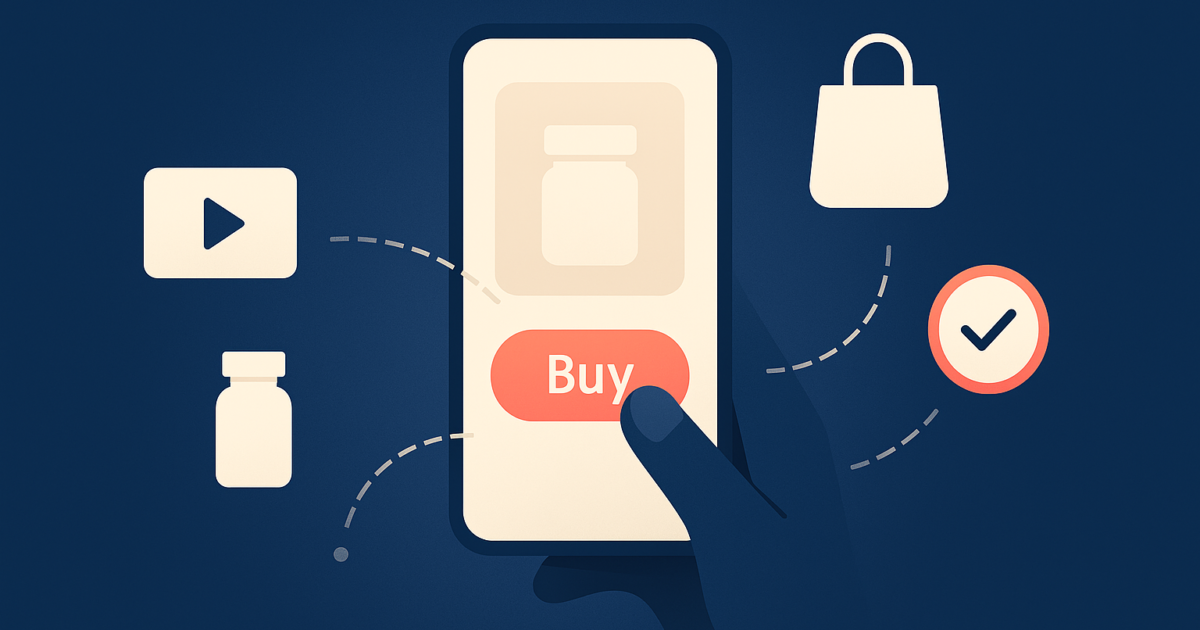
Native Social Checkout: The Psychology of the Tap

Friction kills sales, and the most expensive friction in ecommerce is the redirect. Native social checkout lets a supplement buyer finish the purchase inside TikTok or Instagram with a saved-payment tap. The conversion data is decisive: global cart abandonment sits at 70.22 percent (Baymard Institute, 50-study average, updated September 22, 2025, retrieved July 14, 2026). This article breaks down the psychology levers behind the tap, the real platform fees, and the setup steps for a zero-inventory supplement brand.
Model your monthly revenue, repeat rate, and net profit as your supplement brand scales – using real catalog costs and fees.
What is native social checkout?
Native social checkout is in-app purchase completion on TikTok Shop, Instagram Shops, and Facebook Shops. A buyer taps a product tag on a video or post, confirms stored payment details, and the order completes without leaving the feed. No browser switch, no card re-entry, no login wall.
Brands using Rocktomic’s zero-inventory model sell through these native checkouts while Rocktomic handles manufacturing, labeling, and drop-shipping.
Why does redirecting kill supplement sales?
Start with the number: 70.22 percent of online carts get abandoned. That is the global average from Baymard Institute’s analysis of 50 studies, updated September 22, 2025 and retrieved July 14, 2026. Statista’s 2026 figure matches at 70.22 percent. Seven of every ten shoppers who start a checkout never finish it.

Now walk the redirect path. A viewer taps the link in a video. They leave the app. A mobile browser tab opens, and the page takes seconds to load. Next comes the login wall, then a payment form asking for card details they already typed once. When the page finally renders, the product they tapped may not even be there, or the price does not match the video. Every one of those steps is a dropout point. The abandoned cart is just the sum of those dropouts.
Most social traffic lives on a phone, where page loads are slowest and forms hurt the most. Redirect-based checkouts force the buyer to restart the entire purchase in a new tab, on a smaller screen, with their thumb hovering over the close button. That is the real difference between a native checkout vs an owned website: one keeps the buyer in motion, the other makes them start over.
Native checkout keeps the shopper inside the social app. No tab switch, no login wall, no retyped card number. The whole transaction happens where the buyer already is, and every step you remove is an order you keep. When 70.22 percent of carts fail, the redirect is usually where the leak starts.
The psychology of the tap: 4 levers that lift conversions
A checkout that lives inside the social feed is a conversion engine. It runs on four psychological levers, and each one removes a reason to say “not now.”

Less friction: fewer decisions, higher completion
Every field, redirect, or login prompt adds cognitive load. The buyer’s working memory fills up before their credit card does. Baymard’s checkout-usability research suggests that design fixes can lift conversion substantially, and the fix that matters most is cutting decisions.
A native checkout keeps the purchase inside the app the buyer already trusts. One tap, one form, one order. For a white-label brand, every redirect is a chance to lose that buyer to the next creator’s post.
Impulse and immediacy: buy while the creator’s credibility is live
Your video is playing. Your product is on screen. The buyer is as close to “yes” as they will ever be. The social feed moves fast, and that yes has a shelf life measured in seconds.
Platforms with native checkout capture the order in that exact moment. External links ask the buyer to hold their intent while the app changes around them. Native social checkout turns that intent into an order right there on the feed, and for a consumable category, the impulse is not a one-off. Let the tap settle it.
Trust in context: proof in the same scroll
Reviews, user-generated content, and a visible Certificate of Analysis answer the final objection before the buyer leaves the feed. If the lab report is one redirect away, the buyer is less likely to see it. Keep it visible.
The Rocktomic quality hub with COAs puts batch-level proof in front of every prospect, and posting lab tests on TikTok shows how that proof performs in the same context where the sale happens. That third-party testing separates a real supplement brand from a label slapped on a bottle. Legitimacy shown at the moment of decision is the strongest trust signal a supplement brand can use.
Saved payment and memory: remove the highest-friction field
The payment form carries the most friction in checkout. Platform wallets and stored cards take that friction off the table. The buyer does not need to remember their card number, dig for a wallet, or re-enter an address. The platform remembers, and the buyer simply taps.
That saved memory also powers repeat purchases. A consumable product runs on reorders, and one-tap checkout makes the reorder a reflex. The saved card becomes a stored decision, so the next restock takes seconds, not minutes. That repeat rate does not cost an extra ad dollar.
What the data says: native checkout conversion benchmarks
The benchmarks below are dated and sourced, because a figure without a date is marketing, not data. Baymard, Statista, and Grand View Research publish the underlying datasets, all pulled for this report in July 2026.
| Metric | Figure | Source |
|---|---|---|
| Global cart abandonment | 70.22% | Baymard Institute, 50-study average, updated September 22, 2025, retrieved July 14, 2026 |
| Global cart abandonment (2026 figure) | 70.22% | Statista, 2026 |
| Global social commerce market | $1,484.5B in 2025, $1,925.3B projected 2026 | Grand View Research, June 23, 2026 |
Read the rows in order and the pattern appears. Seven out of ten carts never reach payment, and that rate has not budged across 50 studies. Meanwhile, the market for buying inside the feed is compounding: $1,484.5 billion in 2025, projected at $1,925.3 billion in 2026. The redirect is the leak. Every hop from feed to browser adds a decision point, and that’s where the 70 percent goes. Category spend is moving into the feed, and checkout inside the app is where it converts. A $1.9 trillion projection is not a niche. It’s the direction of the category.
For a supplement operator, those are not abstract figures. Seventy percent abandonment means most of the traffic you pay for disappears between intent and payment. Keeping the buyer inside the social app removes that handoff altogether. The brands doing it capture checkout spend that most sellers never see. Your ad spend, your creative, and your audience all do their job up to the tap. The loss happens after.
For the supplement-specific version of that pattern, see where supplement buyers actually click buy. The conversion report walks through which platforms finish the sale and which ones hand the buyer off.
Native checkout fees: what the platform actually takes
Every platform takes a cut. The question is whether you see it coming. Native checkout bundles the referral fee, the affiliate commission, and the fulfillment cost into one number on your payout report. If you don’t model each line before launch, that number will surprise you.
Here is the fee stack to build into your pricing model. These are the lines you will actually see on TikTok Shop.
| Fee line | What it costs | Source |
|---|---|---|
| TikTok Shop referral fee | ~6% on most US categories, 5% on select categories, 3% for eligible new sellers for 30 days | TikTok Shop Seller Academy, May 14, 2026, retrieved July 14, 2026 |
| Refund administration fee | 20% of the referral fee, capped at $5 per SKU | TikTok Shop Seller Academy, effective May 15, 2025 |
| Affiliate commission | Seller-set, with no fixed platform rate; model a range in your margin calculator | Seller campaign settings |
| Fulfillment | Flat $2 per item fulfillment; no inventory, no pallet minimums, no warehouse fees | Rocktomic pricing |
Two of those lines move with your price. The referral fee scales up as your product price scales. The refund admin fee only appears when a buyer returns an order, so budget for it separately instead of assuming every sale settles clean. The affiliate commission is the variable you control: you set the rate, your affiliates see it, and it comes out of the same sale.
Run the math on a real order. A $29.97 sale minus about $1.80 (6% referral) minus about $2 fulfillment leaves the contribution before wholesale cost. That’s price minus referral fee minus $2 fulfillment. You know exactly what you keep before you buy a single unit.
That transparency is the category differentiator. Most fee stacks hide a line or two until payout. Platforms that force pallet buys and per-order warehouse fees make the redirect model costlier than it looks. Rocktomic’s model means a brand pays only when an order ships. It’s the difference between a margin you plan and a margin you discover.
Model your own numbers in the supplement margin calculator, then compare Rocktomic’s membership plans. Free runs $0 a month. Scale runs $297 a month and carries the lowest per-unit wholesale pricing.
How to Set Up Native Checkout for Your Supplement Brand
Native checkout for a supplement brand is a setup problem, not a manufacturing problem. You need four things: platform approval, a synced catalog, a fulfillment path, and a price that works. Nothing in that list requires you to buy inventory first, which is why a launch timeline of days is realistic instead of a fantasy.

Work the steps in order because platform approval gates everything else. TikTok Shop and Instagram both review supplement sellers before native checkout goes live, and they want the same documents: label files, manufacturer details, and a Certificate of Analysis. Rocktomic issues a COA with every batch, so the file your review needs exists before you even submit. Send the full packet in the first pass and you skip the back-and-forth that stretches approvals into weeks.
Most of the setup time goes to document prep, not software. Keep label files, manufacturer details, and the Certificate of Analysis in one folder before you apply. When the platform asks for them, answer the same day. That single habit removes the most common delay in the whole process.
The steps themselves take an afternoon. Here is the exact launch flow.
| Step | What to do |
|---|---|
| 1. Get platform approval | Submit compliance docs: label files, manufacturer details, and a Certificate of Analysis for each SKU. Here’s what getting fast-tracked for TikTok Shop supplements actually involves. |
| 2. Sync your catalog | Connect the same product data to TikTok Shop and Instagram Shops. Rocktomic’s store and channel integrations keep pricing, images, and descriptions identical across both storefronts. |
| 3. Map fulfillment | Route orders straight to on-demand production, labeling, and drop-ship. Read how on-demand fulfillment works before you go live. |
| 4. Go live with pricing and bundles | Set retail pricing, build bundle offers, and enable checkout in each channel. Test one real order end to end before promoting anything. |
Notice what is missing from that table: inventory. There is no pallet to buy, no warehouse to fill, and no minimum order blocking the storefront from earning. The first real cost, about $2 per item, appears only when an order ships and Rocktomic picks, packs, and labels it. So a brand can go from zero to a live native checkout in days, with every dollar still in the bank until a customer actually buys. The tap happens in the feed. The rest of the machine runs without you.
3 quick wins to lift your in-app conversion rate
You already removed the friction. Now make the tap itself sell harder. These three levers reuse the psychology from earlier in this piece, and none of them cost you a new integration.
Win 1: Show all-in pricing on the product card
Show the full price on the product card. Buyers tap expecting confirmation, not a surprise. Baymard’s 2025 checkout research names surprise costs as the top reason shoppers abandon. If a new charge appears after the tap, the customer assumes the worst and leaves. Put the all-in number in front of them before they commit.
Win 2: Offer bundles or a subscription option
Bundle two or three units together, or offer a subscribe-and-save option. Both raise order value without extra ad spend. A subscription also builds a reorder rate you can forecast, which makes your supplement brand worth more when you ever sell it.
Win 3: Put proof on the product page
Reviews, UGC, and a visible COA badge. In a native checkout, buyers scan for reasons to trust you in seconds. A certificate of analysis on every batch does that work for you. The deep trust breakdown lives in Part 4; here, just make sure the proof sits right next to the buy button.
Frequently asked questions
What is native social checkout?
Native social checkout is the ability to complete a purchase inside a social media app without being sent to an external website. On platforms such as TikTok Shop and Instagram and Facebook Shops, a buyer taps a product tag on a video or post, confirms payment details the platform already stores, and the order is placed in the same session. The buyer never opens a browser tab, never re-enters a card number, and never leaves the content feed. For supplement brands, this removes the redirect step where most carts are lost.
Why does native checkout convert better for supplements?
Native checkout converts better because it removes the steps where buyers quit. Baymard Institute measured a global cart abandonment rate of 70.22 percent across 50 studies, and mobile abandonment runs near 80 percent. A redirect forces a thumb tap out of the app, a page load, a login, and re-entered payment details. In-app checkout collapses all of that into one saved-payment tap. Supplements are consumable and impulse-friendly products, so buyers act while the creator’s credibility and the video’s momentum are still fresh.
Which platforms support native checkout for supplements?
TikTok Shop, Instagram Shops, and Facebook Shops support native checkout, and each runs its own approval process for supplements. TikTok requires sellers to submit compliance documentation, including product labels, manufacturer information, and in practice a Certificate of Analysis, before the health and wellness category is approved. Instagram and Facebook route supplement approval through Meta’s commerce review. Rocktomic members sell across these channels with on-demand fulfillment, so one catalog can feed TikTok, Instagram, and a Shopify store without buying inventory.
What fees come with native social checkout?
Each platform charges differently. TikTok Shop charges a US referral fee of about 6 percent on most categories, 5 percent on select categories, and a 3 percent rate for eligible new sellers for 30 days, per TikTok’s Seller Academy. Meta’s checkout carries payment processing fees similar to standard online transactions. Affiliate commissions are seller-set and commonly run 10 to 25 percent for beauty and supplement categories. The predictable cost is fulfillment: Rocktomic charges a flat fee of about $2 per item, so sellers can model fees before launch.
Can I run subscriptions through native checkout?
Yes. TikTok Shop and Meta’s Shops support recurring purchase options, which matter for supplements because they are consumable and reorderable. A subscription smooths the reorder path and raises lifetime value without forcing the buyer to remember to rebuy. The same zero-inventory model applies: when a subscription order ships, Rocktomic produces, labels, and drop-ships the item, and the member pays the flat per-item fulfillment fee. Brands keep the customer and billing relationship, and the platform handles the recurring payment.
What does it cost to start selling supplements with native checkout?
The starting cost can be $0 a month. Rocktomic’s Free plan carries no monthly fee; members pay only the flat fulfillment fee of about $2 per item when an order ships, and they can sell up to 10 white-label products through one sales channel. That structure matches a native checkout launch: platform registration is free, inventory costs nothing upfront, and the first real cost appears only after the first order. Brands that want the full catalog and lowest wholesale pricing move to the Scale plan at $297 a month.
How do platform fees affect supplement margins on native checkout?
Platform fees stack on top of product cost and fulfillment. On a $29.97 supplement sale, a 6 percent referral fee is about $1.80, and Rocktomic’s flat fulfillment adds about $2 per item. Compare that with a model where a seller also pays warehouse storage, pallet minimums, or per-order platform fees. The math is easy to model: price minus wholesale cost minus platform referral fee minus $2 fulfillment equals contribution margin. Rocktomic’s supplement margin calculator does that work for any SKU.
What does the Scale plan add for sellers using native checkout?
Scale, at $297 a month, is built for sellers running native checkout at volume. It unlocks the full 140+ product catalog, including Scale Exclusives, unlimited sales channels, the lowest per-unit wholesale pricing, and priority fulfillment. For a creator selling on TikTok Shop and Instagram at the same time, unlimited channels matter because one catalog can feed both checkouts. The trade-off is simple: a fixed monthly fee replaces per-order surprises, and the lower wholesale cost directly improves every margin calculation.
Own the Tap
The redirect is the leak. Native checkout closes it. A zero-inventory supplement brand can launch in days, with no upfront purchasing and no inventory risk.
Scale, at $297/mo, gets you unlimited sales channels, the full 140+ catalog, lowest per-unit wholesale pricing, and priority fulfillment. The Free plan stays $0/mo: a zero-risk entry where you pay only when an order ships. Every product is US-manufactured, GMP-certified, with a COA on every batch.
Your buyers already have their wallets open in the app. If you want to own that tap, book a call with Rocktomic.
Last updated: July 14, 2026.