
The First-Order Profit Playbook: Calculating CAC for New Supplement Brands
· 17 min read · By Rocktomic Labs Team
Customer Acquisition Cost for Supplement Brands
Customer acquisition cost (CAC) is total acquisition spend divided by net-new customers, and it is the number that decides whether your first order profits or bleeds. Blended DTC ecommerce CAC runs $68 to $84, while supplement brands sit near $89, according to Ringly’s June 2026 acquisition cost statistics. On a $35.97 bottle (ROC105) with a $5.71 wholesale cost and the $2 per-item fulfillment fee, contribution lands at $28.26, so CAC must stay under that ceiling for order one to profit at all. That ceiling is your benchmark for every ad channel, offer, and product you push. Go over it and every paid first order loses money before a single reorder. Most supplement sellers never run this math until the ad budget is already gone. This playbook fixes that: measure CAC accurately, benchmark it, and budget so your zero-inventory brand profits on order one.
See the first-90-days cash a traditional private label run actually demands – next to what the same launch costs on Rocktomic.
What Is Customer Acquisition Cost for a Supplement Brand?
Customer acquisition cost (CAC) is the full marketing cost required to earn one new paying customer for a supplement brand. It covers ad spend, creative production, software subscriptions, and the acquisition portion of labor or agency fees. Divide that total by the number of net-new customers gained in the period, and the result is the cost of acquiring each one.
For supplement brands, the number is judged against first-order contribution margin, not gross revenue, because high ad costs can erase margins that otherwise look healthy.
Why CAC Is the Make-or-Break Metric for Supplement Brands
Your ad costs are not a personal failure. They are structural. Paid traffic keeps getting more expensive for every DTC seller, and supplements sit at the top of that cost curve. Every week, another founder blames the creative or the targeting. Rarely is either the real problem. The brands that survive are the ones with the tightest contribution-margin discipline, not the ones with the flashiest ads.
The benchmarks below show the trend. These are dated, sourced numbers, not guesses.
| Benchmark | Source | Date |
|---|---|---|
| Blended DTC CAC runs $68-$84; supplement brands near $89, the highest DTC vertical | Ringly | June 2026 |
| CAC up 222% over eight years; brands now lose about $29 per new customer | SimplicityDX data via LoyaltyLion | June 2025 |
| Average US retail CAC of $226.38 in 2024, up 7% year over year | Shopify data via Retainful | March 2026 |
Read those rows together and the picture is blunt: even the cheapest verticals lose money on the first sale, and supplements start from a higher baseline. So the math that matters is the gap between what a first order contributes and what it costs to win that customer. Shrink the gap enough, and every paid click becomes a step toward profit. Let it run negative, and you are essentially renting customers you never own. That gap is the whole game.
Now look at how your supply chain touches that gap. Platforms that force pallet buys tie your cash up in inventory before you have proven demand, and platforms that charge per-order fees on top of ad spend quietly raise your effective acquisition cost. Rocktomic sells on demand with zero inventory, so your money goes to acquiring customers, not warehousing units that may not move. That is the structural advantage a new brand can actually control.
The Exact CAC Formula (and What Actually Counts)
CAC = (ad spend + creative production + marketing tools + acquisition labor or agency fees) / net-new customers.
That’s the full equation. It’s only useful if you fill it in honestly. The numerator is where most brands fudge the math: they pull the ad invoice from Meta or TikTok and stop there. The real cost of a first order includes every dollar that went into earning it: the ads themselves, the UGC clips you paid a creator to film, the tracking tool behind your campaigns, and the labor you or your agency poured into setup and optimization. Skip any of it and your CAC is fiction.

Here’s what belongs in the numerator and what gets left out:
| Include in the numerator | Exclude from the numerator |
|---|---|
| Ad spend | Refunded orders |
| Creative production | Existing-customer revenue |
| Marketing tools | General overhead |
| Acquisition labor or agency fees |
Refunded orders never should have counted as acquisitions. Existing-customer revenue is money from buyers you already won, so it doesn’t belong in the cost of winning someone new.
Classic error 1: Counting returning customers as new customers
Returning customers cost zero to acquire. They already bought once, and their revenue comes in without a matching acquisition dollar. Drop them into the denominator and your CAC looks lower than it really is. That flattered number leads you to overspend on ads and misjudge your budget. Net-new customers only.
Classic error 2: Tracking ad spend and nothing else
Creative production, marketing tools, and acquisition labor are all real costs. Ignore them and you undercount the numerator, which makes CAC look better than reality and quietly breaks your budget math. Track them from day one, even as a rough estimate, and refine as you go.
Run this formula monthly with the same categories. The result tells you what each first order actually costs to win. That’s the number your ad budget starts from.
The First-Order CAC Ceiling: Real Money Math on One Bottle
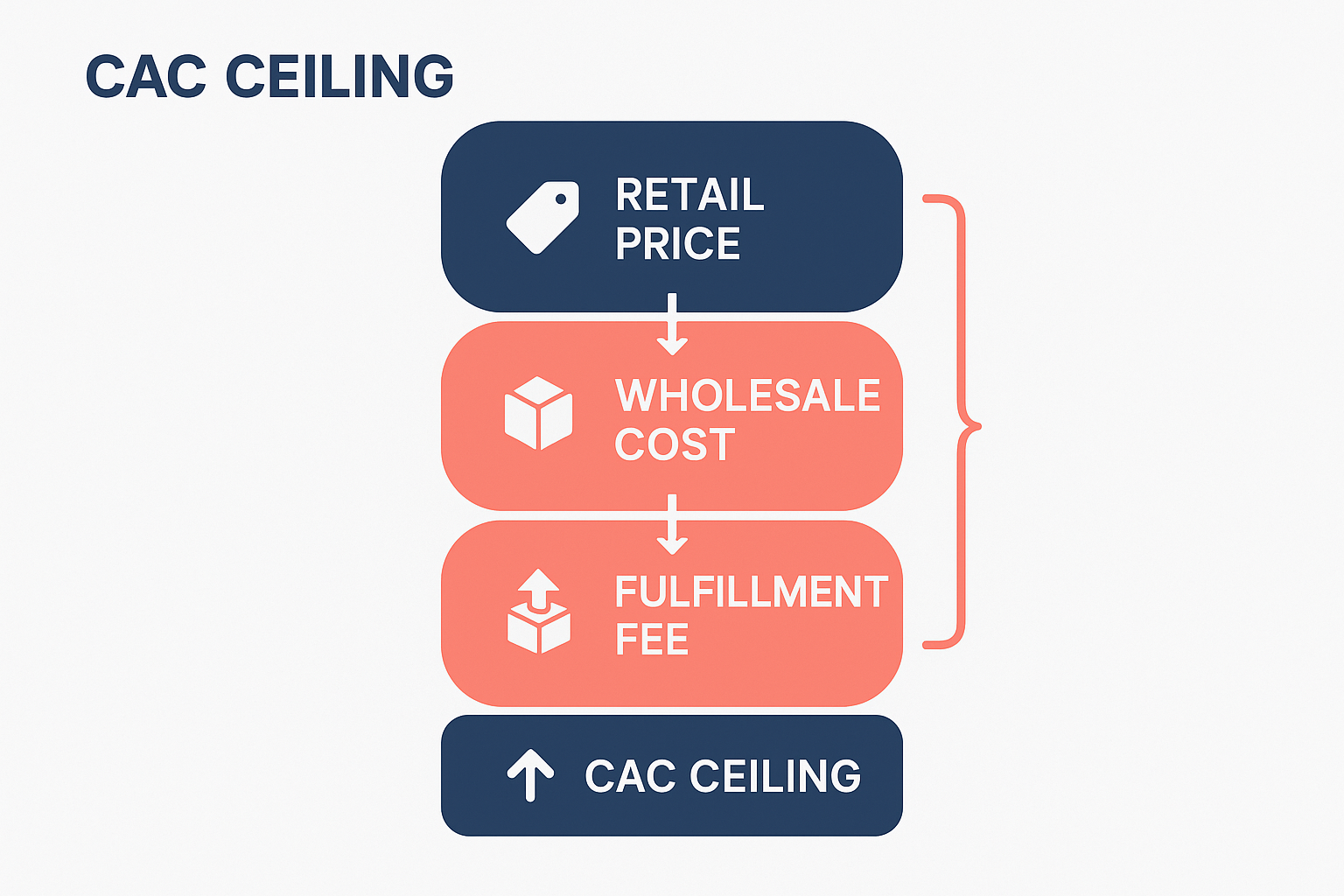
Your CAC ceiling is the most important number in your ad account. It’s the contribution margin on one bottle, and it tells you the maximum you can spend to acquire a customer before order one loses money. Spend above the ceiling and you’re financing every sale with future revenue. Spend below it and the first order carries its own weight.
The money math on one bottle
Lock the example to Best Sellers Blend (ROC105), a $35.97 retail product on the Scale plan. This is the only SKU in the playbook, and these are the dollars you plan with.
| Line item | Amount | Note |
|---|---|---|
| Retail price (MSRP) | $35.97 | Best Sellers Blend (ROC105) |
| Scale wholesale cost (COGS) | $5.71 | Scale plan wholesale price per unit |
| Fulfillment fee | $2.00 | Flat per-item fee, paid only when an order ships |
| Contribution margin | $28.26 | $35.97 minus $5.71 minus $2.00 |
| CAC ceiling | $28.26 | CAC must stay under this for order one to profit |
| Break-even ROAS | 1.27x | $35.97 in revenue per $28.26 of contribution |
A $20 CAC on this bottle leaves $8.26 of net contribution on order one before repeat purchases ($28.26 minus $20.00). That spread is your buffer, and it’s real margin, not projected lifetime value. The 1.27x break-even ROAS is the flip side of the same coin: any campaign that returns more than $1.27 per ad dollar clears the ceiling, and anything below it quietly burns contribution.
Why the ceiling holds with zero inventory
Notice what is not in the math. The flat $2 per-item fulfillment fee is the only fulfillment cost in this model. No pallet minimums, no storage line, no pick-and-pack surprise on the invoice. The $5.71 wholesale cost rides on the Scale plan’s lowest per-unit pricing, and you only pay the $2 fulfillment fee when an order actually ships.
Run your own numbers with the supplement margin calculator and model volume with the profit projection tool before you set a single bid. The ceiling only works when it’s attached to your real product price and your real wholesale cost.
Build the ceiling once, set your target CAC under it, and every campaign gets a pass or fail verdict before it spends a dollar. The discipline applies to every channel, and the ceiling does not move. Your CAC either fits under $28.26, or the campaign does not run.
Blended CAC vs Channel CAC: Which Number Do You Manage?
Blended CAC tells you whether the whole business is healthy. Channel CAC tells you where to spend next week. They answer different questions, and mixing them up is how a brand overspends on one platform while the overall number still looks acceptable.
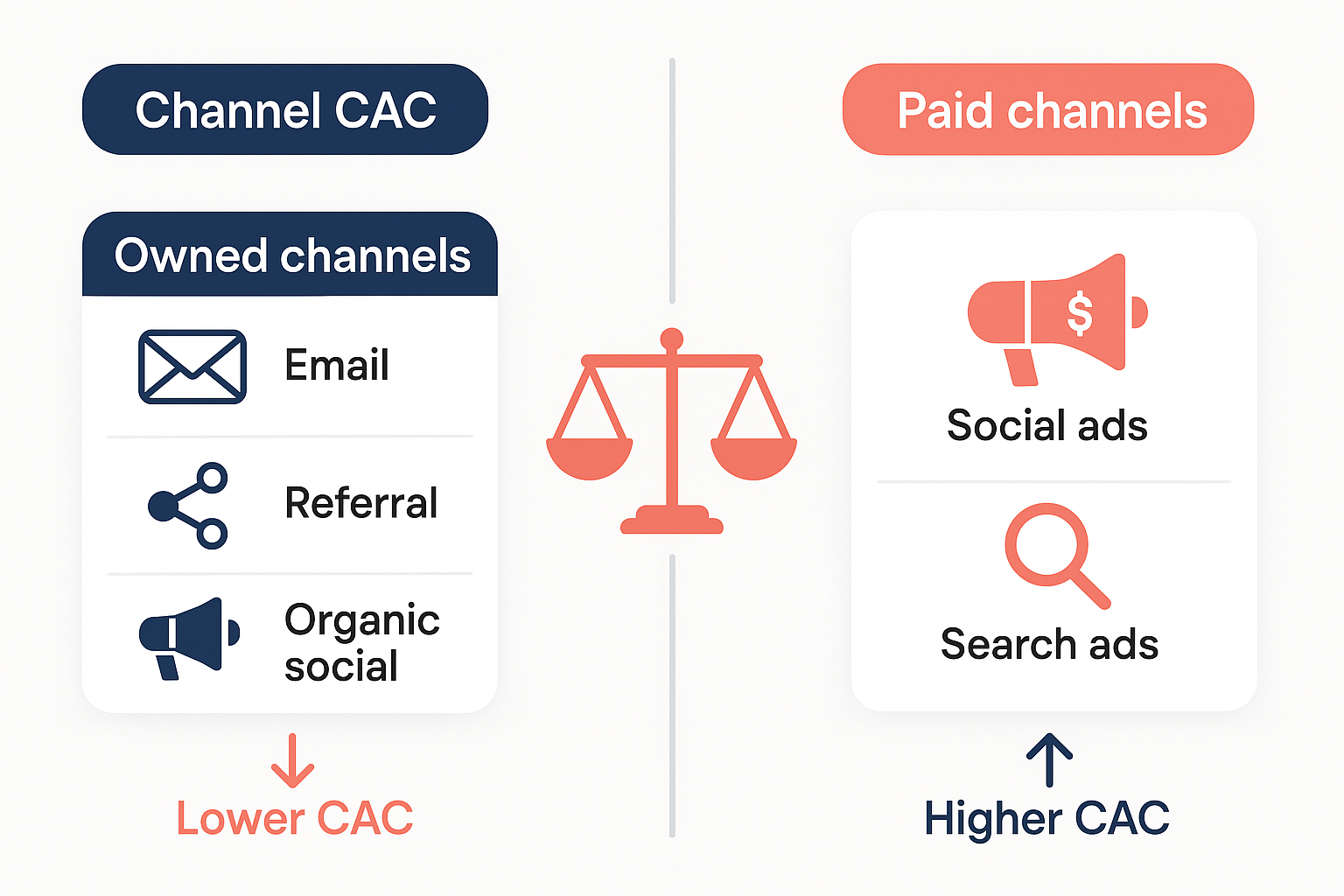
Blended CAC hides your winners and losers. An expensive paid channel can sit inside a blended average that still looks fine because owned channels bring the cost down. The blended figure will not tell you where the waste is. Only the channel view shows that.
Track all four, but for different jobs.
| CAC type | What it measures | What to use it for |
|---|---|---|
| Blended CAC | All acquisition spend divided by all net-new customers | Business health and monthly reporting |
| Paid-channel CAC | Per-platform spend divided by per-platform customers | Budget shifts between platforms |
| Owned-channel CAC | Email, referral, and organic spend divided by those customers | Near-zero-cost growth channels |
| Fully loaded CAC | Blended CAC plus creative and tools | The honest number for planning |
Channel-level benchmarks live separate from blended figures. Do not measure one platform’s CAC against a blended industry average; the mix of owned and paid traffic makes that comparison meaningless. Judge a channel against its own history and target.
The rule: manage channel-level CAC every week, report blended CAC every month. Channel numbers drive budget shifts, creative swaps, and ad tests, so they need a short feedback loop. Blended CAC drives pricing, planning, and any report you send to partners or investors, so it needs a stable monthly view. Watch both. Act on the channel number first.
The 3:1 LTV:CAC Rule for Supplement Subscriptions
Your customer’s lifetime value should run at least three times what it costs to acquire them. The 3:1 LTV:CAC rule is the commonly cited healthy floor for ecommerce, and Shopify’s research treats it as the benchmark for sustainable growth. That floor tells you how much room you have to bid for a customer. Fall below 3:1 and every new customer makes your margin thinner; hold it and you can keep buying demand profitably.
Most new brands never calculate the lifetime side at all. They look at order one, see a thin margin next to an ad cost, and quit before the second order exists.
Repeat revenue is why the rule works. About 60% of DTC revenue comes from returning customers, according to Ringly’s June 2026 data. One-and-done buyers wreck the math. Returning buyers build it, and a brand that sells each customer twice gets a fundamentally different business than one that sells each customer once; that gap is the whole ballgame for subscription brands.
Consumables change the ceiling
Supplements are consumables. People run out, so they reorder. That natural reorder rate is the structural advantage over one-off products like apparel or electronics. A subscription turns that reorder into predictable revenue, raising LTV without raising CAC because you are not paying to re-earn a customer you already own.
That’s the edge for your first order. A subscription brand can afford to spend more on acquisition over time because the back end covers it. Order one doesn’t have to carry the whole profit load. The contribution ceiling still applies to that first transaction, but a subscription lifts what that ceiling allows you to spend.
For the full breakdown, read the 3:1 LTV:CAC rule for supplements.
First-Month Ad Budget: How Much Should a New Supplement Brand Spend?
Start with a test budget you can afford to lose. For a new supplement brand, that is commonly $500 to $1,000 across 10 to 20 creatives. A spread that wide matters: three ads will not tell you which angle, offer, or audience carries the brand. Judge every result against contribution margin, not revenue. A low-margin order cannot pay for the next click, no matter how many you close.
Here is the cost structure that decides how far your first-month budget goes:
| Plan | Monthly fee | Paid when an order ships | Wholesale example |
|---|---|---|---|
| Free | $0/month | ~$2 per-item fulfillment fee, paid only when orders ship | Standard wholesale pricing |
| Scale | $297/month | ~$2 per-item fulfillment fee | Lowest per-unit wholesale; $5.71 on Best Sellers Blend (ROC105) |
Reading the table against your budget is simple. On Free, you pay nothing monthly and the ~$2 per-item fee only hits when an order ships, so nearly the whole $1,000 goes to traffic. On Scale, $297 of it is committed before the first impression, and you need the lower wholesale cost to earn it back.
The $297 Scale plan funds itself only if the higher margin converts into profitable first orders. So model the ceiling first. Work backwards from your target cost per acquisition, apply the per-order contribution margin, and see whether the plan fee survives contact with real results. Compare Rocktomic membership pricing to see both structures side by side before you commit.
Run the same model over a full month. If blended contribution margin per order covers ad spend plus the plan fee, raise the budget. If it does not, fix the offer before you buy more traffic. Ads do not fix a margin problem; they amplify it.
For a spend-by-spend map, follow the $1,000 launch ad budget plan.
Five Ways to Lower CAC Before You Spend a Dollar
Every dollar saved before your first ad is margin you keep. These five levers stack, and none of them require inventory or an upfront spend. Run them on the Free $0 plan while you build the brand, and your first paid campaign starts from a lower number.
Owned audience beats rented traffic
Post native content daily and route every follower to one owned channel, your email list or your store. That’s exactly how creators reach near-zero CAC for creator brands. People who already follow you cost nothing to reach again, and every piece of content adds a touchpoint you did not pay for.
Referral programs reward your best salespeople
Reward existing customers for bringing net-new buyers with a discount or store credit. A referred friend arrives with built-in trust that rented clicks do not carry. Each successful referral lowers your blended CAC without a cent of ad spend. Run it from day one, before you have traffic to waste.
Email is the cheapest channel you own
Capture emails before any paid push. Put a signup on every page, in every bio, and at checkout, then send value first and offers second. An address in your database turns a future order into the cost of a send, not a bid. Email keeps compounding while paid costs reset every auction.
Customer clips replace expensive agency creative
Ask buyers to film a quick unboxing or product-use clip, get permission, and repurpose those clips as ad creative. Each clip costs a discount code instead of a production budget. Your asset spend drops while the ads stay authentic. When the clip sells, you already own the creative and the rights.
Publish the COA and let trust lift conversion
Publish the Certificate of Analysis on every product page so prospects can verify GMP manufacturing and third-party testing before checkout. Higher conversion on traffic you already paid for means lower effective CAC. That single document keeps working on every visit at zero marginal cost. Skeptical buyers resolve their last objection before they click buy.
Stack all five before you fund an ad account. For more of the same math, run these three tactics to slash supplement CAC next.
How Zero Inventory Changes the CAC Calculation
Most supplement brands calculate CAC after they have already paid for the product. Pallet minimums, warehouse space, label runs. That capital sits in the CAC stack before a single ad converts, and it stays there whether the campaign wins or loses. You carry that cost no matter what.
The dropship model under how Rocktomic works starts with zero minimums. No pallet minimums. No required buy-in. You pay the ~$2 per-item fulfillment fee only when an order ships. No dead capital parked in inventory. No risk of overbuying stock before the ad math is proven. Your first dollar goes to acquiring a customer, not to a purchase order.
That changes what CAC actually measures. Instead of the number absorbing product cost, ad spend, and the cost of being wrong, it covers the cost of acquiring a customer. The contribution ceiling stays intact because every ad dollar goes to finding buyers, not funding a warehouse.
Month one is for testing, not waiting
The payoff lands fast. A brand with no inventory commitment can test more creatives and more SKUs on the same budget. Cut losers fast. Push more spend into winners. You iterate in weeks while competitors wait on their first pallet. That speed is the whole game for a new brand.
The fee math lives earlier in this playbook, and the plan economics have their own section. The point here is simpler: when inventory can’t eat your contribution ceiling, CAC becomes a number you can manage. Test. Measure. Scale.
FAQ: Customer Acquisition Cost for Supplement Brands
What is customer acquisition cost (CAC) for a supplement brand?
Customer acquisition cost is the total marketing spend required to earn one new paying customer. It is calculated by dividing all acquisition expenses, including ad spend, creative production, software, and any agency or labor costs, by the number of net-new customers in the same period. For direct-to-consumer brands, blended CAC averages between $68 and $84, while supplement brands run higher, near $89 per customer (Ringly, June 2026). CAC only becomes useful when compared against the margin a first order produces.
How do you calculate CAC for a new supplement brand?
Add every cost tied to winning customers: ad spend, creative, marketing tools, and the portion of any salary or agency fee that goes to acquisition. Divide that total by net-new customers acquired during the same window, and exclude returning customers from the denominator. Track the number weekly, and also compute channel-level CAC for paid social, organic, and referral because a blended figure hides which channels are profitable. A fully loaded number that includes creative and tools is more honest than an ad-spend-only figure.
What is a good CAC for a supplement brand?
A good CAC is any number below your first-order contribution margin. Contribution margin is retail price minus wholesale cost minus fulfillment fee. For a bottle sold at $35.97 with a $5.71 wholesale cost (ROC105) and a $2 fulfillment fee, contribution is $28.26, so CAC must stay under that to break even on order one. Industry context helps: supplement brands average near $89 CAC (Ringly, June 2026), so a margin-driven ceiling keeps a new brand honest while benchmarks set expectations.
What is the LTV:CAC ratio for supplements and why does it matter?
The LTV:CAC ratio compares lifetime customer value to acquisition cost. The commonly cited healthy floor is 3:1, meaning a customer returns three dollars for every one dollar spent to acquire them (Shopify research, cited 2026). Supplements have an advantage here because consumables drive repeat purchases, and roughly 60% of DTC revenue comes from returning customers (Ringly, June 2026). A repeat-purchase subscription lifts LTV quickly, which lets a brand afford a higher CAC in later months without sacrificing first-order profit.
How can a zero-inventory supplement brand profit on the first order?
First-order profit happens when contribution margin exceeds CAC. Because Rocktomic dropships with no minimums, a brand pays only the wholesale cost plus the flat ~$2 per-item fulfillment fee when an order ships, so there is no inventory or dead capital in the calculation. That keeps the contribution ceiling high. With a strong organic channel, like a creator’s own followers, or a low-cost channel such as email, CAC can sit far below the ceiling, which makes order one profitable even before repeat purchases arrive.
What should a first-month ad budget be for a supplement brand?
Start with a test budget you can afford to lose, commonly $500 to $1,000 across 10 to 20 creatives, and judge it against contribution margin rather than gross revenue. On the Free plan at $0 per month, the only variable cost is the ~$2 per-item fulfillment fee when orders ship. On the Scale plan at $297 per month, brands get the lowest per-unit wholesale pricing, which raises contribution margin and gives a higher CAC ceiling at the same retail price. Reallocate to winning creatives only after payback is visible.
How does the Scale plan change supplement CAC math?
The Scale plan costs $297 per month and lowers wholesale cost per unit, which raises contribution margin and the CAC ceiling. Using Best Sellers Blend (ROC105) as an example, Scale wholesale is $5.71 on a $35.97 retail bottle, producing $28.26 of contribution after the $2 fulfillment fee. A $297 monthly plan is only justified if the higher margin converts into profitable first orders, so brands should model the ceiling before spending. The plan also unlocks the full catalog and priority fulfillment.
What fees should a supplement brand include when calculating CAC?
Include ad spend, creative production, marketing software, and any agency or contractor fees in the CAC numerator. In the cost stack, remember the flat ~$2 per-item fulfillment fee Rocktomic charges when each order ships, plus payment processing and any platform commission, because those reduce contribution margin before ads are accounted for. Excluding fulfillment and processing fees is the most common reason a first-order profit model looks better than reality. Stack all of them, then compare the remaining contribution to CAC.
Your First Move: Model Your CAC Ceiling
Run the supplement margin calculator to get your own CAC ceiling, then compare Rocktomic membership pricing to pick the Free $0 start or the Scale $297 plan. If the math holds, own your brand with zero inventory. Rocktomic handles US GMP manufacturing with a COA on every batch, and the Free plan starts at $0/month. That is why creators launch here instead of tying cash up in pallets. Want a first-order budget review? Then book a call with Rocktomic, or see how other creators launch with white label for creators.
Last updated: June 21, 2026.