
The Custom Label Fast-Track: How Long Does It *Really* Take to Launch?
· 17 min read · By Rocktomic Labs Team

How Long Does It Really Take to Launch a Supplement Brand?

About 7-14 days. That’s how long a custom-label supplement launch takes when you work with an on-demand private label manufacturer that already stocks 140+ US-manufactured products. You can move from logo to first live sale inside that window. The traditional route – formula development, packaging lead times, minimum order runs – typically stretches 3-6 months or more. This guide breaks down both timelines step by step and shows exactly where those weeks go.
What Is the Custom Label Fast Track?
The custom label fast track is a launch model built for speed. A member picks a ready-made, GMP-certified product from the Rocktomic catalog, applies their own logo and label, connects a store, and starts selling. No inventory to buy. Rocktomic manufactures, warehouses, labels, and drop-ships each order under the member’s brand.
See the first-90-days cash a traditional private label run actually demands – next to what the same launch costs on Rocktomic.
Because the formula already exists and stock is on the shelf, the only real work left is branding, store setup, and compliance review.
Why Traditional Supplement Launches Take 3-6 Months
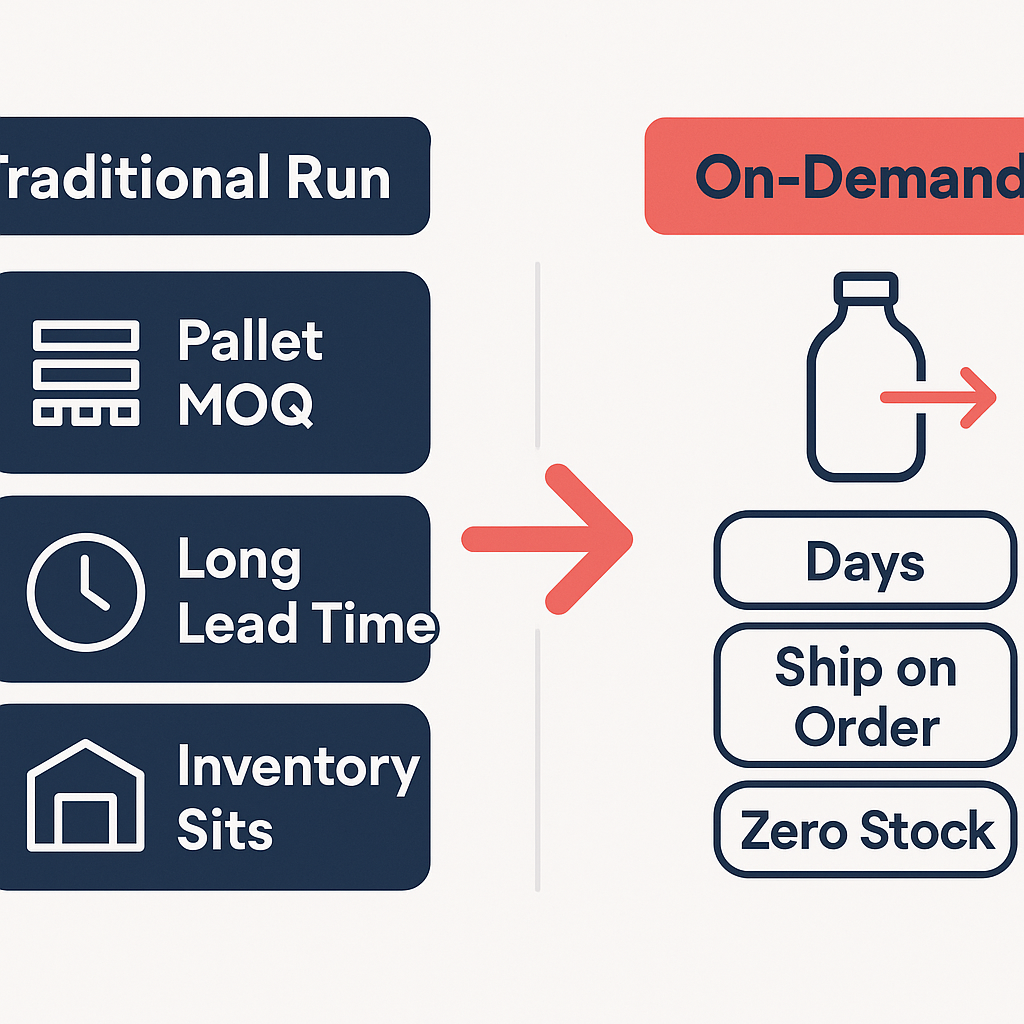
Every step in a traditional supplement launch waits for the one before it. Custom formulation has to wrap before ingredients get sourced. Sourcing has to finish before stability testing can begin. Label proofs can’t be approved until the formula is final, and production can’t start until labels exist. That gating repeats across six steps, and three months slip away before a single bottle reaches a shelf.
The conventional pipeline runs in one direction
Custom formulation comes first. You brief the manufacturer, iterate on the blend, and lock the ingredient profile. Formulation alone can eat weeks when you are going back and forth on dosage and ingredient forms. Every revision resets part of the clock. Next is ingredient sourcing, where raw materials carry their own supplier lead times. A single backordered ingredient stalls the whole project.
Then stability testing parks your batch in controlled conditions for weeks to verify shelf life. There is no shortcut around it, and there is no overlap: the product must pass before you print labels or book production. A failed check means starting over, not waiting. Label printing follows with proofs, revisions, and a print run. Only then does your first production run get scheduled. Fulfillment setup comes last: storage, picking, packing, and connecting your store to a warehouse system.
Notice what is missing: any overlap. Each handoff waits on the prior handoff. Small runs get batched into shared production windows with other brands, so your first run waits for the manufacturer to fill a full schedule. That queue alone adds weeks before production starts.
Built for pallets, punishing for new brands
That pipeline exists to serve big orders, and it shows. Manufacturers that force pallet-size buys turn a first order into a gamble on inventory you might not sell. Platforms that charge per-order fees tax every shipment, so testing a product costs you twice: once on the buy-in, once on every unit. Both models assume you already know what will sell. The math only works when volume is guaranteed.
Rocktomic runs the opposite way. No inventory to purchase, no shared production window to join, no minimum order standing between you and a first sale. The product, the label, and the customer relationship all belong to you. The detailed case for why choose Rocktomic is that the queue disappears entirely instead of being managed around.
For a side-by-side look at how the two calendars diverge, read traditional launch timelines vs supplement dropshipping. And if you want a direct feature-by-feature comparison against the per-order-fee model, the Rocktomic vs Supliful breakdown shows where the costs hide.
The On-Demand Fast Track: 7-14 Days From Logo to Live
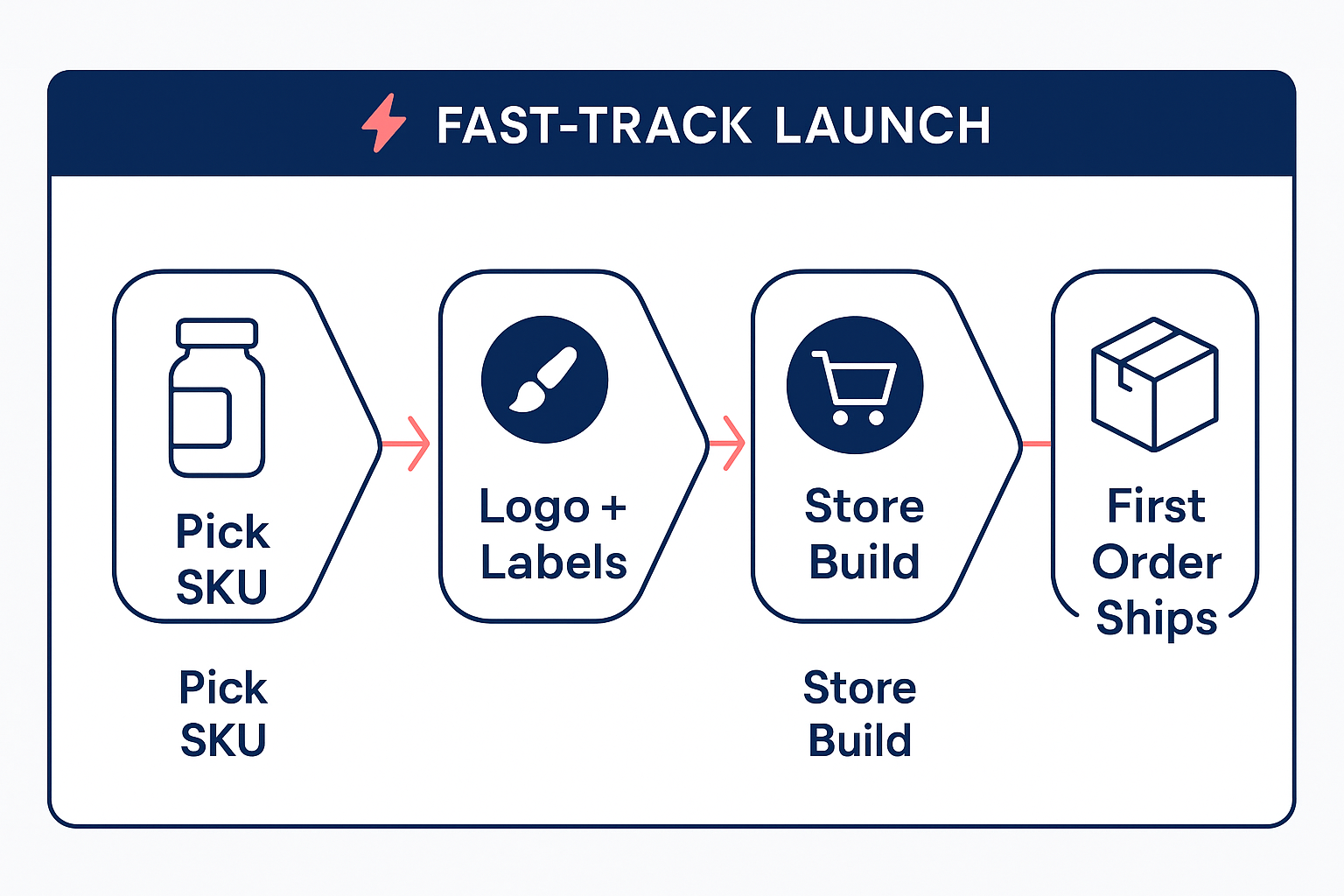
Speed comes from parallel tracks, not faster work. A traditional launch runs in sequence: wait for the label, then build the store, then approve the label, then list the product. Each step waits on the one before it, and each wait costs a week or more. The on-demand track collapses that sequence. Design and store setup run at the same time, and label approval happens while the store is already being connected to the sales channel you’ll sell on.
That’s the structural reason a 7-14 day launch is possible. You’re not compressing the work. You’re running it in parallel. Here’s the exact day-by-day path:
| Day | What happens |
|---|---|
| Day 1 | Sign up on the Free plan at $0/month, pick a SKU from the 140+ catalog |
| Days 2-4 | Logo, label, and 3D mockups via the optional Starter Branding Package ($497 one-time, 1 logo + 10 labels + 10 3D mockups) or member-supplied files |
| Days 5-6 | Store build (optional done-for-you Shopify build-out at $1,497 or Business-in-a-Box bundle at $997) plus sales channel connection |
| Day 7 | Label approval and compliance review |
| Day 8+ | Store goes live and first orders ship in 1-2 business days under the member’s label |
Two tracks, one deadline
Two tracks overlap between Day 2 and Day 6. While your logo and label are in production, your store is being built and your sales channel is being connected. Both finish around the same time, so Day 7 is an approval checkpoint, not a production day. You approve the label once, review the compliance details, and the store is ready to go live. The whole flow maps to four steps: select a SKU, build the brand assets, connect the store, and ship the first order.
The optional packages remove the two biggest bottlenecks: design and store setup. The Starter Branding Package covers the logo, labels, and 3D mockups. The done-for-you Shopify build-out handles the store itself. Business-in-a-Box bundles both at $997. If your files are already ready, you skip those days entirely and move straight to approval.
The flat $2 per item fulfillment fee
The fulfillment fee is the reason this model works without inventory. Every order that ships carries a flat fee of about $2 per item for pick, pack, and label. You pay it only when an order ships. No order, no fee. There is no minimum buy-in, no pallet sitting in a warehouse, and no guesswork about how much to order.
That shifts the risk. With traditional manufacturing, you commit to hundreds of units and hope they sell. With on-demand, that $2 per item fee is the only fulfillment cost, and it appears only after a customer pays you. Your product is manufactured, labeled, and shipped under your brand the moment an order comes in. The customer sees your label, your inserts, and your packaging. That’s how on-demand fulfillment works, end to end.
For the exact fee breakdown, read on-demand fulfillment and the $2 per item fee. If 7-14 days feels too fast, the 30-day supplement launch blueprint walks through a slower, more deliberate schedule. Either way, the clock starts on Day 1 when you pick your SKU, not after a 90-day manufacturing run. The final step: your first order ships in 1-2 business days under your label, and the brand is live.
What Actually Slows a Launch Down – and How to Avoid It
Most launch delays never happen on a production line. They happen in review queues: label compliance, marketplace approval, and custom packaging. Each one, left unplanned, adds weeks to your calendar. A fast launch plan assumes these gates clear on schedule. Here is what each lever costs you and how to clear it fast.
Label Compliance: One Missed Line, One Full Reprint
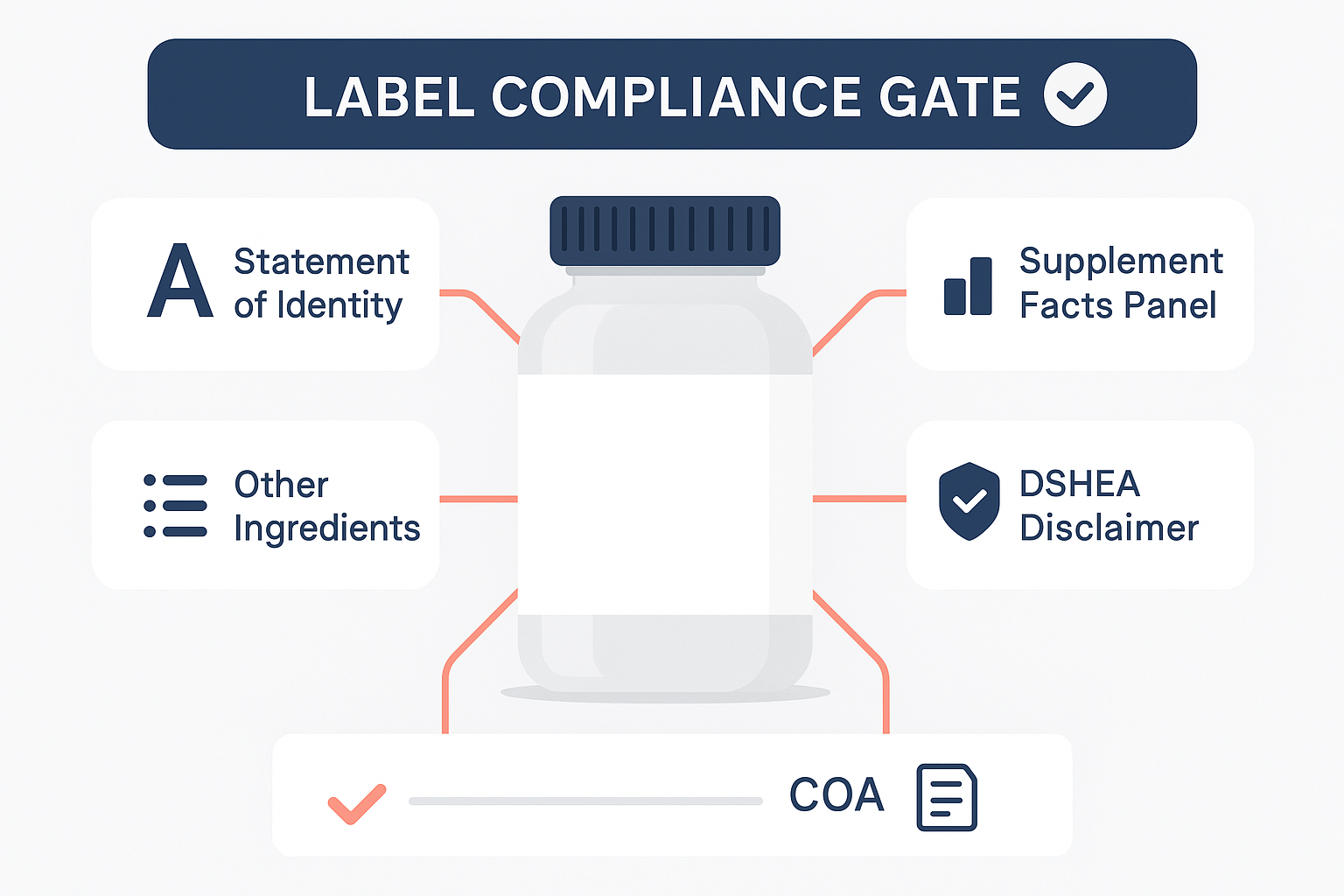
The Supplement Facts panel is required on virtually every supplement label under eCFR 21 CFR 101.36 (retrieved 2026-06-21). If your label makes a structure/function claim, the DSHEA disclaimer under eCFR 21 CFR 101.93 (retrieved 2026-06-21) must appear right below it. The FDA’s May 27, 2016 final rule revised these requirements and their compliance dates (Federal Register, retrieved 2026-06-21).
Miss one element and you reprint, then you re-review. That is a two-week detour on a launch that should run in days. It is also entirely avoidable when someone checks the label against the current rule before printing.
Platform and Marketplace Approval: Paperwork Gates the Store
Sales channels gate supplement sellers on documentation. They want a Certificate of Analysis and GMP evidence before listings go live. Missing paperwork stalls the store, not the product. Most sellers never touch this step until their store is already built, which turns a five-minute upload into a multi-week review. The fix is to have the documents ready on day one, not after the channel asks.
Custom Packaging: The Longest Detour
Bespoke bottles and custom prints add weeks to months. Every design revision, mold, and print run stretches the calendar. Some brands design packaging first and then wait for inventory, which is the longest single detour in the whole launch. This is the lever that kills the fastest launch plans.
| Delay | Why it happens | Fast-track fix |
|---|---|---|
| Label compliance | Required Supplement Facts panel and DSHEA disclaimer elements get missed, forcing reprints and re-review | Rocktomic’s label review on Day 7 covers compliance before the store goes live |
| Platform and marketplace approval | Channels gate supplement sellers on COA and GMP documentation; missing paperwork stalls the store | Every Rocktomic batch ships with a COA, ready for channel review |
| Custom packaging | Bespoke bottles and prints add weeks to months | Member label is applied to in-stock product at ship time; no packaging lead time |
Rocktomic’s Answer: In-Stock Product, COA on Every Batch
Two of those three levers are closed before you start. Rocktomic ships in-stock product, so there is zero packaging lead time. The member label is applied at ship time, which removes the bottle and print queues entirely. A COA on every batch, documented through Rocktomic quality and COA pages, gives channel reviewers the paperwork they ask for before they ask. The label compliance gate clears in the Day 7 review. That is the fast-track math: the delays are engineered out, not managed around.
Zero-Inventory Money Math: What the Fast Track Costs
Here is where the fast track pays for itself. Take the canonical Rocktomic example: Super Creatine Gummies 1000mg (ROC943). At full MSRP of $29.97 and Scale wholesale of $8.45, you keep $21.52 per bottle. That is a 71.8% margin before a single fulfillment fee is touched.
That margin comes from Scale’s lowest per-unit wholesale pricing. It also assumes you sell at full MSRP, which is the right way to model a launch. Discount early and you will watch that margin erode in real time.
Every cost that touches this model fits in one table. That is the point. No hidden line items waiting in month three.
| Cost line | What you actually pay |
|---|---|
| Membership | Free $0/month or Scale $297/month |
| Fulfillment | Flat about $2 per item, only when an order ships |
| COGS per unit | $8.45 (ROC943) |
| MSRP reference | $29.97 |
| Gross margin per unit before fulfillment | $21.52 (71.8%) |
| Net per unit after flat fulfillment | $19.52 at full MSRP, before platform fees |
| Optional one-time add-ons | Starter Branding $497, Store Build-Out $1,497, Business-in-a-Box $997 |
Read the net line twice: $19.52 per bottle at full MSRP, before platform fees. The $2 flat fulfillment fee is the only per-item cost that appears when an order ships. No storage fee for sitting inventory. No restocking line item. No pallet to finance.
Now stack that against a traditional first run. A conventional manufacturer wants pallet quantities, and you pay for thousands of units months before your first sale lands. That cash is tied up before you have proof of demand. If the product misses, you are sitting on bottles that cost you money every day they sit still. The dropship model flips the order: zero MOQ, and you spend nothing until a customer actually orders. Your first paid purchase is the first purchase a customer already made. Money parked in pallets is money that cannot fund content, ads, or the next product idea.
That changes what month one looks like. Instead of writing a check for inventory, your only real launch costs are the optional add-ons you pick. Starter Branding covers your logo, labels, and 3D mockups. Store Build-Out delivers a finished Shopify store with up to 10 products. Business-in-a-Box bundles both. All are one-time packages.
Those are choices, not requirements. The Free plan stays $0/month, and you still pay only the ~$2 per-item fulfillment fee when orders ship. Month two looks the same: no membership fee on Free, no inventory to carry, no minimum order to meet.
Run your own numbers before you commit. You can calculate net margin per bottle with the ROC943 math or your own target price, then compare supplement startup costs side by side.
That is the whole financial case: low fixed costs, a flat per-item fee, and a margin structure you can see before you sell a single unit. The risk is not eliminated. It is just moved to where it belongs, after the customer pays.
Why Speed Matters: Launch Before You Over-Plan
Demand is not waiting on your timeline. The global dietary supplements market was valued at $209.5 billion in 2025 and is projected to reach $228.2 billion in 2026, growing to $431.7 billion by 2033 at a 9.5% CAGR (Grand View Research, June 16, 2026, retrieved 2026-06-21). Every quarter spent planning is a quarter of that growth flowing to someone else’s store.
A 7-14 day launch is not a rushed launch. It is a decision to test in the market instead of in a document. Your audience’s momentum is a real asset, and it decays. Content that connects this month loses its pull by next quarter. A fast launch moves while that attention is still warm and turns it into orders.
Trend windows work the same way. Brands that enter early capture the attention; late entries pay more to chase the same customer. A 7-14 day launch puts you in the first wave instead of the crowded follow. Speed is a positioning advantage, and it costs nothing extra.
First Orders Beat a Perfect Plan
A perfect launch plan is guesswork dressed up as strategy. First-sale data is truth. Real orders tell you which SKU deserves more inventory, which price point actually converts, and which channel pays for itself. You learn from buyers, not assumptions. No spreadsheet can deliver that. Six months of planning answers questions nobody asked; one launch answers the ones that matter. Launch small, read the data, and scale what works.
The creator funnel is built for speed: publish content, send viewers to the margin calculator, and let the numbers decide if the Scale plan makes sense. The math drives the move, not the planning cycle. You can launch white label supplements with zero financial risk because there is no pallet to buy and nothing ships until a customer orders. Start on the Free plan at $0/month, prove the product, then step up to Scale at $297/month once orders confirm the demand. The first order is the only forecast you should trust.
What You Need Before You Start
Most dietary supplements do not need FDA pre-approval before they go to market. A responsible brand still has to comply with GMP and labeling rules under 21 CFR 101.36 (retrieved 2026-06-21). That single reality keeps this checklist short.
On a traditional custom-label launch, you would be lining up a manufacturer, a warehouse, a label designer, and a compliance consultant before you ever saw a proof. None of that applies here. The on-demand model absorbs those jobs, which is why the pre-launch list stops at five lines.
Five items stand between you and a live storefront. The owner column matters as much as the item itself.
| Item | Owner | Why it matters |
|---|---|---|
| Business entity or tax ID | Member | Required for channel and payment setup |
| Logo files (or use the $497 Starter Branding Package) | Member or Rocktomic | Brand identity for labels and mockups |
| Product pick from the catalog | Member | Selects the SKU to launch |
| Compliant label direction | Rocktomic | Rocktomic handles the regulated Supplement Facts panel so the member does not redraw 21 CFR 101.36 elements from scratch |
| Channel accounts ready for documentation | Member | COA and GMP evidence are required for platform approval |
The member-owned rows are the ones to line up first. If you do not have a designer, the $497 Starter Branding Package delivers your logo, labels, and mockups. The compliance row stays with Rocktomic, so it never becomes your bottleneck.
The list is tight on purpose. The fast track strips out packaging decisions, inventory buy-in, and formula development. You do not redraw a Supplement Facts panel from scratch, and you do not guess at GMP paperwork. Rocktomic owns the regulated label elements from the catalog SKU, and every batch ships with a Certificate of Analysis.
Your real job is the brand and the customer relationship. That is what the checklist reflects: entity, logo, SKU, label direction, and channel documentation. Get those five in order and you can move to launch sequencing.
FAQ: White Label Supplement Launch Timeline, Costs, and Compliance
How long does it take to launch a white label supplement brand?
On the fast track, a white-label supplement brand can go from concept to ready-to-sell in about 7 to 14 days. That window covers picking a product from the catalog, submitting a logo, approving label proofs, and connecting a sales channel. Rocktomic’s Free plan costs $0/month, and the optional $497 Starter Branding Package handles the logo, 10 labels, and 10 3D mockups. Most of that time is the brand owner’s feedback loop, not production.
What steps are on the custom label fast track?
The fast track runs through five steps: choose a product from the 140+ product catalog, lock the label design, upload artwork, connect one sales channel, and start selling on demand. The $497 Starter Branding Package includes 1 logo, 10 labels, and 10 3D mockups, so the brand looks finished before the first order ships. Optional store build-outs cover a fully built shop with up to 10 products. No inventory is purchased at any step.
Do I need FDA approval before I can sell supplements?
The FDA does not approve dietary supplements before they go to market, so there is no approval to wait on. Compliance is still mandatory. Labels must follow 21 CFR 101.36 for nutrition labeling and 21 CFR 101.93 for structure/function disclaimers, and manufacturing must meet 21 CFR Part 111. Rocktomic produces in GMP-certified US facilities and attaches a Certificate of Analysis to every batch, which keeps the compliance burden manageable for a new brand.
What delays a supplement launch the most?
The biggest delays come from custom work. Custom bottles can add weeks to months, and proprietary formulas extend the timeline further because of formulation and testing. The fast track avoids both by using stock bottles, existing formulas, and on-demand labeling. Once a store is live, orders ship in about 1-2 business days. The Free plan at $0/month keeps launch costs low while the brand validates demand before spending on custom packaging.
How fast can I get my label on a product and start shipping?
Once the label artwork is approved, Rocktomic applies the label at fulfillment and orders ship in about 1-2 business days. The fee is a flat about $2 per item, charged only when an order actually ships. A brand can put a label on a product, list it, and fulfill the first sale within two business days without prepaying for stock.
What does it cost to launch on the fast track?
A fast-track launch starts at $0/month on the Free plan, which includes up to 10 white-label products and one sales-channel integration. Fulfillment runs about $2 per item, charged only when an order ships. The Scale plan at $297/month opens the full 140+ product catalog, unlimited sales channels, and priority fulfillment. Optional one-time packages: $497 for Starter Branding, or $997 for Business-in-a-Box, which bundles branding with a store build-out.
How much margin can I keep on a fast-track launch?
On a fast-track launch, margin is the spread between wholesale and retail. Using ROC943 as an example: MSRP is $29.97, wholesale cost is $8.45, which leaves $21.52 per unit (71.8%) before the flat about $2 per item fulfillment fee. Wholesale across the catalog runs about $4.55 to $44.90 per unit. The MSRP is a reference price, not a price set by Rocktomic, so the brand owner controls the final margin.
Do I have to buy inventory to launch?
No. The dropship model runs at a zero minimum order quantity, so $0 in upfront inventory is required; Rocktomic produces and ships only when an order is placed. Bulk orders use a 24-unit minimum per SKU for a lower per-unit cost, and custom formulas run under a separate high-MOQ program. Either way, the member owns the brand, the customer relationship, and the margin.
Your Next Step: Compare Plans, Run Your Numbers, and Launch
Own your brand with zero inventory, a $0/month entry, and US GMP quality with a COA on every batch. The launch clock starts today, not next quarter.
Your move: compare Rocktomic membership plans, run a SKU through the margin calculator, and book a call with Rocktomic. Scale at $297/month includes lowest per-unit wholesale, unlimited channels, full catalog, and priority fulfillment.
Last updated: 2026-06-21