
The Profit Margin Masterclass: Analyzing the Top White Label Supplements
· Updated · 16 min read · By Rocktomic Labs Team
The most profitable white label supplements are light, premium-priced formats: capsules and gummies routinely clear 70% to 85% gross margin, while heavy powders like protein run thinner at 43% to 68%. The smartest first SKU combines a fat margin with rising demand, and this guide ranks real per-unit numbers across creatine, pre-workout, gummies, and protein so a creator can pick the money-maker before spending a dollar on ads. Gross margin is the engine behind ad spend, samples, and free shipping. A few points of margin shift whether a launch breaks even in week two or week twelve.
What Are White Label Supplement Profit Margins?
A white label supplement profit margin is the difference between the retail price a brand sets and the wholesale cost it pays its white-label manufacturer, Rocktomic, expressed as a percentage of retail. The brand owns the label and the customer, so every dollar between wholesale and MSRP is gross profit. Fulfillment and marketing fees all come out of that gross margin, which is why format choice matters as much as the sticker price.
See the first-90-days cash a traditional private label run actually demands – next to what the same launch costs on Rocktomic.
Why Margin, Not MSRP, Decides Your First SKU
Sticker price is meaningless without COGS. Gross margin is simple math: retail price minus wholesale cost, divided by retail price. Net margin is what survives after fulfillment fees, payment processing, ad spend, and chargebacks. The gap between the two is where most first-time brands lose money. COGS confusion is the classic creator pain: they price against a competitor’s bottle and forget that every fee attached to the order moves the real margin.
Start with the rule of thumb: a $30 bottle at 80% margin beats a $60 bottle at 40% margin for cash flow and ad payback. The higher-margin product recovers its acquisition cost faster, leaves room to test creatives, and can absorb a launch discount without going negative. The expensive bottle looks bigger on the label but does not automatically put more in your pocket after fees.
Programs that force pallet buys or charge per-order fees eat the same gross margin from both ends. A launch that requires inventory upfront turns a margin decision into a cash-flow gamble. Rocktomic’s dropship model requires no inventory, so you calculate margins on real per-unit costs instead of guessing at volume pricing. Run the numbers through the supplement margin calculator before you commit to a first SKU.
Demand decides whether a fat margin ever turns into revenue. Grand View Research tracks sports nutrition as a growing category, and a high-margin product nobody searches for is still a losing SKU. This guide ranks the formats that combine margin with demand, starting with the lightest SKUs a creator can launch.
The Margin Spectrum: Where Each Category Sits
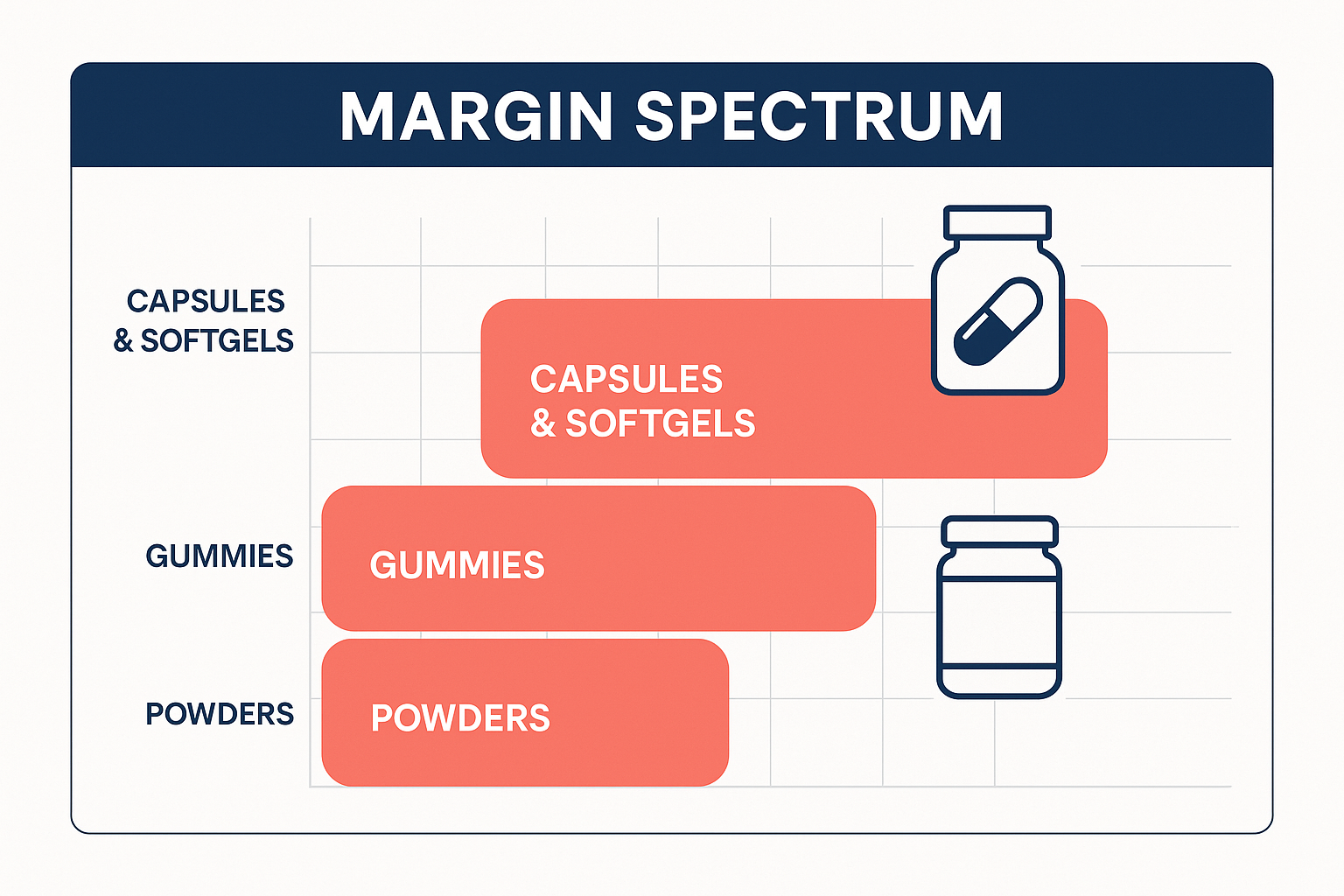
Format decides your margin band before you sell a single unit. Capsules ship light and pack a premium price. Gummies carry low raw-material cost. Powders give away margin through formulation, jar weight, and freight. The table below uses real Scale wholesale prices from the Rocktomic pricing list, so this is not a theoretical band. These are the actual dollars on five sellable SKUs.
| Format | Example SKU | MSRP | Scale Wholesale | Margin $ | Margin % |
|---|---|---|---|---|---|
| Super Fruit Gummies w/Essential Vitamins | ROC944 | $25.97 | $5.12 | $20.85 | 80.3% |
| Sea Moss Capsules | ROC835 | $35.97 | $5.34 | $30.63 | 85.2% |
| Creatine Powder 300g | ROC609 | $35.97 | $9.30 | $26.67 | 74.1% |
| Pre-Workout Fruit Punch | ROC605 | $39.97 | $12.64 | $27.33 | 68.4% |
| Protein Whey 2lb Chocolate | ROC607 | $59.97 | $27.25 | $32.72 | 54.6% |
The one-line takeaway: capsules and gummies top the band, while protein and heavy powders sit at the bottom because formulation and freight cost more per unit.
Dollar Margin vs Percentage Margin
Look at the dollar margin, not just the percentage. Sea Moss Capsules return $30.63 per unit at a $35.97 MSRP. Protein Whey 2lb returns $32.72, but it carries a $59.97 price tag and far heavier logistics. The percentage column tells you efficiency; the dollar column tells you cash in hand.
The pattern holds across the broader catalog. Light, concentrated formats win on percentage margin; heavy, bulky formats carry a bigger dollar margin but cost more to move. If your store leans on repeat purchases, gummies and capsules give you quicker restock cycles at better margins. If you anchor with protein to build trust, pair it with a high-margin capsule line to balance your average.
That spread is why category choice matters more than label design. A gummy brand clears roughly 80 cents per dollar at wholesale before marketing. A protein brand works harder for similar gross profit. Before you pick a lane, compare white label vs private label margins and see which ownership model fits the category you choose.
Creatine: The High-Demand, Low-Cost Margin Leader
Creatine is the classic first SKU in sports nutrition. Demand is massive, the cost of goods is small, and your audience already knows the ingredient. That combination produces margins most categories cannot touch.
The demand numbers you can build a brand on
Grand View Research (June 2026) valued the global creatine supplements market at $1.4 billion in 2025. It projects a 26.2% compound annual growth rate to $8.7 billion by 2033, with powder holding an 80.4% share of the market. See the Grand View Research report for the full breakdown.
Retail data points the same direction. SPINS data via Nutritional Outlook (February 2026) shows creatine up 71.9% in MULO performance for the 52 weeks ending November 30, 2025. Nutritional Outlook covered those tailwinds here.
The per-unit money math
| Product | Wholesale | MSRP | Margin | Margin % |
|---|---|---|---|---|
| Creatine Powder 300g (ROC609) | $9.30 | $35.97 | $26.67 | 74.1% |
| Super Creatine Gummies 1000mg (ROC943) | $8.45 | $29.97 | $21.52 | 71.8% |
Why low COGS makes this the classic first SKU
Low cost of goods is what lets a fitness creator launch without inventory risk. At a $9.30 example wholesale on creatine powder, you have room for platform fees, ad spend, and still keep a real margin. The canonical Super Creatine Gummies example works the same way: $8.45 Scale wholesale on a $29.97 MSRP leaves $21.52 per unit.
Those margins hold up at any order size. A low wholesale price per unit means you are not tying up cash in product, and the gap between wholesale and MSRP covers the costs of selling it.
Creatine is also a repeat-purchase product. Customers finish a tub and come back for another. That built-in reorder cycle turns one sale into a dependable revenue stream.
Your audience already knows creatine. You do not need to educate them on what it is. You only need to be the brand they buy it from. That shortens your sales cycle and lowers your customer acquisition cost.
For the full category breakdown, read the profit margin masterclass on creatine.
Pre-Workout: Formulation Costs Eat Into Margin
Global pre-workout sales hit $21.0 billion in 2025, and powder alone accounts for 88.6% of that volume, according to Grand View Research (July 2026). That creates a crowded market, and powder is the default entry point for almost every new brand. The catch: pre-workout formulations are expensive to make, and that expense lands directly on your wholesale price.
| SKU | Wholesale | MSRP | Margin per unit | Margin % |
|---|---|---|---|---|
| Pre-Workout Fruit Punch (ROC605) | $12.64 | $39.97 | $27.33 | 68.4% |
| Pre-Workout Watermelon (ROC606) | $14.03 | $39.97 | $25.94 | 64.9% |
The two flavors carry the same $39.97 MSRP, yet the wholesale prices differ by $1.39. That gap comes from each formula’s ingredient load. Pre-workout is a multi-ingredient blend: caffeine, beta-alanine, creatine, citrulline, and often a half-dozen more actives. Every active ingredient adds to the cost per scoop, and heavier tubs mean more material, more packaging, and more freight. That’s why pre-workout margins land below capsules and gummies, which use simpler formulas and lighter tubs. The category still beats most protein powders because the retail price holds a strong premium. In plain terms, the higher wholesale cost on the Watermelon SKU shaves $1.39 off your per-unit margin compared to the same formula in Fruit Punch.
Flavor variety turns one formula into two SKUs. The same base recipe can be sold as Fruit Punch and Watermelon, with only the flavoring system changed. That gives you two product listings, two customer entry points, and two margin streams without a second formulation project or extra inventory risk. Most brands run both flavors side by side and let the data pick the winner.
Before you commit to a pre-workout SKU, work through the unit economics on heavy powders. The math changes faster than you expect once weight and ingredient count climb.
Gummies: Premium Price, Light Product, Heavy Margin
Gummies are the margin play in the white-label catalog. Take three Rocktomic SKUs and look at the spread between wholesale and MSRP. These are per-bottle numbers, not per-case.
| Product | SKU | Wholesale | MSRP | Margin | Margin % |
|---|---|---|---|---|---|
| Multivitamin Gummies (Adults) | ROC918 | $6.45 | $29.97 | $23.52 | 78.5% |
| Super Fruit Gummies | ROC944 | $5.12 | $25.97 | $20.85 | 80.3% |
| Super Creatine Gummies | ROC943 | $8.45 | $29.97 | $21.52 | 71.8% |
Three gummy SKUs, three margins between $20.85 and $23.52 per bottle, or 71.8% to 80.3%. What gummies give up in ingredient cost, they win back on price and weight.
Two levers protect the gummy margin
The first lever is price. Gummies carry a premium retail price because buyers expect one. A $29.97 MSRP reads as normal for a gummy jar, and that premium lands straight on the margin line.
The second lever is weight. A gummy jar ships light, far lighter than a tub of powder. Rocktomic’s flat per-item fulfillment fee stays the same either way, so a lighter product means the fee takes a smaller share of each sale. The full net-profit math on that fee gets its own section.
The creator angle: jars that sell on camera
Gummy jars photograph well, and that is a business asset. A jar of colorful gummies reads instantly in a TikTok hook or an Instagram post. No studio setup needed: the jar, the pour, the label, the texture shot all work on a phone.
That content does real work. When a creator posts the product at its retail price, the audience absorbs the premium positioning, which helps the MSRP hold. The margin stays intact because the brand looks like what it charges.
For the bottle-by-bottle math behind ROC943, the unit economics of creatine gummies post lays out every line.
The Protein Powder Margin Trap
Protein is the first category most new supplement brands reach for. It’s also the one with the thinnest margins on this list. The dollars look big. The percentage tells the real story.
| SKU | Wholesale | MSRP | Margin | Margin % |
|---|---|---|---|---|
| Protein Whey 2lb Chocolate (ROC607) | $27.25 | $59.97 | $32.72 | 54.6% |
| 2lb 100% Whey Isolate Chocolate (ROC281) | $39.80 | $69.97 | $30.17 | 43.1% |
| 5lb Whey Protein Chocolate (ROC220) | $62.79 | $89.97 | $27.18 | 30.2% |
Watch what happens as the tub gets bigger. The 5lb tub carries the highest wholesale price and the lowest margin percentage at 30.2%. Raw whey is expensive. Heavier tubs cost more to source and more to ship, and freight eats into every unit. All three costs scale up together, and that’s why the margin percentage drops as the tub size climbs.
That makes protein a volume game. If you’re moving thousands of tubs a month and you’ve built a brand people reorder, a 30-54% margin on a $60-$90 ticket is a solid business. The gross dollars add up fast when customers buy every few weeks.
As a zero-inventory first SKU, though, protein is risky. You’re asking a new customer to pay $60-$90 for a trust purchase before your brand has proof. And because the margin sits at the thin end, there’s less room to absorb freight surprises or discount your way into a launch.
This is the difference between a real breakdown and a shallow roundup. A roundup quotes a category average and calls it a day. Publishing per-unit figures across three protein SKUs shows exactly where the margin goes before you commit a single dollar of inventory budget.
Money-Math: One Bottle, Every Cost
Here is the full cost breakdown for Super Creatine Gummies 1000mg (ROC943), the reference case behind every category ranking in this guide. One bottle, every cost, no rounding.
| Item | Amount |
|---|---|
| MSRP (seller’s choice) | $29.97 |
| Scale wholesale cost (COGS) | $8.45 |
| Flat fulfillment fee | $2.00 |
| Gross margin before fees | $21.52 (71.8%) |
| Net per bottle after fulfillment | $19.52 |
Three rules that apply to every SKU
COGS is always the wholesale figure on your plan, never a landed-cost estimate. The margin percentage is precomputed for you, so you never redo the division. The flat ~$2/item fee Rocktomic charges for pick, pack, and label is identical across all 140+ SKUs, which means heavier products absorb a bigger relative hit than lightweight ones.
The $8.45 line is a Scale-plan wholesale cost. The $0/month Free plan uses the same $2 fee with standard wholesale pricing, so the structure never changes: MSRP minus wholesale minus fulfillment. The 71.8% gross margin is calculated on wholesale before the fee; your only job is setting a price customers will pay.
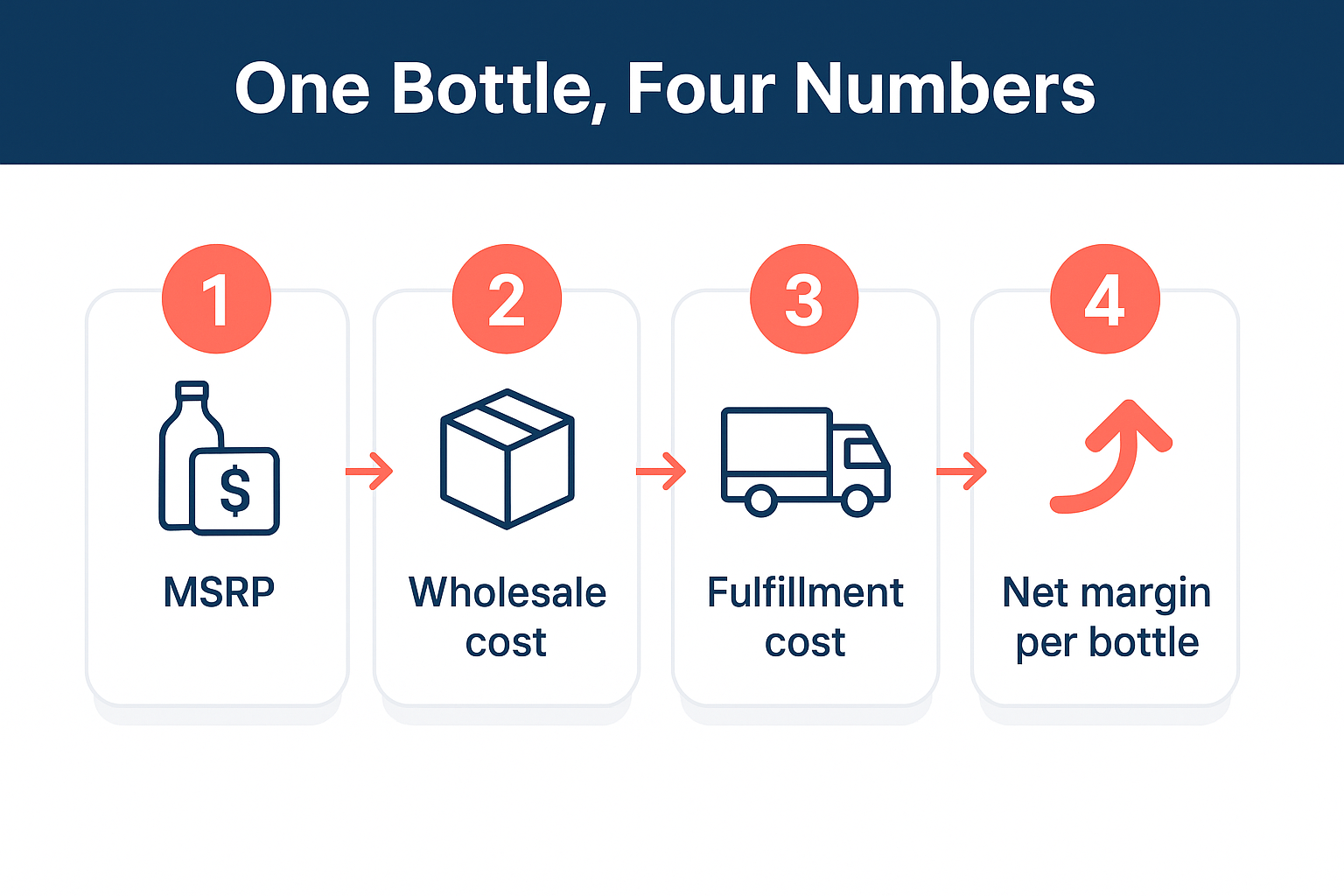
Sell this bottle at $29.97 and you keep $19.52 after COGS and fulfillment. That spread covers ads, creatives, and the content that sells the next bottle. Nail this math on every product and margin becomes a repeatable system, not a guess.
Run your own numbers with the supplement margin calculator before you commit to a product line. Then review the flat $2/item fulfillment page to see exactly what ships out of your price.
How the Zero-Inventory Model Protects Those Margins
The delivery structure is a margin feature, not an afterthought. Every fee layer between a product’s wholesale price and the customer’s checkout is profit you never see. That is why the way a supplement brand fulfills orders matters more than most new sellers realize.
The Free Plan: Test Before You Commit
The Free plan costs $0/month. There is no upfront purchasing and no minimum order quantity. Rocktomic manufactures, warehouses, labels, and drop-ships each order on demand, and members pay only the flat ~$2/item fulfillment fee when an order actually ships. A brand can test a product against real demand without tying up capital in boxes of inventory that may or may not move. That alone changes the risk profile of a first launch.
The Scale Plan: Lower Wholesale, Faster Fulfillment
The Scale plan runs $297/month and exists for one reason: to make per-unit economics better. It gives members Rocktomic’s lowest per-unit wholesale pricing across the full 140+ catalog, including Scale Exclusives not available on the Free plan. Members also get unlimited sales channels and priority fulfillment, which matters when a creator runs TikTok Shop, Instagram, and Shopify off the same stock.
Those two plans contrast sharply with platforms that tack on per-order fees or force pallet commitments. Per-order fees eat into every transaction. Pallet minimums force you to buy, store, and eventually discount stock that sits. Rocktomic’s pay-as-sell structure keeps margin math predictable: the wholesale price, the ~$2 fulfillment fee, and what the customer pays.
The mechanics are worth knowing before you build. Read about how on-demand fulfillment works, check the supplement startup costs for bootstrappers, review why Rocktomic structures the business this way, and see third-party testing and COA so the quality story holds when customers ask.
Pick Your First SKU
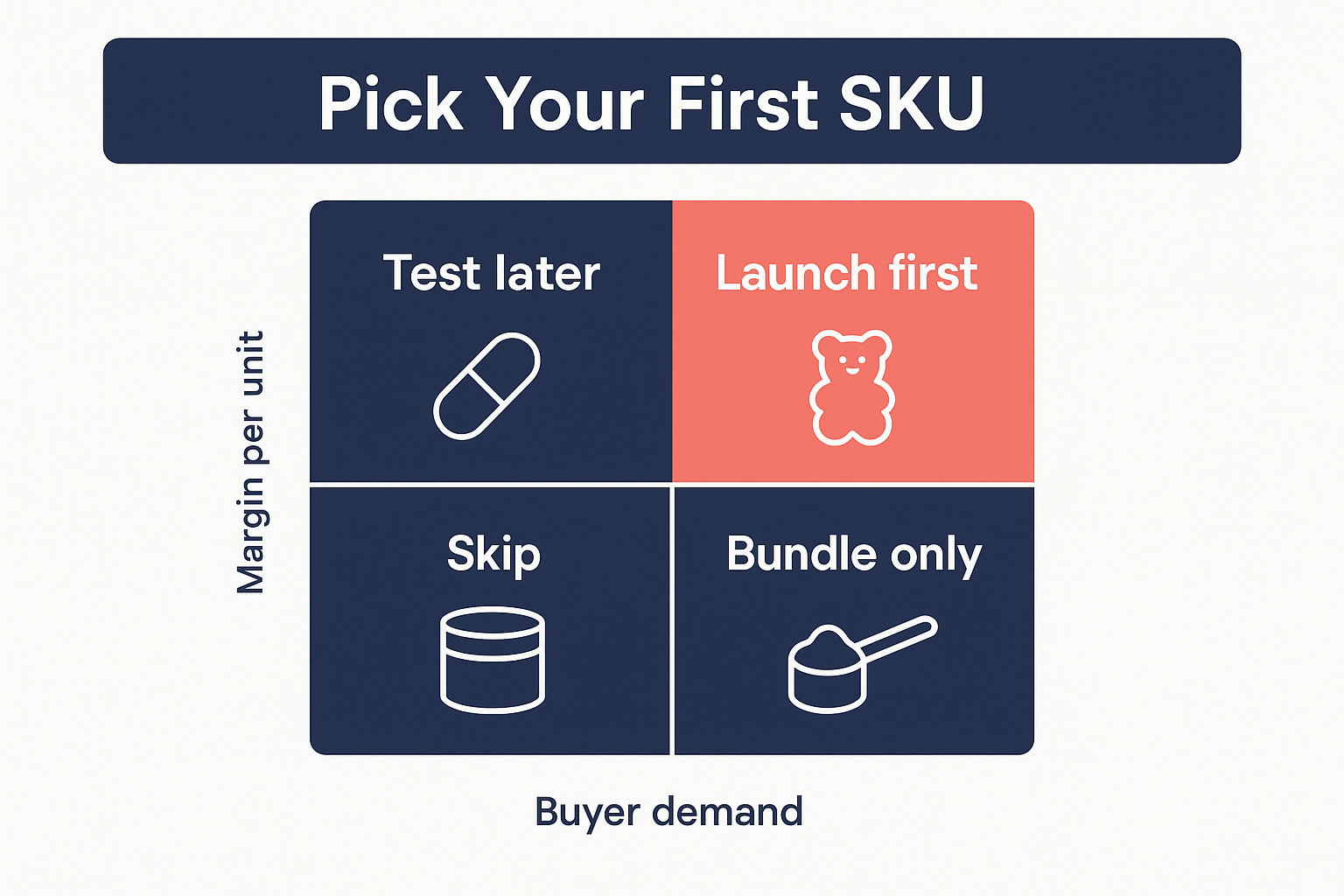
The first product choice comes down to demand versus margin. Creatine and pre-workout move fast but carry thinner margins. Gummies and specialty formats hold fatter margins but need more marketing push. Start with one SKU where demand is proven and margin is acceptable, then expand after the first shows real order volume.
White Label Supplement Margins: 8 Questions Answered
Which white label supplement category has the highest profit margin?
Capsules and softgels, followed closely by gummies, consistently show the highest per-unit margin in white label catalogs. As a reference, Sea Moss Capsules (ROC835) carries a Scale wholesale cost of $5.34 against a $35.97 MSRP, a margin of $30.63, or 85.2%. Light products with premium retail prices keep both COGS and shipping weight low, which protects the take-home on every order. Capsules also carry a premium perception, which supports the higher MSRP that drives the margin.
What is a good profit margin for white label supplements?
A gross margin between 60% and 85% is strong for white label supplements. Capsule and gummy formats typically land in that band, while heavy powders run lower, often 43% to 68%, because formulation and shipping cost more per unit. The exact number depends on the MSRP a brand sets, so the practical target is a margin that still leaves room for ads, platform fees, and a profitable payback. Chasing a high percentage is pointless if the channel cost kills the dollar left over.
Are creatine supplements profitable to white label?
Yes. Creatine Powder 300g (ROC609) has a Scale wholesale cost of $9.30 against a $35.97 MSRP, a margin of $26.67, or 74.1%. Demand is the multiplier: Grand View Research (June 2026) valued the global creatine supplements market at $1.4 billion in 2025 and projects 26.2% annual growth through 2033. Powdered creatine alone held an 80.4% share of that market in 2025. A familiar ingredient with a straightforward story also makes the product easier to sell on social.
Are gummy supplements more profitable than protein powders?
In most cases, yes. Super Creatine Gummies 1000mg (ROC943) carries a $8.45 Scale wholesale cost against a $29.97 MSRP, a margin of $21.52, or 71.8%. By comparison, Protein Whey 2lb Chocolate (ROC607) wholesales at $27.25 against a $59.97 MSRP, a margin of $32.72, or 54.6%. Gummies also ship lighter, which cuts fulfillment cost per unit. Lighter carts also mean cheaper shipping for the customer, which supports conversion at checkout.
What is the profit margin on pre-workout supplements?
Pre-workout lands in the mid-to-upper margin band. Pre-Workout Fruit Punch (ROC605) has a $12.64 Scale wholesale cost against a $39.97 MSRP, a margin of $27.33, or 68.4%. A second flavor, Pre-Workout Watermelon (ROC606), wholesales at $14.03 for a $25.94 margin, or 64.9%. Powder is the dominant format, holding an 88.6% share of the pre-workout market in 2025, per Grand View Research (July 2026). That format familiarity shortens the sales pitch, since most buyers already know what a scoop does.
How much does it cost to start a white label supplement brand with no inventory?
A brand can start on Rocktomic’s Free plan at $0 per month with no upfront purchasing. Members pay only the flat ~$2 per item fulfillment fee when an order ships, which covers pick, pack, and label. That structure keeps fixed costs near zero while the brand builds sales volume, and it is how creators test a first SKU without tying up cash in inventory. Payment happens only when the customer pays, so the brand’s cash flow stays matched to demand.
What does the Scale plan cost and what does it include?
The Scale plan is $297 per month and is the primary conversion target for brands ready to grow. It includes the lowest per-unit wholesale pricing in the catalog, unlimited sales channels, access to the full 140+ product catalog including Scale Exclusives, and priority fulfillment. The lower COGS on Scale is what pushes per-unit margin higher as order volume increases. Most brands that outgrow the Free plan move to Scale for that per-unit edge alone.
How do you calculate net profit per bottle after fees?
Take MSRP, subtract the wholesale cost, then subtract the flat fulfillment fee. Using Super Creatine Gummies 1000mg (ROC943): $29.97 MSRP, minus $8.45 wholesale, minus $2.00 fulfillment, leaves $19.52 net per bottle before marketing and platform fees. That is a 65% take-home on the sticker price. Rocktomic’s supplement margin calculator runs the same math for any SKU. Run the math before you set an MSRP, not after you launch.
Run the Numbers on Your First White Label SKU
Run your first SKU through the supplement margin calculator before you pick a plan. It takes two minutes and shows you exactly what each sale leaves behind.
Next, compare the Free and Scale plans. Free keeps you at $0/month with pay-as-you-ship fulfillment across up to 10 products. Scale runs $297/month and drops wholesale cost to the lowest per-unit rate across the full 140+ catalog.
You own the brand. Rocktomic holds zero inventory, manufactures in US GMP-certified facilities, and attaches a Certificate of Analysis to every batch. No pallet buys, no per-order platform fees.
Ready to map your first launch? Then book a call and run the numbers with a real human at Rocktomic. Bring your product idea and leave with a clear first-step plan.
Last updated: July 24, 2026.