
The Vegan Verification: How to Market Plant-Based Supplements Without Legal Drama
· Updated · 17 min read · By Rocktomic Labs Team
Yes, you can market a supplement as vegan without FDA pre-approval. FDA does not define the word, does not require a filing, and will not stop you at the door – but the moment the word appears on your label or storefront, you own the proof. This playbook covers what qualifies as a vegan claim, where brands get burned, and how to verify the claim on every batch.
What Is a Vegan Claim Under FDA Supplement Rules?
Under U.S. law, vegan is a voluntary marketing claim, not a regulated nutrient claim and not a structure/function claim. FDA guidance confirms that claims such as vegan and non-GMO do not require any premarket or postmarket submission. FDA, Notifications for Structure/Function and Related Claims (retrieved 2026-06-21)
Answer three quick questions and get pointed to the supplement niche that fits your audience and your margins.
What actually binds the brand is the FD&C Act: labels must be truthful and not misleading. Vegan is a sourcing promise, and the marketer has to prove it. The claim is not the label text. It is the paper trail – ingredient specs, supplier declarations, and batch records showing no animal-derived input entered the product.
Rocktomic treats verification as a batch-level job, not a one-time checkbox. When a supplier swap changes a source, the proof has to change with it. That is the standard regulators expect, and it is the standard that keeps a vegan label defensible.
How Big Is the Plant-Based Supplement Opportunity?
Plant-based shoppers shop with a filter, not a wish list. They scan for the word “vegan” before they read a single benefit claim, and the label either clears them to keep scrolling or kills the purchase on the spot. For a creator-operator with a health-conscious following, that filter is a conversion event. A verified vegan claim removes an objection before checkout, and it costs nothing extra once the formula is clean.
The opportunity is not the ingredient. The opportunity is the verified positioning. Plant-based demand is broad enough that the raw material stopped being a differentiator years ago, and proof is the differentiator now. A brand that can show a finished-product COA behind the claim outsells a brand that just prints the word on the front panel, because the first one already answers the question the shopper is about to ask. The brands that win those shoppers treat the claim as a documented fact, not a marketing angle.
Where Suppliers Fall Short
Supplier behavior splits the market in two. Some manufacturers sell plant-based labels without ingredient-level proof, and the brand inherits the risk the first time a customer asks for documentation. That first time is coming. Other manufacturers run a US GMP facility and issue a COA for every finished batch. One approach is a sticker on a jar. The other is a document you can screenshot and publish in your product gallery.
The gap shows up in the details that cost brands money. Some suppliers force pallet buys, some layer per-order fees on top of fulfillment, and most can’t trace every excipient in the formula back to its source. Rocktomic runs the other way: zero inventory and no upfront purchasing, flat about $2 per item fulfillment, and batch-level documentation behind every claim the label makes.
The brand builder program exists for creators who want that documented position without owning a warehouse. You bring the audience and the brand. Rocktomic handles manufacturing, labeling, warehousing, and drop-shipping as the orders come in, so the vegan claim sits on a paper trail instead of a promise.
What Actually Qualifies as Vegan: 6 Hidden Animal-Derived Ingredients
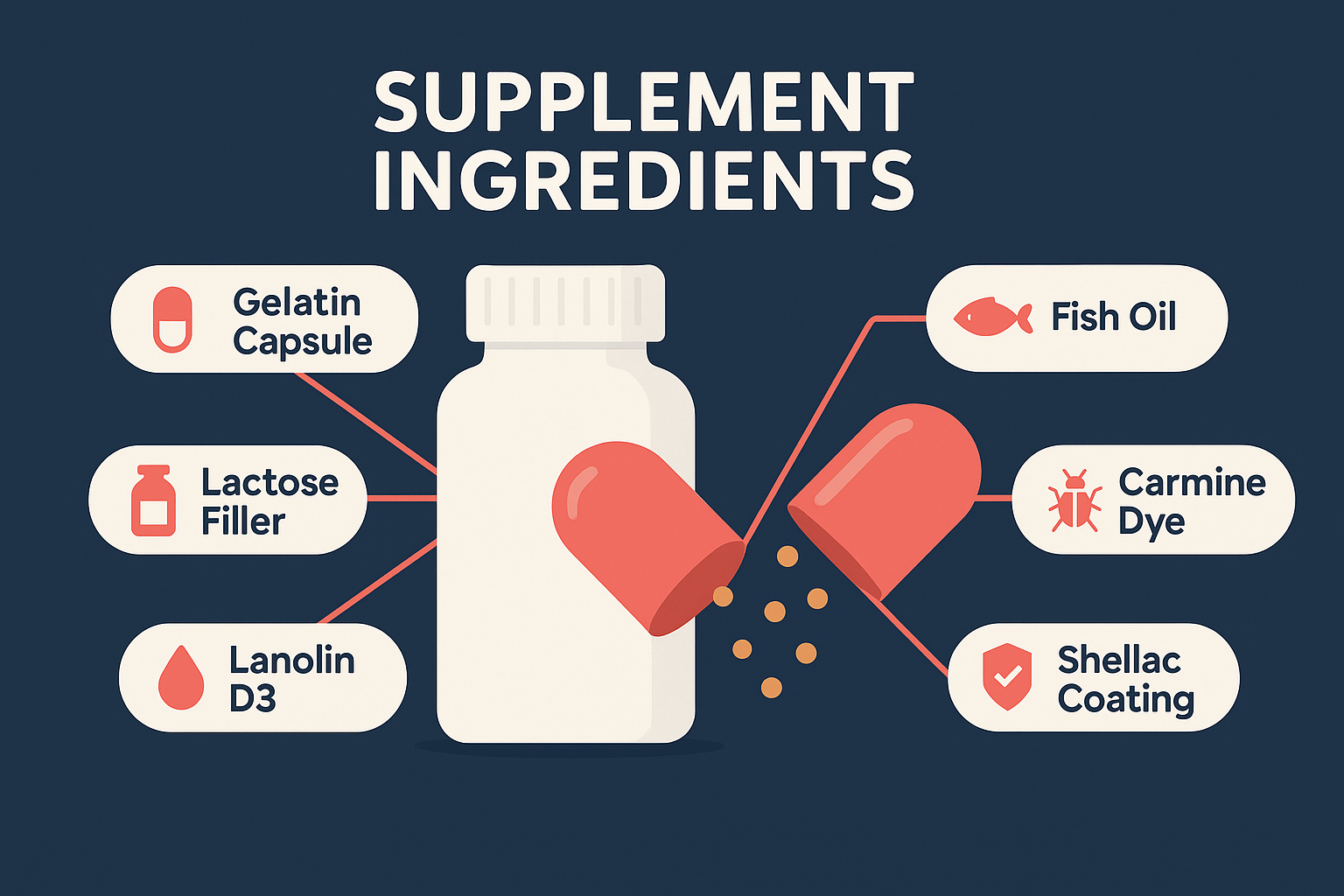
The claim fails on excipients more often than actives. The lead ingredient can be a clean plant extract while the capsule shell, filler, or coating quietly breaks vegan status. These six ingredients cause most of the damage a plant-based claim can take, and every one of them is easy to miss on a spec sheet because none of them is an active ingredient.
| Ingredient | Common Source | Why It Breaks Vegan Status |
|---|---|---|
| Gelatin | Capsule shells from bovine or porcine connective tissue | The most common hidden animal product |
| Lactose | Milk sugar filler | Dairy |
| Vitamin D3 | Lanolin from sheep wool | Animal-derived unless lichen-sourced |
| Omega-3 | Fish oil | Marine animal source |
| Carmine | Red dye from crushed insects | Animal-derived color |
| Shellac | Resin from the lac beetle | Tablet and gummy coating |
Gelatin is the biggest trap because it’s invisible inside a finished capsule. Lactose and carmine hide in blends and coatings that look plant-based on the front panel. Vitamin D3 surprises most brands, because the standard commercial source is lanolin from sheep wool unless the supplier sources a lichen-based version.
The list does not end there. Magnesium stearate, honey, collagen, chondroitin, and glucosamine all raise the same flag, and each one has a plant-based or synthetic alternative. That alternative only exists if the formulator plans for it before the batch runs, not when the artwork is already in production.
Audit the Whole Formula Before You Print
So audit the full formula before you print the word: capsule shell, coating, colorants, flavorings, and fillers included. The formula decides the claim, not the front panel. Sign off on the document trail first.
The anatomy of a compliant supplement label walks through every panel and required statement, so a vegan position survives inspection instead of forcing an expensive redesign after launch.
The FDA Rule That Actually Binds You: Truthful and Not Misleading
Supplements never get FDA pre-approval. Under DSHEA they are regulated as food, which means a new product goes straight from your label to the shelf. Nobody from the agency reviews your vegan claim, your ingredient list, or your safety file before launch. That job falls on the manufacturer and the marketer. Your name goes on the label, and your liability goes with it.
The FDA recognizes three claim categories: health claims, nutrient content claims, and structure/function claims. “Vegan” sits outside all three. It is not a health claim, it does not describe nutrient content, and it promises no structure/function effect. That is why a vegan claim triggers no FDA notification. It also means no clearance, no blessing, and no safety net. The FDA’s Label Claims for Food & Dietary Supplements guidance, published March 2024, lays out the categories, and none of them cover plant-based positioning.
Miss that standard and misbranding attaches. The moment a label is false or misleading in any way, the product is legally misbranded. Intent does not matter. A sloppy supplier form, an outdated ingredient deck, or a “vegan” callout on a formula that changed last quarter all qualify. For a young brand, one mislabeled batch is enough to kill the launch. Misbranding is the enforcement hook behind warning letters, seizures, and recalls.
Labeling is only half the story. Advertising belongs to the FTC, and the FTC requires prior substantiation for every express and implied claim in ads, social posts, and email. Prior means the evidence exists before you publish, not after a complaint lands. Implied counts too: product names, package images, and influencer captions fall under the same rule. The FTC’s Health Products Compliance Guidance, published December 2022, makes the standard explicit.
Two agencies, one standard: prove it before you publish. The USDA vs FDA label claim rules show where organic claims diverge from supplement rules, and the FDA vs FTC enforcement guide maps who comes after you and when.
FTC Green Guides: Marketing Plant-Based Without Overclaiming
The FTC Green Guides (16 CFR Part 260) set the enforcement benchmark for environmental marketing claims. Most recently revised in 2012, the guides are under review again. The FTC opened a new comment period with a Federal Register notice published December 20, 2022. That review matters: the rules you label against today could tighten before your next production run.
Three principles govern every claim
First, identify every express and implied claim on the package. Second, qualify claims clearly and prominently. Third, substantiate every reasonable consumer interpretation. A phrase can imply more than it says. “Plant-based” reads one way to you and another way to a buyer scanning a shelf in four seconds.
A certification seal does not erase your duty
Third-party seals help with credibility, but they do not transfer the substantiation burden. The FTC holds the marketer responsible for the claims the seal implies. Your brand owns the claim. The certifier does not.
Plant-based language needs qualifiers
Plant-based is not automatically vegan. If minor ingredients are not plant-derived, use qualified wording such as “made with plant-based ingredients.” Save unqualified “eco-friendly” or “sustainable” claims for packaging you can actually substantiate. Those count as environmental claims, and the Green Guides treat them as seriously as sourcing claims. The same standard applies to label copy and social posts, not just the bottle.
The practical test is simple. Write the label language a reasonable customer would read, then ask whether you can back every interpretation. For a working walkthrough of phrasing that holds up, see how to frame claims without getting sued.
How to Verify a Vegan Claim Before You Print It
No pricing math here. This is the proof stack, the five layers that turn a vegan claim from a marketing line into a defensible legal position.
A vegan label statement is a factual claim about every component in the bottle. That includes the excipients most buyers never see: capsule shells, flow agents, coatings. Any one of them can carry animal origin. If one slips through, the claim is wrong, and the liability lands on the brand that printed it. The buyer does not care which supplier made the mistake. The brand owns the label.
The five layers of verification
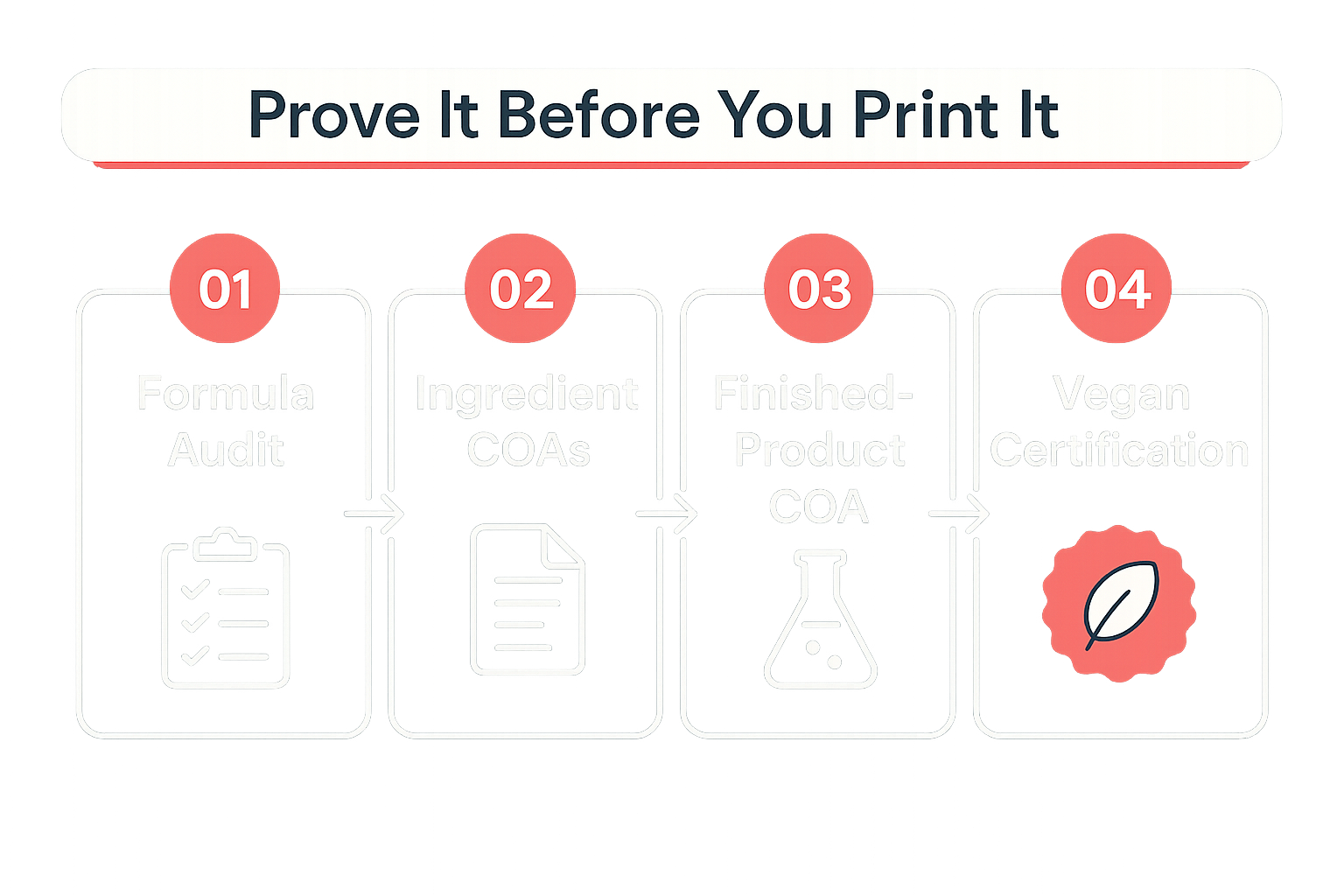
Five parties contribute to a verified vegan claim. Each one answers a different question, from raw material origin to finished batch identity. Together they form an audit trail you can show a customer, a retail buyer, or a regulator.
| Verification Layer | What It Proves | Who Provides It |
|---|---|---|
| Formula audit at excipient level | Confirms no animal-derived fillers, shells, or coatings | The manufacturer |
| Ingredient-level COAs | Documents plant origin of each raw material | Raw material suppliers |
| Finished-product COA from a third-party lab | Confirms the finished batch matches the label | The manufacturer’s quality program |
| GMP compliance under 21 CFR Part 111 | Verifies facility controls and identity testing | The FDA-registered facility |
| Voluntary vegan certification | Independent audit plus a recognizable seal | A certification body such as Certified Vegan or the Vegan Trademark |
Read the table top to bottom and the pattern is clear. The first four layers are documentary, and they come from the supply chain. The fifth layer is optional, but it adds an independent audit and a seal your customers already recognize at the shelf.
The partner shortcut
You don’t need to run all five layers yourself. Your job is to find a manufacturing partner that runs the ones you cannot. The most important is the finished-product COA from a third-party lab, because it proves the batch in the bottle matches the claim on the label.
The practical move is to work with a manufacturer that documents that finished-product layer for you. The Rocktomic quality and COA program is built exactly that way: a COA on every batch, so the proof exists before the label goes to print. If you are new to these documents, here is what a COA actually proves and why it separates 7-figure brands from amateurs.
Vegan Claims Are Still Supplement Claims: The DSHEA Line
Vegan status changes the sourcing story, never the claim rules. A plant-based label tells customers where the ingredients came from. It does not expand what you can say about what those ingredients do. Marketers assume a vegan badge means more latitude. Under the FD&C Act, it means the exact same review. The claim rules do not shift based on ingredient origin.
Structure/Function Claims Still Trigger the 30-Day Clock
Under section 403(r)(6) of the FD&C Act, a structure/function claim requires two things: substantiation and an FDA notification within 30 days of first marketing. Substantiation means competent and reliable scientific evidence that supports the claim. A vegan ingredient story adds shelf appeal. It does not add evidence.
The FDA notification is a one-time filing, but it only counts if it lands inside that 30-day window. Miss it and the claim is unapproved from day one. The label must also carry the FDA disclaimer: this product is not intended to diagnose, treat, cure, or prevent any disease. The FDA lays out the full requirement in its Label Claims for Food & Dietary Supplements guidance, published 2024-03-28.
Disease Claims Stay Off the Label
Disease claims are prohibited unless the FDA has authorized a specific health claim. “Supports normal immune function” might pass review. “Treats the flu” will not. Cross that line and the FDA treats the product as an unapproved drug, not a supplement, regardless of what is inside the capsule.
A plant-based product is not exempt because it is plant-based. The FDA evaluates the claim, not the sourcing story. Vegan is a feature of your brand. Compliance is a feature of your label. Keep them separate.
Before you write a single label line, run it through the DSHEA compliance playbook. It walks through substantiation, the 30-day notification, and disclaimer language without wrecking your margins.
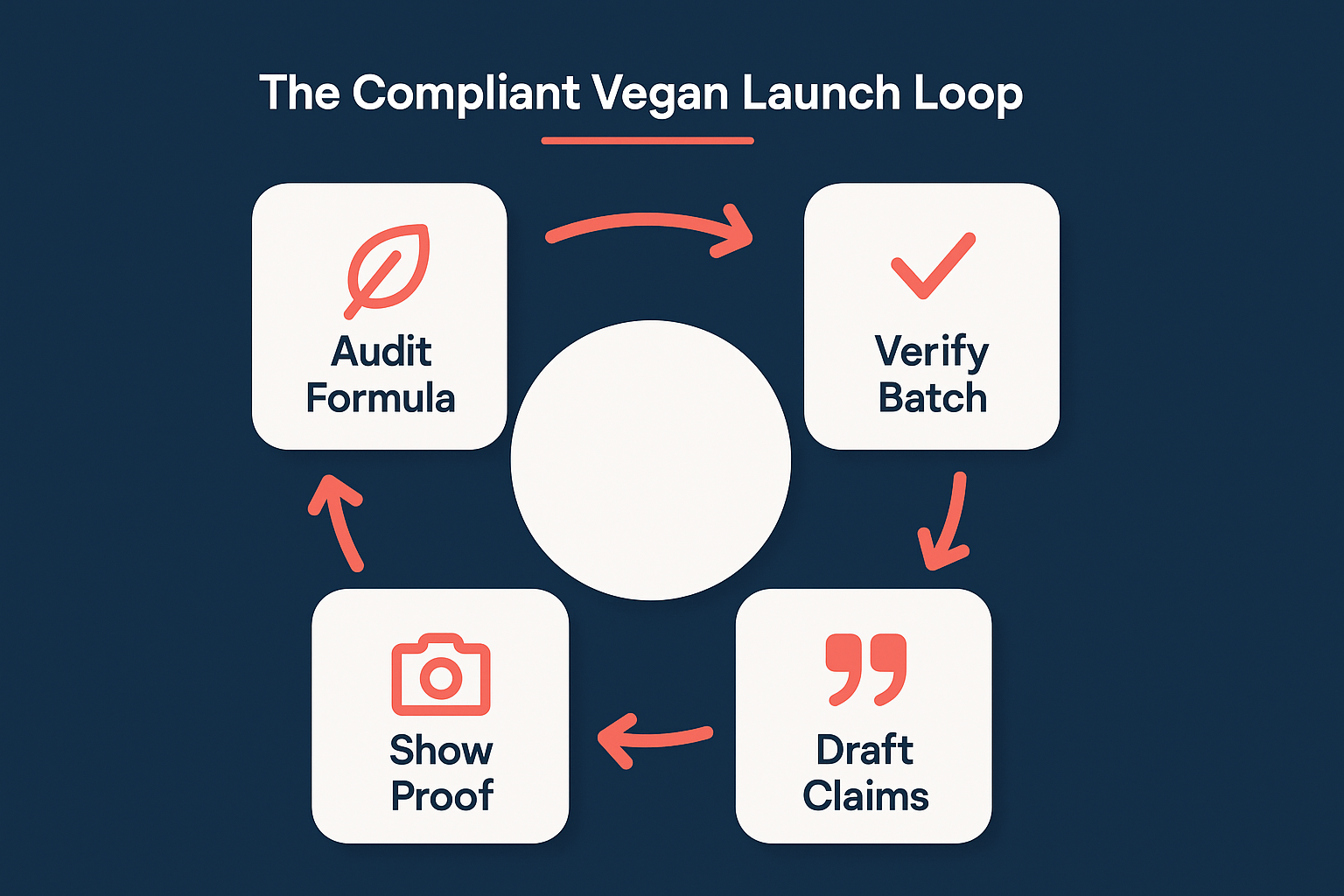
The 5-Step Vegan Launch Checklist
Here is the launch sequence, distilled from the compliance rules in Parts 2, 5, and 6. Skip a step and you build a brand on a claim you can’t back.
- Choose a genuinely plant-based SKU. Start with a protein, greens, or gummy format that is vegan by formula, not by marketing. The formula decides, not the label. Pick the SKU before you write a single word of copy.
- Audit the formula and every excipient. Check the active ingredients, then the inactive ones: shell, coating, flow agents, flavoring. The hidden-ingredient gotchas from Part 2 apply here, and the capsule material matters as much as the nutrient blend. What’s not in the formula still ends up on the COA.
- Request the finished-product COA and review the ingredient origin lines. A finished-product COA documents the final good, not just raw material receipts. Confirm the origin lines match what your label will claim, and file that document now. This is the evidence a platform will ask for later.
- Draft claim language with qualifiers and the FDA disclaimer. “Vegan” is a sourcing claim, so qualify it per product: “vegan formula” for a plant-based SKU, “certified vegan” only when you hold the certificate. Add the FDA disclaimer and keep structure/function language disciplined. The claim rules from Part 6 tell you which words are safe.
- Publish with a substantiation file. Pair every claim with its evidence before launch. The verification layers from Part 5 live in this file, and it is the first thing you reach for when a platform or a customer asks. Update it when the formula changes.
The full loop takes days, not quarters, when the formula, documentation, and labeling already exist in one place. That is how white-label fulfillment works: you assemble claims from finished goods, not from supplier promises. No inventory to buy, no pallets to store, no labels to print yourself.
How to Market the Vegan Story Without Legal Drama
The compliance work is not a cost center. It is the conversion asset. A shopper who filters for vegan wants proof, and proof is what separates you from brands running on bare labels. The same file that keeps you compliant is the asset that closes the sale.
Publish the finished-product COA on every product page. Put a verified vegan badge next to it, with a qualifier that matches your certification status: “certified vegan” only if you hold the cert, “vegan formula” if you don’t. Then build ingredient-origin content as short-form video. Show where the B12 comes from, why the capsule shell is plant-based, how the greens are processed. That content answers the objection before it gets asked, and it gives the algorithm a reason to push the video.
Watch your vocabulary. Bare eco-friendly or sustainable claims drift into greenwashing territory, and the FTC treats them as claims. A specific sourcing statement is not a health claim, so platform policies generally leave it alone. Platforms restrict health claims, not sourcing claims. That distinction is your freedom: you can talk about plant sourcing all day, as long as structure/function language stays disciplined and every claim is paired with its line in the substantiation file from Part 3.
Sell the proof, not the identity. The vegan label earns the click. The COA earns the sale.
Vegan Supplement Marketing FAQ
This FAQ is the compliance quick-reference for launching a vegan white-label supplement brand: what the FDA requires, which ingredients break a claim, and what the unit math looks like at launch.
Does the FDA approve or pre-approve vegan claims on supplements?
No. The FDA does not define or pre-approve the term vegan on dietary supplements. FDA guidance states that claims such as vegan and non-GMO do not require any premarket or postmarket submission (retrieved 2026-06-21). The requirement that does apply comes from the FD&C Act: product labels must be truthful and not misleading. The marketer owns the burden of proving the claim, including verifying the source of every ingredient at the supplier level.
Which ingredients secretly break a vegan claim?
Animal-derived ingredients hide in excipients and actives: gelatin capsule shells, lactose fillers, magnesium stearate from animal fat, vitamin D3 from lanolin, fish-sourced omega-3, collagen, carmine dye, shellac coatings, and honey. Bovine and shellfish compounds such as chondroitin and glucosamine also break vegan status. Brands must audit the full formula, including the capsule shell, coating, and flavorings, before printing vegan on a label.
Can I call a supplement plant-based if it is mostly but not fully plant-sourced?
Only with a clear, prominent qualifier. Under FTC principles for marketing claims, an unqualified statement implies the entire product meets it. “Made with plant-based ingredients” is defensible when minor ingredients are not plant-derived; a bare plant-based claim is not. Marketers must substantiate every reasonable interpretation a consumer could draw, so qualify early and often.
Is third-party vegan certification required to sell vegan supplements?
No. Programs such as Certified Vegan and the Vegan Trademark are voluntary. They add independent audit and consumer trust, but the FTC position is that a certification seal never removes the marketer’s obligation to substantiate the underlying claims. Certification bodies set their own thresholds, so review their criteria against your full formula before you apply or display a seal.
Can a vegan supplement make structure/function or health claims?
Vegan is a sourcing claim, not a health claim. A vegan supplement follows the same DSHEA rules as any other: structure/function claims need substantiation and an FDA notification within 30 days of first marketing, and disease claims are prohibited unless FDA has authorized a specific health claim. Sourcing status never expands what a brand may say about effects.
What does it cost to start a vegan white-label supplement brand?
Rocktomic’s Free plan costs $0 per month and charges only the flat ~$2 per item fulfillment fee when an order ships, so brands can list vegan SKUs with no inventory and no minimum purchase. Rocktomic’s Scale plan costs $297 per month and includes the lowest per-unit wholesale pricing across the catalog plus priority fulfillment. Optional done-for-you branding and store packages are one-time add-ons.
How do plant-based SKUs compare on margin?
Margin follows the SKU, not the sourcing claim. Plant-based protein and greens carry higher wholesale costs than some capsule staples, which is why Rocktomic’s Scale plan rate of $297 per month matters: it delivers the lowest per-unit wholesale pricing in the catalog. Add the flat ~$2 per item fulfillment fee and unit economics stay predictable at any order size. Model any product before launch.
Do I need a license to sell vegan supplements?
No special vegan license exists. Dietary supplements do not require FDA pre-approval, and no license is required to market a vegan-labeled product. The legal obligations sit on the claim: truthful labels, substantiated advertising, GMP-compliant manufacturing at the facility level, and the FDA disclaimer on structure/function statements. A GMP-certified manufacturer with finished-product COAs handles most of the compliance backbone.
Launch Your Compliant Vegan Supplement Brand
A verified vegan claim works twice. It pulls in the plant-based buyer who reads labels before buying, and it acts as a legal shield if a claim ever gets challenged. The proof stack – COAs on every batch, formula audits, clean claim language – is what separates a defensible brand from a lawsuit.
Run the numbers before you launch. Model a plant-based SKU in the supplement margin calculator and see exactly what you keep per sale after the flat ~$2 per-item fulfillment fee. With zero inventory and a $0 per month entry, you can test a vegan SKU without tying up cash in a pallet. You pay only when an order ships.
You can compare Rocktomic membership plans – Free at $0 per month gets you up to 10 products with on-demand dropship; Scale at $297 per month opens the full 140+ product catalog, unlimited sales channels, and the lowest per-unit wholesale pricing. Every batch ships US GMP quality with a Certificate of Analysis attached.
If you want the compliance details mapped before you commit, book a call with Rocktomic. Bring your formula idea, leave with a launch plan.
Last updated: 2026-06-21