
Audit Your Manufacturer: The 5 Questions You Must Ask Before Launching
· 16 min read · By Rocktomic Labs Team

Most supplement brands become compliance liabilities before the first order ships, not because the formula is bad but because nobody audited the manufacturing partner. A proper audit covers five questions: FDA facility registration, cGMP under 21 CFR Part 111, batch-specific Certificates of Analysis, independent lab testing, and the full paper trail. Run this audit before you sign, and your brand starts legally bulletproof instead of hoping it gets lucky.
What is a white label supplement manufacturer audit?
A white label supplement manufacturer audit is a structured review of a production partner’s regulatory paperwork before you put your name on its products. It verifies four things: FDA facility registration, cGMP compliance under 21 CFR Part 111, batch-level testing documentation (COAs), and independent lab verification. The audit costs nothing, takes about an hour, and decides whether your brand is defensible or one inspection away from a warning letter.
Answer three quick questions and get pointed to the supplement niche that fits your audience and your margins.
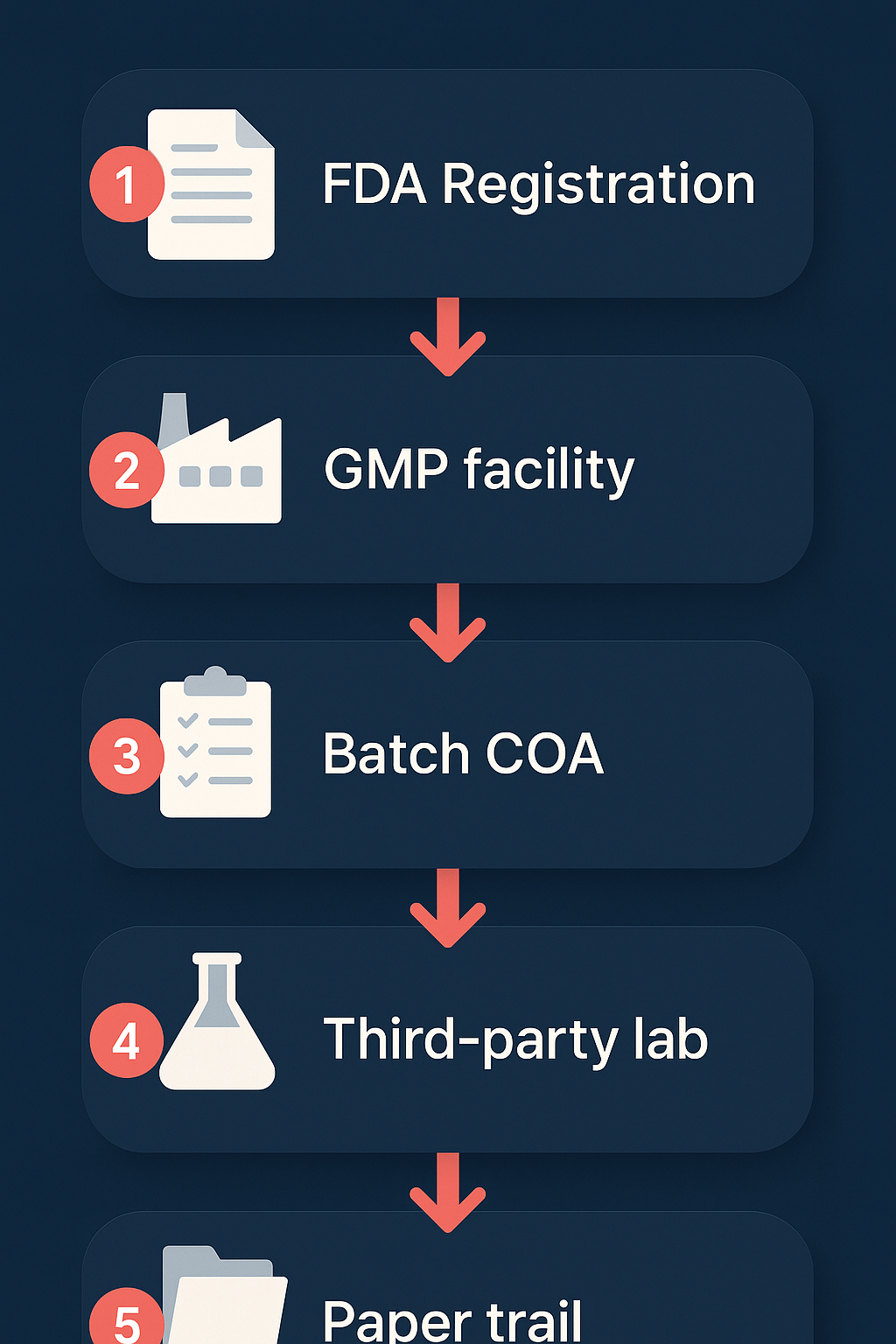
The rest of this article walks through the five questions in order: registration, GMP, COA, independent lab, and paper trail. Each one is a check you can run before you commit to any white label partner.
Why the Audit Is a Compliance Problem, Not a Trust Problem
Under the Dietary Supplement Health and Education Act of 1994 (DSHEA), supplements are regulated as food, and the FDA does not pre-approve them before they go on sale (FDA, Questions and Answers on Dietary Supplements, retrieved 2026-06-21). The product can ship to customers with zero federal sign-off. There is no approval step waiting in the background.
The firm that places the product into commerce is the one that carries the legal weight. That firm must ensure the supplement is not adulterated or misbranded, and the FDA has made clear a brand cannot contract out that responsibility (21 CFR Part 111, eCFR, retrieved 2026-06-21). Your manufacturer handles the cGMP work, but the obligation sits with your brand.
Enforcement follows the label. Warning letters have gone to brand owners who failed to oversee their contract manufacturers, not to the factory deeper in the supply chain. The name on the label is the name the FDA contacts, and the name that becomes public record. A warning letter can stall your sales channels and scare off retail partners before you get a chance to fix the issue.
That is why the audit is a compliance transfer point, not a trust exercise. When you verify a partner’s COA process, facility registration, and cGMP documentation, you are verifying the evidence you would hand the FDA if questions ever come. You cannot outsource the answer. For the full walkthrough, launch legally under DSHEA with the playbook before you sign any agreement.
Question 1: Is the Facility Actually FDA Registered?
You ask a potential partner if their facility is FDA registered. The yes comes instantly. It always does. The document behind that yes separates real operators from well-designed sales pages. Under federal law, every facility that manufactures, packages, labels, or holds dietary supplements for U.S. consumption must register with the FDA as a food facility. That registration must be renewed every two years, a requirement the FDA spells out in its Questions and Answers on Dietary Supplements (retrieved 2026-06-21).
Registration is not approval
This is the distinction most supplement sellers miss. FDA registration is not FDA approval. The agency does not approve facilities, and it does not approve supplement formulas. “FDA approved” does not exist in this category, so a partner that uses that phrase has already told you how much compliance research they actually do.
The ask: request the FFRN
The ask is simple. Request the facility’s Food Facility Registration Number, or FFRN, and treat that as the starting point, not the finish line. Confirm the registration is current, then confirm the name: it must be the actual manufacturing facility that will make your product, not a parent company or a distribution center. Registration status is public record, so a legitimate manufacturer has no reason to stall.
The verification takes minutes once you have the number. A contract manufacturer that hesitates, deflects, or points you to a generic certifications page has already failed Question 1. Walk away, or hold the line until they hand over the FFRN and let you check it against FDA records. Every later question in this audit assumes this one comes back clean, so take the time to check it now.
Question 2: Does the Facility Operate Under 21 CFR Part 111 cGMP?
Ask this question in writing, and ask it before you send a dollar. The FDA’s dietary supplement cGMP final rule, published June 25, 2007 (72 FR 34752), requires manufacturers to establish and follow current good manufacturing practices covering personnel, plant and grounds, equipment, production and process controls, quality control, recordkeeping, and complaint handling. The full requirements are laid out in the FDA Small Entity Compliance Guide, retrieved 2026-06-21 from https://www.fda.gov/regulatory-information/search-fda-guidance-documents/small-entity-compliance-guide-current-good-manufacturing-practice-manufacturing-packaging-labeling.
That “current” in cGMP matters more than most sellers realize. The rule is not a one-time checklist. It’s a living system, and a manufacturer has to show ongoing control over every batch it ships.
Here is the catch that trips up new brand owners. The FDA does not issue “GMP certificates.” No agency hands a facility a plaque that says “passed.” A manufacturer proves cGMP compliance one of two ways: through a third-party GMP audit from a program such as NSF, or through a clean FDA inspection history with no significant Form 483 observations.
So make the ask concrete. Request the facility’s most recent third-party GMP audit report or inspection summary. Check the FDA warning letter database for the facility’s name. Look at the audit scope, too: does it cover the product form you plan to launch, and is the audit recent? A facility that hesitates to share these documents is telling you everything you need to know.
This single question separates real manufacturers from labelers with a warehouse. Skip it, and you’re accepting risk on someone else’s schedule. Read what happens to brands that get this wrong: how choosing the wrong manufacturer destroys brands.
Question 3: Is There a Batch-Specific COA for Every Lot?
A Certificate of Analysis is a batch-level lab report. It records what was actually measured in one specific lot, not what a manufacturer promises in a brochure. The lot number on the document is what makes it a quality record instead of a marketing badge. No lot number, no proof.
What a COA must contain
The benchmark for these documents is the CHPA voluntary guideline for COAs for dietary supplement components. The guideline says the document should identify the component, the lot, the test methods, the specification limits, and the measured results (CHPA, Voluntary Codes and Guidelines, Certificate of Analysis for Dietary Supplements, retrieved 2026-06-21). Each element does a job. The method tells you how the lab tested. The limit gives the acceptable range. The result shows what the lot actually measured.
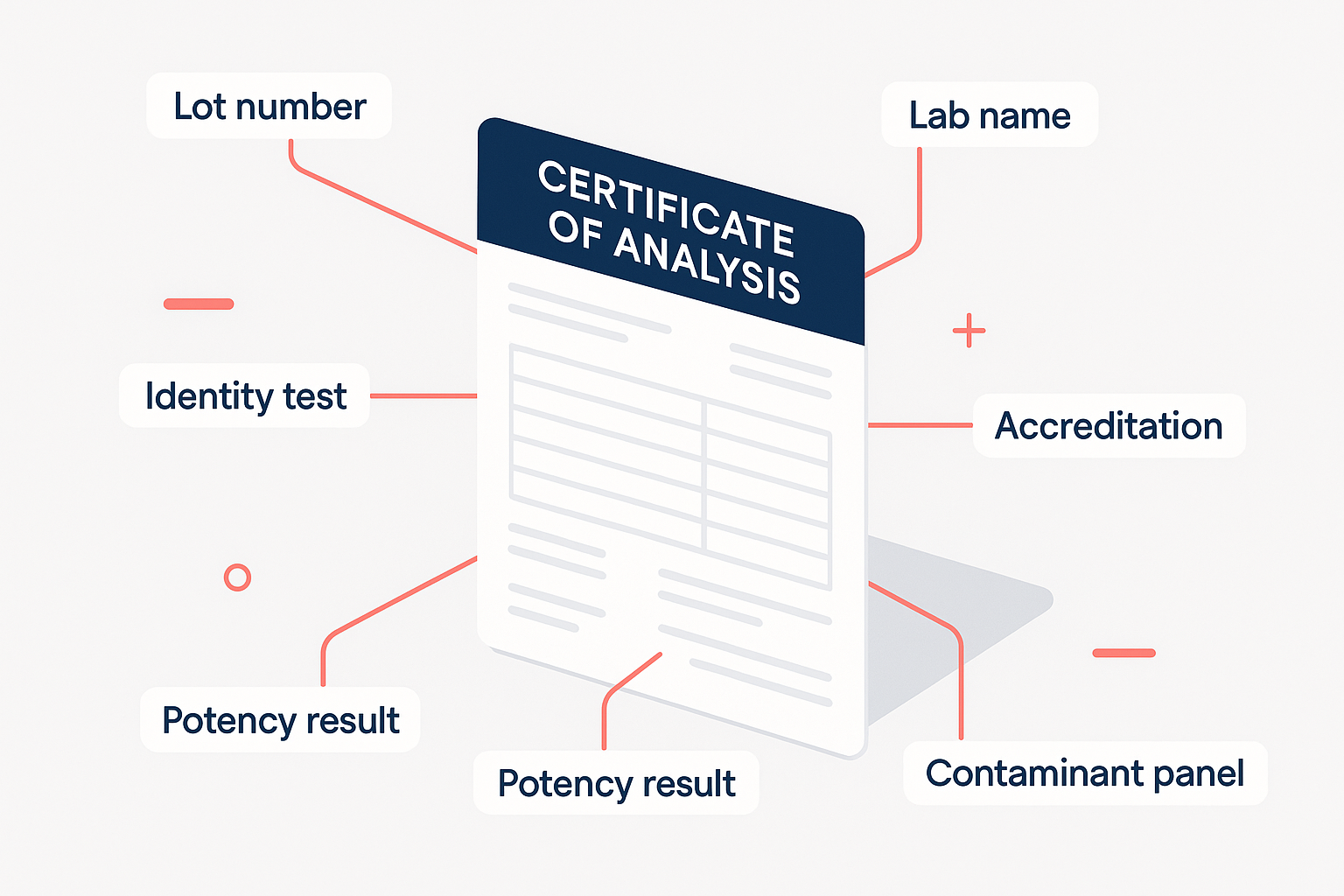
Identity testing is the legal floor. Under 21 CFR 111.75, manufacturers must perform at least one identity test on 100 percent of incoming dietary ingredients (21 CFR Part 111, eCFR, retrieved 2026-06-21). A supplier COA can be relied on only after the supplier is qualified and periodically reconfirmed. So a COA is not a free pass. It is evidence tied to a relationship the manufacturer has already vetted.
The lot number has to match
Then comes the lot match. A COA is valid only for the lot number it names. That means the lot on the document must match the lot on the bottle. If the numbers differ, the document proves nothing about what your customer is holding. Check both before any batch ships, and check again when stock rotates.
This is where a quality and COA hub should earn its keep. A manufacturer that posts COAs openly makes your audit easy. And knowing what a COA actually proves keeps you from being impressed by a PDF with no lot number. Look for the lot, the methods, the limits, and the results. If all four are present, the document is doing its job.
Question 4: Who Runs the Lab: In-House or Independent?
A COA is only as trustworthy as the lab that signed it. Some manufacturers test their own products and call it third-party verification. They don’t. An in-house COA satisfies cGMP documentation, but it is the manufacturer attesting to its own work. That is self-attestation, not independent verification.
Independent third-party testing comes from a lab with no financial stake in the outcome. The credible standard is ISO/IEC 17025 accreditation, verifiable in the accrediting body’s public registry. You can check that registry yourself in minutes.
Here is what separates a real independent lab from a manufacturer’s quality department: the lab’s revenue does not depend on your product passing. It has no incentive to soften a result. That is the entire point of third-party testing.
Marketplaces Are Already Requiring It
Retailers and marketplaces increasingly require COAs from accredited labs for supplement listings. That makes independent testing a practical requirement for any brand selling at scale. The policy is already written, so you can argue in-house testing is sufficient all day and still lose your listing if the manufacturer only self-attests.
The Ask: Name the Lab, Then Verify It
Ask the partner to name its testing lab. Not the lab division of its own facility. The actual third-party lab. Then look up the accreditation number in the accrediting body’s public registry. Confirm the scope covers dietary supplement testing. Accreditation scopes are specific: a lab accredited for environmental water testing is not accredited for supplement potency testing.
If the partner hesitates to name the lab, that is an answer. Rocktomic publishes a Certificate of Analysis for every batch, traceable to accredited labs. Your brand deserves at least that much.
Question 5: Can They Show the Full Paper Trail?
The paper trail is where cGMP compliance actually lives. Anyone can claim their facility is certified. Documents prove it. You need to see four things: the master manufacturing record, the batch production record for every lot, supplier qualification files, and reserve sample records.
The master manufacturing record defines how the product is supposed to be made. The batch production record shows what actually happened on the day your lot was produced. Side by side, the two reveal whether the run matched the formula and whether deviations were logged and resolved. Supplier qualification files prove the ingredients came from approved, audited sources.
Federal law sets the floor for how long those records must survive. Under 21 CFR Part 111, a manufacturer must retain records for at least one year past the product’s shelf life, and those records must be producible on request during an inspection (21 CFR Part 111, eCFR, retrieved 2026-06-21, https://www.ecfr.gov/current/title-21/chapter-I/subchapter-B/part-111). Ask for the retention policy in writing before you sign anything.
The hard line comes fast. If a partner cannot produce a batch production record or a supplier qualification file on request, the audit ends there. A missing record for a single lot means that lot is untraceable, and untraceable is the one thing a supplement brand cannot afford to be.
The opposite signal is just as clear. A partner that volunteers the paper trail before you ask is telling you it expects scrutiny. That expectation is the single best predictor of a clean relationship. It means the documents exist, they are organized, and someone has checked them recently enough to hand them over without hesitation.
Red Flags That Kill the Deal
These six red flags are hard filters, not negotiation points. One strike on any of them and the audit ends. A manufacturer that cannot produce independent, lot-traceable proof on demand will not protect you when a retailer or a regulator asks. Don’t bargain with any of these. They are exit signs.
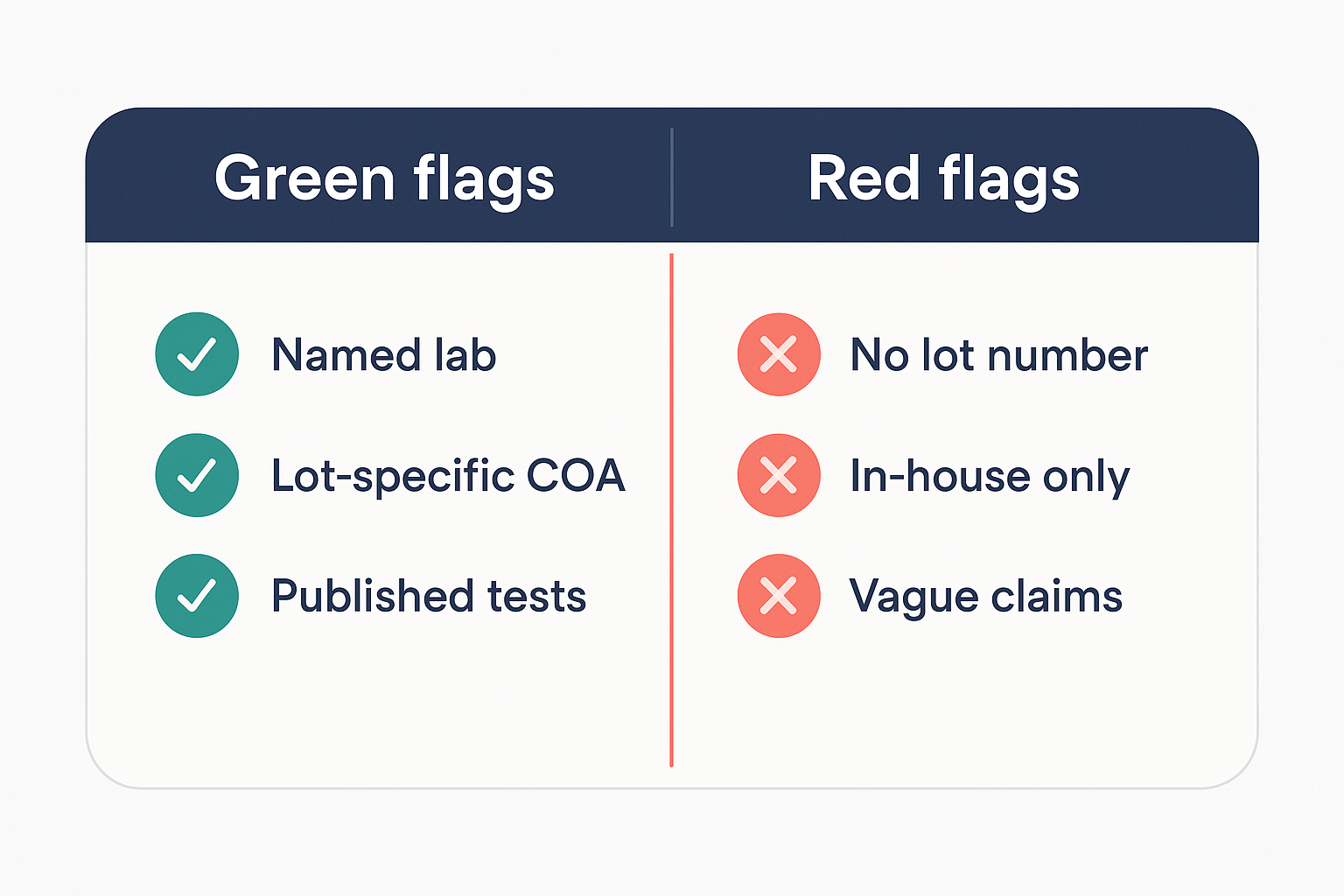
Run every candidate through this list before you sign anything. Each row on its own is enough to kill the deal.
| Red flag | Why it matters | Your move |
|---|---|---|
| COA with no lot number | Cannot be tied to the bottle in your hand | Reject the document and ask again |
| Results that exactly match specification limits | Numbers may be copied, not measured | Ask for raw data or a new test |
| Testing lab is also the manufacturer | Self-attestation, not independent proof | Require an accredited third-party lab |
| Cannot name the testing lab | No way to verify accreditation | Treat as a failed audit |
| “FDA approved” or “certified” with no document | Misleading marketing, legal exposure | Walk away |
| Refuses to show batch records | No evidence of process control | Walk away |
Every row is a hard filter, not a negotiation point. Accept none of them as industry norms. The right manufacturer hands over lot-matched COAs, names its accredited third-party labs, and shows batch records without being asked twice. That’s the baseline for moving forward. Anything less costs you time, money, and credibility.
How to Verify a White Label Partner in 60 Minutes
These five steps convert “trust me” into evidence. Run them against any partner before you sign anything.
Sixty minutes is enough. Budget about ten minutes per step and ask for every document in one email so the partner replies in one batch. You do not need a lawyer for this. You just need the documents below.
| Step | Ask for | Pass criteria |
|---|---|---|
| 1. Registration | FFRN and facility name | Current registration in FDA’s system |
| 2. GMP | Latest third-party GMP audit or inspection summary | No unresolved 483s or warning letters |
| 3. Testing | Sample COA with lot number | Measured identity, potency, and purity values plus named methods |
| 4. Lab | Lab name and ISO/IEC 17025 accreditation number | Accreditation active and scope covers supplement testing |
| 5. Records | Master manufacturing record and batch record sample | Documents exist, match the COA lot, and are retention-compliant |
Read the rows top to bottom as a chain. Registration proves the facility exists. GMP proves it operates to standard. Testing proves the product matches the label claim. The lab proves a credible third party ran the test. Records prove the whole story is documented and traceable.
Ask for all five in a single request. A partner with nothing to hide sends them the same week. A partner that stalls is showing you exactly what they cannot produce.
Run these five steps against any partner and you convert “trust me” into evidence.
What Does a Compliance-Ready White Label Partner Look Like?
Some fulfillment platforms ship whatever a third-party facility produces and never show a test report. Others force pallet purchases before you can verify a single batch. You only find out what you bought after the money is gone. Neither model protects your brand when a customer or retailer asks for proof.
A compliance-ready partner publishes a COA for every batch, not just the sample you requested. It manufactures in US GMP-certified facilities and submits products to third-party testing. It lets you review quality documentation before you spend a dollar. That transparency is the difference between a supplier and a liability.
The Rocktomic Feature Set
Rocktomic fits that profile as a feature set. The catalog holds 140+ US-manufactured, GMP-certified, third-party-tested products, each with a Certificate of Analysis available per batch. Products move through the on-demand fulfillment model, so you sell with zero inventory and no minimums. Every order ships only when your customer buys, so you never tie up cash in product you might not sell.
The documentation is the point. Before you launch, read why brands choose Rocktomic and check the quality paperwork yourself. Walk through how Rocktomic fulfillment works to confirm the flow matches your expectations. A compliance-ready partner answers hard questions before you commit, not after. If a supplier hesitates to share a COA, treat that silence as the answer.
White Label Supplement Manufacturer Audit FAQ
Is “FDA approved” real for dietary supplements?
No. The FDA does not approve dietary supplements before they reach the market. Under the Dietary Supplement Health and Education Act of 1994 (DSHEA), supplements are regulated as food, and the firm that manufactures or distributes them is responsible for making sure they are not adulterated or misbranded. Any white label partner that advertises “FDA approved” is showing a misunderstanding of the law. What a brand should verify instead is facility registration, cGMP compliance under 21 CFR Part 111, and a batch-specific Certificate of Analysis.
What should a Certificate of Analysis actually include?
A Certificate of Analysis is a batch-level lab report, not a marketing badge. It should name the issuing laboratory, state the lot number tested, list the test methods, show the specification limits, and report measured results for identity, potency, and purity. The lot number on the COA must match the lot number printed on the bottle. Measured values beat a single “pass” line, and a missing method or a missing lot number are grounds to reject the document.
What is the difference between an in-house COA and third-party testing?
An in-house COA comes from the manufacturer’s own quality lab and can satisfy cGMP documentation under 21 CFR Part 111. Third-party testing comes from an independent laboratory with no financial stake in the result, ideally accredited to ISO/IEC 17025. The difference is accountability: an in-house result is self-attestation, while an independent COA is evidence a retailer, platform, or regulator accepts without further scrutiny.
Does my white label manufacturer need FDA registration and GMP certification?
Facility registration is mandatory. Any facility that manufactures, packages, labels, or holds dietary supplements for US consumption must register with the FDA and renew that registration every two years. GMP compliance under 21 CFR Part 111 is also mandatory. The FDA does not hand out “GMP certificates,” so ask for third-party GMP audit reports, a clean inspection history, or certification from a program such as NSF instead.
What are the biggest red flags when auditing a supplement manufacturer?
The biggest red flags are a COA with no lot number, results that exactly match the specification limits, a testing lab that is also the manufacturer, refusal to share batch records, and vague claims like “certified” or “FDA approved” with no document to back them. A partner that cannot name its testing lab or produce a batch-specific COA fails the audit before price is ever discussed.
How much does a compliant launch cost with a white label partner?
Compliance does not have to mean inventory risk. Rocktomic’s Free plan costs $0 per month, and members pay only the flat fulfillment fee of about $2 per item when an order ships. The Scale plan at $297 per month adds the full catalog, unlimited sales channels, and priority fulfillment. The audit itself costs nothing but one hour of questions, which makes it the highest-ROI hour in the launch process.
Who is responsible if a batch fails testing: the brand or the manufacturer?
Both, which is exactly why the audit happens first. The manufacturer must follow cGMP, but the brand owner cannot contract out its ultimate responsibility for products sold under its label. The FDA has cited brand owners for failing to oversee contract manufacturers. One failed batch can trigger a warning letter, platform removal, and a recall that costs far more than the $297 monthly Scale plan.
Can I review a manufacturer’s COAs before I commit?
Yes, and any serious partner will show them. Rocktomic manufactures in US GMP-certified facilities, third-party tests its products, and makes a Certificate of Analysis available for every batch in its 140+ product catalog. A brand can verify identity, potency, and purity documentation before its first order ships under the $0 entry plan, so the audit happens before any commitment.
Launch a Brand You Can Defend With Paperwork
You asked the five hard questions. Now demand the paperwork. Ready to launch a brand you can defend with records, not promises? Book a call with Rocktomic to walk through this audit checklist against a real fulfillment partner. Or compare Rocktomic membership plans and start on the Free plan at $0 per month, with a COA on every batch. No inventory minimums. No pallet buys. Just a brand built on documents a regulator can verify.
Last updated: June 21, 2026.