
Shield Your Assets: Why Every Supplement Startup Needs Liability Insurance
· 16 min read · By Rocktomic Labs Team
A brand name on a supplement label carries manufacturer-level liability, even when another company made the product. Insurance is the only thing standing between a claim and your personal wealth, and the fastest way to reduce both risk and premium is partnering with a GMP-certified, third-party-tested manufacturer. This guide covers the claims, the coverage, the costs, and the documents underwriters demand.
What Is Supplement Brand Liability Insurance and Why Does a Startup Need It?
Supplement liability insurance is a set of policies that protect a brand when a customer claims harm, mislabeling, or misleading advertising tied to a product. It includes dedicated product liability coverage because standard general liability policies often exclude ingestible products.
Answer three quick questions and get pointed to the supplement niche that fits your audience and your margins.
Every supplement startup needs it from the first bottle sold. U.S. law holds the named brand responsible for safety and truthful claims even when a contract manufacturer made the product. The name on the label is what makes the liability yours.
If Your Name Is on the Label, You Carry Manufacturer-Level Risk
The bottle has your logo. Your website sits on the back panel. In the eyes of a U.S. court, that makes you the responsible party, even when a contract manufacturer produced the bottle.
That’s how liability works here. Courts and insurers treat the brand on the label as the manufacturer. The facility that filled the bottle handles production, but the name on the front owns the outcome. If a claim gets filed, it names you, not your vendor.
Federal law takes the same view. Under the Federal Food, Drug, and Cosmetic Act and DSHEA, the named brand is responsible for substantiating the safety of its products, avoiding adulteration or misbranding, and keeping every label truthful. The FDA’s 2007 backgrounder on current Good Manufacturing Practices makes clear that supplement makers must control quality from ingredient sourcing through finished product. You can’t subcontract that responsibility away.
Private-label status doesn’t change it. Admiral Insurance flags the exposure directly: product liability belongs to the company whose name is on the product, regardless of who actually manufactured it.
Three Scenarios, One Outcome: The Brand Pays
Run the scenarios. An undeclared allergen shows up in a batch. A Supplement Facts panel lists the wrong serving size. A contaminant finding gets flagged in testing. In every case, the consumer, the retailer, and the regulator look at your label, not the contract facility’s paperwork. The claim lands on your brand, and so does the cost of defense.
This is where your manufacturing partner matters. A facility that turns over a Certificate of Analysis for every batch and current GMP documentation gives you a standing defense. A manufacturer that can’t produce either leaves you exposed at the exact moment you need protection most. Documentation isn’t paperwork. It’s your evidence.
What Are the 5 Claims That Actually Hit Supplement Brands?
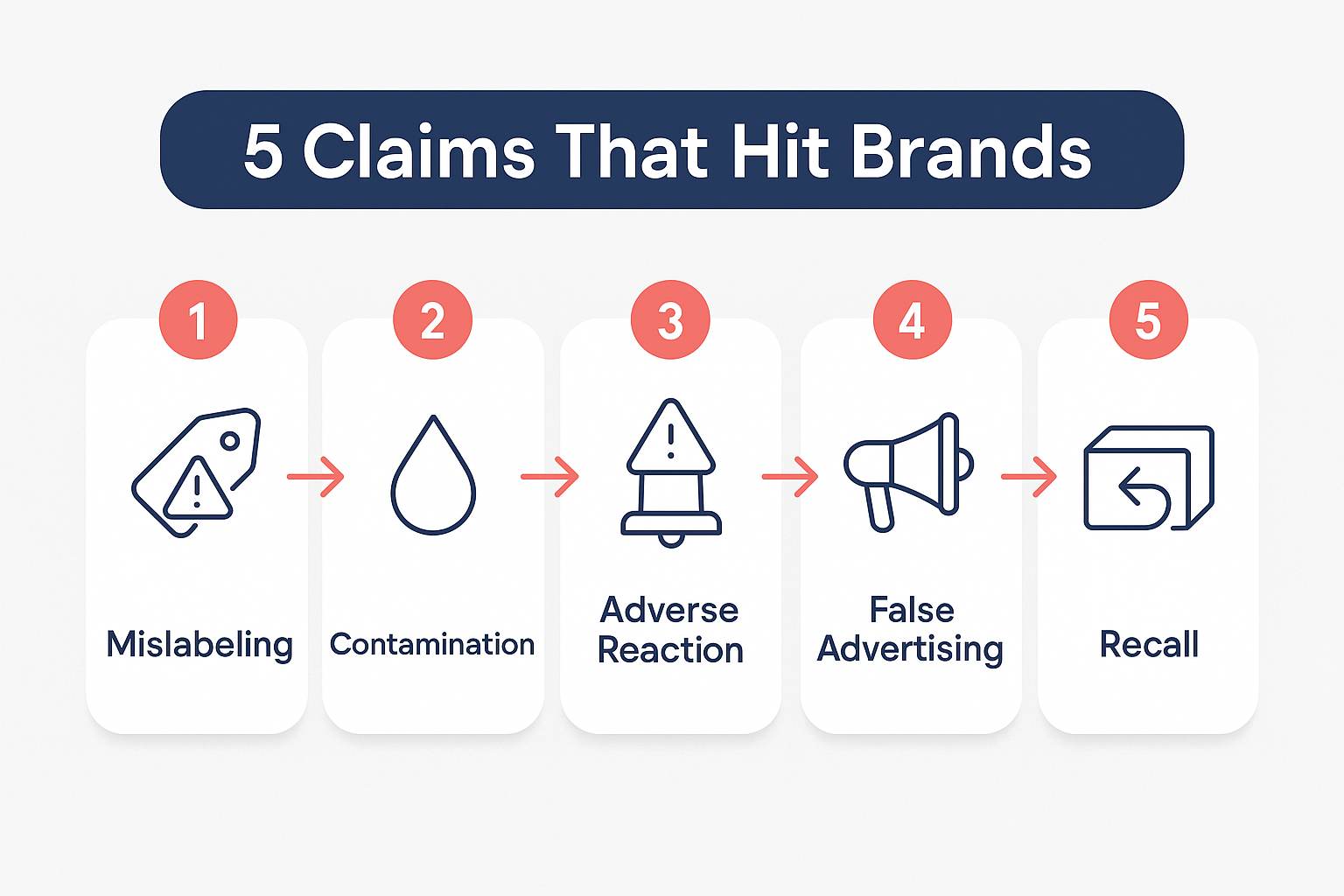
Most claims against supplement brands fall into five categories, and knowing which policy responds is the first step to protecting yours. The Coyle Group (2026) tracks these claims across the industry, and the same five patterns keep appearing.
| Claim type | What triggers it | Policy that responds |
|---|---|---|
| Mislabeling | Undeclared allergen or wrong Supplement Facts panel | Product liability |
| Contamination | Heavy metal or microbial findings | Product liability |
| Adverse reaction | Customer injury or adverse event tied to the product | Product liability |
| False or misleading advertising | Overstated or unsupported claims in ads or labels | General liability advertising-injury coverage plus FTC action |
| Product recall | Mandatory or voluntary recall of a batch | Recall expense endorsement, not base coverage |
The first three rows share a trigger: something went wrong with the product itself. A mislabeled allergen, a contaminated batch, or an injury tied to use all point to product liability. The Coyle Group (2026) groups them because the policy response is the same, even when the story is different.
The false advertising wrinkle
False advertising claims don’t start with a sick customer. They start with an ad or a label that overstates what the product does. General liability advertising-injury coverage responds, but the FTC can open a parallel action over the same campaign. The Coyle Group (2026) flags this as the category where brands discover the coverage gap last.
Why recall catches brands off guard
Recall is the classic blind spot. Base product liability does not cover it. A recall expense endorsement pays for notification, shipping, and disposal, and you need it before the recall happens. The Coyle Group (2026) notes that most brands assume recall is bundled into product liability. It is not.
General Liability vs Product Liability: Know the Coverage Gap
Most creators assume a standard business insurance policy covers whatever they sell. For supplements, that assumption can leave you fully exposed. Standard commercial general liability (CGL) policies often explicitly exclude consumable products, including nutritional supplements. The Coyle Group, which specializes in insurance for dietary supplement manufacturers, flagged this gap directly in its 2026 guidance.
Know what you are actually buying. A general liability policy handles classic small-business claims: a visitor slips in your office, a contractor trips on a cord, an ad you ran triggers an advertising injury complaint. It does not respond when a customer says your supplement caused bodily harm. Only a dedicated product liability policy is written for that exposure, and it must name the specific product line to respond at all.
| Policy | What it covers |
|---|---|
| General liability | Premises, slips, advertising injury |
| Dedicated product liability | Bodily injury tied to the product |
That table is the whole story in two lines, and the gap between the two policies is where supplement brands get hurt. You can hold a valid general liability certificate, show it to a retailer, and still have zero coverage for the product that generates your revenue. Marketplaces and retail buyers ask for proof of insurance during onboarding, but a certificate only lists coverage types, not the exclusions buried in the policy language.
The rule to remember: if the product line is not named in the policy, it is not covered. Before you launch, ask your insurer to put every supplement product you sell in writing. A verbal “you should be fine” is not a policy. Read the exclusions page before you sign.
What Does Supplement Product Liability Insurance Cost?
Premiums for small supplement brands typically start around $2,500 a year, according to The Coyle Group’s May 2026 market data. Insurance Canopy’s June 2026 pricing guide puts most brands in the $2,800 to $4,500 a year range. At that level, product liability insurance is a manageable line item for a brand generating real revenue.
The spread widens fast as you scale. Mid-size brands with high-risk ingredients or broad distribution can reach $25,000 to $50,000 or more per year, according to The Coyle Group. The gap between the low end and the high end is not random. Underwriters price supplement risk on a short list of drivers:
| Driver | Why it moves the rate |
|---|---|
| Annual revenue | Higher revenue means more exposure, so a higher premium |
| Ingredient risk profile | Stimulant or novel ingredients raise underwriting risk |
| GMP documentation | Documented GMP compliance lowers the rate |
| Claims history | Prior claims push the premium up |
| Sales channels | Retail and marketplace distribution add exposure |
Three of those drivers are fixed facts about your business: revenue, ingredient risk, and claims history. The other two are decisions you make before launch. GMP compliance and third-party lab testing reduce rates, because underwriters price documentation, not promises. A brand that can show certified manufacturing and batch-level certificates of analysis looks different to an insurer than a brand buying from an unknown facility.
That is the connection insurance has to your manufacturing partner. Every quality system you put in place for your customers is the same system your underwriter prices. A manufacturer with GMP certification and third-party testing on every batch, like Rocktomic, gives you the documentation underwriters want to see before they quote a lower rate.
The Documents Underwriters Demand: GMP, COAs, and Clean Labels
Underwriters price risk from documents before they price premiums. They don’t look at your follower count or read your mission statement. They read the file, and the file decides the rate. A clean file gets a conversation. A thin one gets a form letter.
That file has four items carriers expect to see. Missing one narrows your options. Missing several gets you declined. Carriers treat your document stack as the cheapest evidence of how you operate, and it rarely lies.
| Document | Why underwriters want it |
|---|---|
| GMP certification or third-party GMP audit (NSF/ANSI 173) | Non-negotiable for preferred carriers |
| Certificates of Analysis from an accredited lab, current within 12 months | Proof the product matches the label and is contaminant-free |
| Label proofs showing FDA-compliant structure/function claims and a proper Supplement Facts panel | Proof the claims language is compliant |
| Warning language on labels | Documents responsible labeling practice |
What a gap in the file means
An incomplete file is a declined application or a higher premium. The Coyle Group’s 2026 guidance names weak quality documentation as a top reason supplement businesses get turned down or hit with loaded rates.
Read each line like an underwriter does. A past-dated COA reads as “no recent testing.” A missing GMP audit reads as “unknown facility.” A label with unapproved claims reads as “liability.” Every gap is a reason to say no.
So build the file before you need it. Every Rocktomic product is third-party tested with a COA on file, and the full documentation lives in the Rocktomic quality and COA hub. New to the form? Read what a COA is and why underwriters want it before you approach a carrier.
Warning language is the row founders skip. It tells a carrier you thought about misuse before it happened, and that thoughtfulness is priced in. Clean labels finish the story: compliant structure/function claims and a proper Supplement Facts panel are proof of responsible labeling, and that proof is exactly what an underwriter reads as lower risk.
Why Your Manufacturing Partner Is Your First Layer of Protection
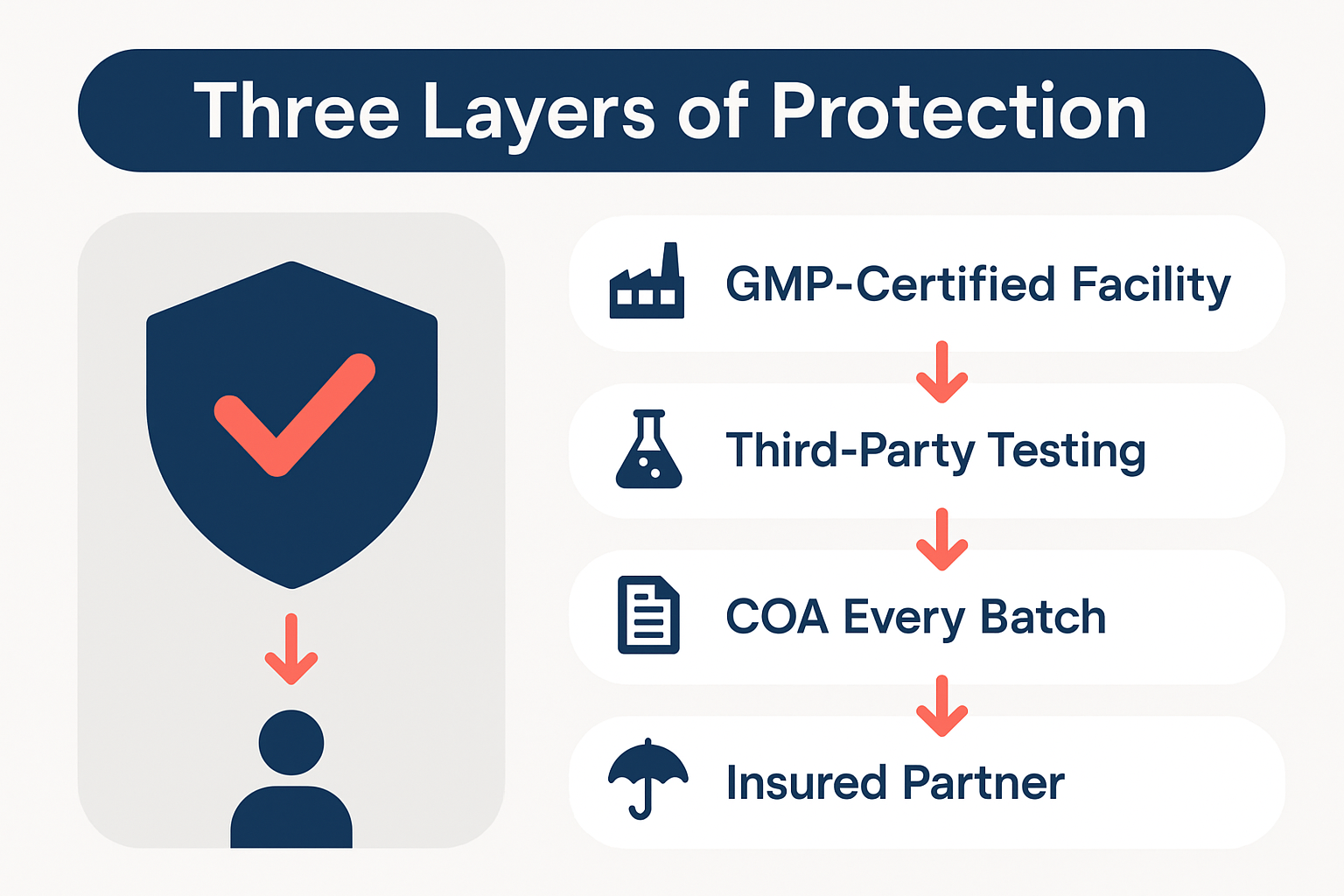
Zero inventory removes warehousing risk. It removes capital risk. It does not remove product risk. Your label still carries the liability, no matter who filled the bottle. That’s why the partner matters as much as the policy. An underwriter prices risk from the paper trail: GMP certification, third-party lab results, a COA on every batch, and an insured facility behind the product. When that paper exists, the risk profile drops. When it doesn’t, the premium climbs or the application gets denied.
The documents are the discount
Underwriters do not read marketing pages. They read certificates. A GMP-certified facility and third-party testing produce the exact documents an application asks for. You hand them over at renewal instead of hunting for them.
How on-demand fulfillment changes the math
With how on-demand fulfillment works, Rocktomic manufactures, warehouses, labels, and drop-ships only when a customer order lands. You never buy pallets or rent shelf space. The flat fulfillment fee of about $2 per item replaces the fixed costs that sink underinsured startups. You pay when the order ships, not before. That model strips out two of the biggest exposures underwriters price: inventory sitting in a warehouse and capital tied up in dead stock. Less exposure, lower risk profile, cleaner application.
The wrong partner makes you uninsurable
The contrast is simple. Manufacturers that force pallet buys push inventory risk onto your balance sheet. Facilities that cannot produce GMP and COA documentation leave you with nothing to submit, which is the trap behind choosing the wrong manufacturer. The brand carries the liability either way, but a bad partner makes it uninsurable liability. A partner with certifications on file and a COA attached to every batch changes the conversation. The underwriter sees less risk. You see a cleaner application. The label still carries liability, but you no longer carry it alone.
Platform and Retailer Requirements You Will Hit
Marketplaces do not care how careful you are. They care about paperwork. Amazon requires sellers to carry at least $1 million in product liability coverage once monthly sales exceed $10,000 (The Coyle Group, 2026). Cross that threshold and the coverage request lands in your seller account whether you are ready or not.
Amazon is not the only gatekeeper. Major retailers write the same demand into vendor agreements, and social commerce approvals routinely ask for compliance documents before your first ad goes live. A TikTok Shop or Instagram storefront approval can stall on missing certificates.
The pattern is consistent:
| Requirement | What it means | How to satisfy it |
|---|---|---|
| $1M product liability certificate | proof of coverage on file | carry dedicated product liability policy |
| GMP documentation | facility-level proof | partner provides it |
| COA per batch | product-level proof | partner provides it |
Two of the three requirements land on your manufacturing partner. A GMP-certified facility like Rocktomic produces the documentation and the certificate of analysis for every batch. Your job is the policy and the paperwork queue.
Claim language feeds into this review too. Platforms audit labels and ad copy against FDA and FTC rules, and a storefront approval can hinge on wording you thought was harmless. Start with the basics on skipping the FDA disclaimer, then run the full DSHEA launch playbook before you submit anything.
A 5-Step Plan to Protect Your Assets Before You Launch
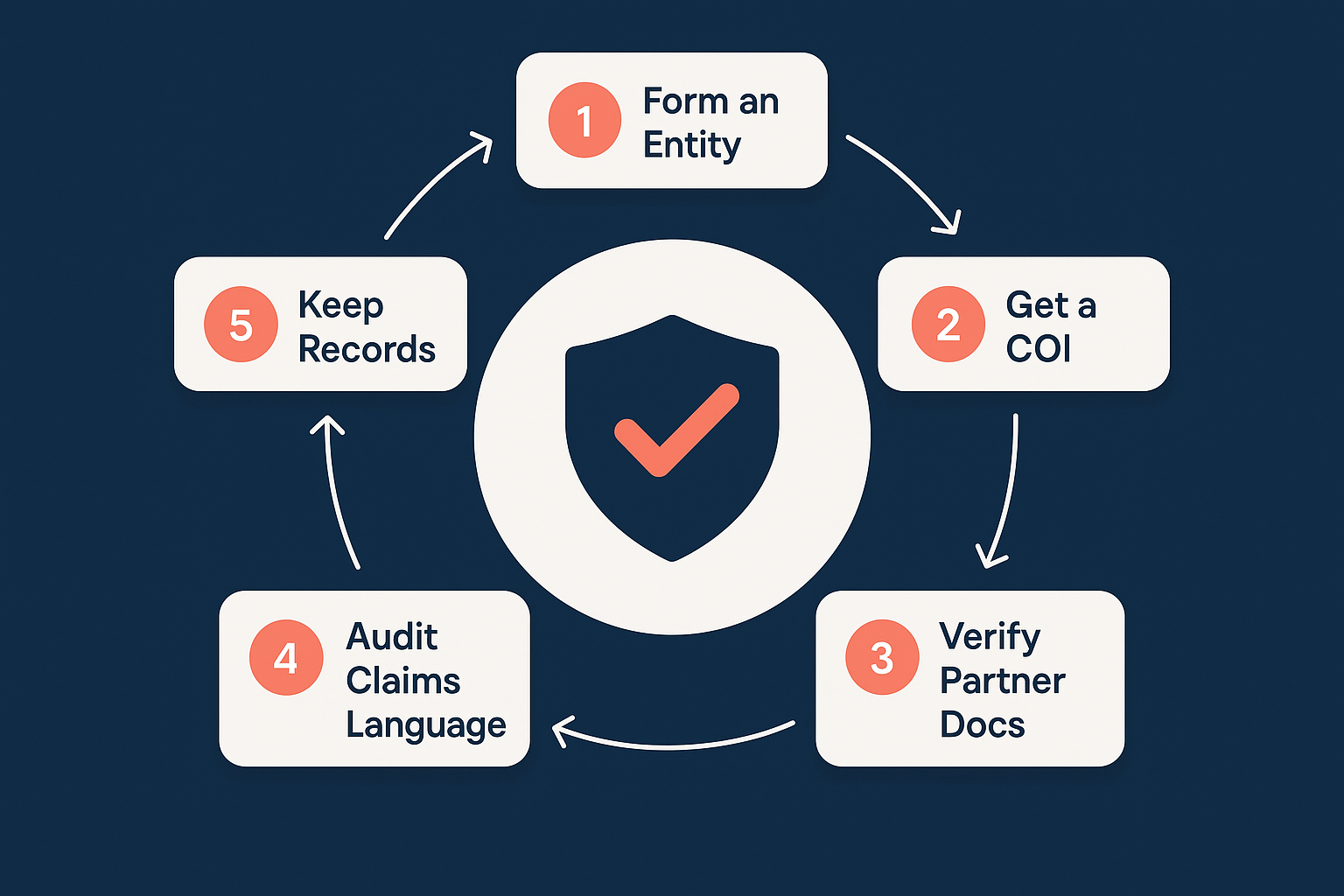
Requirements are reactive. This plan is proactive. Run it before you launch so the business, not your personal bank account, carries the risk.
| Step | Concrete action |
|---|---|
| 1. Form an LLC or corporation | so the business, not the person, owns the risk |
| 2. Get a certificate of insurance | with dedicated product liability |
| 3. Verify partner documents | GMP certification, current COAs, and the partner’s own coverage |
| 4. Audit every claim word | on labels and ads, for compliant structure/function language |
| 5. Keep batch records | plus complaints and adverse event files |
Step one is the foundation. An LLC or corporation creates a legal wall between your personal assets and your brand. If a claim comes in, the entity answers for it, not your home or savings.
Step two buys the actual protection: a dedicated product liability policy. Make sure the certificate names your business entity, not you personally.
Step three is where a white-label partner earns its keep. Ask for GMP certification, current COAs on the products you sell, and proof of the manufacturer’s own coverage. Documents expire, so set a calendar reminder to re-verify each year.
Step four is wording. Every label line and every ad caption needs structure/function language that stays inside FDA and FTC boundaries. One overreaching phrase can trigger a warning letter or a marketplace takedown. If this sounds like a lot, the legal basics for a zero-inventory supplement company walk through the full setup.
Step five is the record trail. Batch records tie every unit to its COA. Complaint logs and adverse event files show regulators you took action. You may never need them. If you do, they are the difference between a manageable inquiry and a disaster.
Asset protection is not a one-time task. Every new product means a new COA, a new label audit, and a new batch record. Build the habit before launch and it becomes routine. If you want a second set of eyes on your plan, book a call with Rocktomic and walk through your checklist with a real human.
Supplement Brand Liability Insurance: 8 Common Questions, Answered
Do supplement brands legally need product liability insurance?
There is no federal law that forces every supplement brand to carry product liability insurance. But the marketplace can. Amazon requires sellers to carry at least $1 million in coverage once monthly sales pass $10,000, per The Coyle Group, 2026. Retailers and distributors often add their own requirements too. If you sell through a major channel, insurance stops being optional. It becomes a condition of doing business.
Does general liability insurance cover dietary supplements?
Usually not. A standard commercial general liability policy covers slips, falls, and property damage. It often excludes ingestible products entirely. Dietary supplements need a dedicated product liability policy, with endorsements added for risks like product recall. Before you buy, confirm with your broker that the ingestible line is named coverage. A generic policy that only lists “products” can leave a supplement claim uncovered.
Can I get insured if I private-label from a manufacturer?
Yes. Even when another facility manufactured the product, the brand on the label carries manufacturer-level liability. Underwriters know this, so they underwrite the co-manufacturer too. Expect to provide the facility’s GMP documentation and current certificates of analysis for every product you sell. A private-label brand with clean documentation can get covered. One with missing paperwork will struggle to find a carrier.
What documents do underwriters require for supplement coverage?
Underwriters typically ask for three things. First, GMP certification or a recent third-party GMP audit of the manufacturing facility. Second, current certificates of analysis, usually within the last 12 months, for each product. Third, label proofs showing FDA-compliant structure/function claims. Brands that work with manufacturers running documented quality hubs, like Rocktomic’s, have these files ready before the application starts.
Does product liability insurance cover product recalls?
Not by default. A standard product liability policy covers bodily injury and property damage from the product itself. It does not pay to pull product off shelves, notify customers, or destroy inventory. Recall expense coverage is a separate endorsement you add to the policy. If recall risk matters to your category, that endorsement is the piece that actually responds when a problem surfaces.
How much does supplement liability insurance cost?
External premiums for a supplement brand start around $2,500 a year, with many brands paying $2,800 to $4,500, according to The Coyle Group and Insurance Canopy, 2026. Larger brands with wider distribution can pay $25,000 or more. Compare that to the membership cost of the manufacturing partner itself: Rocktomic’s Free plan is $0 a month, and the Scale plan is $297 a month. The policy is the real cost. The platform access is not.
Do I need insurance with a zero-inventory dropship model?
Yes. A zero-inventory dropship model removes the warehouse risk, but it does not remove product liability. The brand on the label still answers for the product. Rocktomic charges about $2 per item for pick, pack, and label through its on-demand fulfillment service, so the model keeps cash outlay low while the operation runs. Insurance remains a separate, necessary line. The fulfillment model changes the risk profile. It does not erase it.
What happens if I skip insurance and a claim hits?
One claim can erase years of profit. Legal defense alone runs into five figures quickly, and a settlement comes out of your personal assets if the business cannot pay. Compare that to a Scale plan at $297 a month, which covers the full catalog, lowest wholesale pricing, and priority fulfillment. GMP compliance and clean labels reduce the chance of a claim. Insurance is what survives the one that still lands.
How Rocktomic Helps You Launch Protected
Rocktomic manufactures in a US GMP-certified facility, tests every batch through third-party labs, and attaches a Certificate of Analysis (COA) to every product. When an underwriter asks for proof of manufacturing quality, you hand them the same documents this article lists, from COAs to GMP certificates. The full checklist lives in Part 5. The point here is that the paperwork exists before you need it.
Flat-Fee Fulfillment With Zero Inventory
Fulfillment runs a flat fee of about $2 per item, and no inventory purchase is required. The Free plan is $0 a month. The Scale plan is $297 a month and adds the lowest per-unit wholesale pricing, the full catalog, and priority fulfillment. Real human support is available on both. See the complete breakdown on the Rocktomic membership pricing page.
For a creator-operator, the choice is straightforward. The Free plan at $0 a month covers on-demand dropshipping, up to 10 white-label products, and one sales-channel integration. The Scale plan at $297 a month pairs the lowest per-unit wholesale with priority fulfillment. That is the launch path for a protected brand with zero inventory. Start on the Scale plan and your brand is protected from the first order. Want to talk it through? Book a call with Rocktomic and bring your insurance questions.
One compliance note: this article is not legal advice. Coverage requirements vary by state, product category, and revenue, so confirm the details with a licensed insurance broker before you launch. To see why manufacturing quality matters for your policy, read why Rocktomic.
Last updated: 2026-06-21.