
Ditch the T-Shirts: Why Top Creators Are Abandoning Low-Margin Merch for Consumables
· 17 min read · By Rocktomic Labs Team
Last updated: June 21, 2026
Top creators are replacing t-shirts with supplements because the business model is structurally better: consumables generate repeat purchases, while apparel generates a one-time sale and a returns headache. The data backs the move: the U.S. dietary supplements market was worth $68.74 billion in 2025 and is projected to reach $131.08 billion by 2033, an 8.5% compound annual growth rate, according to Grand View Research (December 2025, retrieved June 21, 2026). That growth pace is pulling the creator economy’s biggest names into consumables: the same customer can repurchase supplements a dozen times a year.
What Is the Merch-to-Consumables Shift in the Creator Economy?
The merch-to-consumables shift is the movement of creators from one-time physical goods like t-shirts and hoodies to daily-use products such as supplements, which buyers replenish on a schedule. Three mechanics drive it: repeat purchase, predictable replenishment cycles, and zero-inventory fulfillment. Rocktomic built its platform around those mechanics. The result is recurring revenue from the same audience a creator already owns.
Pick any product, set your monthly volume, and see your real per-unit and monthly profit on every plan – fulfillment, card processing, and membership all included.
The Merch Math Trap: Why Apparel Margins Keep Shrinking.
Apparel is a discretionary purchase, and discretionary is the first line item shoppers cut when budgets tighten. Analysts forecast low single-digit revenue growth for the apparel category while rising material, transport, and energy costs squeeze the margins that remain. The BoF/McKinsey forecast, cited via Oracle NetSuite on November 13, 2025, describes exactly that pressure: modest top-line growth with thinner margins underneath, a dynamic that pushes retailers into discount cycles and trains shoppers to wait for a sale instead of buying at full price. Read the Oracle NetSuite analysis of apparel industry challenges (retrieved June 21, 2026).
That math lands directly on creators. A t-shirt line is built on a category growing in the low single digits. It competes for the same squeezed consumer dollar as every other optional buy. And it shows up in the earnings mix as a side line, not the main line.
Merchandise is 11.4% of creator earnings
ShortsIntel’s April 2026 creator economy data puts the mix in order. Merchandise generates only 11.4% of creator earnings. Brand deals lead at 22.7%, ad revenue follows at 22.1%, and subscriptions hold 20.0%. All figures retrieved June 21, 2026, from ShortsIntel creator economy statistics.
| Revenue source | Share of creator earnings |
|---|---|
| Brand deals | 22.7% |
| Ad revenue | 22.1% |
| Subscriptions | 20.0% |
| Merchandise | 11.4% |
Notice what sits at the bottom of that table. Merchandise is the only stream tied to a physical product you must manufacture, store, and ship, and it still trails every recurring source. Brand deals renew. Subscriptions renew. A t-shirt sells once unless the design catches fire again.
The costs a t-shirt line hides
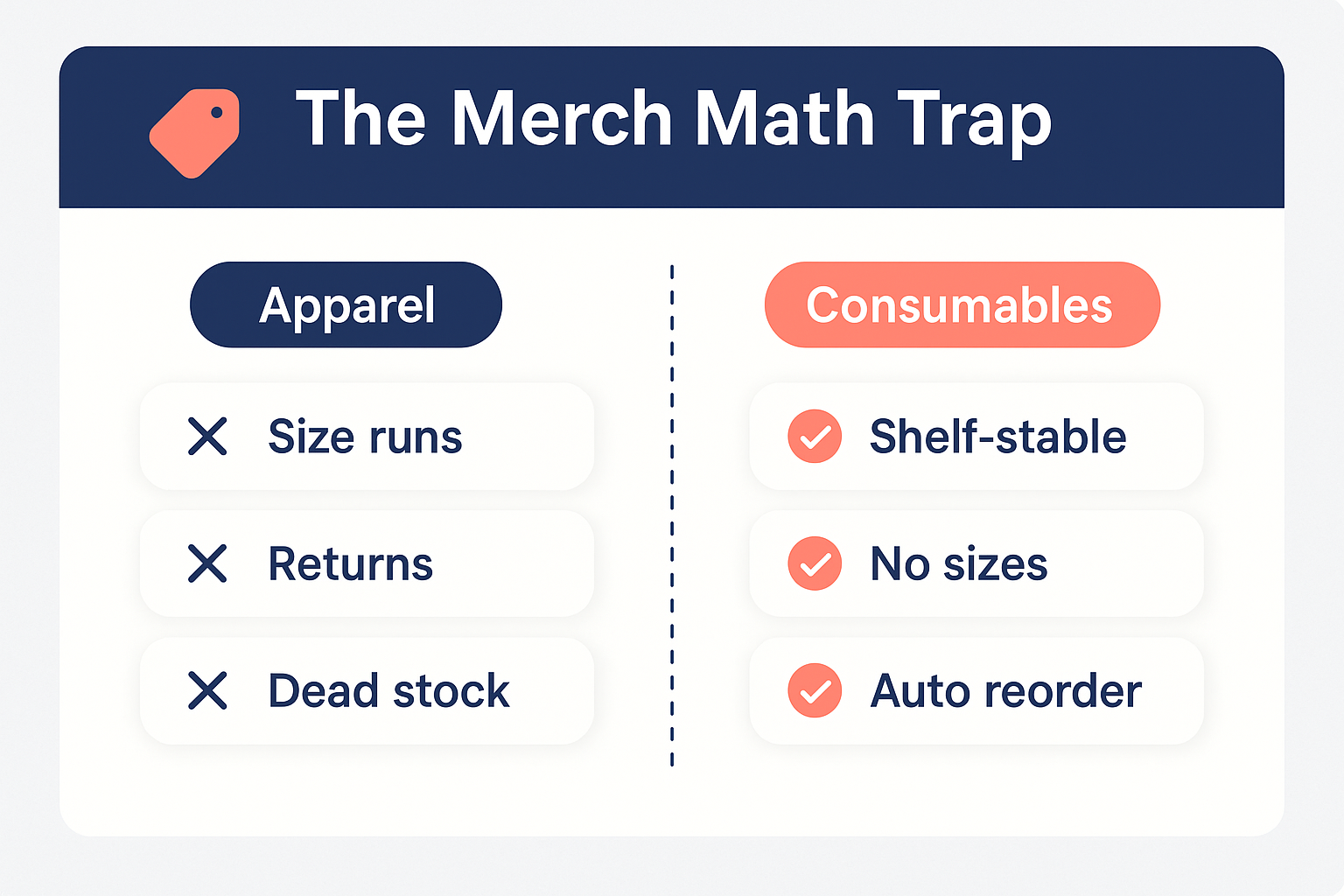
Run the merch math line by line and the trap is obvious. A t-shirt line starts with size runs, so you stock multiple sizes of every design. Seasonal dead stock sits in storage when summer ends. Returns eat your margin twice when a fit is wrong, and per-order print fees stack on top of the base garment cost.
Every one of those costs lands on a product that sells once at a one-time price.
None of those costs exist for a shelf-stable consumable. One SKU holds one formula. No sizes, no seasons, no fit-related returns. That structural difference is the core of why t-shirts are killing your fitness brand’s profits.
Then compare what happens after the sale. Apparel ships once and the relationship is over. A consumable ships, gets used, and creates a reason to reorder in 30 days. That second sale is where the brand economics change, because consumables run out and the refill comes back to your brand.
Supplements: The Category Growing 8.5% a Year While Apparel Crawls.
Growth rate is the quiet half of the margin conversation. When a category compounds at 8.5% a year, a new brand gets tailwind instead of headwind. Apparel offers no such lift.
The figures below come from Grand View Research market reports. External citations carry a retrieval date of June 21, 2026.
| Market | 2025 value | Projection | Growth rate |
|---|---|---|---|
| U.S. dietary supplements | $68.74B | $131.08B by 2033 | 8.5% CAGR (Grand View Research, Dec 2025) |
| Global dietary supplements | $209.5B | $431.7B by 2033 | 9.5% CAGR (Grand View Research, Jun 2026, retrieved June 21, 2026) |
| Global nutritional supplements | $517.1B | Not stated | Not stated (Grand View Research, Jun 2026, retrieved June 21, 2026) |
| North America holds 36.1% of global dietary supplement revenue (Grand View Research, 2025, retrieved June 21, 2026). | |||
Read the table twice. The first row alone shows a U.S. market that nearly doubles by 2033, from $68.74B to $131.08B. The global dietary supplement row moves from $209.5B to $431.7B over the same window, a 9.5% CAGR. Even where Grand View does not state a projection, the global nutritional supplement market is already the largest number on the table at $517.1B.
The note row matters just as much. North America holds 36.1% of global dietary supplement revenue. For a U.S.-based creator, that means the demand is not somewhere far away; it is in your own backyard, inside the same platforms your audience already uses.
Why the growth rate is the real signal
Projections are forecasts, not promises. But the direction is consistent across three separate market definitions, and that direction is what counts. A category growing at this pace expands the pie every year, which means a new brand can win without forcing an existing competitor out.
Here is the business read. You are not entering a flat market and hoping to steal share. You are entering a category expanding faster than the apparel market you are leaving, with demand that grows whether or not you run a single ad. That changes the math on everything downstream: pricing, retention, and what your brand is worth a year from now. Every one of those gets easier when the market itself is pulling in new customers every year.
For a deeper look at the demand side, the 2026 supplement market boom walks through why the category keeps pulling creators into consumables and what that means for new brand owners.
Why Consumables Beat T-Shirts on Unit Economics
| Dimension | Merch | Consumables |
|---|---|---|
| Sizing | Size runs | None |
| Returns | High | Rare |
| Inventory | Seasonal dead stock | Shelf-stable |
| Purchase pattern | One-off | Replenishment |
| Fulfillment | Per-order logistics | Flat ~$2 per item pick/pack/label |
Those five rows are the difference between a business that compounds and one that resets with every launch. The merch column front-loads risk; the consumables column moves it off your plate. One formula, a fixed cost per unit, and a customer who comes back when the bottle runs out.
Fulfillment is where the models really split. Some manufacturers force pallet buys and layer per-order platform fees on top. You pay for the whole batch up front, then pay again every time a unit moves. That only works if everything sells. An on-demand model flips the sequence: you pay when an order ships, and not before.
The fulfillment fee sits at a flat $2 per item for pick, pack, and label. That is the whole logistics cost. No warehouse line item. No per-order platform surcharge. No minimum batch to trigger production. The fee exists only when a sale exists.
Cash flow is the quiet advantage. With a pallet buy, the money leaves your account months before the first sale. With pay-on-ship, the product cost and the customer’s payment land in the same week. That changes what a launch needs: no capital pile, just an audience and an offer.
That structure is what makes consumables a recurring revenue play instead of a merchandise gamble. The first order covers the customer’s introduction. The second, third, and fifth orders hit the same flat fulfillment cost, and the margin on each one keeps the same shape.
T-shirts sell once. A supplement sells on a cycle. The customer finishes the bottle, then reorders. That repeat order is where the economics improve, because the cost to serve it is the same flat few dollars and the marketing cost is zero. Retention is the margin.
Run the numbers before you pick a product
A member can run the math for any product with the supplement margin calculator. Plug in a product, set a price, and the calculator shows per-unit contribution after fulfillment. No guesswork, no spreadsheet, no surprise costs at the end of the month.
The Recurring Revenue Loop: From One-Off Tee to Monthly Replenishment.
A tee shirt sells once. The buyer wears it, washes it, and moves on. Your next sale depends on your next drop. A supplement is different: it gets used up on a schedule, so the buyer has to come back.
That structural difference is the whole business case for consumables. Apparel is a one-off transaction. A supplement is a replenishment cycle with a built-in reason to repurchase. The product physically disappears, and that creates a natural reorder point you can count on.
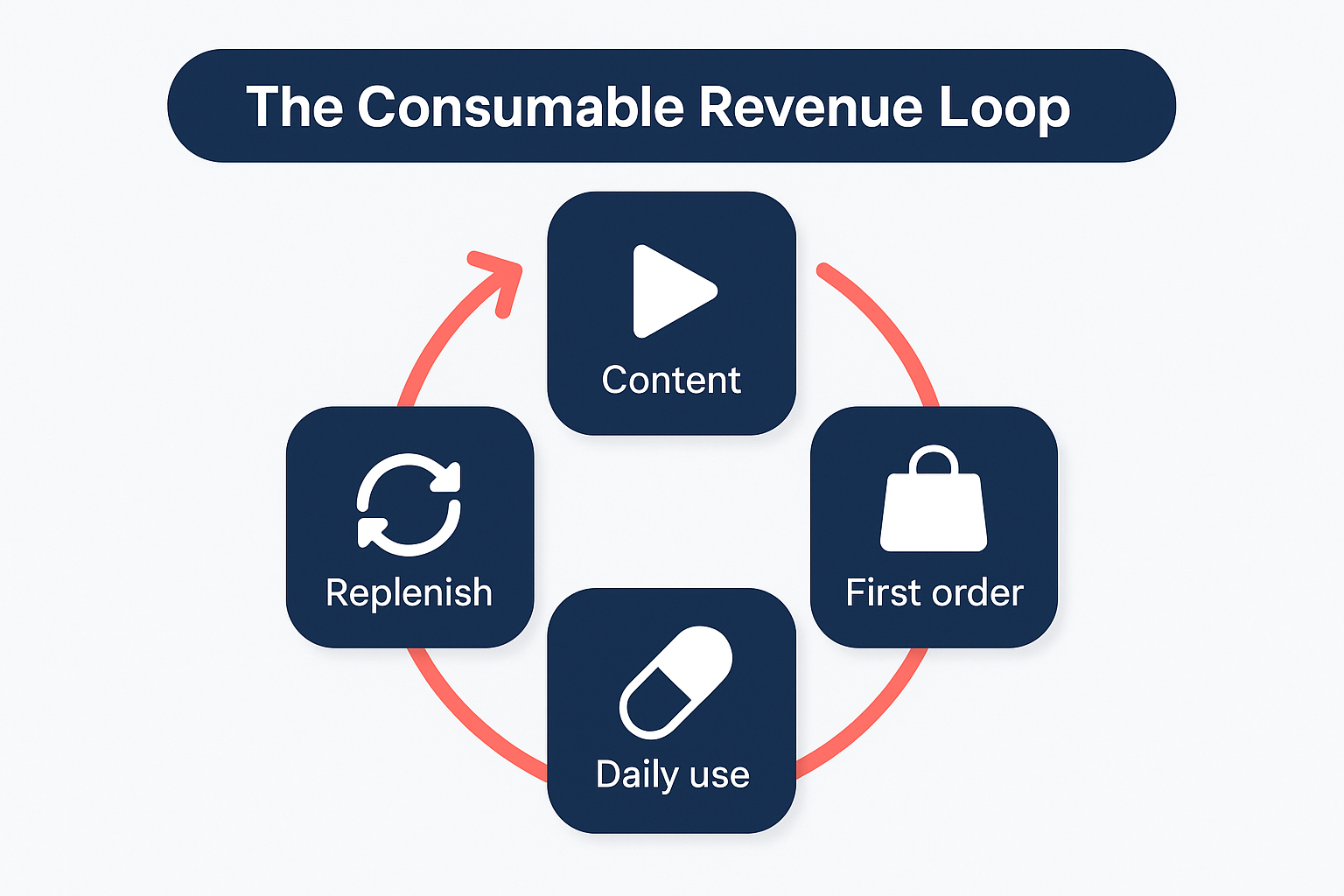
Here is the loop in practice:
- Content drives the first order.
- The customer uses the product daily.
- The bottle empties.
- They reorder.
- Repeat.
Every piece of content you publish feeds the top of that loop. Every order feeds the bottom. Once the loop is running, revenue stops being spike-and-forget and becomes something you can forecast. You are no longer renting attention for each sale; you are building a base of customers who repurchase on their own schedule.
Subscribe-and-save is what converts that one-time buyer into a recurring one. Instead of waiting for the customer to remember they are running low, you offer a subscription at checkout. The customer sets it once. The product ships on a schedule they choose. The sale happens automatically, and the order value shows up on a predictable cadence.
Each repeat order skips the acquisition cost of the first one. You already won that customer. The second sale is a renewal, not a new conquest. That is why the consumable model beats the merch model over time: the first order pays for the audience, and every order after it pays you.
That turns a transaction into a monthly revenue line. Merch drops are events you have to chase with fresh content and fresh ad spend. A replenishment subscription is a number you can plan around, and it grows every month as new customers enter the loop. The same logic explains why influencers are launching owned supplement brands instead of another apparel drop.
Zero Inventory: How Creators Launch Without a Warehouse.
You own the brand. You own every customer relationship. You never order a pallet, rent a storage unit, or pack a shipping box. The inventory problem that sinks most merch lines does not exist here.
Rocktomic manufactures, warehouses, labels, and drop ships on demand. Through it all, the member owns the brand and the customer relationship. When an order comes in, the product ships under your label with your branding. You keep the customer. Rocktomic handles the logistics.
That split is the whole operating model, and it changes the launch math in your favor.
Two plans, and one of them costs nothing
You do not need a paid plan to start. The Free plan costs $0/month, covers up to 10 white-label products, and carries no minimum order. The Scale plan runs $297/month and opens the full 140+ catalog, including Scale Exclusives, with the lowest per-unit wholesale pricing Rocktomic offers.
| Plan | Price | What you can sell | Extras |
|---|---|---|---|
| Free | $0/month | Up to 10 white-label products, no minimum order | 1 sales channel |
| Scale | $297/month | Full 140+ catalog incl. Scale Exclusives | Lowest per-unit wholesale, unlimited channels, priority fulfillment |
Days, not production runs
This is where the model beats apparel. A merch drop means weeks or months of production, proof approvals, and inventory that has to sell. A supplement brand on this model goes from signup to selling in days. No production run. No upfront buy. No dead stock when a product stalls.
No warehouse, no bulk buy, no dead-stock risk. You only pay for what ships. Orders flow in, your label goes on the bottle, and the package lands at the customer’s door. You never handle the inventory. You just collect the revenue. Pick your products, build your store, and start selling. That is the whole job. See exactly how on-demand fulfillment works before you decide which plan fits.
Which Supplement Categories Are Creators Choosing in 2026?
Category choice follows content fit. The creators who sell the most consumables pick the product they can film naturally, not the one with the loudest ad claims. Apparel sells once. A supplement tied to a daily habit can sell every month.
Here is how the six main categories line up with creator niches in 2026.
| Category | Why creators pick it | Content fit |
|---|---|---|
| Sports nutrition | protein, creatine, pre-workout | training content |
| Gummies | easy on-camera demo | on-camera demo content |
| Greens and reds | daily ritual | morning routine content |
| Hydration and electrolytes | lifestyle and recovery | lifestyle and recovery content |
| Nootropics | focus and productivity | focus and productivity content |
| Men’s and women’s wellness | audience-specific | audience-specific content |
Read the table as a match game. A fitness creator turns training clips into sports nutrition orders. A gummy brand lives or dies on camera, which is why creators with strong on-camera presence pick it. A morning-routine creator turns a filmed ritual into repeat greens and reds purchases. The niche decides the shelf, not the other way around.
Notice what is missing from every row: no category sells itself on a claim. Each pick is a usage decision. The creator films the product in its natural context, and the audience sees exactly where it fits in a routine. That is what makes the content repeatable, and repeatable content is what makes the revenue recurring.
The Rocktomic catalog covers all six categories across 140+ US-manufactured products. That covers the full run from sports nutrition to men’s and women’s wellness. A member can launch exactly the categories their content supports and skip the ones it does not.
This is the same logic behind why creators are shifting to high-margin physical products: consumables repeat, and the content that sells them repeats too.
The Trust Advantage: Why Fans Buy Consumables From Creators.
A t-shirt gets worn a few times a month. A supplement gets consumed daily. That daily contact makes consumables one of the highest-exposure products you can put your name on. Every container, every scoop, every shared photo is a billboard for your brand.
That exposure raises the stakes. Fans are putting something in their body, and they will verify your legitimacy before they buy. Proof points are what close that gap.
Proof Points, Not Marketing Claims
Rocktomic products are manufactured in the US under GMP certification, tested by third parties, and shipped with a Certificate of Analysis (COA) on every batch. That is not a marketing claim. Each COA is a document that lists what was tested and what was found.
Lab Results Are Content
Publishing lab results and COAs turns quality into a content asset. Post the COA. Walk through what third-party testing means. Show the facility. That content answers the objection before a fan can ask it, and it keeps working after the sale. Buyers who see proof once are more likely to buy again. That repeat trust is the whole point: a t-shirt buyer is done after one purchase, while a supplement buyer reorders every month.
You do not build that infrastructure yourself. Rocktomic members own the brand and the customer relationship while the manufacturing, testing, and documentation are handled for them. The full Rocktomic quality and COA process is public. The brand builder program is built around that division of labor: you bring the audience and the trust, Rocktomic brings the compliance and the proof.
How to Make the Switch From Merch to Supplements (Step by Step).
| Step | What you do | How Rocktomic helps |
|---|---|---|
| Step 1 | Pick a category from the catalog. | 140+ US-manufactured products, from sports nutrition to gummies, each with a Certificate of Analysis. |
| Step 2 | Build brand assets (logo, labels, mockups). | Done-for-you packages available. |
| Step 3 | Connect your store (Shopify, TikTok Shop, Instagram) via store integrations. | Orders sync to every channel automatically. |
| Step 4 | List up to 10 products on the Free plan or the full catalog on Scale. | Free is $0/month. Scale is $297/month with the lowest per-unit wholesale pricing. |
| Step 5 | Promote with content and replenishment offers. | Rocktomic manufactures, warehouses, labels, and drop-ships each order for about $2 per item. |
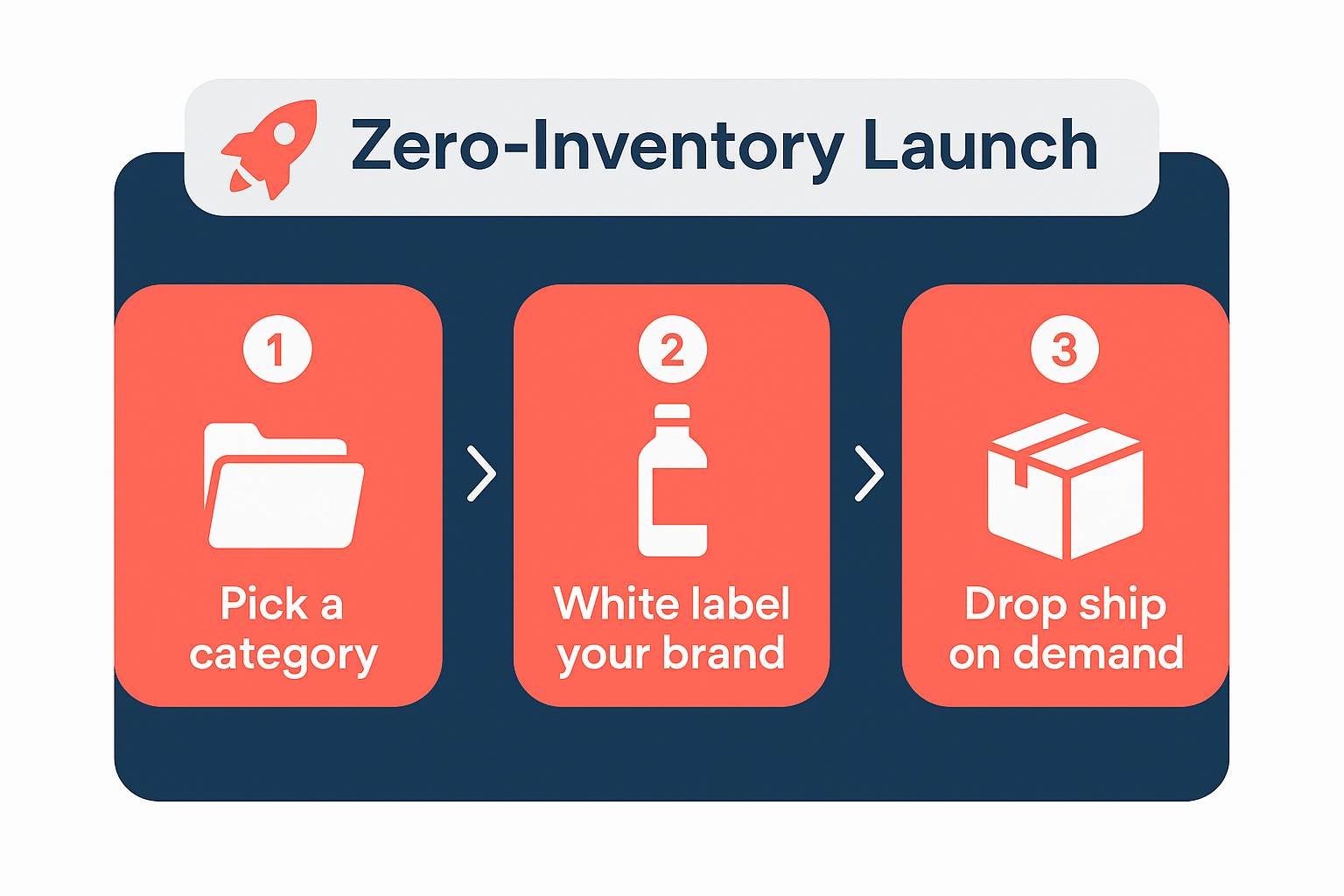
That is the whole path, and it takes an afternoon of setup. No pallet buys, no purchase orders, no inventory sitting in your garage. You go from idea to a listed product without buying a single unit upfront, and Rocktomic only bills you when an order ships.
Live in days, not months
Now stack that against a merch drop. Apparel means design rounds, sampling, production runs, and weeks or months of lead time before a single unit ships. Miss the window and the drop sits in a warehouse until the season passes. The supplement path puts you live in days. No sampling round, no factory minimum, no waiting on a production slot. Pick a product, build your assets, connect your store, and list.
The refill is the point
A T-shirt sells once. A supplement refills. Add a replenishment offer and a one-time buyer becomes a repeat customer, which is where consumable margins actually build. You own the brand and the customer relationship the entire time, not the platform and not the manufacturer.
Start with one product in the category you already talk about. If your content covers protein, launch a protein. If it covers greens, launch a greens powder. Prove the refill works, then expand across the catalog as demand shows up. You can test, measure, and double down on what actually sells. That is the switch apparel never gives you.
FAQ: Switching From Merch to Supplements
Why are top creators abandoning merch for supplements?
Apparel is a one-time purchase with built-in costs: size runs, seasonal inventory, returns, and per-unit fulfillment overhead. Supplements are shelf-stable consumables that fans repurchase on a weekly or monthly rhythm, which turns a single transaction into a recurring revenue stream. Creators also avoid inventory risk because a white-label partner can drop ship on demand.
What makes consumables higher margin than merch?
The comparison is structural, not brand-specific. Apparel margins shrink under returns, dead stock, and seasonal markdowns, while consumables sell by the unit with no sizes and no fit issues. Members can pair a flat fulfillment fee of about $2 per item with wholesale pricing, which keeps the math simple. The real margin engine is repeat purchases, not a markup on a single t-shirt.
Do supplement brands really produce recurring revenue?
Yes, because supplements are consumed daily, so buyers naturally replenish on a schedule. That creates repeat-purchase behavior creators can formalize with subscriptions and subscribe-and-save offers. Each renewal is a new transaction at a similar margin, building predictable monthly revenue instead of spike-and-forget merch drops.
Which supplement categories are creators launching?
The most common creator categories are sports nutrition, gummies, greens and reds, hydration and electrolytes, nootropics, and men’s or women’s wellness. Gummies are popular because they are easy to demo on camera, and daily-use staples like protein, creatine, and multivitamins fit a consistent content cadence. Creators should pick a category their audience already trusts them in.
Can a creator launch supplements with zero inventory?
Yes. White-label partners offer on-demand drop shipping, where the member owns the brand and the customer relationship while the manufacturer holds the stock. The Free plan lets members sell up to 10 white-label products with no monthly fee and no minimum order. That removes the warehouse, the bulk buy, and the dead-stock risk that kills merch lines.
What does a supplement membership cost?
Rocktomic has two membership plans. The Free plan is $0 per month and includes on-demand drop shipping with a flat fulfillment fee of about $2 per item. The Scale plan is $297 per month and adds the lowest per-unit wholesale pricing, unlimited sales channels, and the full 140+ product catalog. Neither model requires pallet minimums.
How does the flat $2 fulfillment fee work?
The flat fulfillment fee of about $2 per item covers pick, pack, and label for every order that ships. Members pay only when an order ships, so there is no upfront purchasing and no idle inventory cost. That is the fee-transparency contrast with apparel: no storage, no return handling, and no seasonal write-offs.
How fast can a creator replace merch revenue with supplements?
Faster than a merch drop. Because products are already manufactured and labeled to the member’s brand, the main tasks are choosing a category, setting up a store, and connecting a sales channel. Members can be live in days, not the weeks or months typical of apparel production runs. The Scale plan at $297 per month is the standard on-ramp for creators treating this as a full business line.
Start Your Supplement Brand With Zero Inventory
The structural case is clear. Consumables generate repeat purchases in a category growing faster than apparel, with no size runs, no dead stock, and no inventory risk. A T-shirt sells once. A supplement reorders all year.
You own the brand. Rocktomic handles the manufacturing, warehousing, labeling, and drop-shipping. That means zero inventory, a $0/month entry on the Free plan, and no upfront purchasing. Every batch ships from a US GMP-certified facility with a COA attached.
Scale, at $297/month, adds the lowest per-unit wholesale and priority fulfillment. Model your first SKU with the supplement margin calculator, then compare Rocktomic membership pricing. When the numbers line up, book a call with Rocktomic for your launch plan. Your brand, your customers, your margin.