
The Ultimate Margin Hack: Dropshipping vs. Bulk Ordering for Creator Brands
· 16 min read · By Rocktomic Labs Team
Dropshipping beats bulk ordering for most creator brands because it removes the two costs that quietly destroy supplement margins: tied-up inventory and dead stock.
On a real white-label SKU, a creator pays $5.67 wholesale (ROC105) plus a flat $2 fulfillment fee and keeps $28.30 on a $35.97 retail bottle, with zero units bought up front. Bulk ordering requires a 24-unit minimum per SKU before the first sale. That is a $136.08 bet on demand that is not proven yet.
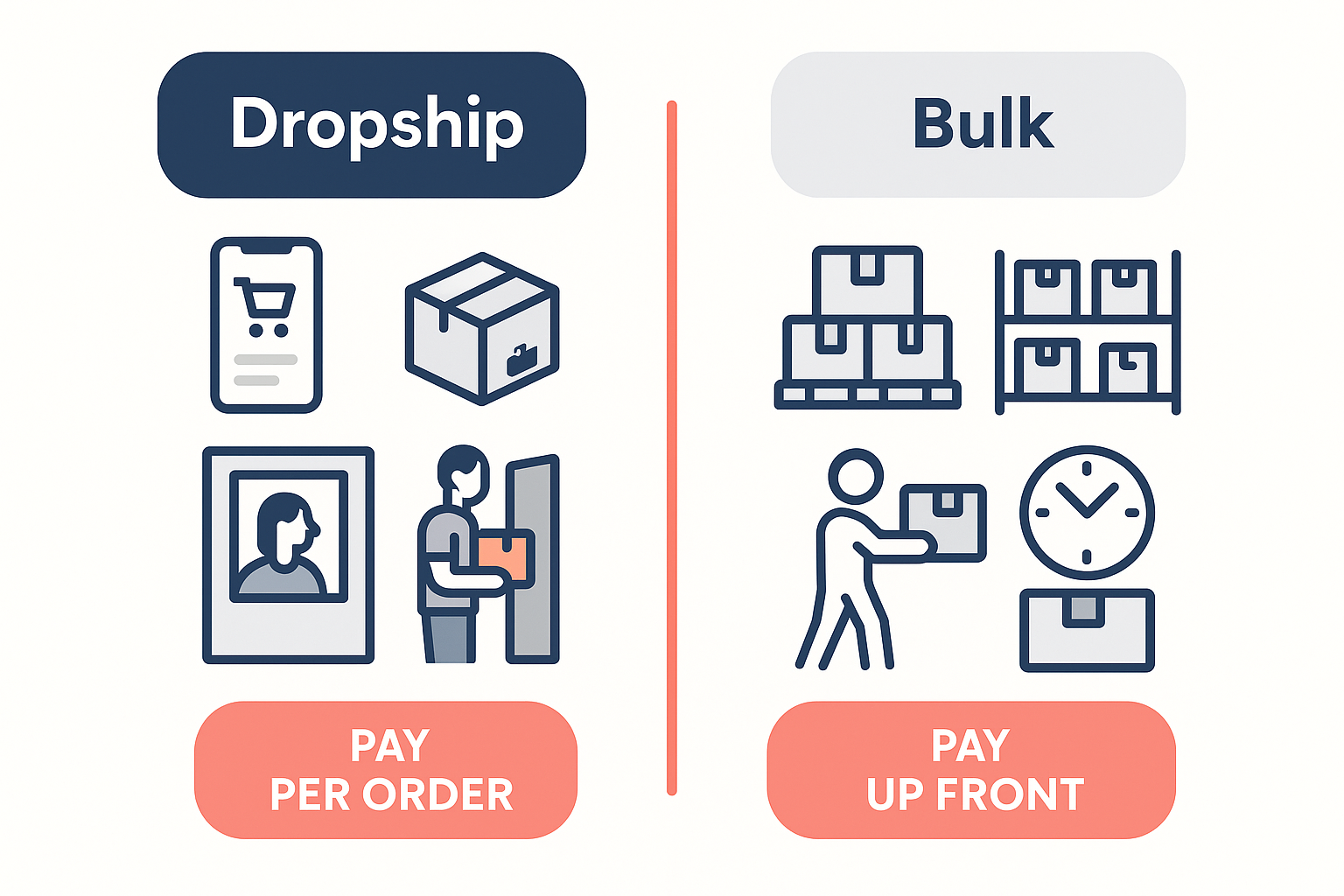
What Is the Difference Between Dropshipping and Bulk Ordering?
Dropshipping is a fulfillment model where the manufacturer warehouses, labels, and ships each order directly to your customer, so you buy a unit only after you have already sold it. Bulk ordering is the traditional wholesale model: you purchase inventory up front, usually at a minimum order quantity, store it, and sell it down before you recover your capital. The per-unit wholesale price can be identical. The difference is who carries the risk.
Pick any product, set your monthly volume, and see your real per-unit and monthly profit on every plan – fulfillment, card processing, and membership all included.
This article compares real margin math on real SKUs, not sticker price. Every number here is sourced and verifiable, so you can run the same calculation on your own product before you commit a dollar. The goal is simple: know your true cost per bottle before you choose a model, so margin survival is a math problem, not a guess.
Why the Margin Question Is Really a Risk Question
Put the two models side by side and the per-unit margin looks close on paper. That’s the trap. The wholesale sticker on a bulk order can look better and still lose, because the margin that actually survives is decided by risk, cash flow, and fees. Not by the price per bottle. Inventory has exactly two outcomes: it sells, or it becomes a discount problem.
Bulk asks you to hand over thousands before the first sale exists. Those units age in a warehouse while your ad budget drains. Storage costs, dead stock, and inventory taxes quietly eat the gap you thought you won.
Every fee that hits after the purchase order is a fee the sticker price never showed you. Zero-inventory dropshipping flips the order: you pay for fulfillment when an order ships, and your capital stays where demand is created.
A market big enough to fund the math
The risk question only matters if the category can support a brand. The data says it can.
| Market | 2025 figure | Growth outlook | Source | Date |
|---|---|---|---|---|
| U.S. dietary supplements market | $68.74 billion | Projected to reach $131.08 billion by 2033 at an 8.5% CAGR | Grand View Research | Retrieved June 21, 2026 |
| Global dietary supplements market | $209.5 billion | Growth outlook not stated in this article | Grand View Research | June 2026 |
| Global dropshipping market | $464.4 billion | Projected 20.7% CAGR through 2033 | Grand View Research | June 2026 |
| Domestic dropshipping fulfillment | 80.2% of dropshipping activity in 2025 | Not stated | Global Market Insights | December 2025 |
Read the table as one story: the supplement category is growing, and the fulfillment model that keeps cash liquid is growing with it.
Bulk ordering doesn’t create demand. It pays for inventory before demand exists. Here is why creators are launching owned supplement brands instead: the dollars that would sit in a warehouse are the same dollars that fund the content and ads where demand actually comes from.
The creator who treats margin as a sticker price is comparing two numbers while ignoring everything between the purchase order and the payout. The creator who treats margin as a risk question controls the timeline: no money out until a customer pays. That’s the whole margin question, answered.
How Dropshipping Margins Work: A Worked Example
Take one SKU and run the math end to end. Best Sellers Blend (ROC105) retails at $35.97. On the Scale plan the wholesale cost is $5.67. That gap is the whole game.
The published margin is computed from wholesale to MSRP. $35.97 minus $5.67 leaves $30.30, or 84.2% of retail. That is the gross contribution before any fulfillment cost. It is the number most platforms quote first because it looks the strongest.
Then the actual cost of shipping shows up. Rocktomic charges a flat $2.00 per item for pick, pack, and label. Add that to wholesale and the true landed cost is $7.67 per bottle. Net margin: $28.30 per unit, about 78.7% of retail. That is the figure that lands in your account when an order ships.
The Money-Math Table
| Line item | Amount |
|---|---|
| MSRP | $35.97 |
| Scale wholesale (COGS) | $5.67 |
| Fulfillment fee | $2.00 |
| Total cost per unit | $7.67 |
| Net margin per unit | $28.30 |
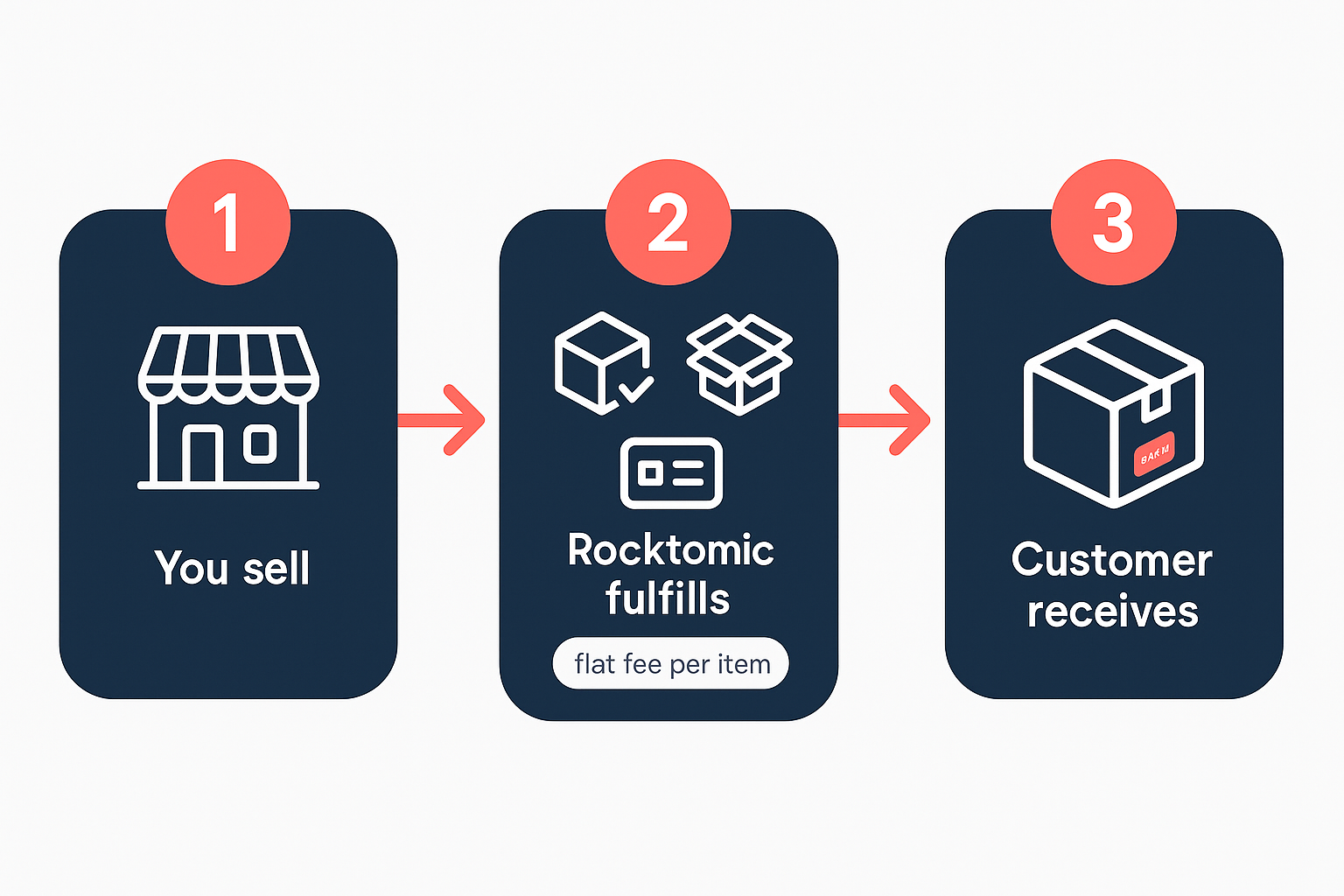
Read the table top down. The wholesale price is the COGS line. The fulfillment fee is what it costs to get the bottle to your customer. Total cost per unit is the sum of both. Net margin is MSRP minus total cost. Two steps, no hidden lines.
When You Actually Pay
You do not pay the $2.00 fee until an order ships. The flat fee covers pick, pack, and label, so there are no per-item surprises later. On the Free plan the monthly fee is $0; you pay the flat per-item fee only when a customer pays you. Scale at $297 per month trades a fixed subscription for the lowest per-unit wholesale, which is why the example above uses Scale pricing. A lower COGS line widens your net margin without touching your retail price.
Every SKU has its own wholesale price, so margins vary by product and plan. The table above is the template: MSRP, wholesale, fulfillment, net. Model your own numbers with the supplement margin calculator before you commit to a lineup.
What Does Bulk Ordering Really Cost?
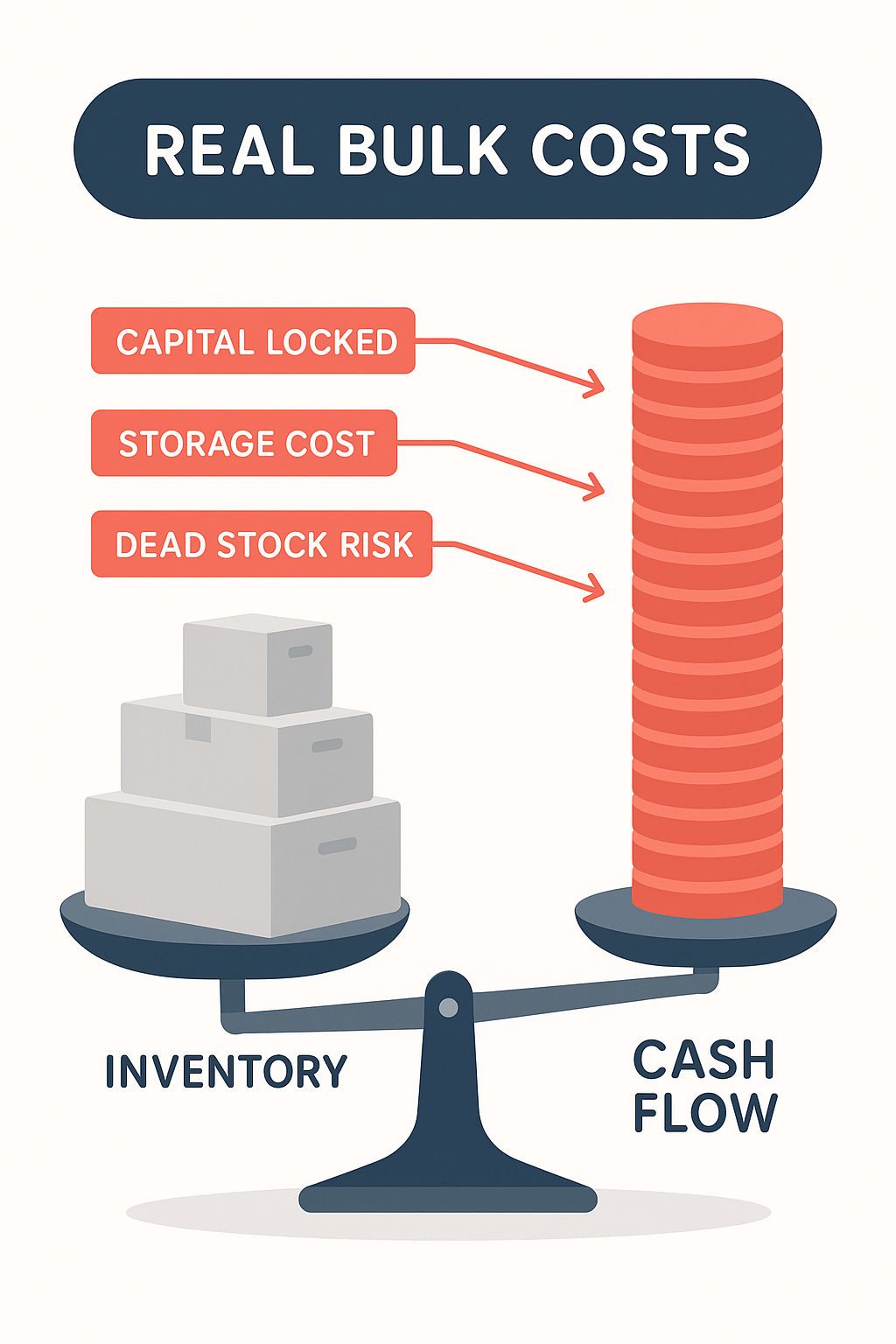
The wholesale price per unit is the same on both models. The difference is structural. Bulk ordering commits your cash before you make a single sale, then adds costs that never show up on the invoice.
Run the numbers on one SKU. ROC105 carries a 24-unit minimum at $5.67 per unit. That is $136.08 of capital locked up before the first customer orders. One SKU. A real product line runs five, ten, or twenty SKUs, and the committed capital climbs with every one. At launch, that means funding a warehouse before you have proven demand. Dropshipping flips the order: prove demand first, pay for product after.
The Sticker Price Is Not the Cost
The wholesale sticker is the smallest part of a bulk buy. You also pay for storage space, picking, packing, and the risk that stock does not move. Every month that a case sits in your garage or a storage unit, it eats floor space and attention. Add the hours spent tracking expiry dates and counting stock. If a formula underperforms, unsold units get discounted or written off entirely.
Dropshipping removes those structural costs because the manufacturer holds the inventory. You buy only after a sale happens.
Dropship vs. Bulk, Side by Side
| Dropship | Bulk | |
|---|---|---|
| Upfront purchase | None, buy only after a sale | Full case before first sale |
| Minimum quantity | Zero, on-demand | 24 units per SKU |
| Storage and handling | Manufacturer warehouses | You store and manage |
| Fulfillment cost | Flat $2.00 per-item fee | Picking, packing, labeling handled by you or added fees |
| Dead-stock risk | None, no unsold inventory | Unsold stock must be discounted or written off |
| Cash flow impact | Capital stays liquid for ads and content | Capital is locked until sell-through |
What On-Demand Replaces
Some suppliers force pallet buys before they will talk to you. Some platforms stack per-order fees on top of wholesale. On-demand dropshipping replaces both with a flat $2.00 per-item fee at fulfillment. No storage bill, no minimums, no dead stock.
That structure keeps your capital liquid. Money that a bulk order would lock into inventory can instead fund ads, content, and the next product launch. For a creator brand, that is the difference between growing and just holding stock. See how on-demand fulfillment works at Rocktomic.
What Does Dead Stock Do to Your Margin?
Dead stock does not announce itself. It sits in a warehouse or on a retail shelf, ticking past its label date. Every day it sits, the wholesale cost converts from an expense into a loss. The loss books quietly, then shows up in the quarter you least expect it.
A SKU that does not move has only three exits: discount it, donate it, or write it off. Each exit pulls the blended margin of the whole line below the published per-unit number. The bottle was priced assuming it sells at retail. When it does not, that markup never arrives, and the cost becomes a hole in the brand’s profit-and-loss statement. The winners now have to earn enough to cover the loser before the line as a whole turns a profit.
The Math on One 24-Unit Case
Run the numbers on a real product. A 24-unit case of ROC105 runs about $136.08 at wholesale. Say a third of that case never sells. That is roughly $45.36 of capital gone before storage, handling, or the discount you will take later to clear it. On paper, each unit carried a margin. In the box, a third of the case is a loss waiting to be admitted.
The Dropship Loop Has No Such Case
Run the same month on the dropship loop. The product is purchased only after the customer pays. A slow month costs ad spend and attention, never inventory. You do not discount a case that was never bought. You do not donate units that never appeared on your balance sheet. The worst case is a flat month, not a box of expired product. There is no case to mark down, no label date to chase, no clearance sale to run.
Bulk ordering front-loads risk into a single decision. Dropshipping keeps that risk inside the channel, where it can be switched off. For the full comparison of total profit across a year, see which model actually makes more money.
Dead stock is not a retail problem. It is a decision you make on the day you place the order.
When Bulk Ordering Actually Makes Sense
Bulk ordering is not the enemy. It is the wrong tool for an unproven product and the right tool for a proven one. The difference is predictability.
Predictable demand is the test
Predictable sell-through turns the 24-unit minimum into a working-capital decision, not a gamble. A gym restocking the same high-velocity protein to members every month knows exactly how many units move. A clinic dispensing practitioner-grade formulas through RocktomicRX works from a patient list, not a hope. And a wholesale brand selling into retail shelves starts with purchase orders already committed on paper.
Each of those operators can project unit movement with confidence. That projection is what lets them convert the lower per-unit cost into real margin. Reorder the same SKU 12 times a year and a small per-unit saving compounds into a meaningful annual number.
This is where the Scale plan at $297 per month earns its keep. Lowest wholesale pricing matters most when you buy the same product on a fixed schedule, because the savings repeat on every reorder.
Unproven SKUs stay on Free
For a creator still testing a product or an audience, the math flips. The Free plan at $0 per month with zero minimums is the lower-risk route until a SKU proves itself. Run a small drop-ship batch, watch the sales data, then move that winner to bulk.
The pattern is simple: prove demand at low risk, then use bulk to widen the margin on what already sells. A SKU that sells consistently for three months on Free is ready for bulk. One that flatlines is a lesson, not a loss.
Gym owners restocking monthly can review the bulk program for gyms to see how predictable demand changes the numbers.
How to Launch a Zero-Inventory Supplement Brand (Step by Step)
You do not need a warehouse, a purchase order, or a single pallet of bottles to start. You need a niche, a label, and a way to sell. The rest is Rocktomic’s job.
- Pick a niche and up to 10 white-label products on the Free plan. The Free plan costs $0 per month, so the only thing you risk is time. Choose products that fit your audience, not the other way around. Your brand is the filter; the catalog is the shelf.
- Connect one sales-channel integration. A single integration routes orders automatically from your storefront to Rocktomic’s fulfillment floor. No manual forwarding, no spreadsheets. Learn how on-demand dropshipping works before you pick your channel.
- Brand the line with your label. You own the brand name, the label design, and the customer relationship. If you want it handled for you, Rocktomic offers one-time done-for-you add-ons: the Starter Branding Package at $497, the Starter Online Store Build-Out at $1,497, or Business-in-a-Box that bundles both at $997. These add-ons do not change your plan; the Free plan stays $0.
- List products and start selling through content. Your content is the sales floor. Product pages, short-form video, posts, and emails all point to your storefront. The white-label program for creators exists so you can build the brand while Rocktomic handles inventory.
- Pay the flat ~$2 per-item fulfillment fee only when an order ships. No order, no fee. That is the zero-inventory model. You can run the startup cost comparison to see how much capital you keep in your pocket.
Here is the part that matters for ownership: you own the brand and the customer relationship. Rocktomic manufactures, warehouses, labels, and ships your orders. That split means you get the upside of a supplement company without the operational drag. You keep the customer data, the repeat revenue, and the equity.
The Verdict: Which Model Wins for Creators
Dropshipping wins the launch. Bulk ordering wins the repeat. The decision is not about which model is better in the abstract. It is about which one fits your demand curve at this exact moment.
If you have not proven sell-through, every unit you buy in bulk is margin you borrowed from your future. Dropshipping protects that margin because the only cost you carry is the fulfillment fee on an order that already exists.
Match your scenario to the right model
| Scenario | Recommended model |
|---|---|
| Launch and testing | Dropshipping on the Free plan ($0 per month, zero minimums) |
| Proven audience | Dropshipping on the Scale plan ($297 per month, lowest per-unit wholesale) |
| Predictable monthly sell-through | Bulk ordering (24-unit minimum when reorders are steady) |
| Retail or clinic wholesale | Bulk ordering (pre-committed units, working-capital decision) |
The pattern is simple. When demand is unproven, dropshipping keeps your cash working on content and ads instead of sleeping on a shelf. When sell-through is steady, bulk ordering lowers your per-unit cost and widens the gap between wholesale and your price.
Here is the verdict in one line: dropshipping wins the launch because it protects margin from risk, and bulk wins only after demand is proven and reorders are steady.
That is the reason you can launch in days with zero inventory. You test a product, read the data, and let the market vote before you commit a dollar to stock.
Both paths run on the same quality standard, which matters when your own name is on the label. Every Rocktomic product is US-manufactured, GMP-certified, and third-party tested with a Certificate of Analysis on every batch. If a customer questions your label, you have the paperwork to answer.
Want the full picture before you choose? Compare Rocktomic vs Supliful to see how the two models stack up on fulfillment fees, catalog size, and channel integrations.
FAQ: Dropshipping vs Bulk Ordering for Supplement Brands
1. What is the difference between dropshipping and bulk ordering for supplements?
Dropshipping means Rocktomic holds the inventory and ships each order directly to the buyer as it comes in. The creator pays about $2 per item, only when an order ships. Bulk ordering means buying product upfront at wholesale, 24 units per SKU as the standard minimum, or $136.08 at an example wholesale price of $5.67 a bottle. The cash leaves the bank before the first sale, and the stock sits until customers buy it.
2. Which model has better profit margins: dropshipping or bulk ordering?
Bulk ordering wins on contribution per bottle. In the standard example, a bottle retails at $35.97. Buying at $5.67 wholesale with no fulfillment fee leaves $30.30 in contribution, an 84.2% margin. The same bottle on dropship leaves $28.30 after the $2 fee, a 78.7% margin. That edge counts only if the entire order sells; dead stock erases it fast. The Scale plan at $297 a month locks in the lowest per-unit wholesale pricing.
3. What are the hidden costs of bulk ordering supplements?
The first cost is the upfront cash: $136.08 for an example 24-bottle order before a single sale. Then come storage space, shipping supplies, packing time, and labels. If the formula underperforms, unsold bottles at $5.67 wholesale each become dead stock that still takes up room. Dropshipping avoids all of it. The only cost is $2 per item, and only when an order actually ships.
4. What is the minimum order quantity for white-label supplements?
Dropshipping has no minimum: the order quantity is zero. The Free plan costs $0 a month, and the first order can be a single bottle. Bulk ordering requires 24 units per SKU, or $136.08 at the example wholesale price of $5.67 per bottle. Custom formulas carry a higher MOQ per SKU because a proprietary blend needs dedicated production. The dropship route lets a creator test a product with one sale instead of committing to a batch.
5. How does on-demand fulfillment work for supplement brands?
A customer orders from the creator’s own store. The order routes to Rocktomic’s warehouse, where the bottle is picked, packed, labeled, and handed to the carrier. The creator pays a flat $2 per item for that work. Rocktomic stocks the product, so the creator never touches inventory. The brand still owns the customer relationship, including emails, follow-ups, and reorders. New products launch the same way, with zero purchasing commitment.
6. How much does it cost to start a dropship supplement brand?
A brand can start with $0. The Free plan charges $0 a month, and the creator pays only the $2 per item fulfillment fee when an order ships. Optional done-for-you add-ons cost $497 for a starter branding package, $1,497 for a built Shopify store, or $997 for the Business-in-a-Box bundle. The Scale plan runs $297 a month and adds the lowest per-unit wholesale pricing plus the full catalog.
7. How much profit can a creator make per bottle with dropshipping?
In the standard example, a dropship bottle retails at $35.97. Wholesale sits at $5.67 and fulfillment adds $2, which leaves $28.30 in contribution per bottle, a 78.7% margin. That is before marketing, paid ads, and platform fees. A creator who runs tight traffic keeps a real share of that $28.30. Exact profit varies by product and channel, so the honest move is to model the numbers before setting a price.
8. When does bulk ordering actually make sense?
Bulk ordering makes sense when demand is proven and sales happen in person. A gym owner selling bottles at the front desk can justify a 24-bottle order at $136.08 because the stock moves fast. It also makes sense once the same SKU reorders every week. Then buying at $5.67 and shipping it themselves lifts contribution to $30.30 per bottle, an 84.2% margin. The rule: buy bulk only after the market has already voted.
How Do You Launch a White-Label Brand With Zero Inventory?
Start on the Free plan: $0 a month, up to 10 white-label products, and a flat ~$2 per-item fulfillment fee that hits only when an order ships. Scale runs $297 a month and opens the full catalog plus the lowest wholesale pricing. Either way, there is no inventory to buy and no MOQ to meet: no pallet buys, no dead stock, no warehouse fees.
You own the brand and the customer relationship. Rocktomic manufactures, warehouses, labels, and ships from US GMP-certified facilities, with third-party testing and a Certificate of Analysis on every batch. That is the proof customers check before they buy from a creator, and it is why your brand looks established from day one.
Model your own numbers with the supplement margin calculator, compare Rocktomic membership plans side by side, and book a call with Rocktomic when you want the math walked through live. Worst case, you spend one call confirming what the numbers already told you. Best case, you have revenue flowing with zero inventory risk.
Last updated: June 21, 2026.