
The Statement of Identity: How to Name Your Supplement Without FDA Penalties
· 12 min read · By Rocktomic Labs Team
The statement of identity is the legal name of your supplement, and the FDA requires it on the front label under 21 CFR 101.3. Get it wrong and your product is misbranded before the first sale. The fix is simple: include the term “dietary supplement” or an ingredient-based replacement, in bold, on the principal display panel, sized to the most prominent printed matter.
What Is the Statement of Identity on a Supplement Label?
The statement of identity is the name of the food or supplement required on the principal display panel by 21 CFR 101.3(a). For supplements, that name must characterize the product as a supplement under 21 CFR 101.3(g). It is not your brand name. A brand name sells the product; the statement of identity tells the FDA and the buyer exactly what it is. Rocktomic labels follow this rule on every white-label product. For the full breakdown, see the FDA Dietary Supplement Labeling Guide Chapter II (retrieved June 21, 2026).
Answer three quick questions and get pointed to the supplement niche that fits your audience and your margins.
What Does 21 CFR 101.3 Actually Require?
21 CFR 101.3 is the mechanism behind every compliant supplement label. Miss one clause and your product is misbranded, even when the formula is flawless.
The rule starts with placement. The statement of identity must sit on the principal display panel, the PDP, the area a consumer sees first at retail. That is 101.3(a). No back-panel identities. No fold-out labels.
Typography is next. Under 101.3(d), the identity must be in bold type. Its size must be reasonably related to the most prominent printed matter on the panel. If your brand logo runs 48-point, the identity statement cannot shrink to 6-point and still pass. The panel is read as a whole, and the identity has to hold its own.
Orientation is mechanical but enforceable. The identity must run parallel to the base of the package. Think horizontal text on a standard bottle. Angled, diagonal, or sideways text fails this clause on sight.
Then comes 101.3(g), the subsection that catches most founders. The label must characterize the product with the phrase "dietary supplement." An ingredient-led or descriptive term may replace it, but only when placed directly beneath the brand name. That replacement still has to name the category truthfully. There is no creative omission. The characterization has to appear, or the FDA treats the label as misleading.
Every requirement above comes from the eCFR text of 21 CFR 101.3, retrieved June 21, 2026. Read it against your label before you order.
| Element | Requirement |
|---|---|
| Legal location | principal display panel, 101.3(a) |
| Typography | bold, 101.3(d) |
| Size | reasonably related to most prominent print, 101.3(d) |
| Orientation | parallel to base, 101.3(d) |
| Wording | "dietary supplement" or ingredient/descriptive replacement, 101.3(g) |
| Failure mode | misbranding, FD&C Act section 403 |
How to Write a Statement of Identity That Passes: 3 Compliant Formats
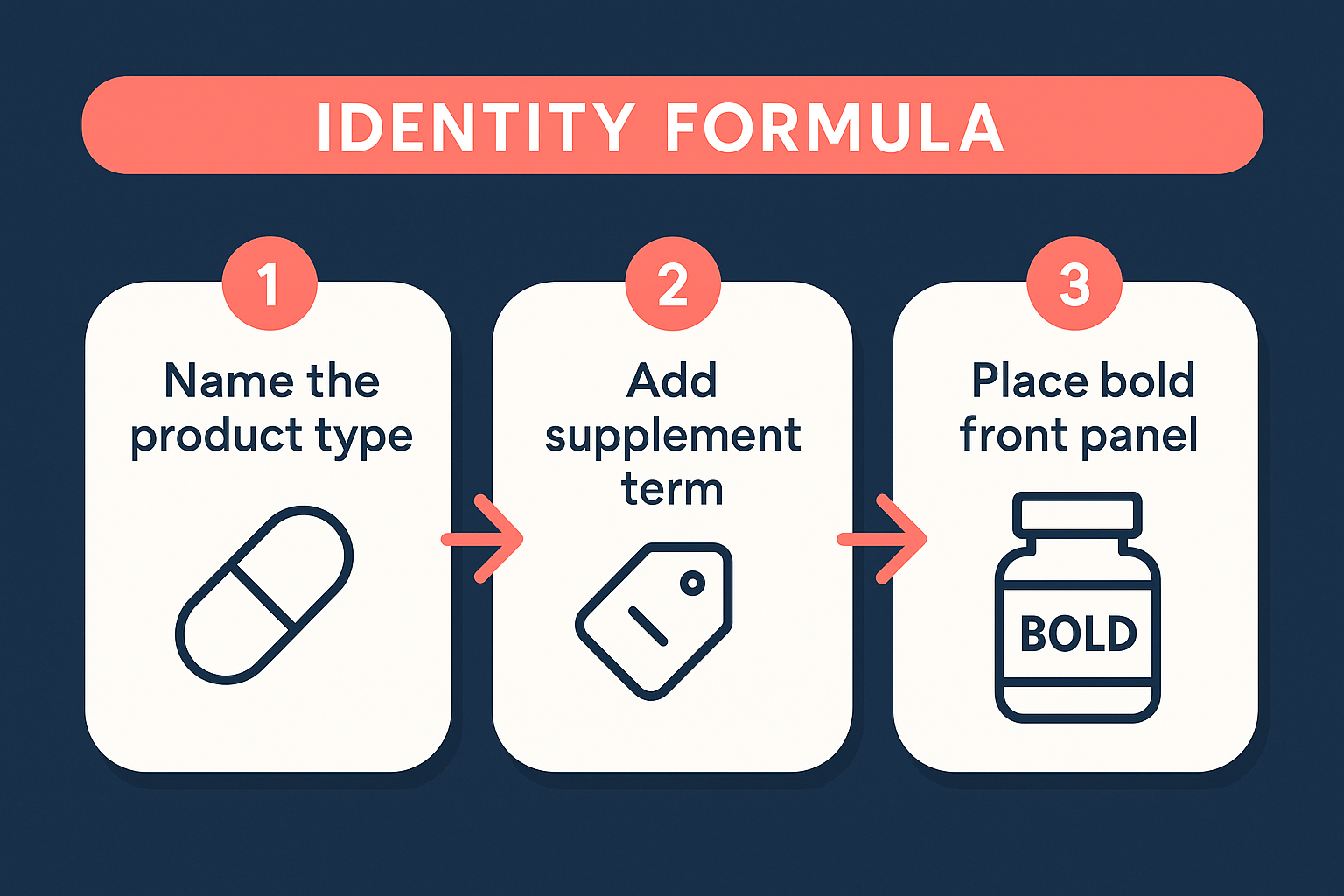
The rule is clear, so here is the design freedom. Three identity formats pass 101.3(g) cleanly. Each one sits beneath your brand name in bold type on the principal display panel. You pick the format that matches your product, and the branding work stays yours.
Format one: the exact phrase "Dietary Supplement." That is the baseline. The FDA’s own labeling guidance, revised in the Federal Register on March 7, 2016, confirms "Dietary Supplement" as the anchor identity statement for any supplement. The phrase is precise, it is compliant, and it is the safest choice when your brand name does not describe what is inside the bottle.
Format two: ingredient-led. Name the active ingredient first. "Calcium Supplement" tells the buyer exactly what they are getting. This works best when a single ingredient defines the product. Pair it with a creative brand name above the line and the label stays compliant.
Format three: descriptive. Combine a category with a qualifier. "Herbal Supplement with Vitamins" passes because it truthfully characterizes a blend. Descriptive identities work when no single ingredient deserves top billing.
The formula repeats across all three. Brand name on top. Identity statement directly beneath it. Pick the format that fits your formula and lock it into your label file. The typography rules from 101.3(d) apply to every format equally.
Choose the format that matches how your product is formulated. One hero ingredient? Go ingredient-led. A blend of botanicals and vitamins? Go descriptive. A proprietary mix with a distinctive brand name? The plain "Dietary Supplement" statement carries it.
| Compliant | Non-Compliant |
|---|---|
| "Dietary Supplement" | brand name only |
| ingredient-led, for example "Calcium Supplement" | a drug-like or disease-suggesting name |
| descriptive, for example "Herbal Supplement with Vitamins" | a food-style name like "Energy Bar" |
Your brand name is where the personality lives. The statement of identity is where the regulation lives. Both sit on the same front panel, and both have separate jobs. Mix them up and the label fails before it ships.
A fanciful brand name like “Vault” or “Summit” can anchor your label. It can be stylized, colored, and trademarked. That is your creative space. But it cannot replace the standardized statement of identity that tells shoppers what the product actually is. The brand name sells the vibe. The identity statement sells the category.
The boundary is simpler than it looks. Creativity applies to the brand name, the logo, the color palette, and the copy. The identity statement stays standardized, on the principal display panel, in its required format. Change the color of the brand name all you want. Change the wording of the identity statement and you are editing regulated text.
The FD&C Act sets the line in Section 403(a)(1): a label is misbranded if its name is false or misleading. That is the enforcement hook. A brand name can be bold. It cannot overpromise. A name that implies a benefit the formula does not deliver is a liability you carry on every single unit that ships.
5 Naming Mistakes That Put Your Supplement at Risk
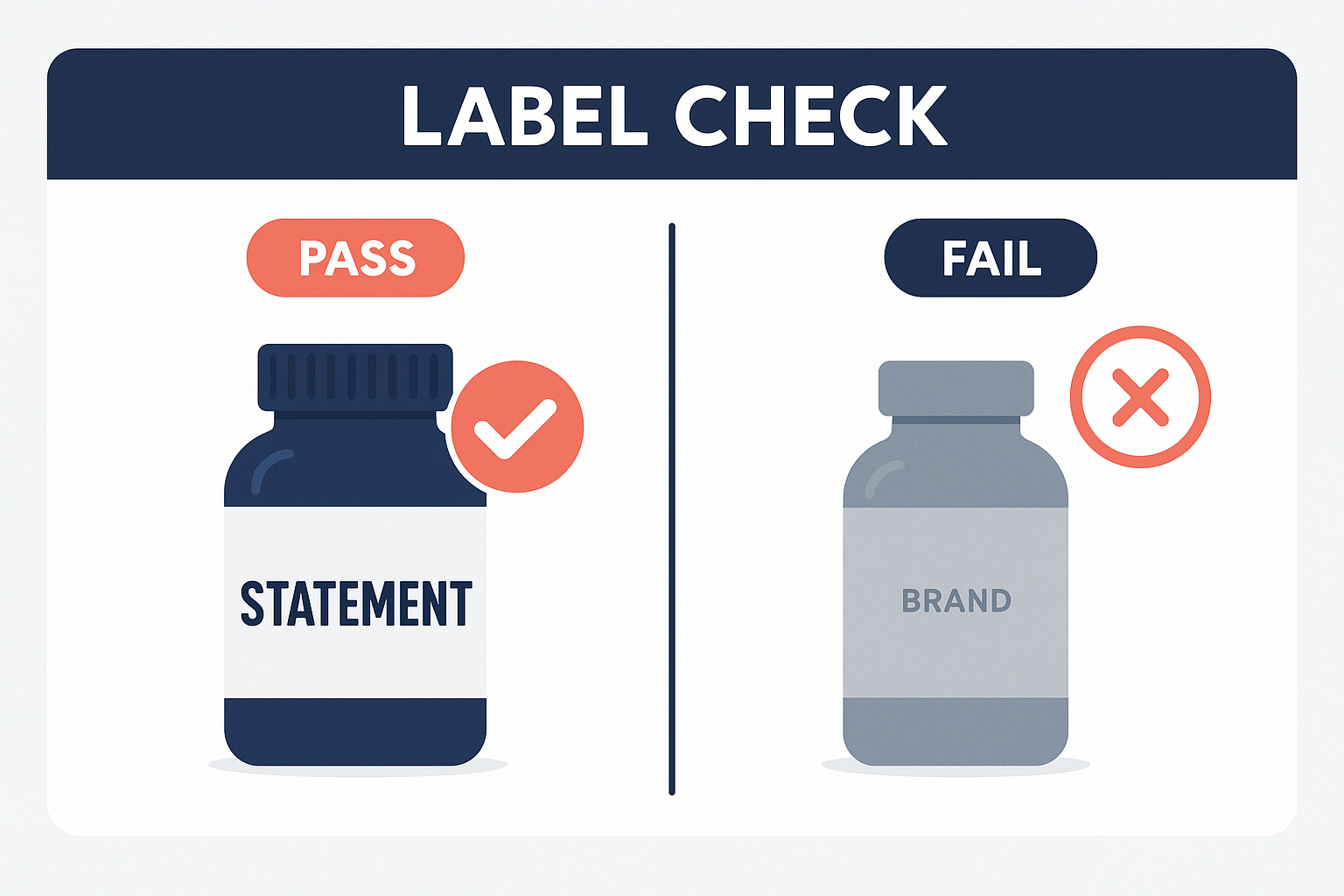
Five missteps show up again and again on submitted labels. Each one creates enforcement exposure long before a product reaches a customer.
- Omitting the supplement characterization. The front panel carries a brand name and nothing else. The identity statement must appear on the principal display panel so shoppers know what they are buying. Leave it off and the label misses its primary requirement.
- Burying the identity in type smaller than the brand name. FDA expects the statement of identity to be prominent, in a type size that holds its own next to the brand name. When the brand dominates and the identity shrinks, the front panel reads as misleading. Regulators see that as an attempt to hide what the product is.
- Using a brand name as the only front-panel text. A minimal label can look sharp, but a bare brand name with no identity statement leaves enforcers guessing. The brand name draws the eye; the identity statement does the declaring. Both have to be on that panel.
- Choosing a name that implies a drug or disease benefit. A name that leans on drug language pushes the product into drug territory. That triggers a different regulatory path and invites enforcement. Keep brand names in structure-function and lifestyle language so the label stays clearly a supplement.
- A name that contradicts the declared ingredients. Calling a multiple-ingredient blend “pure” sets the front panel against the Supplement Facts panel. Regulators can flag that as misleading, and customers will read it as a bait-and-switch. The name and the ingredient list have to agree.
How White Label Brands Stay Compliant Without a Compliance Team
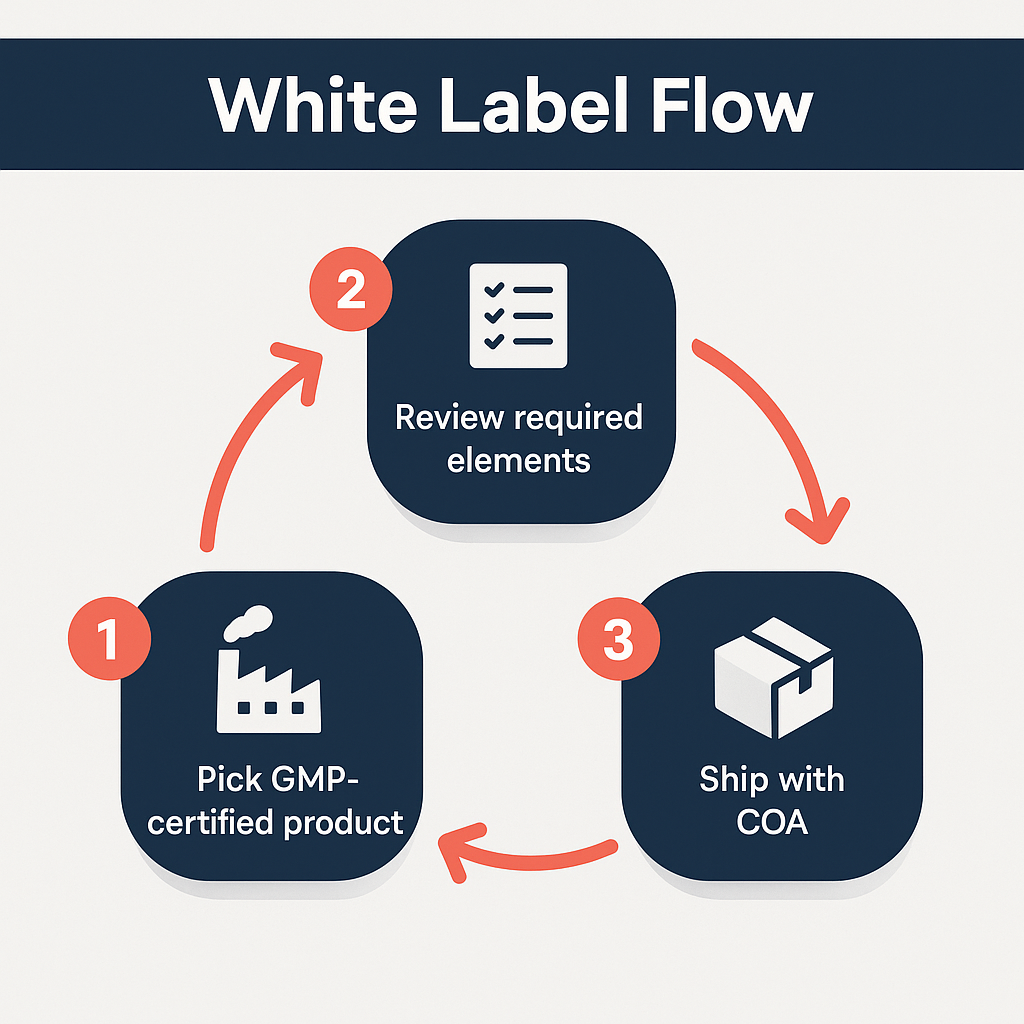
You stay the labeler, and the labeler owns compliance. That part never changes. What changes is the documentation behind the label. A GMP-certified manufacturing partner supplies the production records, test results, and batch traceability that back every claim you print.
Rocktomic manufactures in GMP-certified US facilities, and every product ships with a third-party tested COA on every batch. That certificate is what you produce when a retailer, marketplace, or customer asks for proof. You do not need a compliance team on payroll. You need a partner whose lab work you can stand behind.
The operational fit matters once your SKU count grows. Fulfillment runs on demand, so a label correction costs nothing to reprint at scale. No pallets sit in a warehouse wearing the old artwork. No dead-stock write-off. You revise the file, approve the proof, and the next order ships with the corrected label. See how Rocktomic on-demand fulfillment works.
Zero inventory also means zero compliance lag. When FDA labeling guidance changes, you do not spend months cycling through existing stock before you can comply. You update the label, and the next unit out the door reflects it. Launch in days, not quarters, because nothing sits between label approval and shipment.
The Other 4 Label Elements That Must Sit Beside Your Identity
Your identity statement does not travel alone. Per the FDA Dietary Supplement Labeling Guide, Chapter I, retrieved June 21, 2026, every dietary supplement label needs five statements:
- Identity (21 CFR 101.3)
- Net quantity of contents (21 CFR 101.105)
- Supplement Facts (21 CFR 101.36)
- Ingredient list (21 CFR 101.4)
- Name and place of business (21 CFR 101.5)
Miss one and the whole label fails inspection. Net quantity tells the customer exactly how much product sits in the bottle. Supplement Facts shows the amount of each dietary ingredient per serving. The ingredient list names everything in descending order of weight. Name and place of business gives the buyer a real company to contact.
Each statement carries its own placement rules. The net quantity sits in the lower third of the principal display panel, while Supplement Facts belongs on the panel consumers read most often. That completes the five-statement picture.
For a real example, review the anatomy of a compliant supplement label. And if you’re tempted to design your own labels from a template, read why DIY supplement labels are a legal nightmare before you spend a dollar on print.
The Disclaimer and Claims Rules That Protect Your Label
A compliant label does more than list statements. It also manages claims, and claims decide whether a product stays a supplement or drifts toward drug status. Under 21 CFR 101.93, any structure/function statement on the label triggers a mandatory FDA disclaimer. That notice, printed in a box in bold type, tells customers the agency has not evaluated the statement.
The line matters for your brand. A disease claim, anything that hints the product acts on a specific condition, pushes the product toward drug regulation and its approval costs. Structure/function language, hedged and tied to how an ingredient supports normal body structure or function, stays on the supplement side of the line.
Your product name is part of that boundary. A neutral identity statement keeps marketing on the Supplement Facts side. A name that promises an outcome drags every other label statement toward a claims problem. Keep the name factual, keep the claims structural, and the disclaimer does its job: it protects your label.
FAQ: 8 Questions About the Statement of Identity
What is the statement of identity on a supplement label?
The statement of identity is the legal name of the product that FDA requires on the principal display panel, the front part of the label most likely to be seen at retail (21 CFR 101.3(a)). For dietary supplements, it must identify the product as a supplement, for example “Calcium Supplement” or “Dietary Supplement.” It is separate from the brand name and tells a buyer exactly what the product is.
What does 21 CFR 101.3 require for the statement of identity?
Under 21 CFR 101.3(d), the statement of identity must appear in bold type, in a type size reasonably related to the most prominent printed matter on the panel, and in lines generally parallel to the base of the package. Under 21 CFR 101.3(g), a dietary supplement must include the term “dietary supplement” as part of the identity unless a descriptive term such as “herbal supplement with vitamins” is used instead.
Can a creative brand name be the statement of identity?
No. A fanciful or brand name does not tell a buyer what the product is, so FDA does not accept it as the statement of identity. The brand name can appear prominently on the front panel, but the label must also carry a compliant statement of identity such as “Dietary Supplement” or “Magnesium Supplement.” Pairing a creative name with the required identity statement is the standard structure on compliant labels.
Does the label need the words ‘dietary supplement’ on the front?
Yes, with one exception. 21 CFR 101.3(g) requires the term “dietary supplement” as part of the statement of identity. The word “dietary” may be replaced by the name of the ingredient (for example “Calcium Supplement”) or by an appropriately descriptive term (for example “Herbal Supplement with Vitamins”). A label that omits the supplement characterization entirely can be deemed misbranded.
What happens if the statement of identity is missing or wrong?
FDA can deem the product misbranded under section 403 of the FD&C Act. Misbranded products may be refused entry, detained, or subject to enforcement action, and marketplaces and retailers can reject the label. For a white label brand the cost is concentrated at launch: relabeling shipped inventory is far more expensive than fixing the label before the first order.
Do you need a lawyer to create a compliant statement of identity?
Formatting a compliant statement of identity does not require a lawyer, but it does require care and the right documentation. A brand can test products on Rocktomic’s Free plan, which costs $0 per month and charges only the flat ~$2 per item fulfillment fee when an order ships, then upgrade to Scale at $297 per month for the full catalog and priority fulfillment. Every batch ships with a Certificate of Analysis to back the label.
How much does a label redesign cost if the identity is wrong?
Relabeling printed inventory can cost hundreds to thousands of dollars per SKU, plus lost selling time while units sit unsellable. The cheaper route is to review the statement of identity before print. Rocktomic’s optional Starter Branding Package is a $497 one-time add-on that includes 10 label designs and 10 3D mockups, so brands can see the final label format before committing to inventory.
Who is responsible for the statement of identity, the brand or the manufacturer?
The brand that markets the product is the labeler and carries responsibility for label compliance, even when a manufacturer warehouses and ships the units. A GMP-certified partner reduces risk by providing the Certificate of Analysis and the documentation a compliant brand needs. On the Scale plan, $297 per month, members get the full 140+ product catalog and priority fulfillment to scale compliant SKUs without new formulation costs.
Launch Your Supplement Brand With Zero Inventory
Your statement of identity is a legal requirement, not a creative choice. The fix is simple: put a bold supplement characterization on the principal display panel. That compliance check gets your labeling right so you can build the business.
Rocktomic handles manufacturing, warehousing, labeling, and drop-shipping, with US GMP quality and a COA on every batch. You own the brand and the customer relationship. Start with zero inventory on the $0/month Free plan, or Scale at $297/month for the full catalog. Compare Rocktomic membership plans or book a call.
Last updated: June 21, 2026.