
Going Global: The Ultimate Guide to Selling Supplements Internationally
· 19 min read · By Rocktomic Labs Team
Yes, US supplement brands can sell internationally, and the lowest-risk entry requires zero inventory. What changes is compliance: every destination market has its own regulator, license, and label rules that stack on top of US DSHEA requirements. This guide maps the export path for white-label brands, with a dated source for every rule it cites.
Can you sell supplements internationally from the United States?
Yes. The US Dietary Supplement Health and Education Act (DSHEA) of 1994 treats supplements as a food category and does not require FDA pre-approval before marketing (FDA Q&A, retrieved 2026-06-21). Exporting adds a second layer: the product must still be manufactured under FDA current Good Manufacturing Practices in 21 CFR Part 111, and it must satisfy the destination country’s food, natural health product, or supplement rules before border release. Plan each market as its own compliance project, not an afterthought.
Answer three quick questions and get pointed to the supplement niche that fits your audience and your margins.
The article then maps the DSHEA baseline, the export document package, Canada, the EU, a compliance cheat-sheet table, shipping and customs, the zero-inventory route, and a phased launch order.
The zero-inventory route matters because it lets a US brand test a foreign market order by order instead of committing to a container. The compliance work stays the same either way; the financial risk does not. Canada and the EU each add their own registration, labeling, and pre-market steps, which is why this guide treats them market by market. Think of the DSHEA baseline as the floor, not the ceiling.
Why DSHEA Still Governs Everything You Export
Every supplement you ship starts from the same US legal baseline, whether it lands in Des Moines or Dubai. Part 1 covered what DSHEA says a supplement is. The part that matters for exports is who carries the risk: the manufacturer owns safety and labeling, because the FDA does not pre-approve products before they hit the market (FDA Q&A, retrieved 2026-06-21).
That default travels with every label you print. Foreign regulators read your product through that US framework first, because it is the evidence trail they can actually verify.
Claims Split at the Label
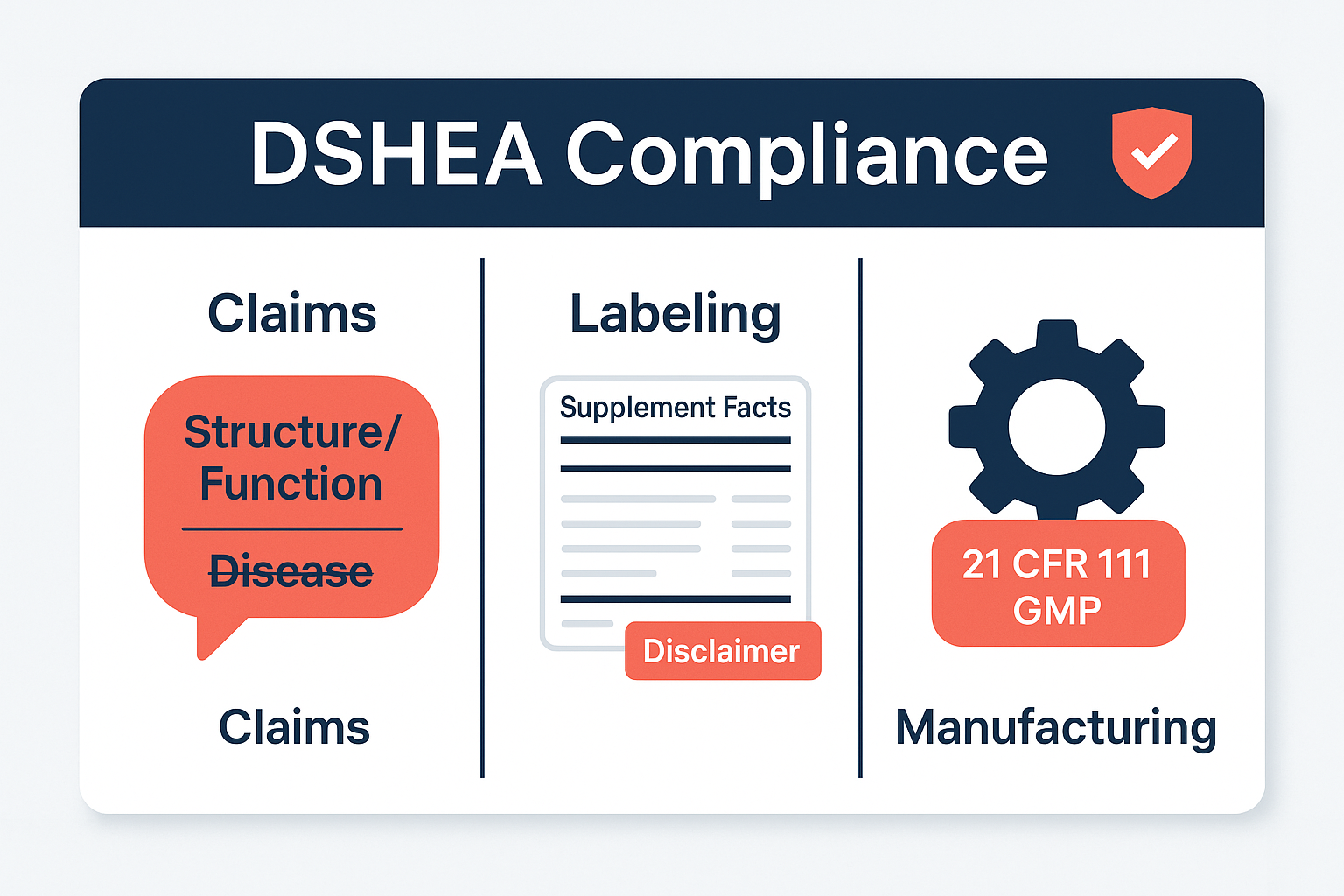
Claims are where export plans break. Structure/function claims require the DSHEA disclaimer at 21 CFR 101.93 plus a notification to FDA within 30 days of first marketing. The notification is a filing, not a permission slip: launch does not wait on it.
Disease claims are off-limits. A supplement that claims to treat or cure a condition becomes an unapproved drug in the agency’s eyes. Your label copy either stays in the structure/function lane or it gets rewritten before it ships anywhere. For the full walkthrough, see the creator’s DSHEA playbook.
The December 11, 2025 FDA Letter
On December 11, 2025, the FDA issued a letter to industry stating it intends to revise 21 CFR 101.93(d). The proposed change drops the multi-panel disclaimer requirement while keeping the disclaimer itself. In plain terms: the disclaimer stays on your label, but the formatting burden may shrink.
Carry the source in your export file: FDA letter, December 11, 2025.
GMP and Facility Registration Close the Loop
Destination reviewers rarely take your label at face value. They start with US manufacturing evidence: GMP compliance under 21 CFR Part 111 and facility registration with the FDA. That is a standardized, auditable record, which is exactly what customs reviewers want to see.
When those fundamentals are in order, the rest of your documentation carries weight. When they are not, no claim format saves you.
That is why the US baseline is the export baseline. Get the domestic fundamentals right first, and the international questions get easier to answer.
Your Export Passport: COA, GMP, and the Paper Trail
Border agencies and foreign retail partners evaluate documentation, not promises. A great formula on paper means nothing if the paperwork does not prove it. When your shipment clears customs or a buyer’s compliance team reviews your brand, they open a specific set of evidence: a Certificate of Analysis for every batch, GMP certification, finished product specifications, lot records, and facility registration.
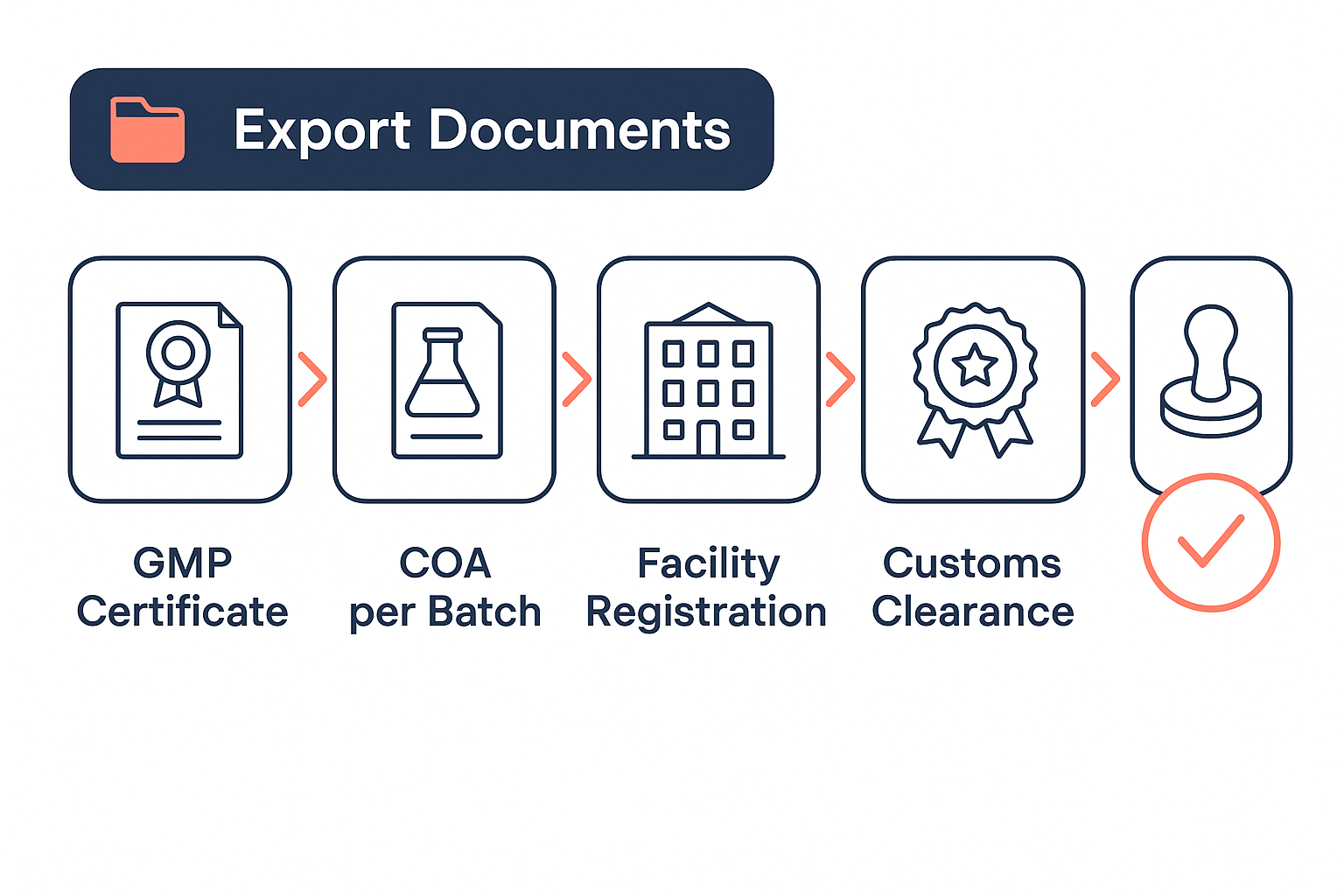
Each document answers a different question. The COA proves the batch matches its label claim. GMP certification proves the facility that made it follows current good manufacturing practice. Finished product specifications define what the product is supposed to be. Lot records tie every unit back to its production run. Facility registration proves the manufacturer is registered with the FDA. Together they form the complete file a border agency or retail buyer expects – and each document gets checked against the others. A missing or mismatched field can hold an entire container.
Small discrepancies cause the largest delays
Canada is the working example. Canada Customs and Health Canada check whether licensing, labeling, and customs paperwork line up with each other. In Canada.ca GUI-0117, October 28, 2019 (retrieved 2026-06-21), small discrepancies cause the largest delays. A product name that does not match its label. A lot number that does not match the COA. A missing facility address. These get flagged long before any inspector evaluates the formula itself.
Export currency you already hold
The fix is simple to say and hard to fake: make every document match the physical product exactly. That is why the COA plus GMP certification function as export currency. A white-label brand working with a compliant US manufacturer such as Rocktomic already holds it. The Rocktomic quality and COA hub shows GMP-certified US facilities and a COA issued with every batch – the same documents foreign regulators and retail buyers ask for first.
Before you hand that file to a customs broker, know what reviewers actually check on the single most important page. Read what is a COA.
How Does Canada’s NPN System Work?
Canada is the natural first export stop for a US-based supplement brand, but it runs its own rulebook. Vitamins, minerals, herbal remedies, and probiotics are regulated as Natural Health Products (NHPs) under the Natural Health Products Regulations. That classification triggers pre-market review by Health Canada before any product can be sold. You cannot simply re-label a product that is legal in the US and ship it north. Compliance starts before your first Canadian order exists (Canada.ca overview, February 18, 2026, retrieved 2026-06-21).
The Commercial Path: Four Requirements
The full licensing route has four moving parts (Canada.ca GUI-0117, October 28, 2019). Each formula requires a Product License from Health Canada. Approval produces an eight-digit Natural Product Number (NPN), which must be printed on the label and shown to the regulator. A product without an NPN cannot be sold in Canada, regardless of how compliant it is elsewhere.
The Site License sits with the Canadian side. It must be held by the Canadian importer or a licensed Importer of Record, not by the US brand. You either partner with an importer that holds the Site License or establish a Canadian entity that can hold one. Budget for that structure when you plan the launch.
Labeling must be bilingual, English and French, covering the NPN, directions, and caution statements. Manufacturing must meet Canadian GMP requirements, so your contract manufacturer needs current audits and documentation ready to share.
The 90-Day Personal Use Exemption
There’s a faster path for direct-to-consumer testing. Shipments under a 90-day supply sent directly to a consumer for personal use are generally exempt from NPN licensing. That’s how creator brands test Canadian demand before committing to full licensing. You run the same on-demand fulfillment flow, measure what converts, and license only the winners. Rocktomic’s zero-inventory model makes that test cheap: no bulk buy, no Canadian warehouse to fill.
Labeling Transition Window
New labeling rules took effect in June 2025. Products licensed on or after June 21, 2025 are temporarily exempt from the updated requirements until June 21, 2028. If you are launching now, you have a defined runway to build the new compliant label while you scale. After the window closes, the updated standard applies to everything on the Canadian market.
How Does the European Union Regulate Food Supplements?
The EU treats food supplements as food, not drugs. That distinction sounds like an easier path, but the EU rulebook is denser than most US brands expect, and it diverges from DSHEA at the ingredient level.
Directive 2002/46/EC is the foundation. Its purpose is to harmonize rules across member states so a compliant supplement can move freely inside the EU. Annex I lists the vitamins and minerals that may legally be used in supplements. Annex II lists the authorized nutrient sources, meaning the specific form of a nutrient must appear in that annex before you can use it. An ingredient that is not in the annex needs a different route or a reformulation.
EFSA Decides Which Ingredients Make the Annex
The European Commission does not act alone. Every annex decision sits on top of a scientific opinion from the European Food Safety Authority (EFSA). EFSA’s food supplements topic (January 6, 2026, retrieved 2026-06-21) explains how the agency evaluates safety and bioavailability for the substances it reviews. In practice, EFSA’s opinion informs the Commission’s decision to add, keep, or remove an entry. No safety opinion, no authorized entry.
Claims are a separate gate. Health claims require authorization under Regulation (EC) 1924/2006, and Article 6(2) of Directive 2002/46/EC prohibits labeling that claims a product prevents, treats, or cures disease. Per the EUR-Lex directive text, that ban covers every food supplement sold in the EU. A health claim that has not been authorized cannot appear on a label. Period. Expect a label rewrite, not a translation.
The Gap for Non-Vitamin and Mineral Substances
Here is where most US formulas stall. Substances other than vitamins and minerals are not harmonized by Directive 2002/46/EC. They fall under national member state rules, so a botanical or amino acid that is legal under DSHEA can be restricted in one EU country and unrestricted in another. One EU approval does not automatically cover all 27 member states for those ingredients. Many US formulas need an EU-specific reformulation before launch.
That is why US vs global FDA rules for supplements matter when you cross borders. The US and EU systems are both strict, but they are strict in different places. Know which annex your formula sits in before you quote a launch date.
Compliance by Market: The One-Table Export Cheat Sheet
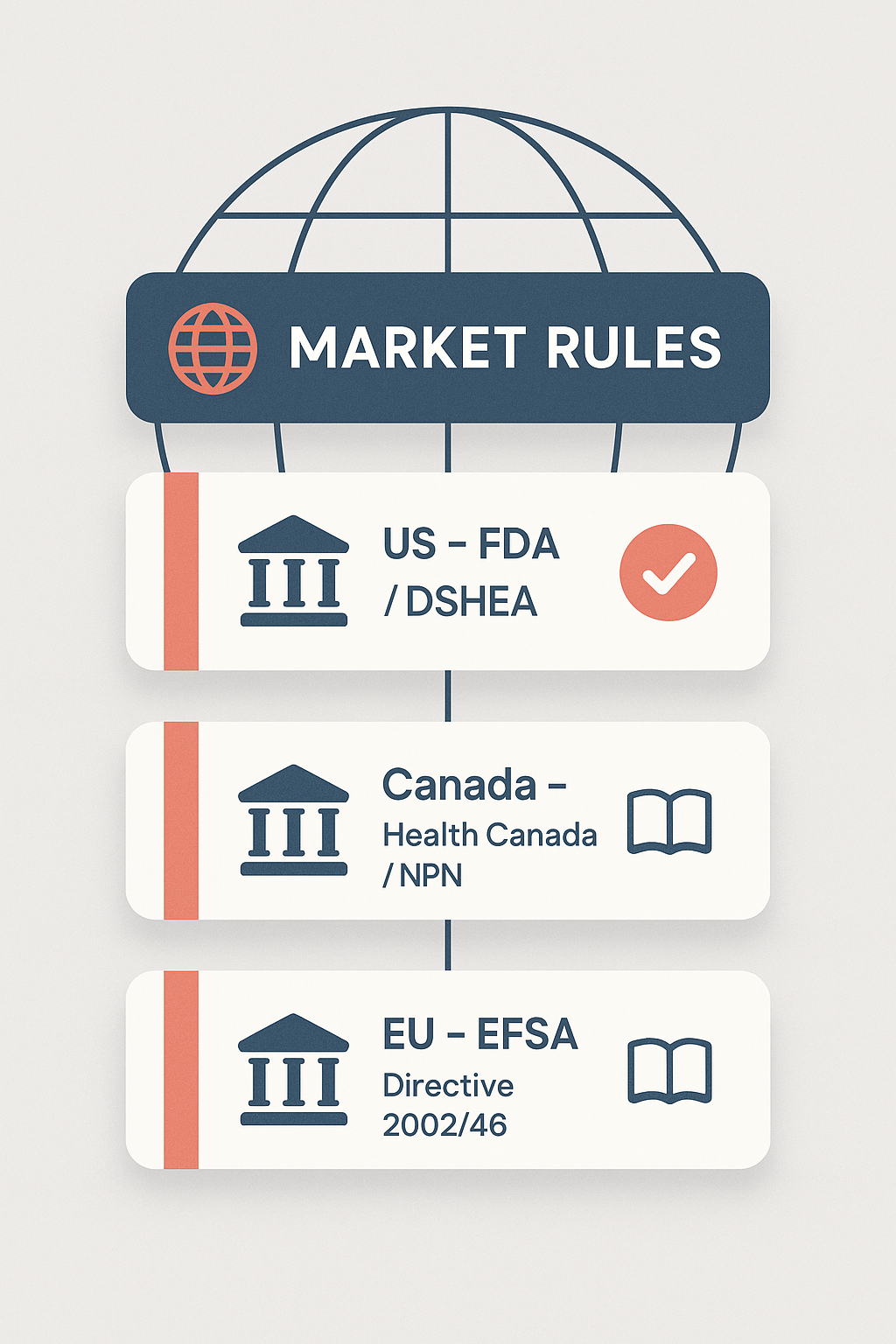
This is the single sourced and dated reference table for supplement compliance across the three markets that matter most: the US, Canada, and the European Union.
Read each row like a checklist before you take an international order. The market tells you where the product lands, the regulator names the authority that approves or audits it, the product class defines how the law treats it, the license or approval is your entry ticket, and the core rule is the requirement most sellers miss on the first pass. The same formula changes class when it crosses a border. Fix the class first, then match your label, claims, and license to it. Most export guides cover one market with no dates. This table covers three markets with sources you can actually cite.
Three markets, one sourced reference
| Market | Regulator | Product class | Key license or approval | Core rule to know | Source (date) |
|---|---|---|---|---|---|
| US | FDA | dietary supplement | no pre-approval; GMP under 21 CFR 111 | DSHEA disclaimer at 21 CFR 101.93 for structure/function claims | FDA Q&A, retrieved 2026-06-21 |
| Canada | Health Canada | natural health product | NPN plus Site License for the importer | bilingual labeling, 90-day personal-use DTC exemption | Canada.ca, February 18, 2026 |
| EU | EFSA and European Commission | food supplement | Directive 2002/46/EC Annex I and II compliance | health claims authorization under Regulation (EC) 1924/2006 | EFSA, January 6, 2026 |
| Rest of world – always verify the local regulator; product class and license differ by country. | |||||
The dates in the source column aren’t decoration. Canada.ca issued its current guidance on February 18, 2026, and EFSA’s position on health claims is dated January 6, 2026. Regulations move; a dated source is a compliance artifact you can defend in a distributor review or at customs. The table compresses the details into the facts you act on; verify each row against the underlying guidance before the first shipment. Use the core rule column to build your label review, because if the label does not clear that row, the license and the product class don’t matter yet. International buyers ask for this exact paperwork before they commit to a brand. Keep the note row in mind even when you ship only to these three markets: your distributor’s end market sets the rules. Confirm the buyer’s market row before you quote a launch date, and let your product paperwork back it up. Rocktomic puts a Certificate of Analysis on every batch, so the compliance file starts with a verifiable product, not a promise.
Shipping and Customs: What Actually Moves Across Borders?
Compliance gets your product legal to sell. Shipping gets it legal to cross a border, and that is a separate set of rules. Every international order runs through the Harmonized System (HS), the global code that tells customs what your supplement is and what it owes.
Codes, Brokers, and Who Pays the Duty
First, know your HS code. Supplements generally sit in Chapter 21, but the exact six or ten digits depend on the form. Gummies, powders, and capsules can carry different classifications, and different classifications mean different duty rates.
Second, decide who files. A customs broker handles the paperwork and clearing for a fee. Self-filing works for high-volume shippers who know the process, but one wrong code delays the whole shipment. Most sellers should use a broker.
Duties and VAT go to the destination country. The importer of record pays them, and that is usually your buyer, not you. Canada is the key exception: it requires a Canadian Importer of Record. If you sell into Canada, you need one, or you use a fulfillment partner who acts as one.
Incoterms set who pays and who owns risk. DAP (Delivered at Place) means you cover shipping but not import duties and taxes. DDP (Delivered Duty Paid) means you cover those too. For supplements, DAP is the safer default, because you cannot verify the buyer’s import status.
Ingredients That Get Blocked at the Border
A formula can be legal under FDA and DSHEA but blocked in another market. Restricted ingredients vary by destination, so the formula review has to happen before you get a freight quote. Liquids, powders, and gummies also face different carrier handling rules, and carriers can enforce stricter limits on international routes.
What Rocktomic’s Flat Fee Covers
Here is the transparency point. Rocktomic on-demand fulfillment covers the flat fulfillment fee for domestic pick, pack, and label. International shipping adds carrier rates plus destination duties and taxes on top. Those costs are not hidden in a markup; they are passed through.
If you sell to international buyers through Rocktomic store integrations, your Shopify store handles the foreign currency and checkout math, giving you a clear view of what each order costs before it leaves the warehouse.
The Zero-Inventory Route to Global Sales
Most supplement brands treat exporting like a warehouse problem. It is not. The real risk is committing capital to pallets of product that may sit in a foreign market for months. On-demand dropshipping removes that risk at the source. Rocktomic manufactures, warehouses, labels, and drop-ships on demand, so the export question becomes a per-order question instead of a capital question.
With Rocktomic, there is no minimum order and you pay only when an order ships. Test demand in Germany with 12 units. No distribution center, no freight forwarder, no pallet prepaid. The market tells you what sells, and you only pay for what actually moved. If the market goes quiet, your downside is a few fulfilled orders, not a container in customs.
Pay per shipped order, not per pallet
Traditional manufacturers force pallet buys. That means thousands of dollars committed before you know whether a label resonates abroad. Platforms that handle fulfillment often stack per-order fees on top of their monthly charge. Rocktomic keeps it flat: an example fulfillment fee of about $2 per item, charged only when an order ships.
That structure changes how you enter a country. Small test orders become cheap experiments. You can run a handful of units into a new market, measure the response, and scale only the winners. Prove demand first, then push volume.
Two plans for two stages of expansion
Rocktomic runs on two membership plans, and the logic maps directly to expansion. The Free plan costs $0 per month and works for small market tests. You pay the per-item fulfillment fee on shipment, and you can sell up to 10 white-label products. That is enough to validate a country before you invest more.
When order volume grows, the Scale plan at $297 per month includes the full 140+ product catalog, unlimited sales channels, lowest per-unit wholesale pricing, and priority fulfillment. Faster turnaround matters once international orders stack up.
See how on-demand dropshipping works at Rocktomic, then compare Rocktomic’s Free and Scale membership plans to map your first test market.
A Market-by-Market Launch Order for Creator Brands
Going global is a sequence, not a sprint. Every market gets a go/no-go gate, and the pass condition is documentation, not vibes. Here is the launch order that works for creator brands.
Phase 1: Lock US compliance first
Your US baseline is your export passport. DSHEA sets the structure for your formulas, and GMP certification proves your facility can hold a standard. Rocktomic manufactures every batch under GMP and ships a Certificate of Analysis (COA) with it, so the document a foreign partner asks for is already in hand.
Go/no-go: you can produce a COA per batch and GMP certification on demand. If you cannot put both in front of a buyer within a day, stay home.
Phase 2: Test Canada with personal-use orders
Canada rewards a cheap learning loop. Run personal-use DTC orders to real Canadian addresses and watch how shipping, duties, and delivery timing behave. While those orders move, file your full Natural Product Number (NPN) application. The filing is the real market entry ticket.
Go/no-go: the NPN application is filed before any commercial Canadian listing. Personal-use testing is fine. Commercial listings without the application in motion get pulled from shelves.
Phase 3: Run the EU ingredient review
The EU does not care that your product already sells in the US. Directive 2002/46/EC controls which vitamins and minerals are allowed, and Annex I and II list the authorized forms and nutrient sources. Map every ingredient in your formula before you list a single SKU.
Go/no-go: every ingredient maps to an authorized nutrient source in Annex II. One unmapped ingredient means reformulate or skip the market.
Phase 4: Measure landed cost before you scale
Duty, tax, and returns eat international margin faster than domestic sellers expect. Price a real shipment, add customs charges and the cost of a return, then compare the total to your per-unit wholesale. If the math does not clear your margin target, the market is not ready for you.
Go/no-go: landed cost per unit still clears your margin target. When it does, scale that market with a number you can defend.
Practitioners and clinics face stricter licensing because their customers are patients. Get expert review before you move RocktomicRX formulas across a border.
To map your first market, book a call with Rocktomic and run your go/no-go against a real compliance checklist.
FAQ: Selling Supplements Internationally
Can you sell US-made supplements internationally?
Yes. US supplement brands can sell internationally, but each market adds its own rules on top of US law. The Dietary Supplement Health and Education Act (DSHEA) lets supplements reach the US market without FDA pre-approval, yet a destination country may classify the same product as a food, a natural health product, or a drug. The practical path is to start from a GMP-certified US manufacturer with a Certificate of Analysis for every batch, then clear each market’s license and labeling hurdles before the first shipment.
Does DSHEA apply when you export supplements?
DSHEA defines what counts as a dietary supplement in the US and sets the labeling and claims rules under the Federal Food, Drug, and Cosmetic Act. Exported products must still be manufactured under FDA current Good Manufacturing Practices (21 CFR Part 111), and structure/function claims still need the DSHEA disclaimer at 21 CFR 101.93. Destination rules then stack on top: Health Canada’s Natural Health Products Regulations in Canada, and Directive 2002/46/EC in the EU.
What documents do you need to export supplements from the US?
A complete export file includes a Certificate of Analysis per batch, GMP certification and facility documentation, finished product specifications, lot records, and US facility registration. The destination market adds its own licenses, such as a Natural Product Number in Canada, plus commercial documents like the commercial invoice, packing list, and Harmonized System (HS) codes for customs. Missing any one link can hold a shipment at the border.
What is a Natural Product Number (NPN) for Canada?
An NPN is an eight-digit product license issued by Health Canada after a Natural Health Product (NHP) review. It is required before a supplement can be sold commercially in Canada. The licensed product also needs a Site License held by the Canadian importer, bilingual English-French labeling, and GMP compliance. Shipments under a 90-day supply sent directly to a consumer for personal use are generally exempt from licensing.
How does the European Union regulate food supplements?
The EU regulates food supplements as food under Directive 2002/46/EC. The directive harmonizes which vitamins and minerals may be used and which nutrient sources are authorized, while EFSA provides scientific opinions that support European Commission decisions. Health claims require authorization under Regulation (EC) 1924/2006, and labels cannot claim that a product prevents, treats, or cures disease. Member states can add stricter national rules.
How much does it cost to launch a white-label supplement brand before going international?
A creator can start on Rocktomic’s Free plan at $0 per month and pay only the flat $2-per-item fulfillment fee when an order ships. That covers branded product, pick, pack, and label with no minimum order and no inventory. The Scale plan at $297 per month adds the full catalog and priority fulfillment. Launch costs stay near zero until sales happen, which is the cheapest possible starting position for a global test.
What is the lowest-risk way to test an international market?
On-demand dropshipping. Because there is no minimum order, a brand can sell a handful of units into Canada or the EU and pay roughly $2 per item in fulfillment fees only as orders ship. That turns market testing into a per-order experiment instead of a pallet-buy gamble. Manufacturers that force bulk purchases or platforms that charge per-order fees make the same test far more expensive.
How do COA and GMP documentation support global expansion?
Border agencies and retail partners approve products on documentation, not promises. A Certificate of Analysis for every batch plus GMP certification is the evidence Health Canada and EU reviewers expect when they assess a product. Rocktomic manufactures in GMP-certified US facilities and issues a COA with each batch, and members on the Scale plan at $297 per month get priority fulfillment so international orders keep moving.
Own Your Supplement Brand in Your First Export Market
Selling supplements internationally is a documentation game. The lowest-risk starting point is zero inventory with a US GMP-certified manufacturer that issues a Certificate of Analysis on every batch. You own the label and the customer relationship while the manufacturer handles production, warehousing, and ship-out. That model works the same in your first export market as it does at home.
Ready to sell your own white-label supplement line at home and abroad? Start on the Free plan at $0 per month, compare the Free and Scale plans on the pricing page, and book a call with Rocktomic to map your first export market.
If you want the math in front of you, compare Rocktomic’s Free and Scale membership plans before you commit. Zero inventory means you never bet a warehouse on an unproven market, and a COA on every batch means no customs surprises. The documentation is manageable, the demand is global, and the brand is yours to keep.