
Ingestible Beauty Profits: Cosmetic vs. Supplement Claims Explained
· 19 min read · By Rocktomic Labs Team
Cosmetic vs Supplement Claims: FDA Rules for Beauty Brands
Cosmetic and supplement claims sit on opposite sides of an FDA line, and crossing it can turn a beauty product into an unapproved drug. A topical cosmetic can describe appearance, while an ingestible supplement can use structure/function claims that describe how an ingredient supports the body, with a disclaimer. Brands that draft claims correctly protect their margins, their storefronts, and their launch timeline.
What Is the Difference Between a Cosmetic and a Supplement Claim?
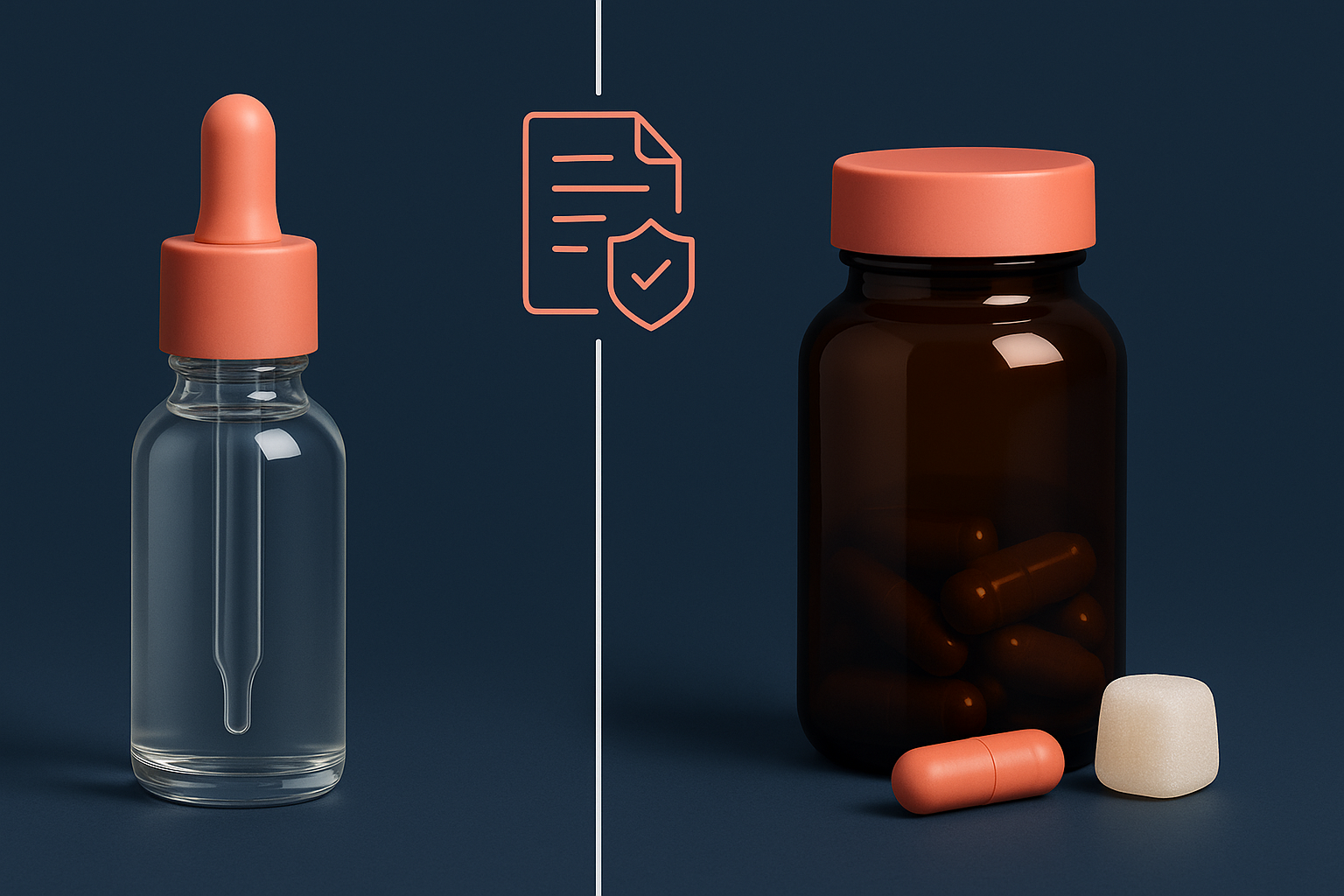
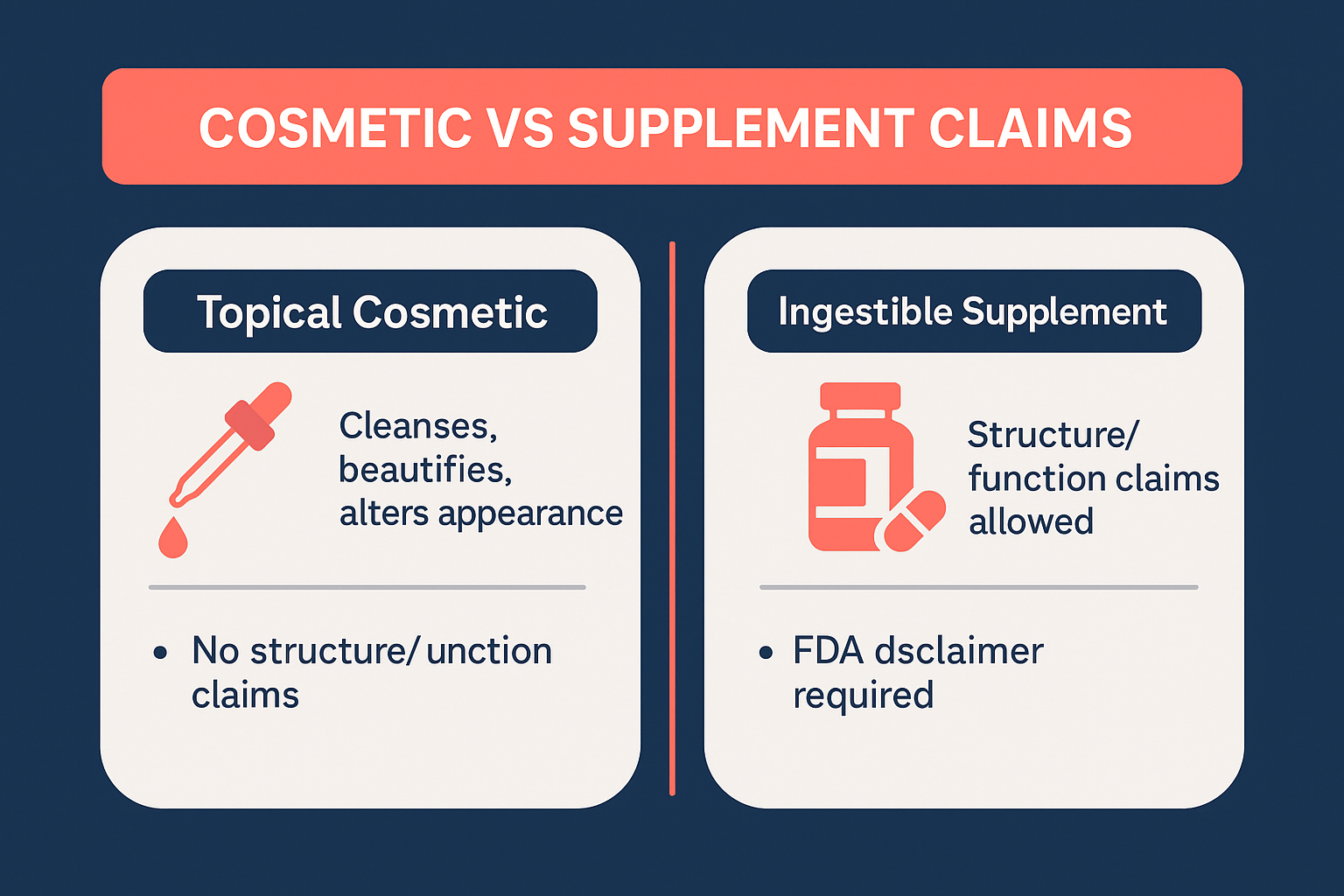
A cosmetic claim describes what a product applied to the body does for cleansing, beautifying, promoting attractiveness, or altering appearance. A supplement claim can go further: under DSHEA, dietary supplements may use structure/function claims describing how a nutrient affects the body’s structure or function, such as “supports skin elasticity.” Disease claims that diagnose, treat, cure, or prevent disease are off limits for both and turn a product into an unapproved drug.
Answer three quick questions and get pointed to the supplement niche that fits your audience and your margins.
That line is the foundation of this guide: a claims-compliance roadmap for a beauty creator-operator launching ingestible beauty through Rocktomic.
Why Ingestible Beauty Is a Compliance Hot Zone
Beauty-from-within is not a fringe category anymore. Collagen-led formulas now anchor store shelves, social feeds, and supplement catalogs. Precedence Research sized the global beauty supplements market at USD 4.02 billion in 2025 and projects USD 8.61 billion by 2035, a 7.92% CAGR (Precedence Research, retrieved June 21, 2026). That is a category worth building a brand around.
Here’s what most operators miss: in the US, a product is classified by intended use, not by ingredient list and not by format. That makes claims the legal identity of a product. The FDA decides where a product lands based on how you present it, not what’s inside the capsule. One phrase in a product name, an ad, or an influencer caption can reclassify a supplement as an unapproved drug. A single “treats” or “prevents” line can turn a clean launch into a warning letter. Same capsule, same bottle, different category.
That’s the hot zone, and it’s exactly where most new beauty brands get burned. Many white-label programs sell labels and nothing else. They hand you a storefront, charge per order, and leave claim drafting to you with zero regulatory backup. Rocktomic does it differently: compliant pre-formulated SKUs, per-batch documentation like a Certificate of Analysis, and GMP-certified US manufacturing, while you still own your brand’s claim drafting. The smart play is to build compliance into product selection, not bolt it on after a warning letter. You keep control; you also keep the risk, so the guidance matters.
Every claim you publish becomes part of the product’s legal identity, including what an influencer says in a caption. Before you write a word of product copy, read the FDA rules for marketing collagen to women. Then understand how the FDA sorts products in the first place.
How the FDA Classifies Cosmetics, Supplements, and Drugs
Under the FD&C Act, section 201(i), a cosmetic is an article “rubbed, poured, sprinkled, or sprayed on” the body for cleansing, beautifying, promoting attractiveness, or altering appearance (FDA: Is It a Cosmetic, a Drug, or Both?, updated September 11, 2024). Ingestion is not in that definition. Neither is changing how the body works. That is why a topical serum and a swallowable capsule never compete in the same regulatory lane.
Drugs sit on the other side. Section 201(g) of the FD&C Act defines a drug partly by intended use, covering any article intended to affect the structure or any function of the body. That is a wide net. The same capsule that passes as a supplement in one storefront can fail as a drug claim in another. If your capsule is promoted to “support skin elasticity,” it can lawfully sit in the supplement lane. Promote the same capsule to “treat acne,” and it has just moved into drug territory.
Dietary supplements are their own category, a food subcategory Congress created with DSHEA in 1994. Supplements get distinct claim rules, label formats, and disclaimer duties (FDA Cosmetics & U.S. Law, updated November 18, 2025).
The FDA does not pre-approve cosmetic products or ingredients before they hit the market, with one exception: color additives. MoCRA, signed in 2022, added facility registration and product listing duties that cosmetics brands now have to manage. Registration and listing are now baseline costs of doing business in cosmetics, not optional paperwork.
| Product form | Legal category | What it may claim |
|---|---|---|
| Topical serum | Cosmetic | May claim only cleansing, beautifying, promoting attractiveness, or altering appearance. |
| Ingestible capsule | Dietary supplement | May use structure/function claims with the FDA disclaimer, such as “supports skin elasticity.” |
| Collagen gummy marketed with an anti-disease pitch | Unapproved drug | May make no claims without FDA approval as a drug. |
Correct classification protects margins, storefronts, and launch timeline. A mislabeled product can get delisted from retail platforms, and a delisted product makes no money. The clock only starts ticking once you launch, and relabeling after a delisting is the most expensive label you will ever buy. Know your category before you pick your claims.
The 4 Claim Types Every Beauty Brand Must Know
Every sentence on a label, a product page, or a caption maps to one of four claim types. Classify it before you publish, not after the warning letter arrives. If you cannot name the claim type, you cannot defend it.
FDA draws a hard line between claims that describe what a supplement does and claims that describe what a disease does. These four types cover every sentence a beauty brand will write. Some sentences fit more than one type; when they do, the strictest one wins.
| Claim type | What it states | FDA pre-approval | Beauty example |
|---|---|---|---|
| Health claims | Link a nutrient to reduced risk of a disease | Require FDA review based on Significant Scientific Agreement | Authorized claims only |
| Nutrient content claims | Characterize the level of a nutrient | Not specified | “Good source of vitamin C” |
| Structure/function claims | Describe effects on the structure or function of the body | No pre-approval, but require substantiation plus a 30-day FDA notification and the disclaimer | “Supports skin elasticity” |
| Disease claims | Diagnose, cure, mitigate, treat, or prevent disease | Never allowed for supplements | “Reduces appearance of wrinkles” pitched as treatment |
Structure/function claims are where most ingestible beauty brands live. They need no pre-approval, but they do need real substantiation, a notice to FDA within 30 days of first marketing under 21 CFR 101.93, and the standard FDA disclaimer on the label. Skip any of those steps and the claim becomes a liability, not an asset.
The business case for clean claims
Health claims are the most restricted. A health claim must pass FDA review based on Significant Scientific Agreement, so you cannot draft one yourself. Disease claims are the simplest: never allowed for supplements, in any wording. The right claim type keeps a product sellable and defensible. The wrong one invites warning letters and pulls inventory off shelves.
When your claim survives review, you gain more than compliance. You gain a label you can run in ads, list on Amazon, and repeat across a COA-backed product line without flinching. Start with the claims that actually pass FDA review, then classify every sentence before it ships. Keep the FDA Structure/Function Claims page (retrieved June 21, 2026) open while you write.
What You Can Actually Say About Skin, Hair, and Nails
One sentence is the difference between a compliant label and a warning letter. The rule is simple: keep the claim on the ingredient or the body’s normal function, never on a condition and never on a guaranteed outcome.
| Safe phrasing | Risky phrasing |
|---|---|
| Supports normal skin elasticity | Reduces wrinkles |
| Contributes to healthy hair | Stops hair loss |
| Supports nail strength | Cures brittle nails |
| Helps maintain skin hydration | Clinically proven to erase fine lines |
Read the pattern. Every safe phrase names a normal body function: elasticity, healthy hair, nail strength, hydration. Every risky phrase names a condition or a result: wrinkles, hair loss, brittle nails, fine lines. Words like “cures,” “stops,” and “erases” promise an outcome the customer can measure. “Clinically proven” makes it worse, because it turns that promise into a guarantee the FTC reads as a drug claim.
Those risky phrases are tempting because they match what customers type into search bars: “best supplement for wrinkles” and “hair loss vitamins.” Matching search intent with a condition claim is exactly how brands end up in the warning-letter file.
The hedging pattern that keeps claims compliant
Structure/function language describes what an ingredient does for a normal process. “Supports,” “contributes to,” and “helps maintain” are the safe verbs. They keep the subject on the ingredient and the target on a normal function. The moment the subject becomes the condition, the claim leaves structure/function territory.
That is why “supports normal skin elasticity” works and “reduces wrinkles” fails. One describes a process. The other promises a change to a condition.
Hedging alone is not a free pass. The FTC requires competent and reliable scientific evidence for any claim you make, and a study citation does not change the wording. If the phrase promises a result, the study won’t save you. The claim itself has to stay inside structure/function bounds. The full breakdown of framing claims without getting sued walks through this pattern line by line, including the exact phrases to flag in your own copy.
Why Topical Cosmetics Cannot Make Structure/Function Claims
Now flip the mirror. A topical cosmetic that claims to affect the body’s structure or function becomes a drug under the FDA’s intended-use doctrine. “Cosmeceutical” is not a recognized legal category. A cream can claim to change the look or feel of skin. It cannot claim to change how the skin functions.
The intended-use trap runs both ways
The FDA determines intended use from the label, the website, social posts, and paid ads. A single phrase in a TikTok caption can trigger the same review as a claim printed on the jar.
K&L Gates (Litigation Minute, March 13, 2024) documents that beauty-from-within phrasing such as “helps reduce the appearance of fine lines” applied to an oral supplement can render it an unapproved drug. Both the FDA and the FTC have issued warning letters on cosmetic and supplement claims.
Here is the practical split. Topical products own appearance language: “improves the look of fine lines.” Ingestible supplements own structure/function language: “supports normal skin elasticity,” plus the disclaimer that the product is not intended to diagnose, treat, cure, or prevent any disease. Swap the lanes and you lose. A topical with structure/function phrasing is regulated as a drug. An ingestible that borrows cosmetic appearance phrasing can be too.
The safest system for a beauty brand is boring: appearance claims on the serum, structure/function claims with the disclaimer inside the supplement bottle, and every new phrase checked against the safe column above before it ships.
The FTC Has Its Own Rules for Advertising
The FDA is not the only agency watching your supplement brand. The FTC regulates how you advertise it, and for a creator-operator that covers nearly everything you publish.
The FTC’s Health Products Compliance Guidance, published December 20, 2022, makes no bright-line distinctions between product categories. One standard applies across the board: advertising must be truthful, not misleading, and substantiated by competent and reliable scientific evidence.
The substantiation bar moves with the claim. A modest benefit claim needs competent and reliable scientific evidence to back it. A claim that edges toward disease territory needs far stronger proof. The more serious the implication, the more the FTC expects you to have on file before you publish a word.
The guidance’s scope is wide. It covers product names, testimonials, influencer posts, and the research citations you lean on. A customer’s video testimonial is not a free pass. It is an advertising claim, and you need substantiation for it before that clip goes live. The same goes for your product name: if the name implies a benefit you cannot back up, the name itself is a claim.
The FTC does not pre-approve ads. It reviews them after the fact, which puts the burden on you to get every claim right on day one.
Here is the division of labor in practice: labeling is primarily the FDA’s job. Advertising is primarily the FTC’s. Both agencies coordinate under the FDA-FTC Liaison Agreement, so you cannot play one against the other.
The practical takeaway for creator-operators: every TikTok caption, email subject line, and UGC clip counts as advertising. The safe-claim rules from Part 4 do not stop at your label. They apply to every caption, script, and on-screen text you ship.
This is a two-regulator world. The FDA vs FTC survival guide breaks down how each agency investigates and where their jurisdiction splits, so you know exactly which rule applies to which asset.
The Compliance Launch Checklist for Ingestible Beauty Brands
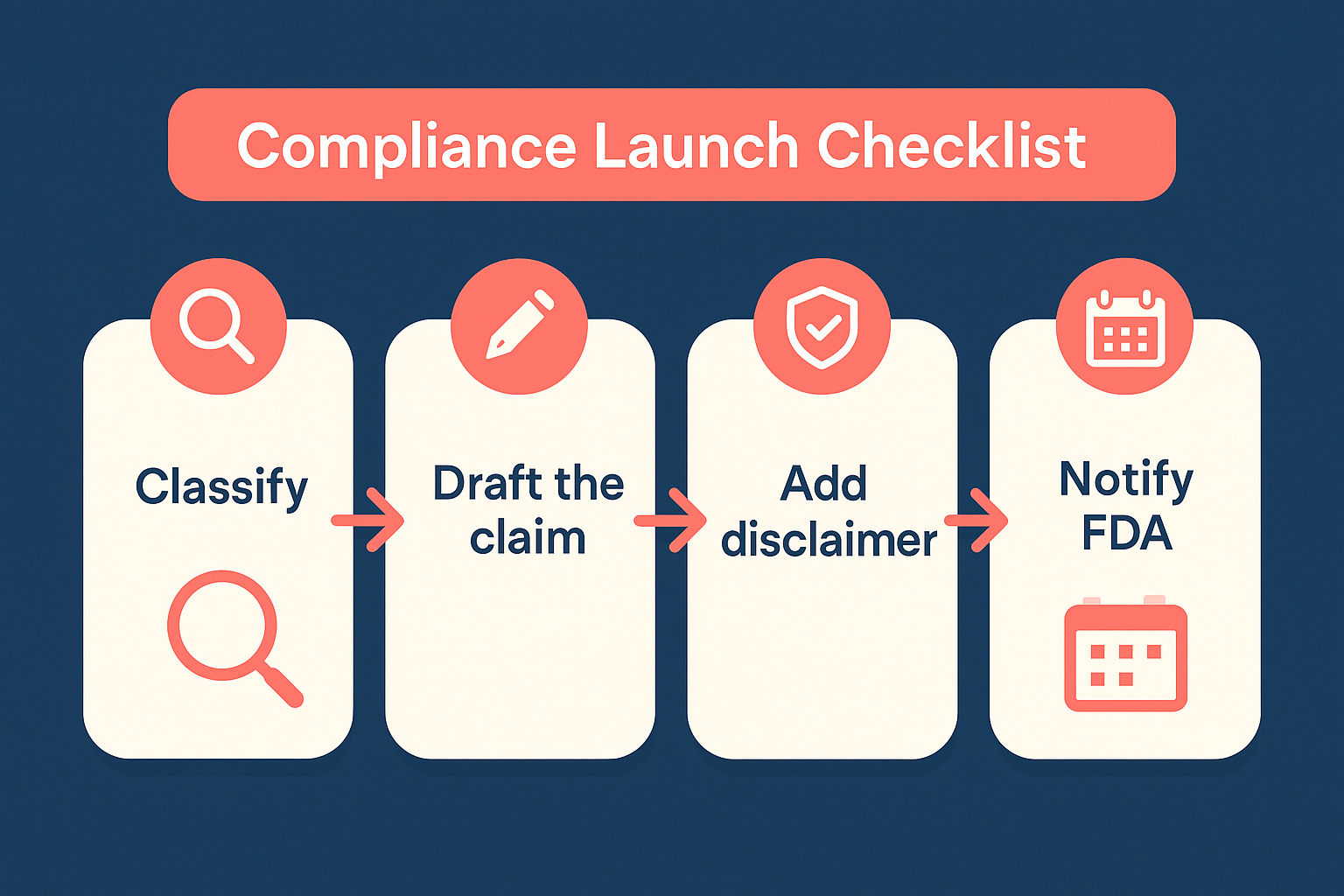
Compliance is not a legal formality. It is the operating system that keeps your ingestible beauty brand listed on marketplaces and out of FTC review. Work the six steps in order, and every claim you ship is backed by a paper trail a regulator can follow in minutes.
The steps below turn every requirement from this article into a single action plan. Check each one off before you order your first label run. Missing one step stalls a launch. Missing step 3 can end it.
| Step | Action | Why it matters |
|---|---|---|
| 1 | Confirm the product is a supplement by form and intended use | Fixes the legal category before any claim is drafted. |
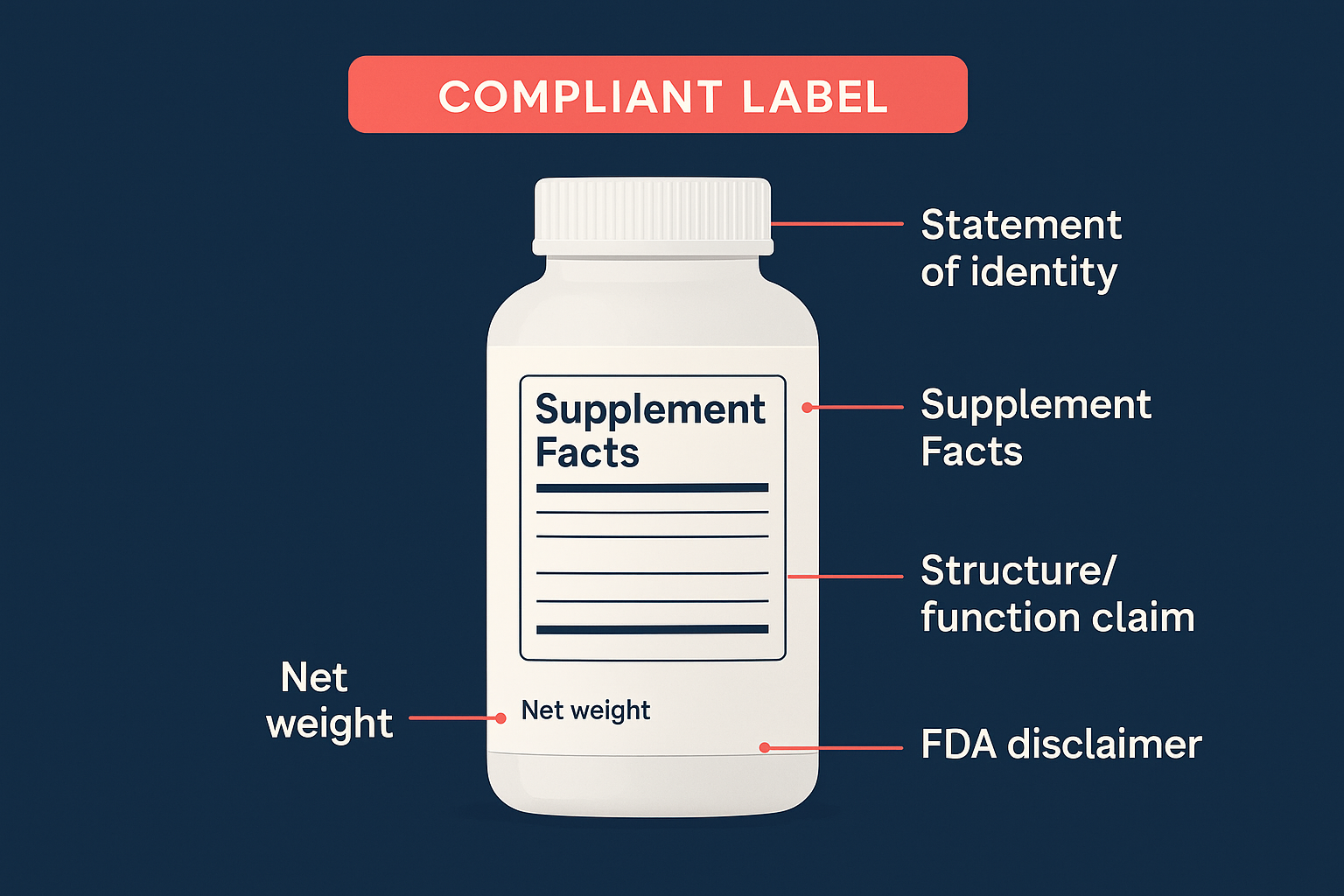
| 2 | Build a compliant label with a statement of identity and a Supplement Facts panel | The label is the first compliance artifact regulators and marketplaces review. |
| 3 | Add the FDA disclaimer verbatim: “this statement has not been evaluated by the FDA and the product is not intended to diagnose, treat, cure, or prevent any disease” | The disclaimer is required by DSHEA for structure/function claims. |
| 4 | Substantiate every structure/function claim and file the 30-day FDA notification after first marketing | Notification is a statutory deadline; substantiation is the evidence standard for FDA and FTC. |
| 5 | Source from a GMP-certified US manufacturer with a Certificate of Analysis per batch | GMP plus COA create the documentation trail that backs every claim. |
| 6 | Keep all advertising truthful to satisfy FTC and marketplace reviewers | Advertising claims face FTC enforcement and marketplace listing rules. |
Step 3 carries the highest stakes: skipping the FDA disclaimer turns a compliant label into a violation the moment a marketplace or regulator reviews it. The wording in the table is the DSHEA requirement for any product that carries a structure/function claim, which covers nearly every ingestible beauty product.
Steps 5 and 6 are where a partner changes the workload. A white-label manufacturer such as Rocktomic handles the GMP-certified US production and a Certificate of Analysis on every batch, so the documentation trail is built before your first sale. What the partner cannot do is draft your claims. The claim is the asset the brand owns and defends.
See how Rocktomic works to map each of these six steps to a production and fulfillment partner that ships direct to your customers.
Quality Infrastructure: COA, GMP, and Third-Party Testing
A Certificate of Analysis is the document that makes a supplement claim defensible. Every batch Rocktomic ships carries one. It verifies identity, purity, and potency, which is the substantiation backbone for any structure/function language on your labels and product pages. The testing is done by an independent lab, not the manufacturer, so the file holds up when someone challenges the claim. Marketplace reviewers ask for the same file when your beauty supplement gets flagged for review. Retail buyers and bulk accounts want it in their onboarding packet. The COA is the answer every time.
Why the COA backs your claims
US GMP certification matters for the same reason. It means the manufacturing facility follows the FDA’s current good manufacturing practice rules for dietary supplements. Those rules cover raw ingredient testing, finished batch records, facility controls, and sanitation. A GMP-certified facility has to prove those systems work, on the record, batch after batch. For an ingestible beauty brand, that paperwork separates you from the seller who cannot show where a batch came from.
The COA also protects against claim drift. If a customer or a platform questions your label, the COA shows the batch matched the label at the time of release. That single file turns a dispute into a documented answer.
The practitioner lever
Licensed professionals don’t recommend products off a label. They need documentation they can file and defend. RocktomicRX-grade documentation gives licensed professionals the paperwork they need before recommending a product, and that recommendation carries weight a social post can’t match. One clinician who verifies your label can send patients your way for years, and each patient becomes a repeat buyer. Review the batch file contents on the Rocktomic quality and COA page.
That documentation does double duty for you as the brand owner. The same files that satisfy a clinician also answer a marketplace compliance desk. You build the proof once and reuse it everywhere.
How to Launch an Ingestible Beauty Brand Without Inventory Risk
The zero-inventory model changes how you test claims. Launch three beauty SKUs at once: a collagen powder, a biotin gummy, a beauty greens blend. Each format tests a different assumption. The powder tests the ingredient story, the gummy tests convenience, the blend tests the all-in-one angle. Watch which claim angle and which format actually converts, then scale the winners. No pallet purchase and no prepaying for units that sit in a warehouse. That is the whole point of white label for brand builders: you own the brand and the customer relationship while a partner handles manufacturing, storage, and shipping.
Test first, scale second
Plans start at $0 per month on the Free entry tier. You pay only the flat ~$2 per item fulfillment fee on ship, and the $2 per item fulfillment page spells out what that covers: pick, pack, and label. The Scale plan at $297 per month adds the full catalog, including Scale Exclusives, unlimited sales channels, and the lowest per-unit wholesale pricing. Most operators start on Free, prove a formula converts, then move up once volume justifies it.
Compliance doesn’t change when you switch tiers. A batch shipped on the Free plan still comes from the same GMP-certified facility with the same COA on file. Lower pricing on Scale doesn’t mean lower proof standards.
The downside math
Because you never bought inventory, a failed SKU costs you label design, a listing, and ad spend. Not a warehouse of dead stock. A winner becomes a validated product you can push harder and reorder in bulk. Run the numbers with the supplement margin calculator before you pick your first SKU. You want to know the contribution per order before you commit a single post to the launch.
Frequently Asked Questions About Beauty Supplement Claims
What is the difference between a cosmetic claim and a supplement claim?
Cosmetic claims describe what a product applied to the body does for cleansing, beautifying, promoting attractiveness, or altering appearance, such as “hydrates skin.” Supplement claims can go further. Under DSHEA, dietary supplements may use structure/function claims that describe how an ingredient supports the body’s structure or function, such as “collagen supports skin elasticity.” A supplement claim that promises to treat, cure, or prevent a disease crosses into drug territory and requires FDA approval as a drug.
Can an ingestible beauty supplement claim to improve skin, hair, or nails?
Yes, within limits. A beauty supplement can use structure/function claims that describe how a nutrient supports normal structure or function, such as “supports healthy hair and nails.” Claims must be truthful, not misleading, and substantiated. Statements that promise to treat a condition, such as “stops hair loss” or “cures brittle nails,” are disease claims that turn the product into an unapproved drug. The label must carry the FDA disclaimer, and the claim must be notified to FDA within 30 days of first marketing.
What are structure/function claims and how do they apply to beauty supplements?
Structure/function claims describe the effect of a nutrient or dietary ingredient on the normal structure or function of the body, such as “antioxidants maintain cell integrity.” For beauty products, permitted examples include “supports skin hydration” or “contributes to normal hair health.” These claims do not require FDA pre-approval, but the manufacturer must have substantiation that the claim is truthful and must notify FDA within 30 days of first marketing the product with the claim.
What claims can a topical cosmetic make without becoming a drug?
A topical cosmetic can claim to cleanse, moisturize, beautify, promote attractiveness, or alter appearance. The moment a cosmetic claims to affect the body’s structure or function, such as “stimulates collagen production” or “reduces wrinkles,” FDA can classify it as a drug under FD&C Act section 201(g), which triggers premarket approval requirements. Marketers should keep appearance-only language on cosmetics and reserve structure/function language for dietary supplements, where it is permitted with a disclaimer.
Do beauty supplement claims require FDA approval?
Structure/function claims do not require FDA pre-approval. The FDA requires that any dietary supplement marketed with a structure/function, general well-being, or nutrient deficiency claim notify the agency within 30 days of first marketing. The claim must be truthful and supported by adequate substantiation, and the label must state that the FDA has not evaluated the statement and that the product is not intended to diagnose, treat, cure, or prevent any disease. Health claims that link a nutrient to reduced disease risk do require FDA review.
What does it cost to launch a compliant ingestible beauty brand?
Launching with Rocktomic starts at $0 per month on the Free plan, with a flat fulfillment fee of about $2 per item when an order ships. The Scale plan at $297 per month includes the lowest per-unit wholesale pricing and the full catalog. Brands pick compliant, pre-formulated SKUs, add their own label, and pay only when customers order, which removes the inventory cost that sinks most supplement startups.
How does a white-label partner help with supplement compliance and quality?
A white-label manufacturer carries the production compliance burden. Rocktomic manufactures in US GMP-certified facilities and provides a Certificate of Analysis with every batch, so brands can verify identity, purity, and potency before a bottle ships. That documentation supports marketing claims and satisfies marketplace reviewers. Brands still own claim drafting, labels, and the FDA disclaimer, and the flat ~$2 per item fulfillment fee keeps costs predictable.
Can I test new beauty SKUs without buying inventory?
Yes. The Free plan allows brands to sell up to 10 white-label products with zero minimum orders, and fulfillment is billed only as orders ship. That structure lets a creator test multiple beauty SKUs, such as collagen gummies and hair vitamins, against real demand before scaling. On the Scale plan at $297 per month, brands get the full catalog and priority fulfillment, so a winning SKU can scale without a pallet purchase.
Launch Your Ingestible Beauty Brand the Compliant Way
Compliant claim drafting protects margins, storefronts, and your launch timeline. One overreaching word can freeze a shop or force a label reprint. Drafting stays yours. A white-label partner handles manufacturing, batch documentation, and every Certificate of Analysis. That split keeps your brand defensible and your storefront open. It is the difference between a launch and a restart.
Membership runs from Free $0/month to Scale at $297/month, but decide after you see the math. Compare Scale plan wholesale pricing first. For launch guidance before you choose a plan, book a call with Rocktomic.
Last updated: June 21, 2026.