
The First-Order Loss Strategy: Acquiring Supplement Customers at a Deficit
· 18 min read · By Rocktomic Labs Team
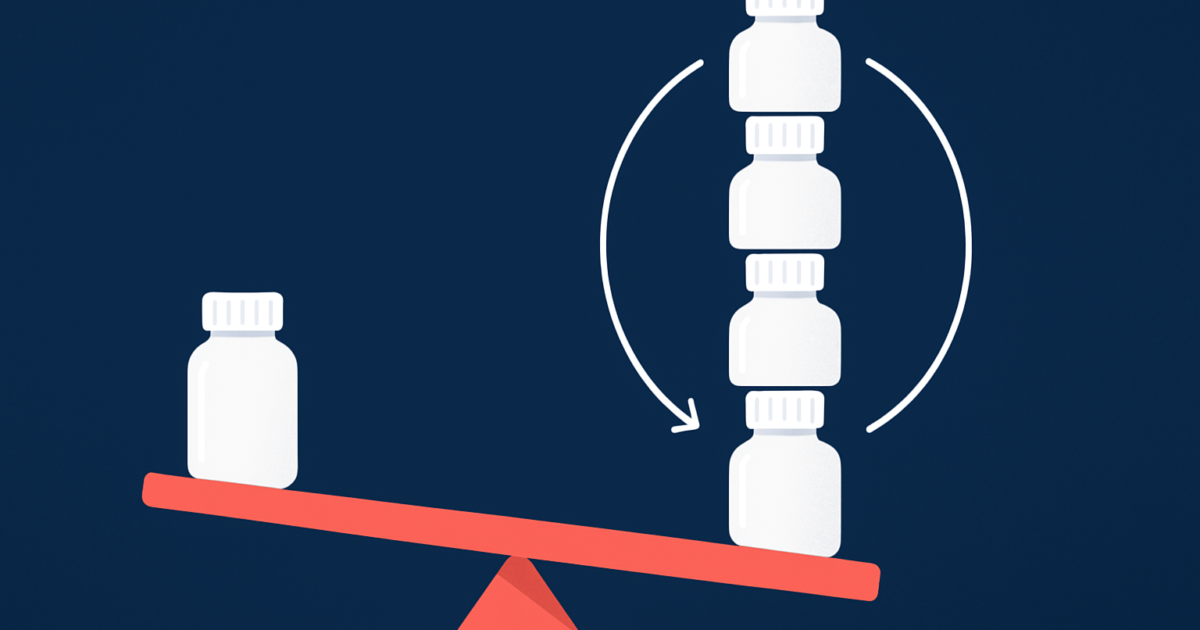
Yes, intentionally losing money on a first order can be the correct business decision for a supplement brand – but only when repeat-purchase economics repay the deficit. A first-sale loss is an acquisition cost, not a sunk cost, and your refill rate decides which one it is.

This guide models the real numbers on one white-label SKU, benchmarks supplement customer acquisition cost against category data, and shows exactly when a first-order loss builds a recurring LTV engine and when it just burns cash. Three moves follow: build the one-SKU P&L, grade your CAC against the benchmark, then run the go/no-go decision.
What Is the First-Order Loss Strategy?
The first-order loss strategy is deliberately accepting a negative contribution on a customer’s first purchase – spending more on acquisition and fulfillment than order one earns – to win a customer whose repeat orders repay the deficit and generate profit over time. It is a cash-flow trade, not a pricing failure.
Pick any product, set your monthly volume, and see your real per-unit and monthly profit on every plan – fulfillment, card processing, and membership all included.
The strategy lives or dies on three numbers. Contribution margin per order tells you how much each shipment actually earns after product cost and the flat fulfillment fee. Customer acquisition cost (CAC) tells you what it costs to put that customer in front of a checkout. Customer lifetime value (LTV) tells you whether the repeat orders will ever repay the deficit.
Get those three numbers right, and a money-losing first order is a calculated investment. Get them wrong, and it is just a loss.
Rocktomic’s model keeps the math legible: a flat fulfillment fee per item and no minimum inventory on the $0/month Free plan. That clarity makes a deliberate first-order loss measurable.
Why Supplement CAC Is Too High to Profit on Order One
Customer acquisition in supplements costs more than most categories. The average DTC brand pays $45 to $70 to land one customer (Ringly.io, June 3, 2026). Supplements run near $89 per customer, and CAC across DTC has climbed 222% over eight years (First Page Sage, December 23, 2025).
Now put that figure next to what an order is actually worth. Roughly 60% of DTC revenue comes from returning customers, and the average DTC retention rate is just 28.2% (Ringly.io, June 3, 2026). Only about one in four customers comes back for a second purchase. Every first sale is subsidized by the repeat buyers who follow, and a growing brand needs thousands of new customers a month to stay in motion.
Order one is an investment, not a profit center
Profit cannot come from order one in supplements. At roughly $89 a customer, even a strong margin on a first order disappears into the cost of earning that buyer. The money only shows up on purchase two, three, and four. The first sale is the toll booth, not the destination.
Brands that force first-order profitability run into an affordability trap. If every sale must clear a profit, the maximum bid on paid traffic drops. Competitors who accept a loss on order one can outbid them in every auction, and the traffic goes to whoever can pay for it.
Add platform fees, per-order fulfillment charges, and manufacturers that force pallet buys, and the picture gets worse. A brand priced for first-order profit either skimps on quality or quietly disappears from the feed.
So the question is not whether order one makes money. It is what order one buys: a customer relationship that pays out across many purchases, plus data, reviews, and social proof that lower the cost of the next acquisition. That repeat purchase is where the unit economics actually work.
The Canonical Money Math: One SKU, Full P&L
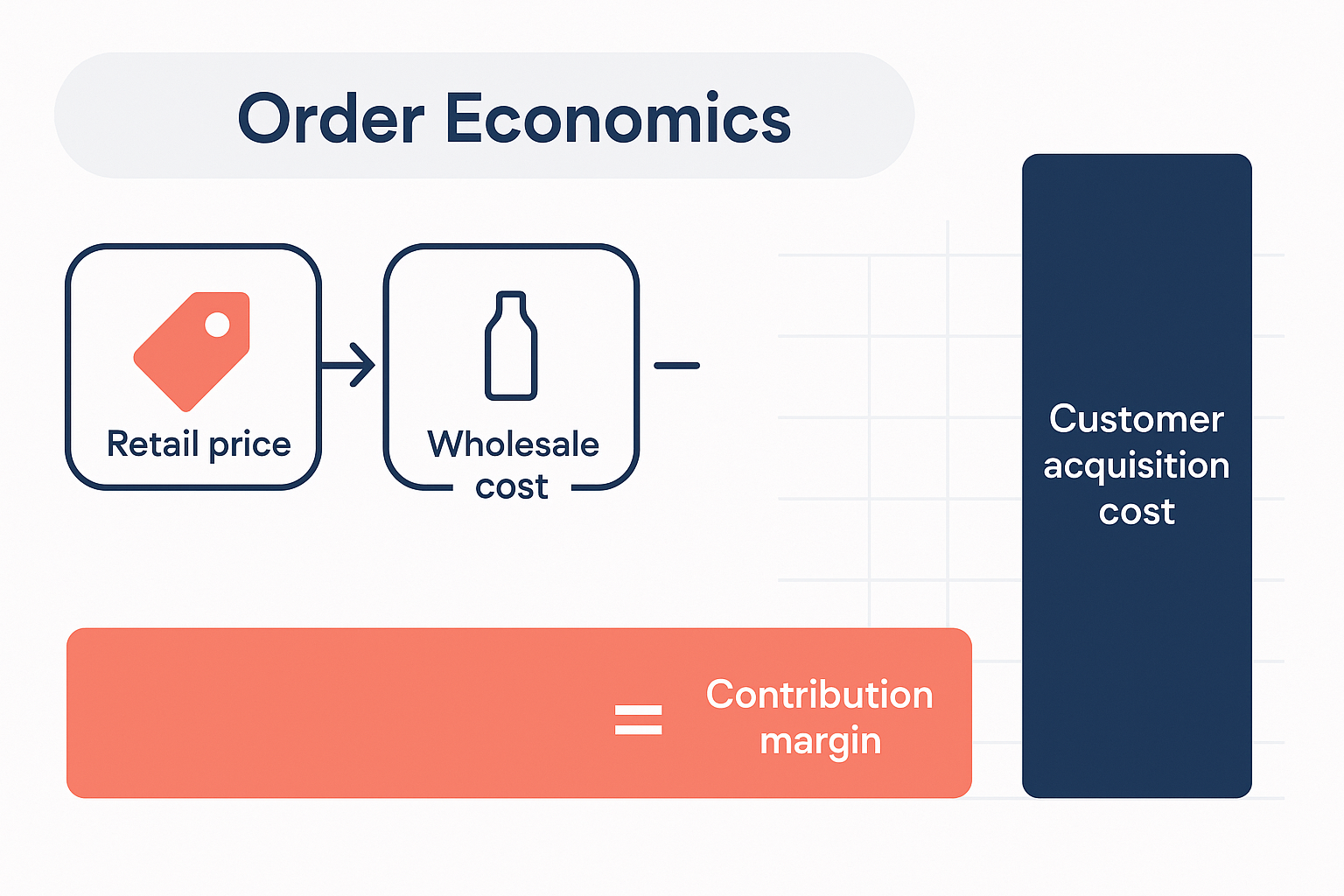
Run one SKU through a full P&L and the model stops being abstract. A single order of Multivitamin Gummies (Adults) (ROC918) on the Scale plan retails at $29.97. Wholesale cost runs $6.70, which leaves a $23.27 gross margin (77.6%) before anything else touches the order. The flat fulfillment fee is $2.00 per item. Everything after that is contribution.
| Order scenario | Retail MSRP | Scale plan wholesale cost (COGS) | Gross margin | Flat fulfillment fee | Contribution before marketing | CAC | First-order loss |
|---|---|---|---|---|---|---|---|
| Single order on ROC918 | $29.97 | $6.70 | $23.27 (77.6%) | $2.00 per item | $21.27 | – | – |
| Deficit scenarios | – | – | – | – | $21.27 | $50.00 or ~$89.00 (category average) | -$28.73 or ~-$67.73 |
Read COGS the way a supplier prices it. The $6.70 is the wholesale value you pay Rocktomic per unit, not the cost to manufacture it. That wholesale number already covers production, quality testing, and the Certificate of Analysis on every batch. Fulfillment stays flat at about $2.00 per item for pick, pack, and label. No pallet minimums, no storage charges, no per-order platform fee stacked on top. One flat fee, one wholesale cost, one contribution number.
Here is the whole subtraction, once: $29.97 – $6.70 – $2.00 = $21.27. That is contribution before marketing, the money you have left to buy traffic or discount the first order. Subtract the first acquisition cost and you get the deficit. $21.27 – $50.00 = -$28.73, a first-order loss of $28.73 at a $50.00 CAC. At the ~$89.00 category average CAC, $21.27 – ~$89.00 = -$67.73, a first-order loss of about $67.73.
That $21.27 contribution is the engine of every scenario after the first order. The loss on order one is only the entry price; orders two through ten carry the same contribution without the acquisition cost. Scale plan wholesale is the lowest per-unit rate in the catalog, which is exactly why the deficit math lives or dies on that COGS line. Run your own SKUs and your real CAC through the supplement margin calculator before you set a single ad budget. The tool is free, and it beats guessing.
Know the number before you spend against it. Any CAC above $21.27 is a deficit on order one; any CAC below it is profit on order one. That single line decides whether your funnel is a business or a donation.
How LTV Turns a Deficit First Order into a Profitable Customer
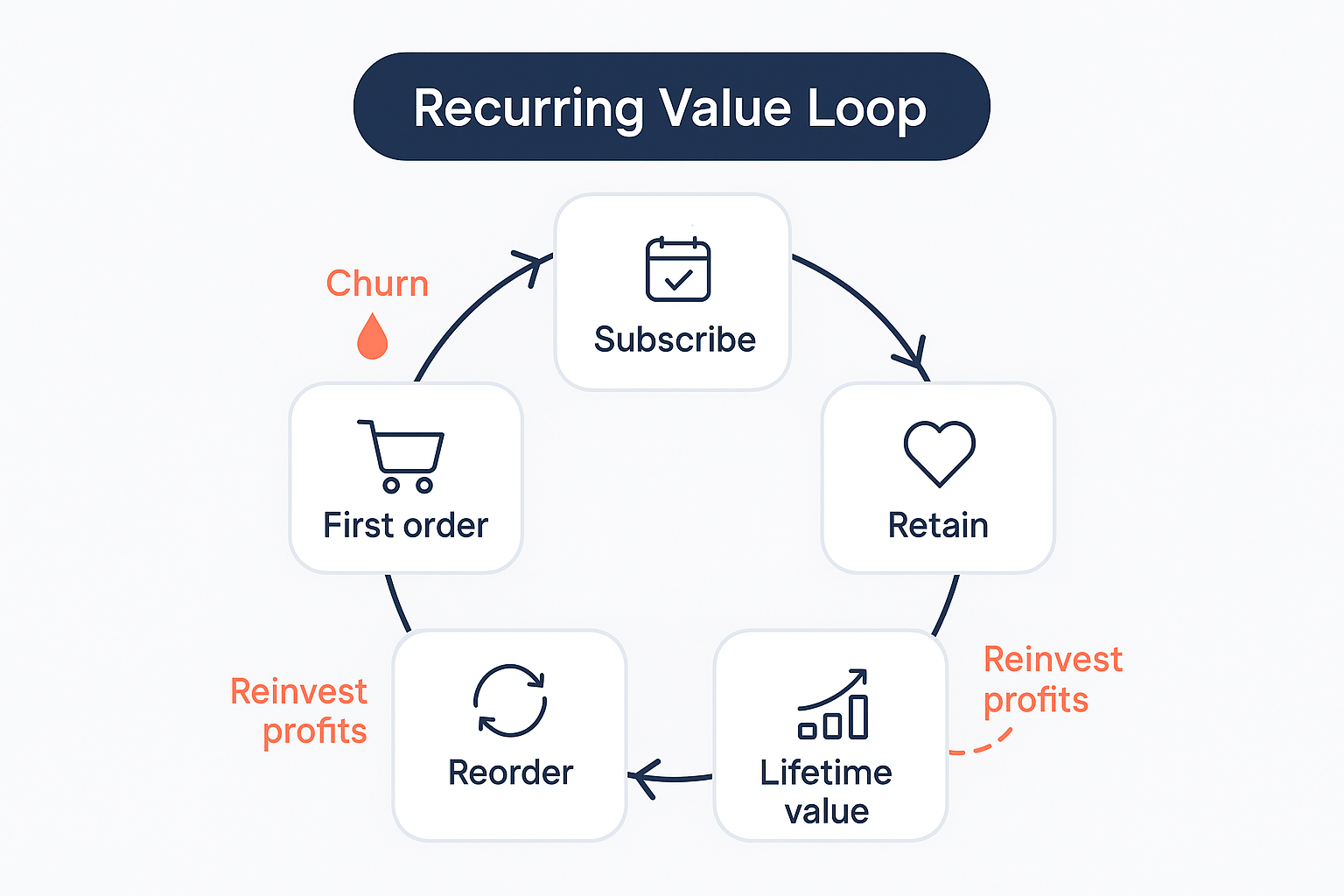
A deficit first order only works if the customer comes back. LTV is the number that tells you whether they will. For subscriptions, Eightx defines lifetime value as monthly revenue per subscriber times gross margin, divided by monthly churn.
Churn sits in the denominator, so retention moves LTV more than any other input in the model. For supplements, that formula means a subscriber’s value lives or dies on two numbers: monthly contribution and months of reorders.
The ROC918 Runway at 5 to 8% Churn
Now apply the ROC918 numbers locked in Part 4. Contribution per order is $21.27, and monthly churn for vitamins and multivitamins runs 5 to 8%, per Foundry CRO. At 5% churn the average customer stays 20 months; at 8% churn that drops to 12.5 months.
Twelve to twenty months of reorders is a long runway. It turns a one-time acquisition bet into a stream of contribution, and the deficit on order one gets spread across every order that follows.
The 7% Churn Case
Run the model at 7% monthly churn, near the middle of that range. The average subscriber stays roughly 14.3 months, which works out to about 14.3 orders. At $21.27 of contribution per order, the model yields roughly $304 of gross profit over that lifetime.
| CAC scenario | LTV | LTV to CAC ratio |
|---|---|---|
| $50 CAC | ~$304 | ~6 to 1 |
| ~$89 category CAC | ~$304 | ~3.4 to 1 |
Both clear the 3 to 1 minimum Eightx set as the floor, and First Page Sage’s December 2025 benchmarks point the same way. Above that floor, the deficit first order gets repaid from subscription cash flow. Subscription customers typically deliver 3 to 5x the lifetime value of one-time buyers, per Eightx. That’s the whole case for eating a deficit on the first order: the second, third, and fourteenth orders pay for the first one.
None of this works if you judge the campaign by order one alone. A $50 CAC against $304 of lifetime gross profit is a 6 to 1 trade. The same $50 looks bad if the cohort cancels after three orders, which is why churn tracking matters as much as acquisition spend.
Want the full framework? Start with the 3:1 rule for supplement LTV to CAC, then build your own numbers in the LTV calculator for supplement brands. If you want to push LTV higher on purpose, the subscribe-and-save pricing math is where that starts.
When to Run a First-Order Loss – and When to Walk Away
Run the math first, not your gut. A first-order loss is a loan your brand makes to itself. The loan only pays off if the customer reorders enough times to cover what you gave up. Four criteria decide it, and each one is pass or fail. A fail on any row is a no-go.
Here is the checklist, applied in order.
| Criterion | Pass | Fail |
|---|---|---|
| Replenishable SKU with a daily-use habit | Buyer uses it up and reorders on a natural cycle | One-and-done purchase with no natural reorder |
| Contribution margin repays CAC inside the funded payback window | Payback lands inside the cash runway | Payback extends past the money you can fund |
| Projected LTV:CAC at 3 to 1 or better | Every acquisition dollar returns at least three | Projected ratio falls under 3 to 1 |
| Enough cash to fund the payback window | You can absorb the deficit while orders stack | One slow month breaks the plan |
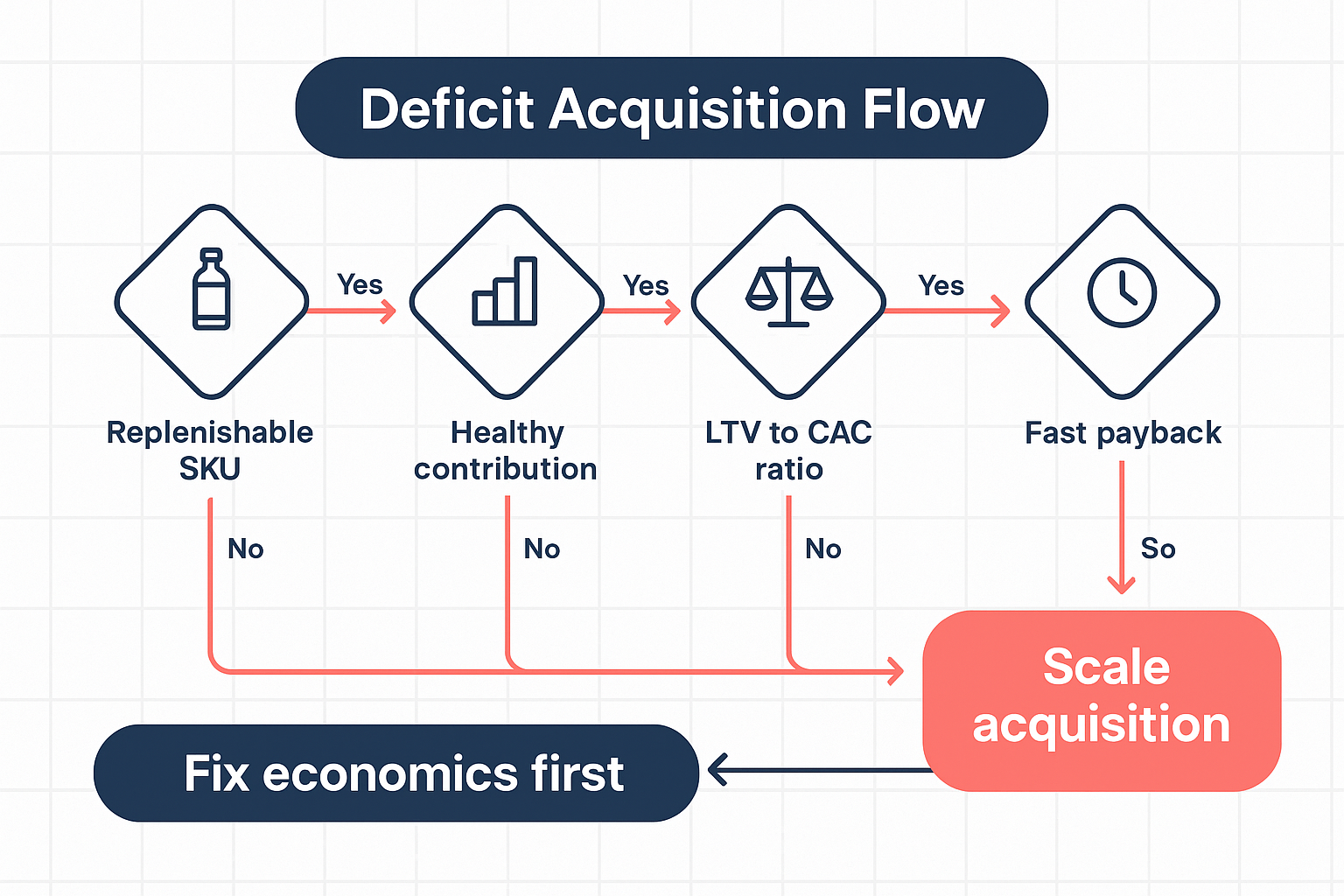
Payback math sets the line. A $50.00 CAC divided by $21.27 contribution per order is about 2.4 orders to break even. Raise the CAC to $89.00 and the same contribution needs about 4.2 orders. At one order per month, that is roughly 2 to 4 months of payback. If the customer cancels before that, the loan defaults. You are betting today’s cash on orders that have not happened yet.
Walk away when the loop never closes
Walk away from one-time purchase products, low-margin SKUs, and categories where first-to-second purchase retention is weak. The surest losers are bottles bought once for a goal and never restocked. If the second order rarely comes, the deficit is a gift, not an investment. The retention mechanics live in our breakdown of supplement subscription churn economics; the short version is that the reorder rate has to carry the deficit.
Trust pulls in the same direction. Products that are third-party tested with a COA on every batch give customers a reason to stay past order one, and the Free plan lets you validate the math on a single channel before you commit. When the four criteria pass, the Scale plan’s lower per-unit wholesale pricing shortens the payback window. When any one fails, fixing the economics beats scaling them. Every dollar spent on a failing criterion is a dollar your next winning campaign will not see. Numbers beat hope.
The Hidden Costs That Turn a Small Loss into a Bleeding Wound
Your ad platform reports cost per purchase. It does not report the honest cost to acquire. The deficit you planned for is never the deficit you pay, unless you itemize every leak before the order lands. The silent costs widen the wound faster than any media buyer expects:
- Payment processing fees, usually 2.9% plus a fixed per-transaction cut.
- Platform commissions from TikTok Shop, Instagram Shopping, or any marketplace.
- Discount codes that stack on top of your first-order offer.
- Free-shipping thresholds that quietly raise the average shipping cost.
- Refunds and chargebacks that erase the contribution for that order entirely.
- Creative production: filming, editing, licensing, and the losing iterations.
Miss any of these and your fully-loaded CAC is fiction. Most brands understate acquisition cost by 2 to 3x because they exclude tools and team time. Shopify apps, ad spy subscriptions, a VA clipping UGC, your own hours approving creatives. All of it belongs in CAC.
The break-even ROAS calculation
Break-even ROAS equals 1 divided by the contribution margin rate. At a 71% contribution rate, based on $21.27 of contribution per $29.97 order, break-even ROAS lands near 1.4x per the table below. This multiple is the point where the product stops losing money before CAC is repaid. Repaying CAC plus fully-loaded costs requires a higher multiple, and every hidden cost pushes that multiple higher.
| Input | Value |
|---|---|
| Contribution margin rate | 71% |
| Contribution per order | $21.27 per $29.97 |
| Break-even ROAS | 1 / 0.71 = ~1.4x |
Apply that to a real decision. If your ad manager celebrates a 1.5x ROAS, celebrate carefully. A 1.5x multiple barely clears product-level break-even and leaves CAC unpaid. Brands that track fully-loaded CAC treat anything below 2x as an early warning.
This is why flat $2 per item on-demand fulfillment becomes a structural advantage. It keeps fulfillment out of the leak column. Manufacturers that force pallet buys or platforms that charge per-order fees make the first-order loss even deeper.
Run the complete model before your next campaign starts: break-even ROAS on supplement ads.
Zero-Inventory Economics: Why the Cost Structure Matters
The first-order-loss bet changes completely depending on what you risk when the test fails. Inventory-backed brands risk product. Zero-inventory brands risk marketing spend only. That difference decides whether a deficit test is a smart experiment or a slow write-off.
Rocktomic’s dropship model has no minimum order quantity. You never buy pallets. You never prepay cost of goods. You list your products, and you pay wholesale cost plus a flat ~$2 per item fee only when an order ships. No order, no fee, no cash out the door. That pay-when-it-ships structure changes the entire risk profile of a deficit test.
Two Cost Structures That Kill the Test
The contrast matters, because two common models break this strategy before it starts.
Manufacturers that force pallet minimums tie your cash to inventory before a single sale lands. Your first-order loss gains a second cost: boxes of product you already paid for, sitting in a warehouse. The contribution margin you budgeted for sits on a pallet instead of moving through your funnel.
Per-order-fee platforms are the other trap. They shave a slice of contribution margin off every single transaction. That margin is the fuel for the whole lose-first, recover-later play. When a platform charges a fee on each shipment, the recovery math gets worse with every order.
The Risk Asymmetry
Here’s the part that makes the test rational. With zero inventory, a failed first-order-loss test costs marketing dollars only. No sunk product. No dead stock in a fulfillment center. No clearance sale at half price to free up cash. You learn what acquisition really costs, you stop the test, and you keep the lesson and your capital.
That’s the entire economic argument for a no-MOQ dropship structure: the downside is capped at the cost of the experiment.
For the mechanics behind it, read how on-demand fulfillment works. To see how those terms stack up against the usual alternatives, check the direct model comparison.
How to Fund Deficit Acquisition Without a Venture Round
Deficit acquisition does not require a venture round. It requires discipline. Fund it from operating margin or a fixed monthly budget you set in advance. Never from credit that expects a compounding return you have not modeled.
Cap the spend at what the payback window can absorb. If a customer pays you back in 90 days, do not spend month-one cash as if they pay back in nine. Track by cohort, not blended numbers. Blended math hides the customers who never return behind the ones who buy every month. A cohort table shows you which acquisition source actually funds its own expansion.
Set a stop point before you start. Decide the maximum dollar amount you will lose per first order, and the number of orders that qualifies as a valid test. When you hit either number, pause, review the cohort, and adjust.
Two plans, one margin lever
Rocktomic’s membership structure keeps the math simple. The Free plan costs $0 per month. You pay the flat ~$2 per item fulfillment fee when an order ships, get one sales channel integration, and can sell up to 10 white-label products. Scale costs $297 per month and gives you the lowest per-unit wholesale pricing, unlimited sales channels, the full 140+ product catalog, and priority fulfillment.
That lower wholesale cost is the lever. It shrinks your first-order deficit before the customer ever repeats. The same retail price on Scale costs you less per unit, so the payback window shortens and the cap can rise.
Optional one-time launch add-ons
If you need a brand or store before your first order, Rocktomic sells three one-time launch packages. Starter Branding Package is $497 for 1 logo, 10 labels, and 10 3D mockups. Starter Online Store Build-Out is $1,497 for a fully built Shopify store with up to 10 products. Business-in-a-Box is $997 and bundles both. These are add-ons; the Free plan stays $0 per month.
First-Order Loss vs. First-Order Profit: Which Model Wins?
The math is in. The question was never whether you can afford to lose money on order one. It is whether you have the margin, the cash, and the retention path to earn it back. That is a product question, not a marketing question.
The table below stacks the two models against each other using the locked ROC918 numbers.
| Factor | First-order loss | First-order profit |
|---|---|---|
| Acquisition goal | Accept a negative contribution on order one to acquire the customer relationship | Every order must stand alone profitably |
| Margin requirement | High contribution per order (ROC918: $21.27 before marketing) | Contribution must exceed CAC on order one |
| Cash needed | Enough to fund the payback window (~2.4 orders at a $50 CAC; ~4.2 orders at the ~$89 CAC) | Minimal; no deficit to fund |
| Retention dependency | High; requires a repeat or subscription path | Low; the win is on the single order |
| When it wins | Replenishable SKUs with subscription paths and LTV:CAC of 3 to 1 or better | One-time purchase products and lean budgets |
The verdict
Profit-first wins for one-time-purchase products and lean budgets. Loss-first wins for replenishable SKUs with subscription paths and a healthy LTV:CAC.
A protein powder or greens SKU that reorders every month can justify a deficit on order one. That is the loss-first model working as intended. A one-off purchase product has no second order to fund the payback, so profit-first is the only sane choice.
Match the model to the product before you spend a dollar on ads. If you cannot say which model you are running, you are paying for traffic and hoping the numbers work out.
FAQ
What is the first-order loss strategy in ecommerce?
The first-order loss strategy means intentionally spending more to acquire a new customer than the first order earns back in profit, so the first sale runs at a deficit. The bet is that a subscription or repeat-purchase relationship generates enough lifetime value (LTV) to repay the acquisition cost and produce profit across later orders. It only works when the customer keeps buying. For supplements, the math depends on replenishment rates, churn, and contribution margin per order.
When does losing money on the first order make sense?
It makes sense when three conditions hold: the product is replenishable, the contribution margin on repeat orders is high, and projected LTV to CAC clears roughly 3 to 1. Supplements fit because daily-use categories drive repeat orders and subscription churn for vitamins and multivitamins averages 5 to 8 percent monthly (Foundry CRO, May 2026). If a brand has no repeat-purchase path, a first-order loss is just a loss.
What is the difference between CAC and first-order contribution margin?
CAC is total marketing spend divided by new customers acquired, including ads, creative, and tools. Contribution margin per order is revenue minus the product cost and fulfillment cost of that single order. The gap between the two is the first-order deficit. A brand can have healthy per-order margins and still lose money on order one when CAC is high, which is why both numbers must be modeled together.
How do subscription models change first-order economics for supplements?
Subscriptions convert a one-time buyer into a stream of orders, so the first-order deficit is repaid over future charges instead of a single purchase. Subscription customers typically deliver 3 to 5 times the lifetime value of one-time buyers at the same gross margin (Eightx, June 2026). With replenishable SKUs such as multivitamins, subscribe-and-save offers raise order frequency and make a higher CAC tolerable.
What is a healthy LTV to CAC ratio for a supplement brand?
A 3 to 1 LTV to CAC ratio is the widely cited minimum for sustainable ecommerce growth, meaning each customer returns three dollars of lifetime value for every dollar of acquisition spend (Eightx, June 2026; First Page Sage, December 2025). Ratios below 2 to 1 signal that acquisition costs more than the customer is worth. Supplement brands with strong retention often run 3 to 6 to 1.
What does a first-order loss actually cost on a white-label supplement?
Model a Multivitamin Gummies (Adults) bottle (ROC918) at the $29.97 MSRP with a Scale plan wholesale cost of $6.70 and a flat $2 fulfillment fee. Contribution is $21.27 before marketing. Against a $50 CAC, the first order loses $28.73. Against the roughly $89 average supplement CAC, the first-order loss is about $67.73. Every repeat order contributes $21.27 toward repaying that deficit.
What does the Scale plan cost versus the Free plan?
Rocktomic has two membership plans. The Free plan costs $0 per month and charges only the flat $2 per item fulfillment fee when an order ships, with one sales channel and up to 10 products. The Scale plan costs $297 per month and adds lowest per-unit wholesale pricing, unlimited sales channels, the full 140+ product catalog, and priority fulfillment. Scale is the plan to model when running a first-order loss strategy because lower wholesale costs shrink the deficit.
How do you calculate payback on a customer acquired at a deficit?
Divide CAC by the contribution margin per order to find how many orders repay acquisition. Using ROC918 at $21.27 contribution per order, a $50 CAC pays back in roughly 2.4 orders, and an $89 CAC in roughly 4.2 orders. At one order per month that is about 2 to 4 months of payback.
Run the Numbers Before You Spend
The first-order loss is a cash-flow trade, not a pricing failure: you spend more to acquire than the first order returns, and the deficit is a deliberate bet. That bet pays off only when repeat-purchase economics clear the deficit, as in the ROC918 model from Part 4, where a $21.27 per repeat order carries the profit against a $50 customer acquisition cost. We won’t re-derive the full math here; Part 4 already did.
Run your own SKU through the free supplement margin calculator before you spend. Then compare the Free $0 and Scale $297 plans on the Rocktomic membership pricing page, or book a call to model first-order economics before you commit.
Last updated: June 21, 2026.