
The Ultimate LTV Calculator for Supplement Brands
· 19 min read · By Rocktomic Labs Team
Customer lifetime value (LTV) is the total profit one customer generates across every order they place with your supplement brand, and it is the number that decides how much you can afford to spend on ads. The formula is average order value times purchase frequency times customer lifespan, multiplied by gross margin. A brand selling Super Creatine Gummies (ROC943) at $29.97 with a $8.45 Scale wholesale cost and the flat $2 per item fulfillment fee earns $19.52 per order, so a customer who reorders 4 times a year for 2 years is worth $156.16 before acquisition costs.
What Is Customer Lifetime Value for a Supplement Brand?
LTV (also written CLV) is the expected gross profit a customer contributes from their first order to their last. It matters more than any other metric because it sets the ceiling on customer acquisition cost: if a customer is worth $156, spending $50 to acquire them is rational and spending $160 is not. For consumable supplement brands, LTV compounds faster than one-time purchase categories because reorder behavior is built into the product.
Pick any product, set your monthly volume, and see your real per-unit and monthly profit on every plan – fulfillment, card processing, and membership all included.
Why LTV Is the Only Metric That Matters in 2026
Conversion rate tells you how many visitors bought. ROAS tells you how much you made per ad dollar. Both answer the same one-transaction question, which is exactly why they hide the real economics of a consumable supplement brand.
A ROAS of 3 can look like a win while you’re still paying to reacquire the same customer next month. A 2% conversion rate says nothing about whether those buyers ever come back. Supplements are a reorder business, and the one-time buyer is a cost. The reordering customer is the asset that pays your ad bill for years.
LTV is the only metric that prices the whole relationship. Roughly 60% of DTC brand revenue comes from returning customers, while average ecommerce retention sits near 28%. Average customer acquisition cost has climbed 222% over eight years, per Ringly customer retention statistics from June 3, 2026.
Retention also compounds profits. A 5% lift in retention can raise profits 25-95%, according to Bain research reported in Harvard Business Review on October 29, 2014. That range is wide because retention compounds: keep a customer one more cycle and every future order gets cheaper to earn.
The operator takeaway
Acquisition gets more expensive every year, and a 222% CAC climb over eight years shows that curve is not flattening. If your model depends on constantly converting new visitors, you’re betting against it. The only defense is a bigger lifetime value: more reorders per customer, more margin per recurring order, and a bigger share of that 60% returning-revenue base.
That’s why zero-inventory brands track LTV first.
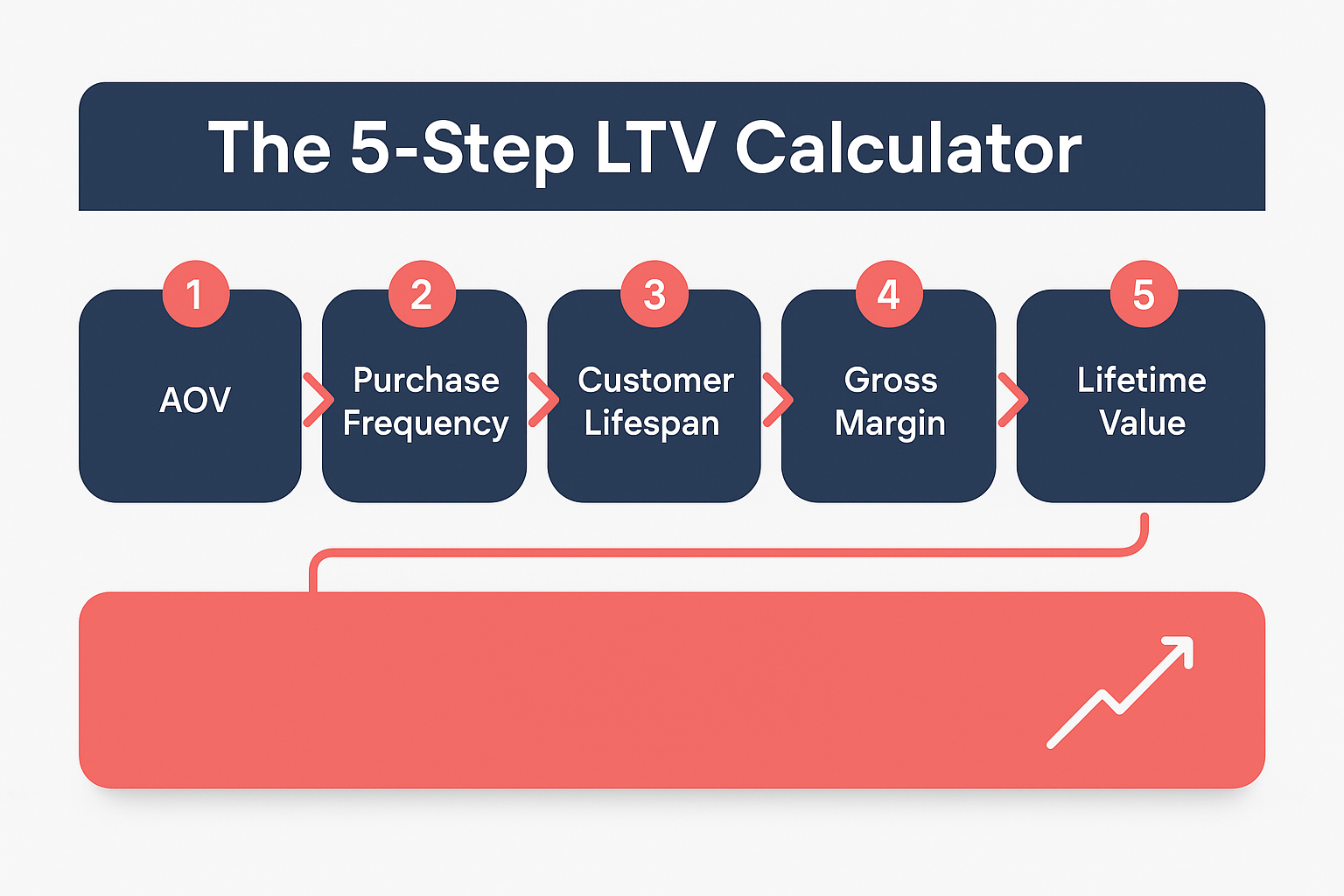
The 5-Step LTV Calculator: The Formula, Broken Down
Here is the whole model in one line:
LTV = AOV x Purchase Frequency x Customer Lifespan x Gross Margin
Five moving parts, one output. Work left to right. The first three inputs tell you how much revenue a customer will generate over their lifetime. Gross margin converts that revenue into profit, the number your ad budget actually runs on.
Four inputs, and each one is a figure you can pull from your own order data: total revenue, total orders, total unique customers, monthly churn, and profit per order.
The Four Inputs
- AOV (Average Order Value): total revenue / total orders. What a customer spends per purchase.
- Purchase Frequency: total orders / total unique customers. How often a customer comes back.
- Customer Lifespan: 1 / monthly churn. How long a customer stays active before canceling.
- Gross Margin: profit per order / retail price. What is left after product and fulfillment costs.
Each input gets its own deep dive in the next sections. Mixing them up is the fastest way to get an LTV that looks good but means nothing.
Revenue LTV vs. Margin-Adjusted LTV
Two formula families exist. Simple revenue LTV uses only the first three inputs. Margin-adjusted profit LTV carries gross margin through to the end, and it is the version that funds ad budgets. Recharge’s subscription metrics guide, published November 21, 2025, walks through which metrics DTC brands should track, starting with 10 subscription metrics every DTC brand should track.
Do Not Stop at Revenue LTV
The most common mistake is stopping at revenue LTV. It looks big, so it feels safe. It is not. Revenue LTV overstates what a customer is worth because product and fulfillment costs still have to come out. The gap between revenue LTV and margin-adjusted LTV is the difference between a brand that can afford ads and one that cannot.
Step 1: Average Order Value (AOV)
Start here. Average order value is the first input in the LTV chain, and it is the easiest one to move.
The formula
AOV equals total revenue divided by total orders. That is the whole math. Run one order for $29.97 and your AOV is $29.97. Run one order for $59.94 and your AOV is $59.94. The number changes as soon as the order does.
Run the ROC943 baseline
One unit at $29.97 is a single AOV data point: $29.97 in revenue, one order, $29.97 AOV. Now take the same customer and sell them two units as a bundle. Revenue hits $59.94 on one order, and AOV doubles to $59.94. You did not acquire a new customer. You just pulled more revenue from the one you already paid to acquire. Bundles and multi-buy offers are the fastest way to lift AOV without touching margin.
That matters because every downstream LTV input multiplies off this number. Higher AOV at the same order count means more revenue per customer. The cheapest way to grow it is not more ads. It is bundle tactics that multiply AOV.
One caution: do not confuse AOV with profit. Margin gets its own step later in this series. Here, just capture the revenue-per-order number cleanly and move on.
Step 2: Purchase Frequency
Purchase frequency tells you how often a customer comes back. It’s the number that separates a one-off sale from a real brand, and it feeds directly into your LTV math.
The formula: purchase frequency = total orders divided by total unique customers. If you sold 400 orders to 200 customers last year, your purchase frequency is 2.0. Measure it over a fixed window, like 12 months, so seasonal spikes don’t distort the number. Pull the two counts from your store’s export.
Supplements carry the highest repurchase rate of any consumer category, with a repeat-purchase share around 37.7% in a 24-month window, per Foundry CRO’s DTC supplement benchmarks (May 12, 2026). People come back because they use the product daily. That’s your structural advantage.
One-time buyers typically land at 1-2 orders per year. Subscriptions change that math. A 90-day cycle means 4+ orders per year on autopilot, before you run a single retargeting ad or email campaign.
Frequency compounds. Moving a customer from 2 to 4 orders per year doubles their contribution to your LTV before average order value moves at all. It also smooths out revenue from month to month.
Your subscription price needs to make those 4+ orders profitable. Run the subscription pricing strategy math before you set the discount.
Step 3: Customer Lifespan and Churn – How Long Does Your Customer Stay?
Churn is the input that decides how long a customer stays. The formula is simple: lifespan equals 1 divided by monthly churn rate. If 10% of subscribers cancel each month, the average customer lasts 10 months. At 5%, lifespan stretches to 20 months.
The 5-8% Monthly Churn Reality
Supplement subscriptions run 5-8% monthly churn, per Foundry CRO’s DTC supplement benchmarks (May 12, 2026). At the low end of that range, the average customer stays 20 months. At the high end, 12.5 months. Most founders never run this number, and it shows when ad costs spike. That spread decides how much you can spend to win each customer in the first place.
Churn Beats AOV
Part 2 already covered the retention economics, so we will not redo that math. One point of churn improvement moves lifespan more than any AOV tweak. Improve churn from 8% to 5% and lifespan jumps from 12.5 months to 20 months. This is why the multivitamin subscription LTV math walkthrough runs the same formula against one product line.
Next up: gross margin per order. Lifespan tells you how many orders you get. Margin tells you what each one is worth.
Step 4: Gross Margin, Where Most Brands Mess Up
Revenue LTV is a fantasy until you multiply it by gross margin. Margin-adjusted LTV equals revenue LTV times gross margin, and that is the number that decides what you can afford to spend acquiring a customer. Most sellers skip this step and then overpay for ads.
Gross margin breaks into three parts:
- COGS: what you pay for the product itself.
- Fulfillment: pick, pack, and label.
- Platform fees: what TikTok Shop, Shopify, or your other sales channels take per order.
Leave one out and your margin math quietly goes wrong. The bigger error is letting the supplier control the cost side. Manufacturers that force pallet buys park thousands of dollars of inventory on your card before you sell a single bottle. Platforms that charge per-order fees stack a variable cost onto every shipment. Both inflate your true cost per order and shrink gross margin without you noticing.
The number also shifts with your order model. Bulk buying drops per-unit COGS but creates inventory risk. Dropshipping holds unit cost steady while your cash stays in your pocket. Know which trade-off you are choosing before you build LTV on top of it.
Rocktomic keeps the cost side visible. Start on the Free plan at $0/month, sell with zero inventory, and pay only a flat $2 per item fulfillment fee when an order ships. No pallet minimums to fund. No layered per-order fees. Your margin stays predictable enough to build a business on.
For the real math behind what a dropship order actually costs, read about the true COGS behind dropship supplements.
The Canonical LTV Worked Example: ROC943
Every LTV model collapses if the unit economics underneath it are mushy. So let’s lock one SKU before touching a single formula: ROC943 Super Creatine Gummies. One product, one wholesale price, one fee, one profit number. Everything in this section uses ROC943 and nothing else, because mixing in a second SKU muddies the math and muddy math is how brands misprice themselves.
| Line item | Value |
|---|---|
| Retail price (seller’s choice) | $29.97 |
| Scale wholesale (ROC943) | $8.45 |
| Flat fulfillment fee per item | $2.00 |
| Gross profit per order | $19.52 |
| Gross margin per order | 65.1% |
Before the fulfillment fee, the list margin on ROC943 is $21.52, or 71.8%. That figure looks better on a pitch deck, but it ignores what you actually pay every time an order ships: a flat $2.00 per item for pick, pack, and label. Every calculation in this article uses the after-fee figure: $19.52 per order and a 65.1% gross margin.
| Customer type | Orders | Profit |
|---|---|---|
| One-time buyer (AOV $29.97) | 1 order | $19.52 |
| Repeat buyer (4 orders per year for 2 years) | 8 orders | $156.16 |
| Subscriber at 6% monthly churn | Lifetime | $325.33 |
The repeat buyer line is not an aggressive assumption for a consumable. People finish the tub and reorder, so four orders a year for two years is a realistic baseline. Eight $19.52 orders compound to $156.16 from one customer.
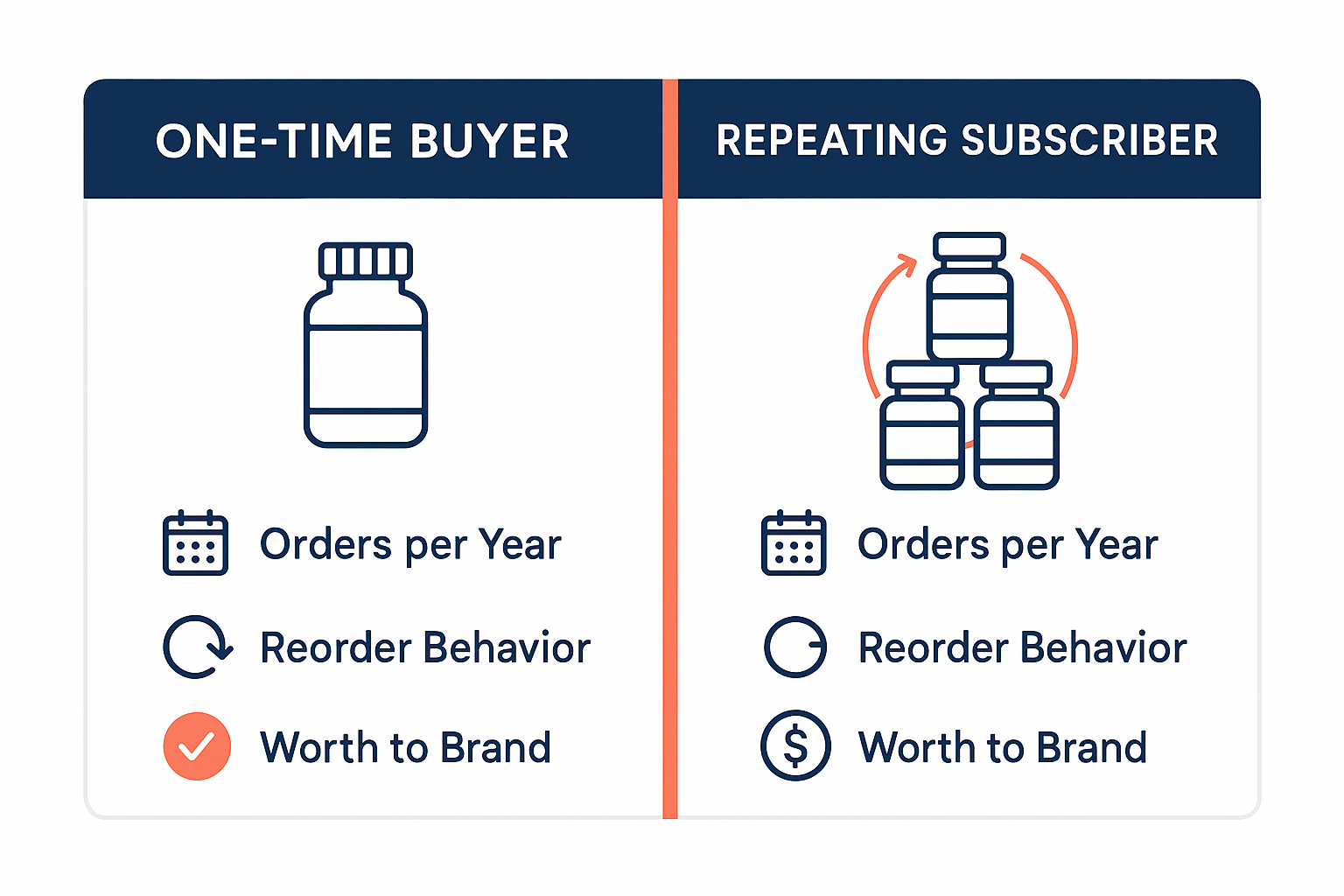
The subscriber scenario is where the math gets loud. $19.52 divided by a 6% monthly churn rate gives $325.33 of lifetime profit from one customer. That is the number that changes how you run the brand. No re-acquisition cost, no discount to win them back, just recurring revenue on the same SKU.
Wholesale costs vary by membership plan. The Free plan dropships on demand with no monthly fee; the Scale plan unlocks the lowest per-unit wholesale pricing across the 140+ product catalog, which is what makes a 65.1% margin realistic. Compare the Scale plan’s wholesale pricing against your retail price to see the spread before you commit to a SKU.
Run your own numbers next. The supplement margin calculator turns your retail price, wholesale cost, and fees into per-order profit in seconds. Lock that figure first – LTV is only as honest as the unit economics beneath it.
Subscription LTV: The Formula That Compounds
A repeat buyer is a win. A subscriber is a business model. The difference shows up in one number: customer lifetime value.
Subscription LTV = (monthly revenue per customer x gross margin) / monthly churn. That’s the whole equation. Churn sits in the denominator, so every point of churn you cut flows straight into LTV. Recharge’s subscription metrics guide (November 21, 2025) treats LTV as a cohort-based metric and measures it over 12 months. Use the same convention and your numbers stay comparable month to month.
The locked numbers on one product
Run the math on a $29.97 Rocktomic product at a 65.1% gross margin and 6% monthly churn:
| Input | Value |
|---|---|
| Monthly subscription revenue per customer | $29.97 |
| Gross margin | 65.1% |
| Monthly churn | 6% |
| Subscription LTV | $325.33 |
$29.97 x 65.1% divided by 6% equals $325.33. That is roughly 2x the $156.16 repeat-buyer LTV on the same product. Same product, same margin, one difference: the recurring order. The repeat-buyer number assumes a second purchase happens. Subscription LTV assumes one happens every month until churn.
That figure sits inside a realistic band. Foundry’s DTC supplement benchmarks (May 12, 2026) put vitamin subscription LTV between $300 and $600. Your run lands at the low end with a 6% churn rate, which means the upside is in retention, not acquisition. Push churn below 6% and LTV climbs without a single new customer.
Subscriptions only pay out when the back end handles them. Rocktomic’s store integrations connect your channels to on-demand fulfillment, so recurring orders ship without you holding inventory. No pallets. No prepaid stock. Just orders that move as they come in. That’s the difference between a subscription on paper and one that compounds.
LTV to CAC Ratio: What Is a Good Number?
Customer acquisition cost only makes sense next to lifetime value. The standard floor is 3:1. For every dollar you spend to acquire a customer, that customer needs to return three dollars in contribution over their lifetime. A 5:1 ratio or better signals strong retention and healthy unit economics, according to Recharge’s subscription metrics guide (November 21, 2025).
Run that ratio against the ROC943 model numbers from Part 8. With an LTV of $156.16, a 3:1 minimum puts your CAC ceiling at roughly $52. Every customer you acquire for less than $52 builds margin. Every dollar above that erodes the model.
Where Supplement CAC Actually Lands
Category benchmarks show how tight that ceiling is. Blended DTC supplement CAC sits near $89 per customer, per Ringly’s customer retention statistics (June 3, 2026). Vitamins come in lower, at $45-$80, per Foundry CRO’s DTC supplement marketing benchmarks (May 12, 2026).
Notice the overlap. The top of the vitamin range runs well above the $52 ceiling. A brand paying blended CAC in the $80s is likely losing money on the ROC943 model unless retention beats the projection.
Acquisition cost is only half the equation. The other half is contribution after ad spend, fulfillment, and platform fees. That’s the break-even ROAS math on supplement ads. Know that number before you scale, and you’ll never mistake a cheap customer for a profitable one.
If your CAC lands under $52, the math works. If it lands closer to the $89 blended average, retention is your first problem. Fix that before you spend more.
How to Raise LTV Without Raising Ad Spend
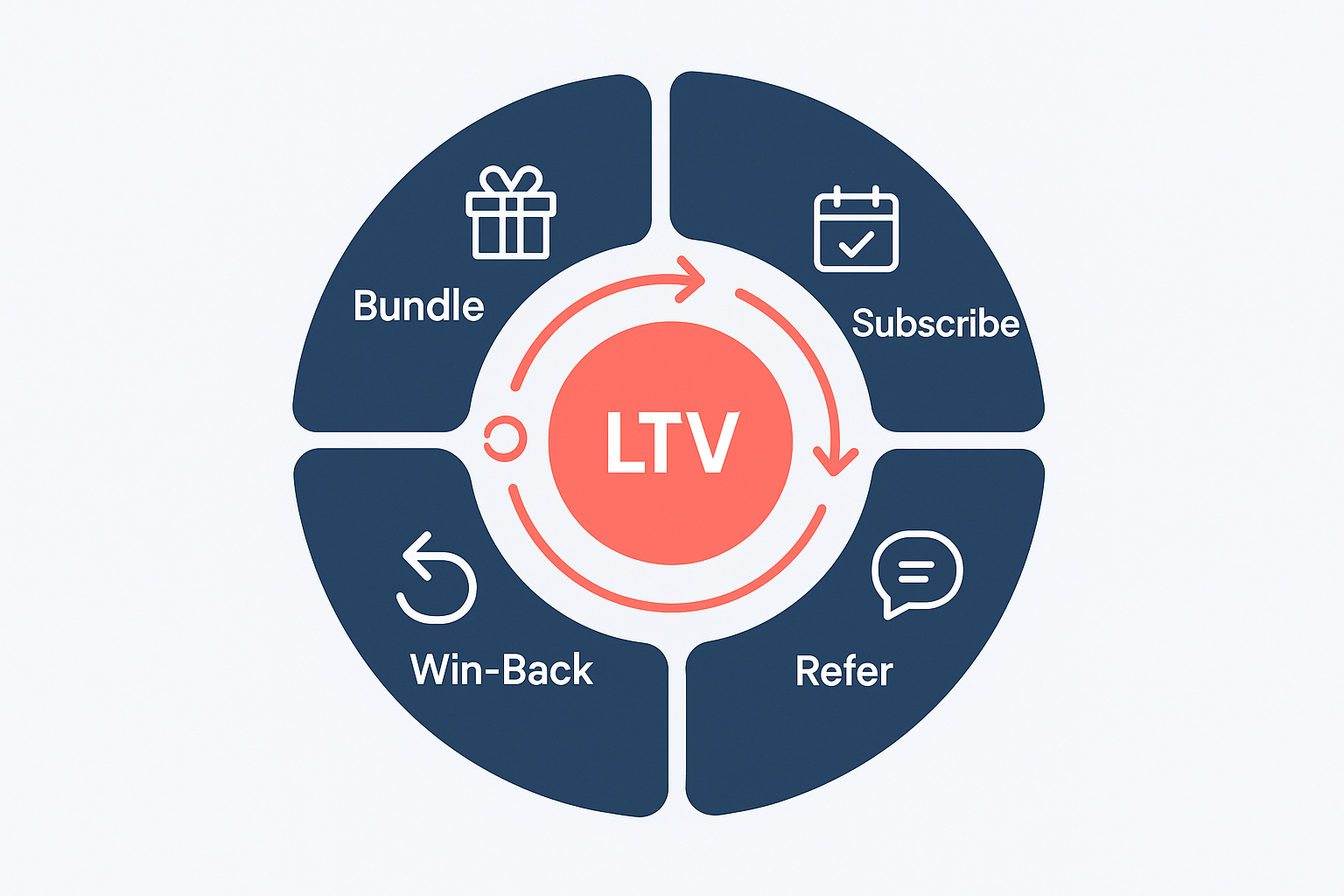
You do not need a bigger ad budget to grow lifetime value. You need one of the four levers that move the LTV inputs: bundle, subscribe, win-back, and margin discipline. Each lever maps to one input from the earlier math. Bundle raises average order value. Subscribe raises purchase frequency. Win-back extends customer lifespan. Margin discipline protects gross profit per order.
Bundle to raise AOV, subscribe to raise frequency
Start with the bundle. One extra $29.97 order per customer is worth $19.52 in profit. That is the ROC943 contribution margin applied to a real order. No new ad spend required. Add a bundle offer and the second purchase becomes the obvious move. The flat per-item fulfillment fee keeps that extra order profitable, and how on-demand fulfillment works explains why.
Subscriptions are the frequency lever. Put a subscribe-and-save option on the checkout and a one-time buyer turns into a recurring one. No extra traffic, no extra ad dollars, just repeat orders stacking on top of each other.
Win-back to extend lifespan, margin discipline to protect profit
Win-back flows extend lifespan. Most brands lose a customer to silence, not to a competitor. A short email sequence aimed at lapsed buyers recovers a portion of them. Move one 2-year buyer into a third year and you add $78.08 in profit. Same customer, same acquisition cost, one extra year of purchases.
Margin discipline is the fourth lever. If COGS and fulfillment fees drift, every other lever gets weaker. Keep product cost controlled and per-item fulfillment flat, and the ROC943 math stays on your side. Scale members at $297 per month get the lowest per-unit wholesale pricing, which is a margin lever by itself.
Pull all four levers and you build a retention flywheel. Bundle raises AOV. Subscribe lifts frequency. Win-back extends lifespan. Margin discipline protects the profit underneath it all. Satisfied customers refer the next buyer, and the flywheel spins again.
FAQ: Customer Lifetime Value for Supplement Brands
What is customer lifetime value (LTV) for a supplement brand?
Customer lifetime value (LTV) is the total expected gross profit a brand earns from a customer across all orders, not just the first sale. It matters most for consumables because supplements get reordered, so LTV beats one-time sale revenue. A customer worth $156.16 in gross profit over two years is worth far more than a customer who buys once. Rocktomic treats LTV as the core business number behind every white-label launch because it tells a brand what it can afford to spend to acquire each customer.
What is the LTV formula for supplement brands?
The LTV formula for supplement brands is LTV = AOV x Frequency x Lifespan x Gross Margin. Average order value times purchase frequency times customer lifespan gives total lifetime revenue; multiplying by gross margin converts that revenue into expected profit. For subscription brands, the version is (monthly revenue x gross margin) / monthly churn, which makes churn the driver of lifespan. Rocktomic uses margin-adjusted LTV so members compare profit, not revenue, when they decide which products to scale.
How do you calculate average order value and purchase frequency?
Average order value (AOV) equals total revenue divided by total orders. Purchase frequency equals total orders divided by unique customers. For example, $30,000 in revenue across 1,000 orders gives a $30 AOV. If those 1,000 orders came from 250 customers, the average customer orders 4 times per year. Rocktomic tracks both numbers on every product so members can spot which items drive repeat purchases versus one-off sales and which marketing spend returns the highest customer value.
Why does gross margin matter in LTV math?
Gross margin decides how much of that lifetime revenue is actually profit. Revenue-based LTV overstates a customer’s worth: $1,200 in lifetime revenue at a 15% margin is worth only $180, while $900 at a 60% margin is worth $540. The lower-margin customer looks bigger on the top line and is worth less on the bottom line. Rocktomic builds gross margin into its LTV math so members price products for profit, not just sales volume.
How does subscription churn change LTV?
Subscription churn sets the lifespan half of the LTV equation. Monthly churn of 6% implies a customer lifespan of about 17 months; 3% monthly churn implies about 33 months. Because lifespan sits in the formula, halving churn roughly doubles subscription LTV. Supplement subscription brands typically run 5-8% monthly churn, per 2026 DTC benchmarks. Rocktomic tracks churn per product so members see which subscriptions hold customers longest and which need a retention fix.
What is a good LTV to CAC ratio for supplements?
A 3:1 LTV to CAC ratio is the minimum benchmark for healthy supplement economics, not the ceiling. Blended DTC supplement customer acquisition cost runs near $89, with vitamins in the $45-$80 range, per 2026 data from Ringly and Foundry CRO. On a ROC943 customer worth $156.16 in LTV over two years at 4 orders per year, a 3:1 target caps acquisition cost at roughly $52. Rocktomic members can compare their real numbers against these benchmarks before scaling ad spend.
How can a white-label supplement brand increase LTV?
White-label brands raise LTV by attacking each part of the formula. Bundles lift average order value, subscriptions lift purchase frequency, win-back flows lift lifespan, and low-cost fulfillment lifts gross margin. On a ROC943 product, a one-time sale earns about $19.52 in profit; the same customer at 4 orders per year for 2 years is worth $156.16, with no new ad spend beyond the first acquisition. Rocktomic’s dropship model is built for that repeat-order math because there is no inventory cost between orders.
What does it cost to launch a supplement brand with no inventory?
A supplement brand with no inventory starts at $0 per month on the Rocktomic Free plan, which includes up to 10 white-label products, one sales channel, and a flat $2 per item fulfillment fee that is paid only when an order ships. The Scale plan costs $297 per month and adds the lowest per-unit wholesale pricing, the full 140+ product catalog, and unlimited sales channels. Neither plan requires pallet minimums or upfront inventory purchases.
Do You Know Your Number Yet?
Do you know your number yet? Most operators can quote their follower count, their open rate, their cost per click. Few can quote their customer lifetime value. That single number sets the ceiling on what you can spend to acquire a customer and still build a profitable brand.
One working number beats a dashboard of guesses. On the ROC943 model, a customer who reorders 4 times a year for 2 years is worth $156.16 before acquisition costs. That figure drives every real decision: ad bids, free shipping thresholds, bundle pricing, retention offers. Cross that ceiling and you are buying customers at a loss.
You do not need inventory to start. The Free plan is $0/month, so you can launch with zero upfront purchasing, sell up to 10 white-label products, and pay only the flat per-item fulfillment fee when an order actually ships. When you want the lowest per-unit wholesale pricing and the full 140+ catalog, Scale is $297/month.
That is the whole game: pick a product, run the math, test the offer. Run your own SKUs through the supplement margin calculator and compare the Scale plan’s wholesale pricing. Then book a call to model your first SKU with a real human who can walk through your numbers.
Every Rocktomic product is US-manufactured in a GMP-certified facility, third-party tested, and ships with a Certificate of Analysis on every batch. You own the brand. You keep the customer relationship. Rocktomic handles the manufacturing, warehousing, and drop-shipping.
Last updated: June 21, 2026.