
High-Ticket Economics: Pricing Premium Supplements for Elite Margins
· 18 min read · By Rocktomic Labs Team
Premium supplements profit at low volume because the margin per bottle is built before the first order ships. A brand selling Ultra NAD+ Support Formula (ROC840) at $59.97 buys at a $9.16 Scale wholesale cost and nets $48.81 per bottle after the $2 fulfillment fee. This guide gives the pricing framework and real money math for NAD+, nootropics, and other high-ticket SKUs.
What Is Premium Supplement Pricing?
Premium supplement pricing is a value-based strategy where retail price reflects perceived quality, clinical-grade positioning, and proof (third-party testing, COA, GMP) rather than ingredient cost alone. The goal is gross margin near or above 80% so low order counts still produce strong absolute profit. It is a business model choice, not a luxury garnish.
Pick any product, set your monthly volume, and see your real per-unit and monthly profit on every plan – fulfillment, card processing, and membership all included.
ROC840 is this guide’s canonical example: $59.97 MSRP, $9.16 Scale wholesale, $48.81 net per bottle. Every pricing step below builds from those three numbers.
Why Premium Categories Are the Smart Play for Low-Volume Brands
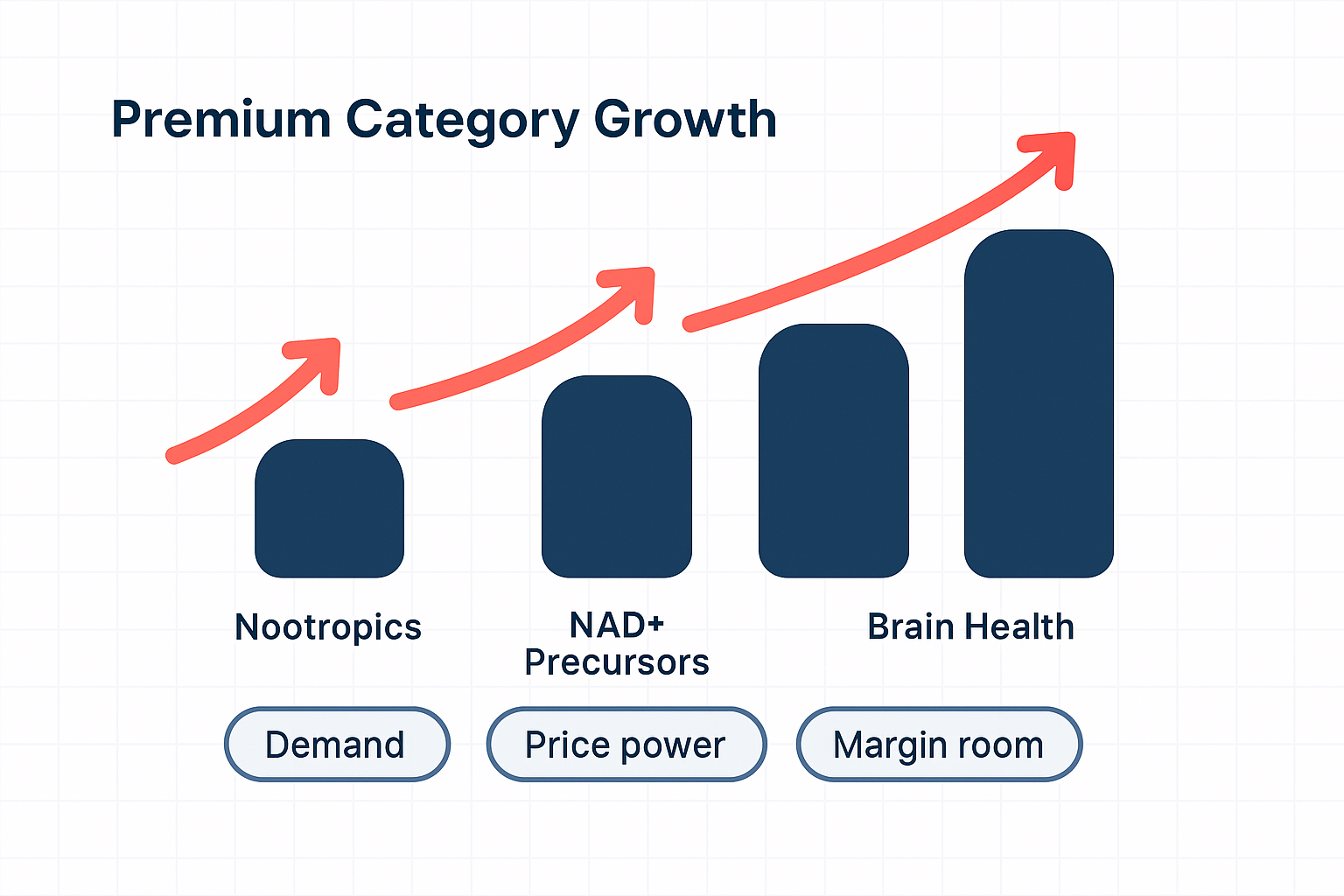
Premium categories change the math for small brands. A nootropic or NAD+ product can carry a price point that commodity supplements never will, so you don’t need a million units to build real profit. The market data backs that up.
Dated market data: nootropics and NAD+
| Category | Base value and date | Projection | Growth rate | Source |
|---|---|---|---|---|
| Nootropics global | USD 5.22B in 2025 | USD 13.29B by 2033 | 12.7% CAGR | Grand View Research, Mar 2026 |
| U.S. nootropics | USD 2.81B in 2024 | USD 4.68B by 2030 | 9.0% growth | Grand View Research |
| NAD+ products | USD 3.45B in 2024 | USD 12.19B by 2033 | 15.1% CAGR | Grand View Research, Oct 2025 |
| NAD precursor supplements | USD 876.2M in 2025, NMN at about 45% of the category | – | – | Future Market Insights, Aug 2025 |
Double-digit growth plus premium pricing equals low-volume viability. When a category grows at 12-15% a year, buyers are already trained to pay more, and a new brand enters on rising demand instead of fighting for scraps in a flat market.
Higher price points are the norm in these categories. A small brand can clear strong absolute profit on a few hundred orders a month without chasing commodity volume or anchoring to the cheapest bottle on the shelf.
NAD+ is the clearest example. The category was worth USD 3.45B in 2024 and is projected to reach USD 12.19B by 2033, a 15.1% CAGR (Grand View Research, Oct 2025). That runway is exactly why NAD+ unit economics favor premium positioning over volume.
Nootropics follow the same pattern. The global market is projected to grow from USD 5.22B in 2025 to USD 13.29B by 2033 at a 12.7% CAGR (Grand View Research, Mar 2026). For a low-volume brand, that growth gives you the cover to price high-margin nootropic supplements on value, not on matching the lowest price in the category.
What Makes a Supplement Premium Enough to Justify the Price
A premium price needs premium proof. Customers paying 3x the shelf price aren’t buying ingredients. They’re buying evidence that the product works as labeled.
Five pillars do that heavy lifting. Each one adds a layer of trust a commodity label can’t match.
1. Meaningful Ingredient Dose and Delivery Form
Premium formulas list active ingredients at clinically studied doses, not trace amounts buried at the bottom of a blend. Delivery form matters too. A fat-soluble compound in a poorly absorbed form costs less to make and delivers less value. The dose and the form are the first proof point a customer can verify on the label.
2. US GMP Manufacturing
GMP-certified US production means every batch follows documented procedures for purity, potency, and sanitation. It’s a baseline in name only. Many commodity white-label operations run overseas with looser oversight. A US GMP facility is a feature a brand can print on its label and stand behind.
3. Third-Party Testing With a COA on Every Batch
A certificate of analysis is the receipt for quality. It shows exactly what’s in the batch, what isn’t, and at what potency. Most private-label brands test once, maybe. Fewer still share the report. Rocktomic quality and COA backs every batch with a certificate your customers can verify before they buy. That transparency is the whole premium argument.
4. Clinical-Grade Labeling and Packaging
Premium products look like they came from a lab, not a garage. Clean typography, full disclosure of every ingredient, and packaging that protects stability. The label is a legal document and a sales asset.
5. Brand Trust and Transparency
Trust compounds. Every COA, every facility detail, every honest answer builds a brand customers return to. Commodity white-label products hide behind generic labels. Premium brands put their proof on display.
That’s the difference: proof layers versus vague promises. Build the proof, and the price justifies itself.
The money math: real margins on premium SKUs
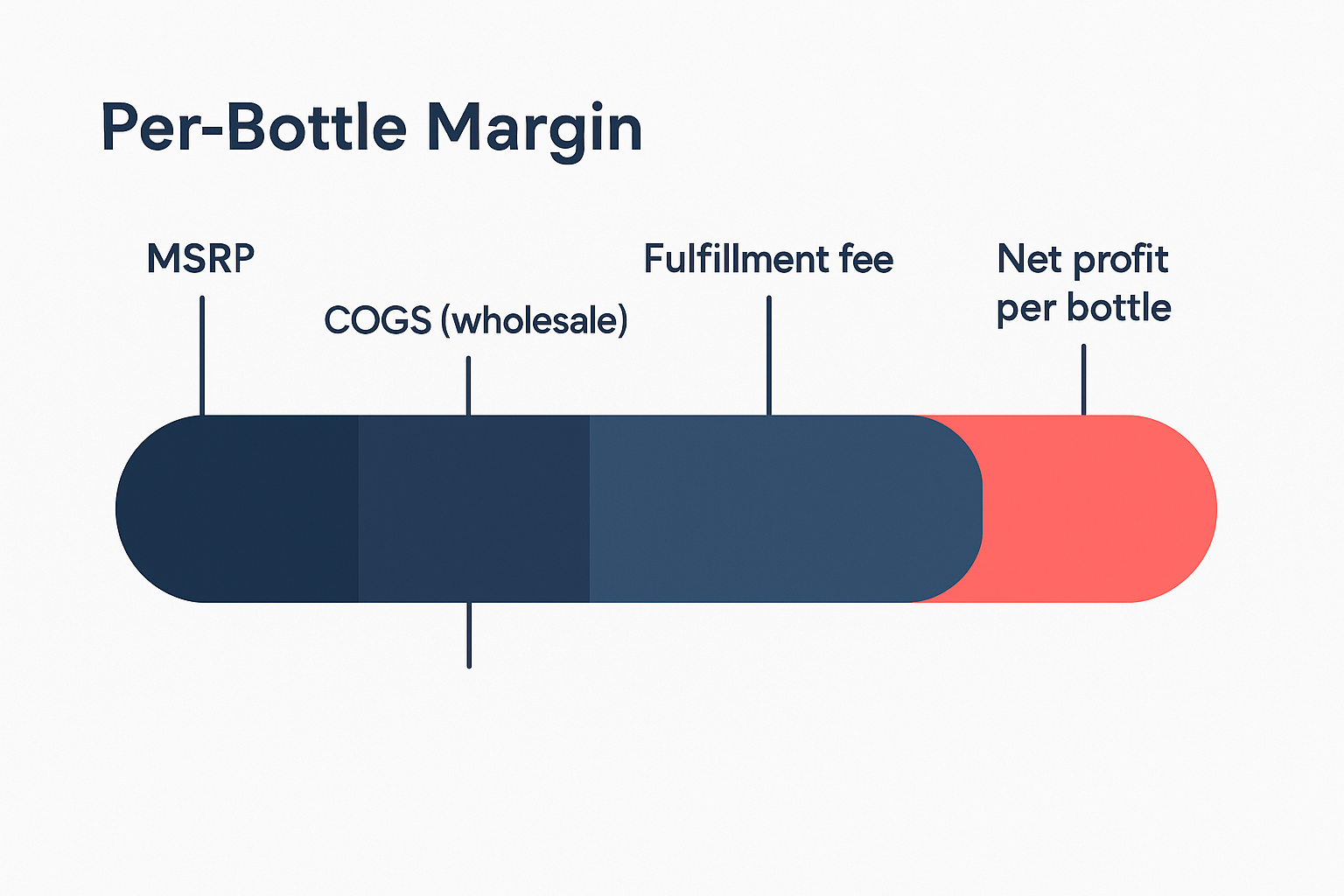
Here is the canonical example from the premium catalog. ROC840 Ultra NAD+ Support Formula retails at $59.97 MSRP. Scale wholesale runs $9.16. That produces a $50.81 list margin, or 84.7%, before fulfillment. Fulfillment is a flat $2 per item. Subtract it and the net lands at $48.81, an 81.4% net margin on one bottle.
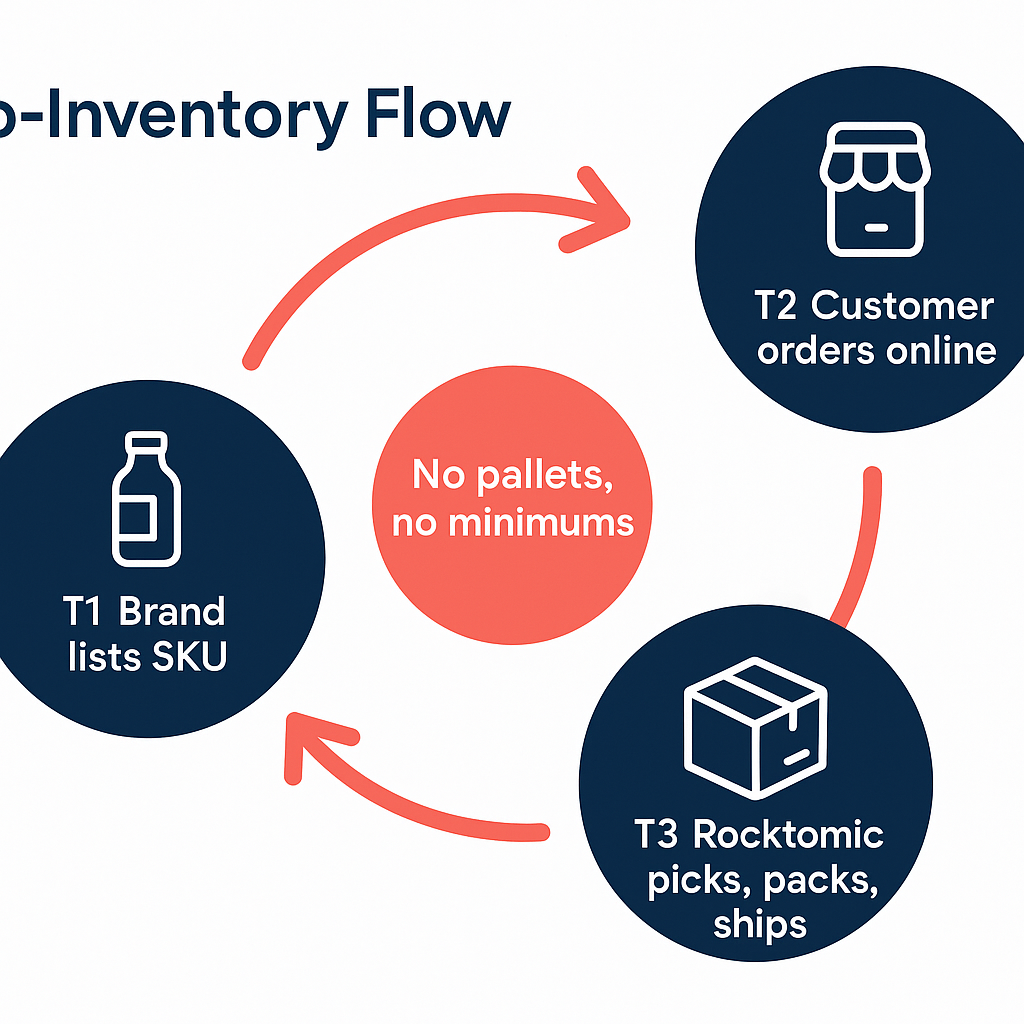
No inventory was purchased up front to make that margin work. No pallet minimum, no warehouse slot, no bulk order sitting in a garage. The bottle is manufactured, labeled, and shipped only after a customer pays. That is the on-demand model: you pay only when an order ships, never before.
Three SKUs show the full premium range. The NAD+ formula above posts the highest margin percentage at 84.7%. ROC841 Ultra-Premium NMN Infinity+ carries the highest MSRP at $79.99 and the deepest dollar margin at $55.19. ROC812 Neuro Plus Brain and Focus is the entry price point at $29.97, still netting $22.50 after the flat $2 fee.
| Product | MSRP | Scale wholesale | List margin | List margin % | Net after $2 fulfillment |
|---|---|---|---|---|---|
| ROC840 Ultra NAD+ Support Formula | $59.97 | $9.16 | $50.81 | 84.7% | $48.81 net |
| ROC841 Ultra-Premium NMN Infinity+ | $79.99 | $24.80 | $55.19 | 69% | $53.19 net |
| ROC812 Neuro Plus Brain and Focus | $29.97 | $5.47 | $24.50 | 81.7% | $22.50 net |
Three inputs drive every row. COGS equals the wholesale price. Fulfillment equals the flat $2 per item. MSRP is the member’s retail choice, set by the brand owner, not by Rocktomic. The $2 covers pick, pack, and label, with no percentage-based fees stacked on top. No surprise line items sit between list margin and net. The flat $2 fee is the only deduction.
That flat fee is the hinge of the whole model. It stays at $2 whether the bottle retails for $29.97 or $79.99. So premium SKUs earn their keep at low volume: each sale carries a large net margin, and you keep the customer relationship and the pricing power. Every batch also ships with a Certificate of Analysis, which is part of why the MSRP holds up in the market.
The wholesale rates above are Scale plan rates. Run your own products through the supplement margin calculator, then check Scale plan pricing to see wholesale pricing across the catalog.
How to price a premium supplement: a 4-step framework
Premium pricing is not a number you guess. It is a bracket, a floor, a story, and a ladder. Run the four steps in order and the price stops being a gamble. Each step has a job: the bracket places you in the market, the floor protects your margin, the story justifies the number, and the ladder makes the buyer spend more per order.
Step 1: Set the market bracket at the premium tier
Start at the top of the market, not the middle. Your catalog anchors do the work for you. ROC840 sits at $59.97 MSRP. ROC841 sits at $79.99. Together they define the premium bracket for NAD+ and nootropic positions.
Price inside that band. Undercutting it tells the buyer your formula is the discount version. Anchoring at the premium tier signals that the formulation, the third-party testing, and the manufacturing belong in that league. You are not setting a price. You are claiming a position.
Step 2: Confirm the cost floor keeps gross margin above 80%
Use ROC840 as the reference: $9.16 COGS against a $59.97 MSRP. The full margin table lives in Part 4, so we will not rerun the math here. The rule is what matters: if a price does not clear an 80% gross margin, it is not a premium price, it is a hobby.
Remember that COGS includes the formula, the packaging, and the per-item fulfillment fee. If those costs eat the margin, you have two levers: adjust the formula or raise the price. The floor is the line you never cross.
Step 3: Build the value story with proof, not discounts
Premium buyers do not respond to markdowns. They respond to evidence. Publish the Certificate of Analysis for every batch. Print the exact dose per serving on the label. Point to the GMP-certified US facility behind the brand. Put the COA on the product page or behind a QR code on the bottle.
Dose transparency matters most with premium ingredients. A buyer comparing two NAD+ products will choose the one that states its dose plainly and backs it with batch-level testing. Discounts train customers to wait for a sale. Proof trains them to buy at full price. That difference is the core of the premium pricing playbook.
Step 4: Test a three-SKU good-better-best ladder
One SKU forces a yes-or-no decision. Three SKUs create a comparison. Build a ladder: a starter capsule at the low end, the hero product in the middle, and a higher-dose or bundled version at the top.
The middle SKU becomes the default buy. The top SKU lifts average order value without a single discount. Because the fulfillment fee stays flat per item, most of that extra revenue drops straight to your bottom line. The full method for setting the price gaps between rungs is in the supplement pricing strategy guide.
Anchor, floor, story, ladder. When the bracket matches the category and the cost floor holds, premium pricing stops feeling like a risk and starts behaving like a margin machine.
Why Low Volume Works: Zero-Inventory Unit Economics
Most supplement manufacturers force you to buy pallets before you sell a single bottle. That model needs warehouse space, credit, and luck that stock moves before expiry. Low volume flips that equation.
Rocktomic’s dropship model runs on zero inventory. There is no minimum order. You pay only when an order ships. The flat fee is around $2 per item for pick, pack, and label. The full flow is on the how Rocktomic works page.
In practice: launch a 10-product line with nothing on a shelf. A customer orders on your store. Rocktomic manufactures, labels, and ships it under your brand. You never touched the product, never prepaid for it, and you keep the margin.
Zero inventory changes what you can test. Launch a formula with no commitment. If it doesn’t move, drop it and lose nothing but effort. If it takes off, scale it on the same terms.
A flat fee instead of a stack of fees
Manufacturers that force pallet buys tie up thousands before the first sale. Platforms that stack per-order fees nibble margin on every transaction. A flat $2 per item fee stays constant while revenue scales, whether you ship 10 bottles a month or 1,000.
Scale at $297/month
The Scale plan at $297/month is where low volume gets its best economics. Members get the lowest per-unit wholesale pricing across the full catalog, including Scale Exclusives. Lower wholesale cost means wider margin per bottle, and with zero inventory, that margin isn’t financing shelf space. It goes to your bottom line.
Low volume isn’t a handicap. It filters out operators who can’t handle inventory risk. The ones who stay know that profit per unit, not volume per pallet, builds a brand that survives.
Hidden Costs That Quietly Shrink Premium Margins
COGS is only the starting line. The margin that survives is the one left after every fee, refund, and promo code is counted. Most premium brands underprice because they never track the variable costs that sit below the product price.
The Fee Stack Eats Gross Profit First
Every order carries a fee stack. Payment processing, marketplace commissions, platform checkout fees. A small percentage per order does not sound like much until the volume is low and the price is high.
Then there is acquisition cost. Before you spend on ads, you need the return on ad spend where your contribution margin hits zero. Skip that math and profitable-looking ads are actually funding customer acquisition with your own margin.
Discounts and promos work the same way. A discount code is not a marketing expense; it subtracts from net revenue. On low volume, a few discounted orders can erase the profit from several full-price orders. Returns and chargebacks stack on top: you refund the order, eat the shipping, and the platform keeps the transaction fee. One return on a premium P&L can wipe out the contribution from multiple sales.
None of these costs appear on the wholesale invoice. That is why a product can look profitable on paper and lose money after thirty days of actual orders.
The COGS Trap
The most common confusion is mixing wholesale cost with total cost per order. Wholesale is what you pay per unit. The real cost per shipped order includes fulfillment, platform fees, ad spend, refunds, and anything given away in a promo.
Fulfillment structure changes that math. Rocktomic’s on-demand fulfillment charges a flat fee of about $2 per item for pick, pack, and label, so the cost stays predictable whether you ship one order or fifty. The ROC840 money-math from the earlier section remains the reference point for per-unit contribution; this breakdown covers what hits after that line. The fee stack and the COGS trap compound fast when both go untracked.
Pricing Mistakes That Kill Premium Brands
Premium prices protect premium margins. Undercut the category and you solve a demand problem by creating a margin problem. The price you set is the biggest assumption in your P&L, and no volume fixes a wrong price.
Where Premium Pricing Breaks
Five mistakes repeat across low-volume supplement brands:
- Underpricing against the category bracket. A NAD+ or nootropic product belongs in a price bracket where buyers expect to pay a premium per bottle. Price far below that bracket and you signal a weaker formula while surrendering the margin you need.
- Competing on price. Your cost base is flat because inventory is on demand. There is no pallet-buy advantage to pass along. Competing on price drags you into a race with manufacturers that force bulk minimums, and the only way to win that race is to crush your own margins.
- Using discounts as the growth lever. Discounts train buyers to wait for the next sale. A premium brand holds price and uses proof, scarcity, and authority instead of markdowns.
- Skipping proof layers like the COA. A Certificate of Analysis on every batch is what justifies the premium price. It also keeps marketplaces satisfied while cheaper, less documented competitors get flagged.
- Claim-based marketing. One disease claim can get a listing delisted and trigger FTC scrutiny. The cost is compliance work plus the margin on every unit sitting in that listing.
Get the cost structure below the price right, and the premium price becomes defensible. Confuse wholesale with total cost, discount your way to volume, or skip the proof layer, and the margin disappears before the order lands.
Premium supplement pricing FAQ.
What makes a supplement premium enough to support a high price?
Premium is a bundle of proof and positioning: meaningful ingredient doses, a delivery form that justifies cost, US GMP manufacturing, third-party testing with a Certificate of Analysis on every batch, and clean label design. Buyers at high price points pay for confidence as much as ingredients. Brands that show a COA and batch-level transparency convert skeptical, high-intent buyers without discounting. Rocktomic produces 140+ US-manufactured, GMP-certified, third-party-tested products, so the proof layer is part of the product, not an add-on.
What do premium NAD+ and nootropic supplements typically sell for?
Premium tiers in the longevity and cognitive categories carry MSRPs well above commodity vitamins. In the Rocktomic catalog, premium SKUs are positioned at $29.97 to $79.99 retail, including Ultra NAD+ Support Formula (ROC840) at $59.97 and Ultra-Premium NMN Infinity+ (ROC841) at $79.99. Demand supports the bracket: NAD+ products were a $3.45 billion market in 2024 and are projected to reach $12.19 billion by 2033 (Grand View Research, Oct 2025). Higher price points are the norm, not the exception.
How much margin can a brand keep on a premium supplement?
Using the canonical example, Ultra NAD+ Support Formula (ROC840) retails at $59.97 with a Scale wholesale cost of $9.16, leaving a list margin of $50.81, or 84.7%. After the flat $2/item fulfillment fee, net per bottle is $48.81, a net margin of about 81.4%. Ten bottles a day is roughly $488 in contribution before marketing and platform fees. The margin structure is built to profit at low volume.
What is the best pricing strategy for high-ticket supplements?
Value-based pricing: set the MSRP from perceived value and the market bracket, then confirm the cost floor keeps gross margin above 70%. Use anchoring by showing a higher-value bundle first, price at a $X.97 or $X.99 figure for price psychology (for example $59.97), and avoid discounting as the growth lever. Premium buyers respond to evidence: dose transparency, a COA, and batch testing. A clean three-SKU ladder gives buyers an upgrade path without commodity comparisons.
Do premium supplements require high order volumes to be profitable?
No. Premium pricing converts low volume into strong absolute profit because margin per unit is high. A $48.81 net per bottle at the $59.97 price point means a brand needs far fewer orders than a commodity SKU to hit the same contribution. Rocktomic dropship has no minimum order, so a brand can sell 5 units or 500 with the same per-unit economics. Low volume is a feature of the premium model, not a limit.
What does it cost to sell premium supplements through Rocktomic?
A member can start on the Free plan at $0/month and pay only the flat $2/item fulfillment fee when an order ships. The Scale plan at $297/month adds the lowest per-unit wholesale pricing, the full 140+ product catalog, and unlimited sales channels. Using ROC840 as the example, a Scale member buys at $9.16 wholesale and nets $48.81 per bottle at the $59.97 MSRP after the $2 fee. No pallet buys and no upfront inventory are required on either plan.
How much do fulfillment fees affect premium supplement margins?
The flat fulfillment fee is about $2 per item, which is roughly 3.3% of a $59.97 MSRP. On ROC840, that leaves $48.81 net versus a $50.81 list margin, so the fee costs about 3.4 percentage points of margin. Compare that with platforms that stack per-order fees on top of product cost. Keeping fulfillment flat and per item protects premium margins at any order count.
Which Rocktomic plan fits a low-volume premium brand best?
Scale at $297/month is the primary choice for a premium line because it unlocks the lowest per-unit wholesale cost, which is exactly where premium margins are built. The Free plan at $0/month works to test demand with up to 10 products and one sales channel. For a brand positioning NAD+ or nootropics at $60-plus retail, the wholesale difference on each bottle outweighs the monthly fee once volume is consistent.
Build Your Premium Supplement Brand
The margin math in this article ends at one place: ownership. A premium price point only works when the brand behind it is yours. The label, the customer list, the reorder relationship. All of it. That is the business you build with Rocktomic.
You own the brand and the customer relationship. Rocktomic manufactures, warehouses, labels, and drop-ships on demand. There is no inventory to buy and no upfront purchasing. A customer places an order and Rocktomic fulfills it under your label while the margin lands in your account.
Entry costs $0 per month. That number matters, because most premium supplement lines die before launch. They die when a manufacturer demands a pallet buy, or a platform charges per-order fees, or the warehouse lease eats the first year of profit. None of that applies here.
The Free plan covers up to 10 white-label products with one sales-channel integration. You pay a flat fulfillment fee of about $2 per item when an order ships. That is the whole cost structure at entry. The Scale plan, at $297 per month, is where the economics get serious: full catalog access, unlimited sales channels, lowest per-unit wholesale pricing, and priority fulfillment.
Start on the Free plan to test demand for a premium SKU. Move to Scale when order volume justifies the $297 monthly investment. That sequence keeps your cash flowing to margin, not overhead.
Your quality story carries the premium price
Premium SKUs like NAD+ and nootropic stacks sell on trust. Every Rocktomic product is manufactured in a US GMP-certified facility and third-party tested, and every batch ships with a Certificate of Analysis. When you charge a premium price, that documentation is part of the product. Clinics verify it before they stock it. Repeat buyers expect it before they reorder.
Launch fast is part of the model too. Because there is no inventory commitment, you can test a premium formula against your audience in days. If a SKU does not move, you are not stuck with a warehouse full of it. If it takes off, the reorder loop is already in place.
Turn the numbers into a launch
Run any SKU through the supplement margin calculator before you commit to a price. Compare the Free and Scale plans on the pricing page side by side. Then book a call with Rocktomic and map out the line that fits your audience.
Low volume only works when the margin is deliberate. Pick a premium formula, set a price that reflects the quality story, and keep the customer relationship in your brand. The price is yours. The margin is yours. The brand is yours.