
Surviving TikTok’s Strict SLAs: The Drop-Shipper’s Guide to Automated Fulfillment
· 15 min read · By Rocktomic Labs Team
Late shipments get TikTok Shop orders auto-canceled and shops hit with performance enforcement. The fix is automated on-demand fulfillment: orders sync instantly, ship from a US warehouse within the 2-business-day dispatch SLA, and tracking pushes to Seller Center the same day. This guide covers the SLA numbers, the metrics TikTok grades, and the zero-inventory setup that keeps shops compliant.
Part 1: What Is the TikTok Shop Shipping SLA?
It is a deadline measured in business days, not calendar days. The clock starts when an order enters Awaiting Shipment. Regular orders must be picked up and scanned by a carrier within 2 business days, with an 11:59 PM PST cutoff.
Model your monthly revenue, repeat rate, and net profit as your supplement brand scales – using real catalog costs and fees.
Tracking must be added within 5 business days, moving the order to Awaiting Collection, or TikTok auto-cancels it. Standard and economy orders deliver within 6 business days; Express within 3. These windows come from the TikTok Fulfillment Policy (retrieved 2026-06-21).
Why the 2-Day Dispatch SLA Breaks Manual Dropshippers
An order lands at 9:47 PM. You export it from the seller dashboard, clean up the CSV, print the label, pack the box. Then the post office is closed, so it waits until morning. That chain is the whole problem: order lands at night, manual export, label printing, post office run, then a carrier origin scan that never happens until the next day. Each step is fast alone. Added together, they chew into the dispatch window before the package leaves your hands.
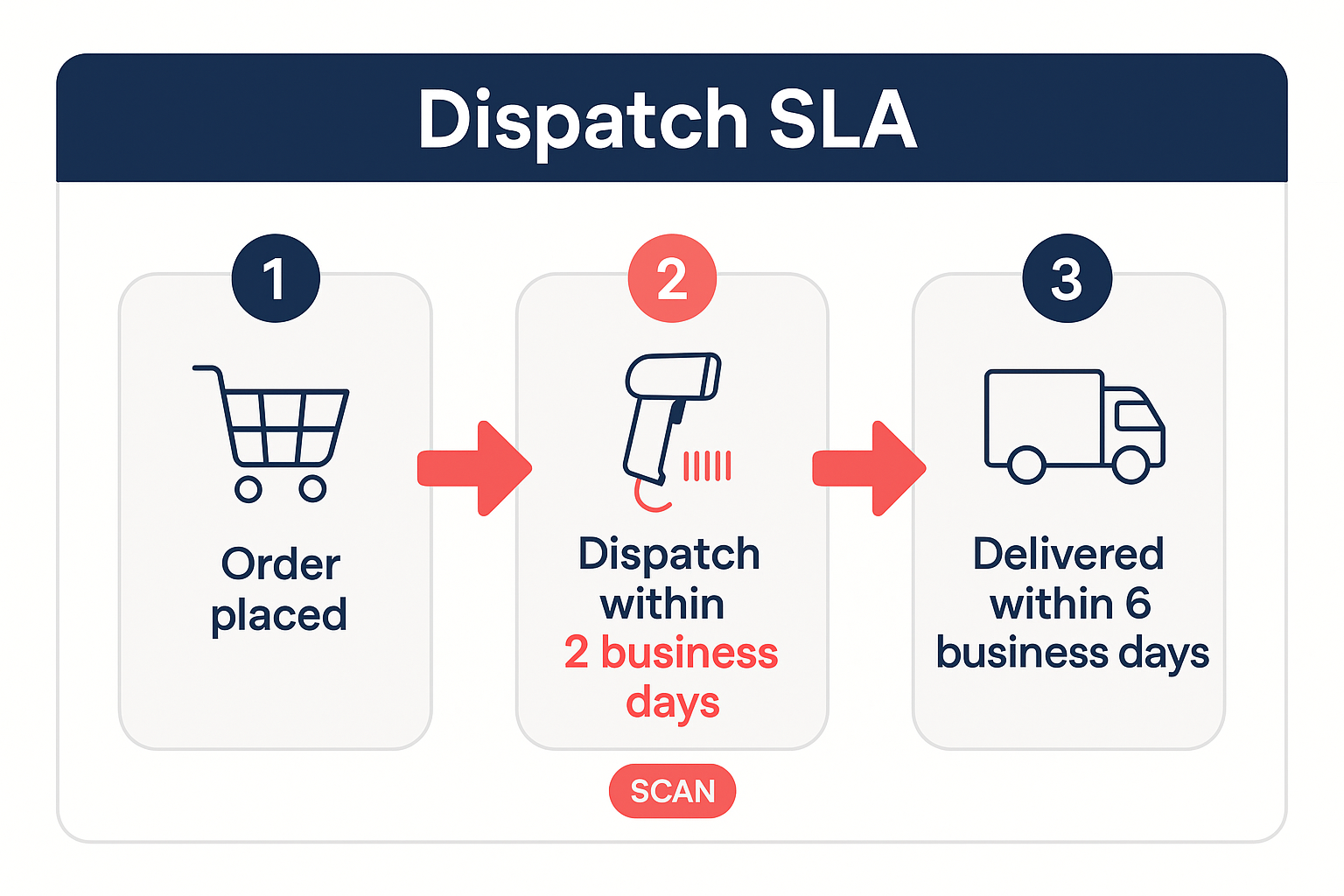
Per TikTok’s Best Practices for Order Fulfillment (retrieved June 21, 2026), an order is late if the carrier hasn’t scanned it within the dispatch SLA, and carrier delays count against the seller. The scan is what counts, not the label you printed at 11 PM. Business-day math makes it worse: a Friday night order doesn’t get a weekend extension that helps you; it just compresses Monday into a race.
Made-to-order and backorder items don’t save you either. They get handling time plus one business day. That’s it. Production time is not a safety valve, so “we make it fresh” becomes an SLA miss, not a selling point.
Now add the viral spike. One video, hundreds of orders, one person packing. Manual dropshipping breaks exactly at the moment it needs to scale. The failure chain compounds: every batch delay pushes the origin scan later, and every late scan erodes your shop’s standing. Hustling harder is not a fix. There are only so many hours between pickup windows.
Contrast that with automated on-demand fulfillment. A manual model needs one person to print, pack, and drop off every box, every day, on schedule. Miss one pickup and every order in that batch loses a day. An automated partner routes each order to a US GMP facility the second it lands, and that facility ships daily, so the dispatch scan happens without a human in the loop. That’s the difference between a one-person bottleneck and a system that never sleeps. For more on how fast a real fulfillment partner can move, see supplement dropshipping fulfillment speeds.
The 4 Fulfillment Metrics TikTok Actually Grades
TikTok does not grade your shop on vibes. It grades you on four fulfillment metrics, and every one of them is tied to a hard number or a carrier scan. Miss them and your Shop Performance Score (SPS) takes the hit.
Here is what TikTok actually measures, what each metric means, and the targets you are aiming at.
| Metric | What it measures | Target |
|---|---|---|
| LDR | Share of dispatched orders not carrier-scanned within the dispatch SLA | At or below 4 percent recommended; enforcement above 10 percent per Late Dispatch Rate Requirements (retrieved 2026-06-21) |
| OTDR | On-time deliveries divided by orders due | 95 percent on-time delivery required for Express, effective March 14, 2025, per Seller Shipping overview |
| SFCR | Seller-fault cancellations from stockouts and late shipping | No fixed target stated in plan |
| VTR | Valid tracking rate; invalid or missing tracking triggers losses and penalties per Customer Order Shipping Requirements | No fixed target stated in plan |
LDR is the one that kills zero-inventory sellers first. You dispatch an order, but if the carrier does not scan it inside the dispatch SLA, that order counts against you. Late Dispatch Rate Requirements call for at or below 4 percent. Enforcement starts above 10 percent, and that gap is where automated fulfillment earns its keep: the faster a carrier scan happens, the safer your LDR sits.
OTDR is simpler. On-time deliveries divided by orders due. Express orders need 95 percent on-time delivery, effective March 14, 2025. That is a razor-thin miss budget, so every handoff has to work the first time.
SFCR catches seller-fault cancellations: stockouts, late shipping, anything you caused. VTR is your valid tracking rate. Invalid or missing tracking triggers losses and penalties per the Customer Order Shipping Requirements. Neither has a fixed public target, but both feed the same score.
How the four metrics roll into the Shop Performance Score
Every metric feeds the Shop Performance Score, a 0 to 5 rating TikTok uses to decide how much visibility your shop gets, how fast you get paid, and whether you can access affiliate marketing and campaigns. Affiliate traffic is where most creator brands build real margin, so a low SPS hits your highest-value channel first.
That score is the real product here. A strong SPS means more traffic and faster settlements. A weak one means your storefront quietly disappears from the feed. For a zero-inventory brand, these four numbers are the whole game.
What Happens When You Miss an SLA
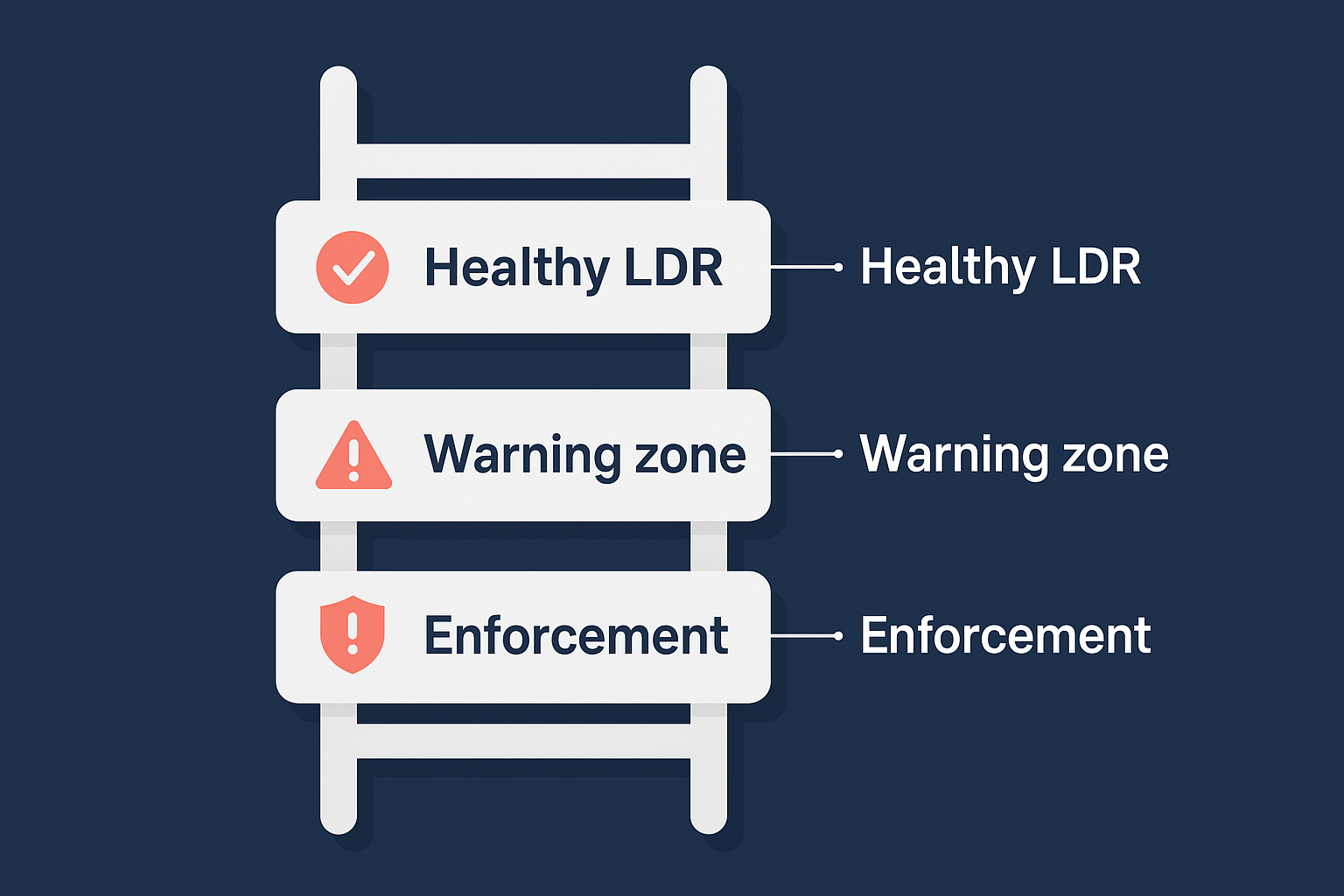
One late shipment is a data point. A second is a pattern. TikTok Shop’s enforcement system is automated, so it escalates whether or not you have a customer-service excuse ready. There is no grace period where the platform waits to see if you improve; the ladder below runs on your numbers, not your intentions. Here is what every seller faces once the SLAs slip.
| Stage | Consequence |
|---|---|
| Auto-cancellation | Order canceled and refunded if not Awaiting Collection within 5 business days |
| Score damage | LDR and SFCR drag down SPS |
| Enforcement | LDR above 10 percent triggers enforcement actions |
| Visibility | Reduced search and recommendation exposure |
| Platform benefits | Campaign, user-growth, and affiliate program suspension |
| Severe | Seller Shipping limitations from 90 up to 365 days, per the Seller Enforcement Policy (retrieved 2026-06-21) |
Read that ladder like a margin statement, because every rung costs you gross merchandise value. Each stage makes the next one cheaper to trigger. The LDR and SFCR numbers from earlier in this guide are not dashboard decoration; they are the inputs that push you down. Visibility drops, orders slow, and the metrics keep sliding. That is the compounding loop that turns one miss into a suspended shop.
The compounding is the real business cost. Reduced visibility means fewer orders, and fewer orders make your fulfillment metrics harder to recover. Enforcement limits shipping, which kills sales velocity. A shop suspended for 365 days is not a setback; it is a dead brand. The content engine that fed it dies with it, and the audience you built moves on to the next seller.
Zero-inventory dropshipping removes the inventory risk from that equation, but it moves the risk to fulfillment speed. Your brand lives or dies on whether a partner ships on TikTok Shop’s clock, not its own. Before you pick one, know exactly where the money leaks in the hidden fulfillment costs on TikTok Shop.
How Automated On-Demand Fulfillment Meets the SLA
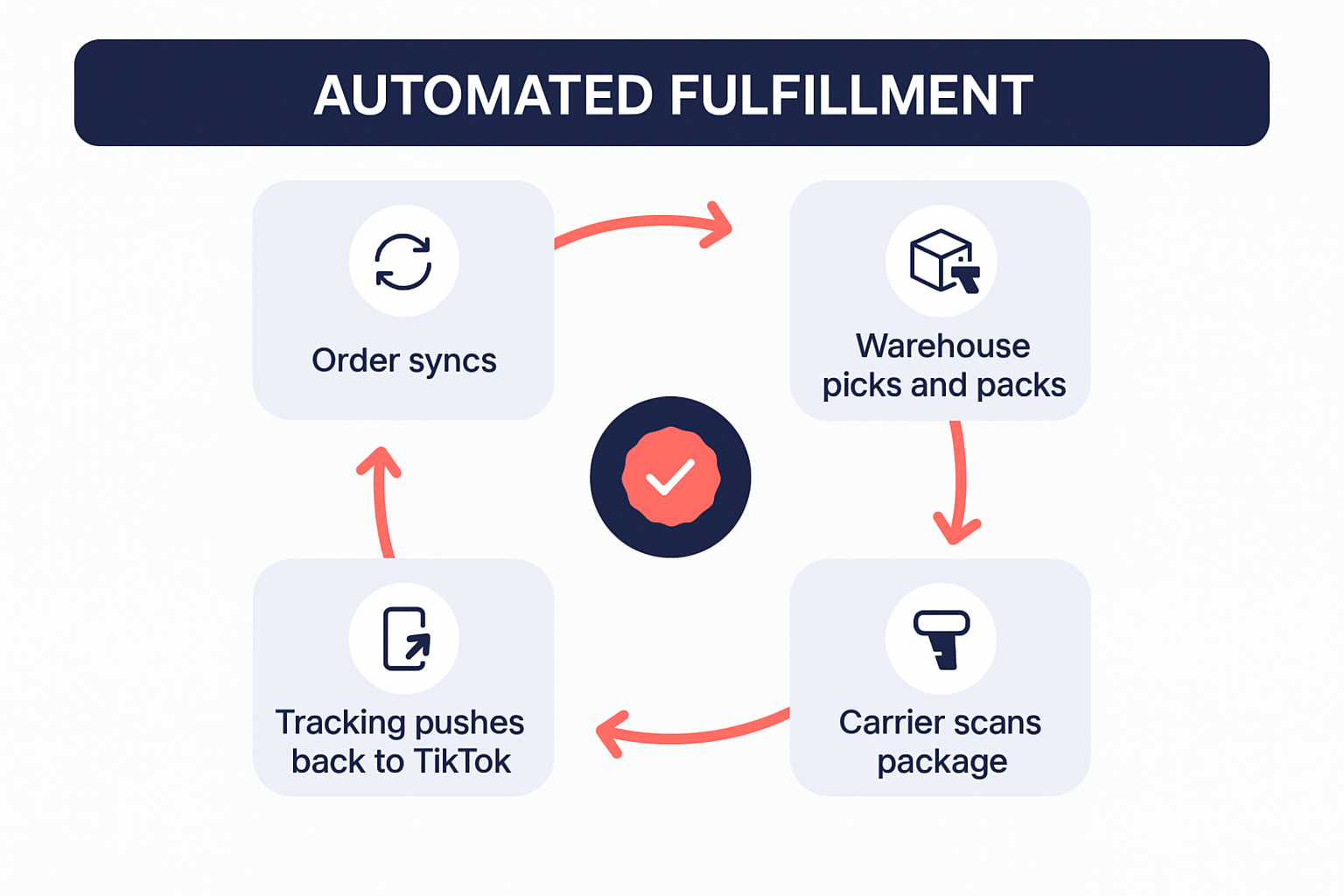
TikTok Shop’s SLA is a hard deadline, and the gap between order and tracking scan decides whether you get paid or penalized. Automated on-demand fulfillment compresses that gap to hours, not days. Here’s the exact flow, step by step.
- The order lands in your store.
- The integration pushes it to the warehouse in real time. No export, no manual re-key.
- The warehouse picks, packs, and labels the product under your brand.
- The carrier scans the package, and the order flips to In Transit.
- The tracking number syncs back to Seller Center the same business day.
The whole cycle runs without you touching a box. Your job is the content that drives the sale; the system handles the rest.
Why this clears the clock
Same-business-day dispatch puts packages in the carrier’s hands before TikTok’s window expires. The carrier scan validates the tracking number, which is the proof point TikTok’s system checks. There’s no batch window to wait through and no post office run to make. That matters because the SLA isn’t graded on effort; it’s graded on a scan. Automated on-demand fulfillment turns that scan into a routine event, not a Friday scramble. One order ships as fast as a hundred, and every package leaves with tracking TikTok accepts.
The Rocktomic specifics that matter on TikTok
Rocktomic’s catalog runs 140+ US-manufactured, GMP-certified products, and every batch ships with a Certificate of Analysis (COA). That COA doubles as the documentation TikTok’s supplement approval process asks for, and it travels through the same Shopify to TikTok Shop sync that moves your orders. Compliance and fulfillment live in one system instead of two, so nothing gets lost between a document folder and a warehouse dock. Every order that leaves the building is on record, labeled, and traceable to its COA. See how the full process fits together on how Rocktomic works.
What you’re replacing
Manufacturers that force pallet buys put your money in inventory before a single order exists, and the SLA clock starts the moment a customer checks out, not when your stock finally moves. You’re also the one doing the order entry, label printing, and drop-off run. Platforms that charge per-order fees stack a new cost on every shipment, which eats margin exactly where TikTok’s economics are thinnest. Rocktomic’s fulfillment runs on a flat fee of about $2 per item for pick, pack, and label. That’s the difference between a model built for volume minimums and one built for the speed TikTok demands.
The Cost of Compliant Fulfillment: Fee Transparency
Fulfillment fees hide in plain sight. A platform shows you a healthy margin at checkout, then the pick, pack, and label charge takes a bite out of it. That is why the fee structure has to be visible before you list a product. When every order ships automatically, per-unit costs decide whether the channel stays profitable.
Rocktomic runs two membership plans. Both use the same flat fulfillment fee of about $2 per item, charged only when an order ships. No pallet buys. No monthly minimum on the entry plan.
| Plan | Monthly | Per item | What you get |
|---|---|---|---|
| Free plan | $0 per month | about $2 per item charged only when an order ships | 1 sales channel; up to 10 white-label products; on-demand dropship |
| Scale plan | $297 per month | about $2 per item on ship | Unlimited channels; full 140+ catalog; lowest per-unit wholesale |
The Scale plan earns its $297 per month through wholesale pricing. Here is the canonical worked example for one SKU. The numbers hold whether you sell one unit or a thousand, so you can model them in a spreadsheet before you commit.
| SKU | MSRP | Scale wholesale | Published margin | Net after the flat $2 per item fulfillment fee |
|---|---|---|---|---|
| Super Creatine Gummies 1000mg (ROC943) | $29.97 | $8.45 | $21.52 (71.8 percent) | $19.52 per unit (65.1 percent of MSRP) |
Sell at the $29.97 MSRP and the published margin is $21.52, or 71.8 percent. Subtract the flat $2 per item fulfillment fee and the net lands at $19.52 per unit, 65.1 percent of MSRP. That $2 is the difference between the two numbers, and it stays constant at any volume.
The math above stops at the fulfillment fee on purpose. TikTok referral fees, payment processing, and buyer shipping all sit on top, and each one varies by region, category, and promotion. Model them before you set a price. The supplement margin calculator handles the math, and the Rocktomic membership pricing page shows the full breakdown. For the deeper fee analysis, read TikTok Shop unit economics.
5-Step Setup Checklist for SLA-Safe Dropshipping
Set this up once and TikTok’s shipping SLAs stop being a daily panic. Each step takes minutes, and together they close the gap between “order placed” and “order delivered.”
- Get the approval documents ready. TikTok Shop requires proof your supplements are legitimate before they show up in search. Pull the COA, label, and GMP certificate for every product you list. Rocktomic publishes each batch’s documents in the quality and COA hub, so you are not chasing a manufacturer every time TikTok asks.
- Connect the store to an automated fulfillment partner. Manual order entry is where late shipments are born. Connect your store to a partner that picks, packs, and labels the moment an order lands. Rocktomic’s store integrations push orders straight from TikTok Shop into fulfillment, with no copy-paste and no human lag.
- Set handling time and shipping templates in Seller Center. If your template promises a delivery window your fulfillment cannot hit, you are scripting your own SLA violation. Match the promised window to real dispatch speed, then add a buffer for carrier delays.
- Check the Fulfillment Performance page daily. Watch LDR, OTDR, SFCR, and VTR the same way you watch revenue. One bad day is recoverable. A trend is how shops get banned.
- Plan for viral spikes before they happen. One video can push hundreds of orders in an hour. On-demand fulfillment absorbs the spike without manual order caps that throttle sales mid-surge.
Setup only pays off if the margins hold. Check what a supplement brand can actually keep per order in the TikTok Shop supplement profitability breakdown before you scale.
TikTok Shop Shipping SLA FAQ
What is the TikTok Shop dispatch SLA?
TikTok Shop’s dispatch SLA requires regular orders to be picked up and scanned by a carrier within 2 business days of entering Awaiting Shipment, with a cutoff of 11:59 PM PST. Orders must show Delivered within 6 business days for standard and economy shipping, or within 3 for Express. Orders that do not reach Awaiting Collection, meaning tracking was added in Seller Center, within 5 business days are auto-canceled. Per the TikTok Shop Fulfillment Policy, retrieved June 2026, the clock starts when payment is confirmed.
What happens if you miss the TikTok Shop shipping SLA?
Missed SLAs raise the Late Dispatch Rate (LDR) and hurt On-Time Delivery Rate (OTDR) readings. TikTok recommends keeping LDR at or below 4 percent; enforcement can apply once LDR passes 10 percent. Consequences include reduced visibility, suspension from campaigns and affiliate programs, and Seller Shipping limitations lasting 90 to 365 days, per the Seller Enforcement Policy. Orders without valid tracking within 5 business days are canceled and refunded; repeated violations escalate to account-level penalties.
Can you dropship on TikTok Shop with zero inventory?
Yes. TikTok Shop grades the order, not the inventory model: on-time dispatch, valid tracking, and return handling matter, per the Fulfillment Policy. A dropshipper can sell without holding stock when orders ship from the declared US origin and meet the same SLAs. The risk is that supplier delays and manual handling push dispatch past the 2-business-day window. Automated fulfillment removes that risk by syncing orders, picking, packing, and pushing tracking back to Seller Center the same day.
How does automated fulfillment keep the Late Dispatch Rate low?
Automated fulfillment compresses the dispatch timeline. When an order lands, the integration sends it to the warehouse, a label is generated, the item is picked and packed, the carrier scans the package, and the tracking number syncs back to Seller Center the same business day. That carrier scan moves the order from Awaiting Shipment to In Transit and clears the dispatch SLA. Manual sellers lose hours to batch exports, label printing, and post office runs; automated systems finish in minutes.
What fulfillment metrics does TikTok Shop grade?
TikTok Shop tracks Late Dispatch Rate (LDR), the share of orders not scanned within the dispatch SLA; On-Time Delivery Rate (OTDR), deliveries completed by the deliver-by date; Seller-Fault Cancellation Rate (SFCR), cancellations caused by stockouts or late shipping; and Valid Tracking Rate (VTR). These feed the Shop Performance Score (SPS), a 0 to 5 rating that controls visibility, settlement speed, and access to affiliate marketing. Seller Center’s Fulfillment Performance page shows them together.
How much does automated on-demand fulfillment cost?
Rocktomic offers two membership plans. The Free plan costs $0 per month, charges a flat fulfillment fee of about $2 per item only when an order ships, and includes 1 sales channel and up to 10 white-label products. The Scale plan costs $297 per month and adds unlimited channels, the full catalog, and lowest per-unit wholesale pricing. No pallet minimums and no upfront inventory purchase mean costs scale with actual sales.
What does the flat $2 per item fulfillment fee mean for margins?
The fee is small relative to wholesale cost. Take Super Creatine Gummies 1000mg (ROC943) as an example: MSRP $29.97, Scale wholesale $8.45, and a published margin of $21.52 (71.8 percent). Subtracting the flat $2 per item fulfillment fee leaves $19.52 per unit before platform fees and ad spend, about 65.1 percent of MSRP. Because the fee is flat, margins hold even when a viral video spikes order volume. Sellers can model their own SKUs in the Rocktomic supplement margin calculator.
Do you need to buy inventory to meet TikTok Shop SLAs?
No. Rocktomic’s dropship model has zero-inventory structure with no minimum order quantity on the Free plan: a seller pays only the flat fulfillment fee when an order ships. That means a seller can list products and meet the 2-business-day dispatch SLA without warehousing a bottle. The Scale plan at $297 per month adds the full catalog and lowest wholesale costs. The manufacturer, warehouse, and labeler handle the physical work while the seller owns the brand and the customer relationship.
Part 9: Run the Numbers Before You Launch
Run the numbers before you launch. The supplement margin calculator shows net per unit after wholesale, the flat $2 item fee, and platform costs. Compare Free $0 or Scale $297, or book a call to map your TikTok Shop launch with a real human.
Last updated: June 21, 2026