
Surviving an FDA Warning Letter: The Creator’s Ultimate Survival Guide
· 17 min read · By Rocktomic Labs Team

Most FDA warning letters are survivable if you respond fast. The single biggest trigger is a disease claim on a label, website, or social caption. The clock starts the day the letter arrives, typically 15 business days. This guide covers the claim patterns that draw enforcement, the response timeline, and a 5-step audit you can run this week.
What Is an FDA Warning Letter for Supplements?
An FDA warning letter is a public notice that a product or its marketing violates federal law. It is not an instant shutdown. The letter lists specific violations and demands a written corrective response, usually within 15 business days, per the FDA warning letters page (retrieved 2026-07-08). Rocktomic treats a warning letter as a fix-it notice, not a death sentence.
Answer three quick questions and get pointed to the supplement niche that fits your audience and your margins.
Brands that document fixes and remove offending claims usually close the matter. Brands that ignore it risk seizure, injunction, and criminal referral.
Which Illegal Disease Claims Trigger FDA Warning Letters?
Disease claims are the single biggest enforcement trigger in the supplement industry. Under 21 CFR 101.93(g), any claim that a product diagnoses, mitigates, treats, cures, or prevents a disease turns that supplement into an unapproved drug in FDA’s eyes. The agency doesn’t need to prove intent. Your label, your landing page, and your social captions are all fair game.
Most warning letters don’t start with a lab result. They start with a screenshot of your marketing. FDA reads the full context of what you publish, and it holds you responsible for every claim attached to your brand.
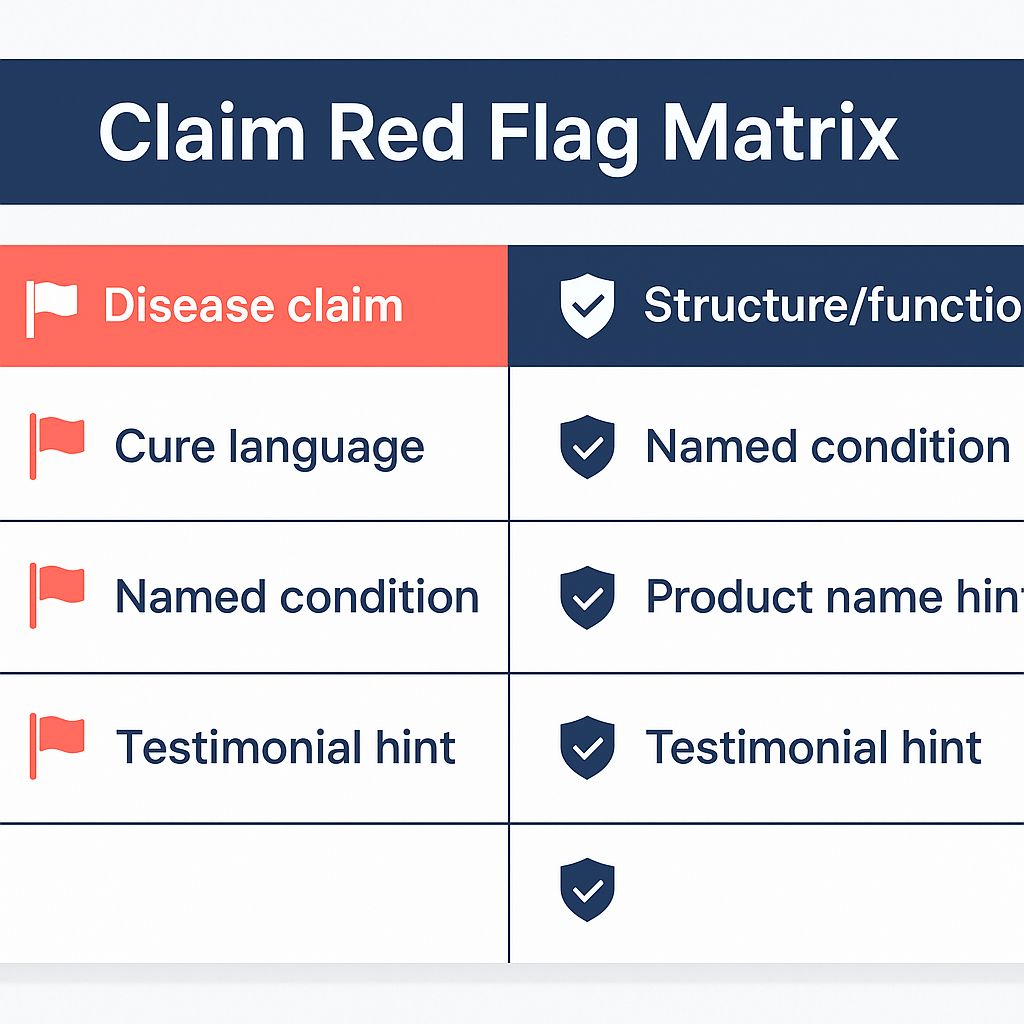
The pattern is consistent enough to map. Here’s the four-row breakdown of what gets flagged and what passes.
| Claim pattern | Why FDA flags it | Compliant alternative |
|---|---|---|
| Direct cure language, e.g., claims about treating or curing a named condition | Such claims make the product an unapproved drug under 21 CFR 101.93(g) | Structure/function wording that describes the nutrient’s role |
| Named disease references, e.g., diabetes, Alzheimer’s, or cancer | Referencing a named disease or its treatment positions the product as a drug under 21 CFR 101.93(g) | Structure/function wording without naming the condition |
| Implied claims via product name, images, or before/after content | FDA reads context, not just captions (21 CFR 101.93(g)) | Neutral product names and imagery with no outcome implication |
| Third-party links and quoted studies that imply treatment | Linked and quoted material counts as claims the marketer must substantiate | Cite studies for background without implying treatment outcomes |
Notice what row three means for your storefront. A product name that references a condition, or a label image showing a blood glucose monitor, can trigger the same review as a caption that says it lowers blood sugar. FDA evaluates the whole impression, not just the fine print.
Row four catches a mistake operators make constantly. You link to a published study with a caption that implies a treatment outcome, and that linked material becomes part of your claim. FDA treats it as marketing you must substantiate, which means you inherit the burden.
Here’s the rule of thumb that keeps your brand clean: if the copy references a disease, its symptoms, or a treatment outcome, it belongs on a drug label, not a supplement. Run every product page, every ad, and every influencer script through that standard before you publish.
The good news: compliant claims are not weak claims. You can still sell on the outcomes your market cares about, as long as the wording stays in structure/function territory. The structure behind supplement claims that actually pass FDA review is learnable, and it starts with this table.
How to Tell a Disease Claim from a Structure/Function Claim
The line is narrower than most creators think. Under 21 CFR 101.93(g), a structure/function claim describes the role of a nutrient or ingredient on the structure or function of the body. A disease claim names a disease, or references a state that leads to dysfunction. One sentence can carry both if you’re not careful.
That distinction decides whether your product clears review or triggers a warning letter. FDA reads every label through this lens, and the agency quotes your exact wording back at you in writing.
Structure/function language talks about how your product supports normal body processes. Disease language talks about fixing something that is broken. Here are three rewrites that show the difference.
1. Muscle recovery, not injury recovery
Disease claim: “Helps you recover from torn muscle tissue.”
Compliant rewrite: “Supports muscle recovery.”
Injury is a disease state under the rule. Recovery from it is treatment language. “Supports muscle recovery” describes the role of an ingredient on normal muscle function.
2. Immune function, not prevention
Disease claim: “Prevents colds and flu.”
Compliant rewrite: “Supports immune function.”
Prevention claims are the fastest single way to earn a warning letter. The moment you name a specific illness, you’ve crossed into disease-claim territory.
3. Healthy blood sugar, not diabetes
Disease claim: “Helps manage diabetes.”
Compliant rewrite: “Supports healthy blood sugar levels.”
Diabetes is a named disease. “Healthy blood sugar levels” points to a normal function without referencing the condition. Same product, same target system, very different legal exposure.
Two compliance mechanics you have to hit
If your label carries a structure/function claim, the DSHEA disclaimer must appear in bold: “This statement has not been evaluated by the Food and Drug Administration. This product is not intended to diagnose, treat, cure, or prevent any disease.” FDA expects it to stay on the label and to be linked to each claim you make. You can’t bury it on an insert or a separate page.
You also have to notify FDA within 30 days of first marketing the product, under 21 CFR 101.93(a). The FDA Structure/Function Claims page (retrieved 2026-07-08) spells out both requirements.
For the full walkthrough on disclaimer placement, launch mechanics, and margin-safe compliance, read the creator’s DSHEA playbook.
What Happens After You Get an FDA Warning Letter
You do not get a quiet email and a private chat. The FDA posts warning letters to its public website the day they issue, and industry trackers republish them within hours. The enforcement clock starts running whether you have opened the envelope or not.
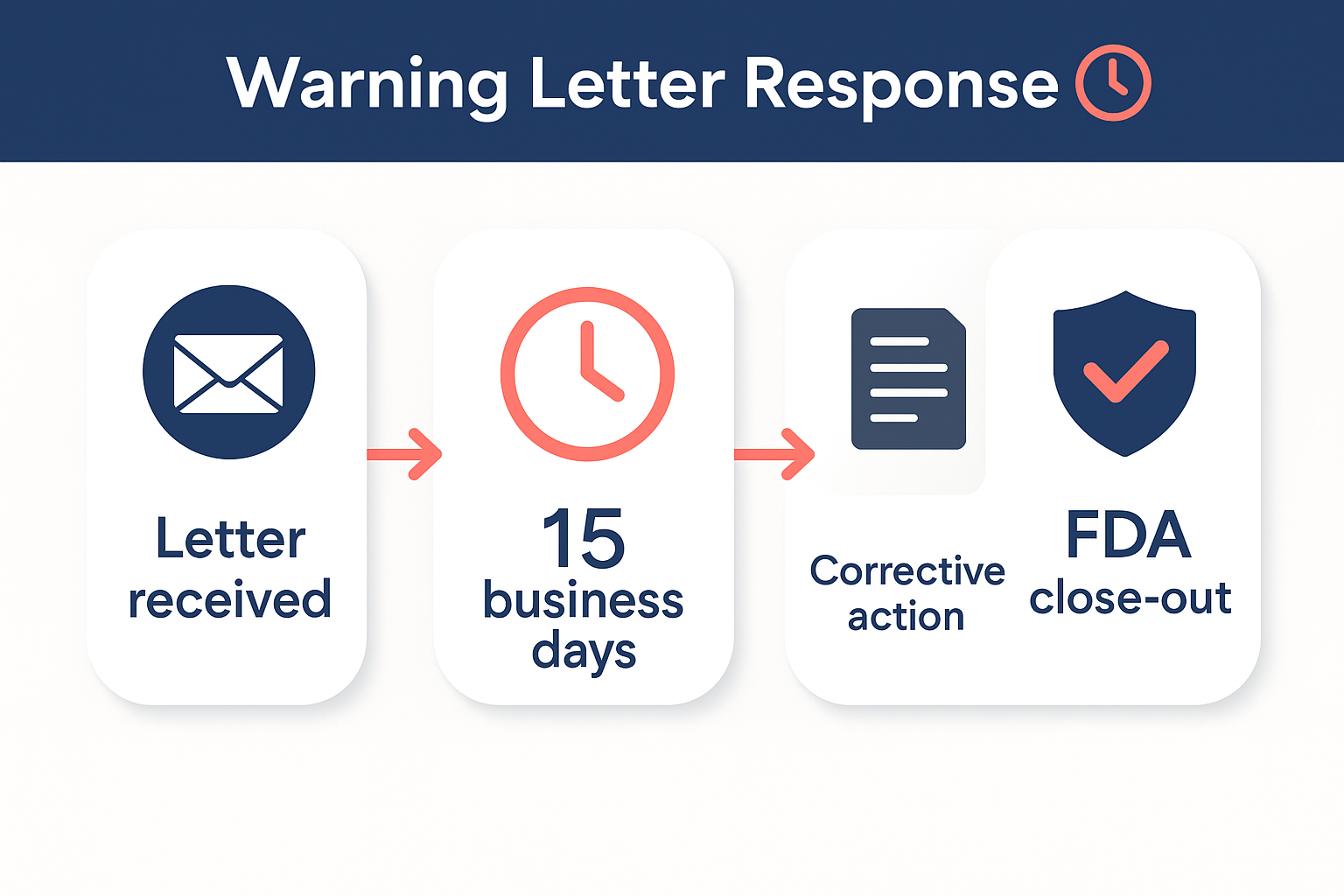
The sequence runs in a fixed order, and each step feeds the next. First, the letter names each violation and sets a response deadline, typically 15 business days, for corrective action and documented evidence. Second, the FDA reviews your reply, and it may re-inspect your facility, your labels, or your website. Third, a documented fix earns a close-out letter that formally closes the matter. An inadequate answer, a missed deadline, or no answer at all escalates the case to seizure, injunction, or criminal referral.
That public posting has business consequences beyond the agency. Retailers, marketplaces, and ad platforms watch the same FDA feed. A warning letter can pause a listing or freeze a merchant account before you even file a response. Treat the letter as a customer-facing event, not just a legal one.
Enforcement is climbing, not cooling off. FDLI’s statistical update, published October 3, 2025, reports the FDA averaged about 51 warning letters per month across all industries in 2025, up from about 49 per month in 2024 and 47 in 2023.
| Year | Monthly average |
|---|---|
| 2023 | 47 |
| 2024 | 49 |
| 2025 | about 51 |
The FDA reviews your website when it evaluates corrective action, not just your label file. A claim that lives in an old blog post, an expired ad creative, or an influencer’s saved video is still a claim. If a reviewer can pull up a banned phrase anywhere in your funnel, your fix is not complete. Scrub the site in the same pass you fix the label.
Emergency Playbook: You Just Got a Warning Letter, Now What?
Move in order. The first 48 hours decide how this ends.
- Read the letter for scope and deadlines. Do not guess. Find every product named, every claim cited, and the exact response date. Write that date where you will see it.
- Pull the offending claims from every channel immediately. Product pages, checkout flows, old ads, influencer posts, saved stories. If the claim is live anywhere, it is live to the FDA.
- Write the corrective response inside the stated window, typically 15 business days. Address each violation one by one, state the concrete fix, and attach evidence: new labels, deleted pages, updated posts.
- Keep a compliance file of everything you remove or relabel. Screenshots, URLs, dates, before-and-after files. This file is your proof if the FDA re-inspects.
- Decide whether counsel is needed, and consider a manufacturer audit if the letter cites GMP issues. A warning letter that names manufacturing conditions is bigger than label copy.
The honest range is simple. Prompt, documented corrections usually close the file. Silence, or a defensive reply full of arguments and no fixes, escalates it. A warning letter is a fixable problem. An unanswered one is a different beast entirely.
The FTC Is a Second Front: Can Your Ads Survive Review?
The FDA owns the label. The FTC owns the ad. Those two agencies have been issuing joint warning letters for years, so a violation on your website can draw both into the same review. You might survive the FDA’s letter only to get a second one from the FTC demanding proof for claims you made in a caption, a hashtag, or a customer’s review.
The FTC’s standard comes from the Health Products Compliance Guidance, published December 20, 2022. Under that guidance, health-related claims must rest on competent and reliable scientific evidence. For most disease and health claims, the FTC generally expects randomized, controlled human trials. A typical creator’s anecdote does not clear that bar.
The traps creators actually hit
Captions and hashtags count as ads. So do testimonials and user-generated content: when you repost a customer’s before-and-after photo, the FTC reads it as your claim, and you are on the hook for substantiating it. Before-and-after content implies outcomes even if you never type the word “results.”
A DSHEA disclaimer does not cure a deceptive ad. Writing “not intended to diagnose, treat, cure, or prevent any disease” next to a claim that implies exactly that does not fix the problem. The guidance says the claim and the disclaimer get judged together, as a whole.
The 2022 guidance even reaches third-party content. In one example, a marketer linked to a book describing a product’s curative properties, and the FTC held the marketer responsible for the implied claim. If you link it, you own it.
For the full breakdown of how the two agencies split jurisdiction, read the FDA vs FTC survival guide for supplement startups. And before you cite a single study in your next ad, check how to cite studies without FTC violations.
The 5-Step Compliance Audit for Supplement Creators
Run this audit once a month. It takes about an hour, and it is the difference between catching a claim early and learning about it from a warning letter. Each step has one concrete action. Do them in order, every cycle.
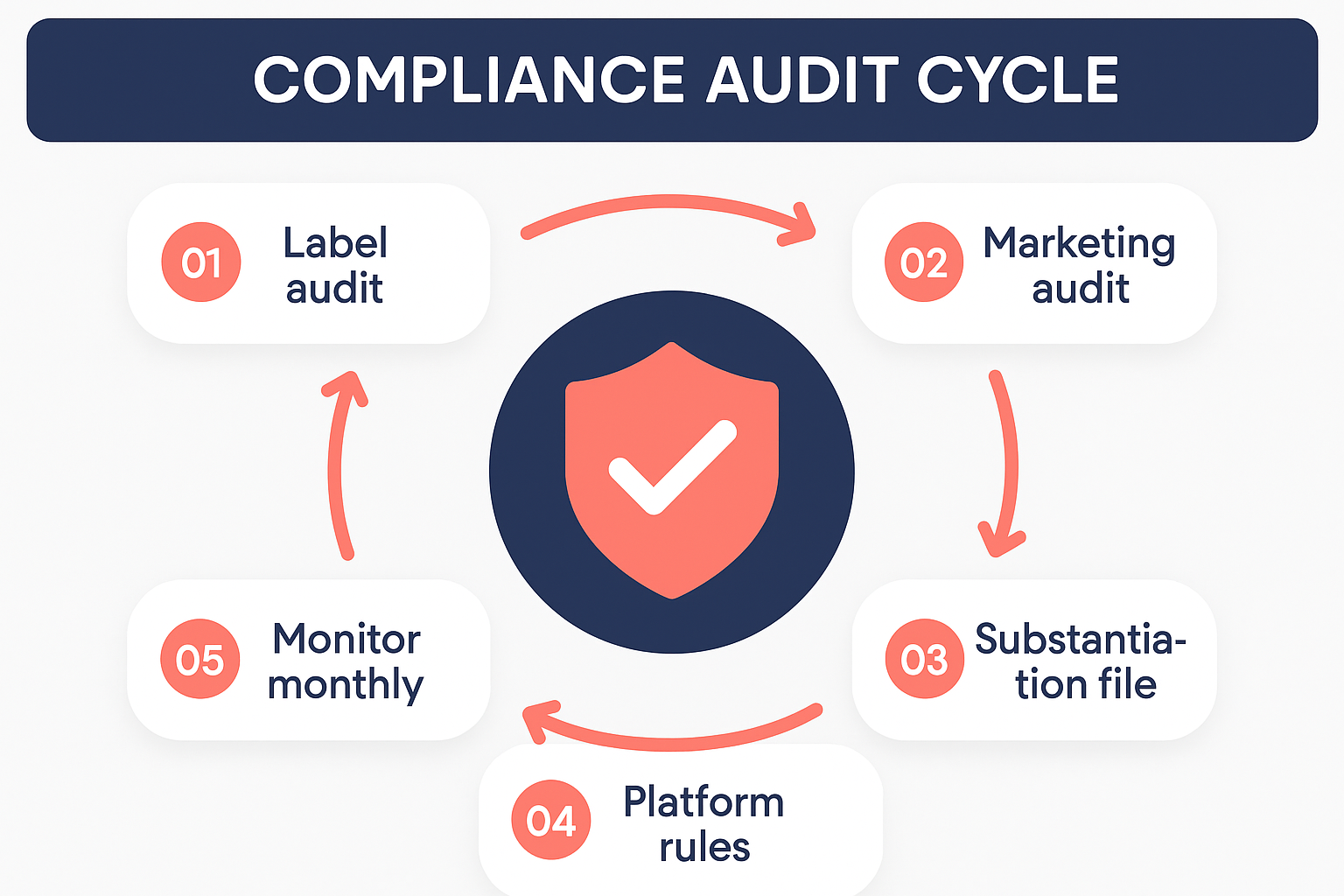
Step 1: Audit your label
Pull your label and check every panel against the 21 CFR 101.93(g) disease criteria. Any phrase that implies a product treats, cures, or prevents a condition fails the test. Rewrite it. Then confirm the DSHEA disclaimer is present, in bold, and linked to each structure/function claim. If the disclaimer is missing or buried, fix it before anything else ships.
Step 2: Audit your marketing
Review product pages, ads, captions, hashtags, and DM scripts for express or implied disease claims. Express claims are obvious. Implied claims are the trap: a customer testimonial that promises a health outcome becomes your claim the moment you post it. Delete or rewrite anything that reads like medical advice.
Step 3: Build your substantiation file
Assemble a Certificate of Analysis for every batch and the studies behind each claim. Keep batch numbers on every document so you can match a COA to a product in seconds. If the FDA asks questions, you have days, not weeks, to respond. A GMP-certified US manufacturer that provides a COA on every batch, as Rocktomic does, covers most of this step automatically. See how Rocktomic works.
Step 4: Check platform rules
Confirm TikTok Shop and Instagram health-category requirements before you list anything. Banned wording gets your store delisted before the FDA ever looks at your label. Platform rules change, so check the current version, not the one from your launch.
Step 5: Reset the audit monthly
Re-review every month. New posts, new affiliates, and new customer reviews reintroduce risk weekly. Calendar the audit for the first week of the month and treat it like payroll: non-negotiable.
Creators who sell white-label products inherit the manufacturer’s label compliance. That’s why GMP-certified US manufacturing with a COA on every batch is the practical shortcut: the label work is handled by people who live inside the regulations. Before you launch anything new, run the label through the ultimate supplement facts checklist so the first pass is clean.
What Non-Compliance Really Costs Your Brand
A warning letter is not a fine. It is a chain reaction that hits every part of your business at once, and the damage compounds across every channel you sell on.
Here is what actually happens when a letter goes public:
- Ad accounts and storefronts get suspended, sometimes within days.
- Chargebacks and refunds spike as buyers lose trust in the brand.
- Labels need a full redesign and existing stock must be relabeled.
- Legal fees pile up for the response you have to file.
- Launch velocity dies. Platforms gate future SKUs once a brand has a public letter.
That last one is the silent killer. You do not just fix one label. You lose the runway for the next five products while the letter sits in public view, scaring off ad reviewers and retailer buyers alike. Every week of that pause costs you orders you had already forecast, while other sellers keep running ads to the same audience.
Now the alternative. A compliant operation is cheaper than it sounds, because the compliance is built in before you ever order a bottle. Rocktomic’s white-label model puts you in a catalog where you own the brand and the customer relationship. There is no inventory to relabel because orders ship via on-demand fulfillment at $2 per item. Membership starts at $0 on the Free plan, or $297 per month on Scale for the full catalog and lowest wholesale pricing.
Compliance is a fixed cost you pay once. A warning letter is a variable cost you pay forever.
How COAs and GMP Certification Pre-Empt Enforcement
Prevention beats response in every scenario. The cheapest way to handle a warning letter is to never earn one. A response letter gets written after the damage is already public. A COA exists before the first bottle sells. That ordering is the whole strategy.
A Certificate of Analysis is the first line of defense. It documents identity, potency, purity, and contaminant testing for every batch. That single document does two jobs: it answers an FDA reviewer’s questions, and it satisfies platform reviewers who check whether a brand can prove what is in the bottle.
Third-party testing matters because it is independent. A lab the manufacturer pays and controls is not the same as a lab with no stake in the result. When an outside lab tests and documents a batch, the retailer and the regulator both get an answer they can trust.
GMP-certified US manufacturing reduces the two violations that show up most often in warning letters: misbranding and adulteration. A product made under current Good Manufacturing Practice is held to a documented standard, batch after batch, so there is little left for an enforcement letter to attach to.
Every Rocktomic product ships with a COA, so the documentation is not something you request after the fact. The 140+ catalog is US-manufactured and GMP-certified, with third-party testing standard across the board. For clinics and practitioners, that paper trail is also what professional buyers demand before they stock a brand.
The full details live on the Rocktomic quality and COA hub.
FAQ
What is an FDA warning letter for dietary supplements?
An FDA warning letter is a formal notice from the FDA that a product or marketing practice violates federal law. For supplements, the most common triggers are disease claims, misbranding, and GMP failures. A warning letter is not an automatic shutdown; it names the violations and demands a written corrective response, usually within 15 business days. Brands that respond with documented corrections can close the matter out without further action. The FDA publishes warning letters publicly on its website, so the letter is also a reputation event.
Which disease claims trigger FDA warning letters for supplements?
Claims that a supplement diagnoses, mitigates, treats, cures, or prevents a disease are the top trigger, per 21 CFR 101.93(g). FDA also considers context: a product name, image, testimonial, or third-party link can imply a disease claim even when the caption looks neutral. Recent joint FDA and FTC letters to 10 companies in March 2025 targeted diabetes-related claims. Brands should audit labels, ads, captions, hashtags, and linked content, not just the label.
How long do you have to respond to an FDA warning letter?
Warning letters typically ask for a written response within 15 business days, stating the corrective actions taken and providing supporting evidence. FDA staff review the response and may re-inspect the facility to verify corrections. An inadequate or ignored response can escalate to seizure, injunction, or criminal referral. Brands should treat the deadline as firm and document every corrective step, including removed claims, revised labels, and destroyed or relabeled stock.
What is the difference between a disease claim and a structure/function claim?
A structure/function claim describes the role of a nutrient or ingredient on the structure or function of the body, such as ‘supports muscle recovery.’ A disease claim references a named disease, its symptoms, or implies diagnosis, treatment, cure, or prevention. Disease claims make a supplement an unapproved drug. Permitted structure/function claims need the DSHEA disclaimer and a notification to FDA within 30 days of first marketing under 21 CFR 101.93(a). Context determines the classification.
Does the FTC regulate supplement advertising claims?
Yes. FDA oversees labeling while the FTC oversees advertising, and the two agencies run joint enforcement actions. The FTC’s Health Products Compliance Guidance, published December 20, 2022, requires that health-related claims be supported by competent and reliable scientific evidence, generally randomized controlled human trials. The FTC reviews captions, ads, reviews, and endorsements for implied claims. A DSHEA disclaimer does not cure an otherwise deceptive ad claim.
What does an FDA warning letter cost a supplement brand?
The direct cost is unquantified and varies, but the business impact is real: paused ads, platform delisting, label redesigns, legal fees, and lost launch velocity. Compare that to the cost of running a compliant operation, where a creator can sell white-label supplements with no monthly fee on the Free plan and pay only the flat $2 per item fulfillment fee on ship, or upgrade to the Scale plan at $297 per month for the full catalog and lowest per-unit wholesale pricing.
How do you audit supplement claims before launch?
Run a 5-step audit: check every label against 21 CFR 101.93(g) disease criteria, review all ads and captions for implied claims, build a substantiation file with Certificates of Analysis and studies, confirm platform rules for TikTok Shop and Instagram, and set a monthly re-review cadence. Working with a GMP-certified manufacturer that provides a COA on every batch, as Rocktomic does, removes most labeling risk before launch. The Scale plan at $297 per month gives brands the full catalog and priority support.
How can a creator launch supplements compliantly without a lawyer?
Start with a manufacturer whose labels are pre-vetted and whose catalog uses only structure/function language, not disease claims. Rocktomic manufactures in the US under GMP certification, tests every batch with third-party labs, and attaches a Certificate of Analysis to each product. Creators can begin on the $0 Free plan with on-demand dropshipping and a flat $2 per item fulfillment fee, or move to Scale at $297 per month. This keeps compliance built into the supply chain instead of handled case by case.
Launch a Compliant Supplement Brand in Days
Fastest path to a defensible brand: start from compliant raw material, not fixing mistakes later. Rocktomic handles US GMP manufacturing, third-party testing, COAs, labeling, warehousing, and drop-ship fulfillment. You own the brand and the customer relationship without touching inventory.
Start on the Free plan at $0 per month with a flat $2 per item fulfillment fee, or Scale at $297 per month for the full 140+ catalog and lowest per-unit wholesale pricing. Compare Rocktomic membership plans, explore the white label supplement program for creators, or book a call with Rocktomic.