
Charm Pricing vs. Round Numbers: The Psychology of Supplement Sales
· Updated · 16 min read · By Rocktomic Labs Team
Does $29.99 beat $30.00? Yes, under specific conditions: 9-ending prices lift unit sales by roughly 24% on average (Capital One Shopping, January 2026), and the left-digit effect is one of the most replicated findings in consumer research (Thomas and Morwitz, Journal of Consumer Research, June 2005). The catch is margin: a charm price gives up a penny per unit, so the lift must beat that trade-off. This guide covers the conversion data, the psychology, and the per-bottle math that decides which ending wins for a supplement brand.
What Is Charm Pricing and Why Does It Work?
What is charm pricing and why does it work? Charm pricing ends a price just below a round number, such as $29.99 instead of $30.00. It exploits the left-digit effect: buyers anchor on the leftmost digit, so $29.99 is encoded as twenty-something, not thirty (Thomas and Morwitz, Journal of Consumer Research, June 2005). The ending also works as a learned deal cue, which is why pricing research finds roughly 60.7% of retail prices end in 9 (Capital One Shopping, January 2026).
Pick any product, set your monthly volume, and see your real per-unit and monthly profit on every plan – fulfillment, card processing, and membership all included.
That trade-off drives the math: a one-penny margin cost versus a researched conversion lift, decided per bottle and per order.
What the Data Says: The Hard Numbers Behind Price Endings
Price-ending research has held steady across decades, product categories, and selling formats, and it maps directly onto how supplements are sold today: social buyers compare prices side by side, fast, on small screens, where a 9-ending changes the leftmost digit they read.
Four findings carry the weight. Two are controlled field tests, one is a multi-experiment catalog study, and one is a large-scale retail price audit. Three of the four were run on physical retail or mail-order catalogs before social commerce existed, which makes their consistency across formats the real signal. The methods differ, but the direction of the effect does not.
| Study | What it found | Source and date |
|---|---|---|
| Anderson and Simester field experiments | 9-ending prices raised demand in all three catalog experiments, strongest for new products. | Quantitative Marketing and Economics, March 2003 |
| Schindler and Kibarian | .99 endings outsold .00 endings by about 8% in a controlled field test. | Journal of Retailing, 1996 |
| Thomas and Morwitz | The left-digit effect appears only when the leftmost digit changes, so $2.99 vs $3.00 reads differently but $3.00 vs $3.01 does not. | Journal of Consumer Research, June 2005 |
| Capital One Shopping roundup | ~24% average sales lift attributed to 9-endings, with 60.7% of retail prices ending in 9, 28.6% in 5, and 7.5% in 0. | January 2026 |
What this means for supplement brands
Supplements are consumables sold to price-sensitive buyers, and the comparison moment is constant on TikTok Shop and Instagram. Scroll a feed and you will see two product cards side by side, one at $29.99 and one at $30.00. The price is the number shoppers compare first, and the left-digit effect does the rest. That is where a researched lift belongs.
The 8% to 24% range is a band, not a guarantee. Results vary by category and audience. A discount greens SKU and a premium practitioner-grade formula face different buyers, and those buyers read endings differently. The takeaway is not that .99 always wins. The ending is a pricing lever you control, and switching it costs nothing. Model your margin math on the low end of the band and treat anything above it as upside.
Consumables compound the effect. Supplement customers reorder, so the chosen ending repeats across every subscription and refill. That makes the price ending worth testing on your own catalog before you lock it into a product page. And because white-label manufacturing means you set your own retail price, the decision is entirely yours.
Why Does $29.99 Feel Cheaper Than $30.00? The Left-Digit Effect
The Brain Encodes the Left Digit First
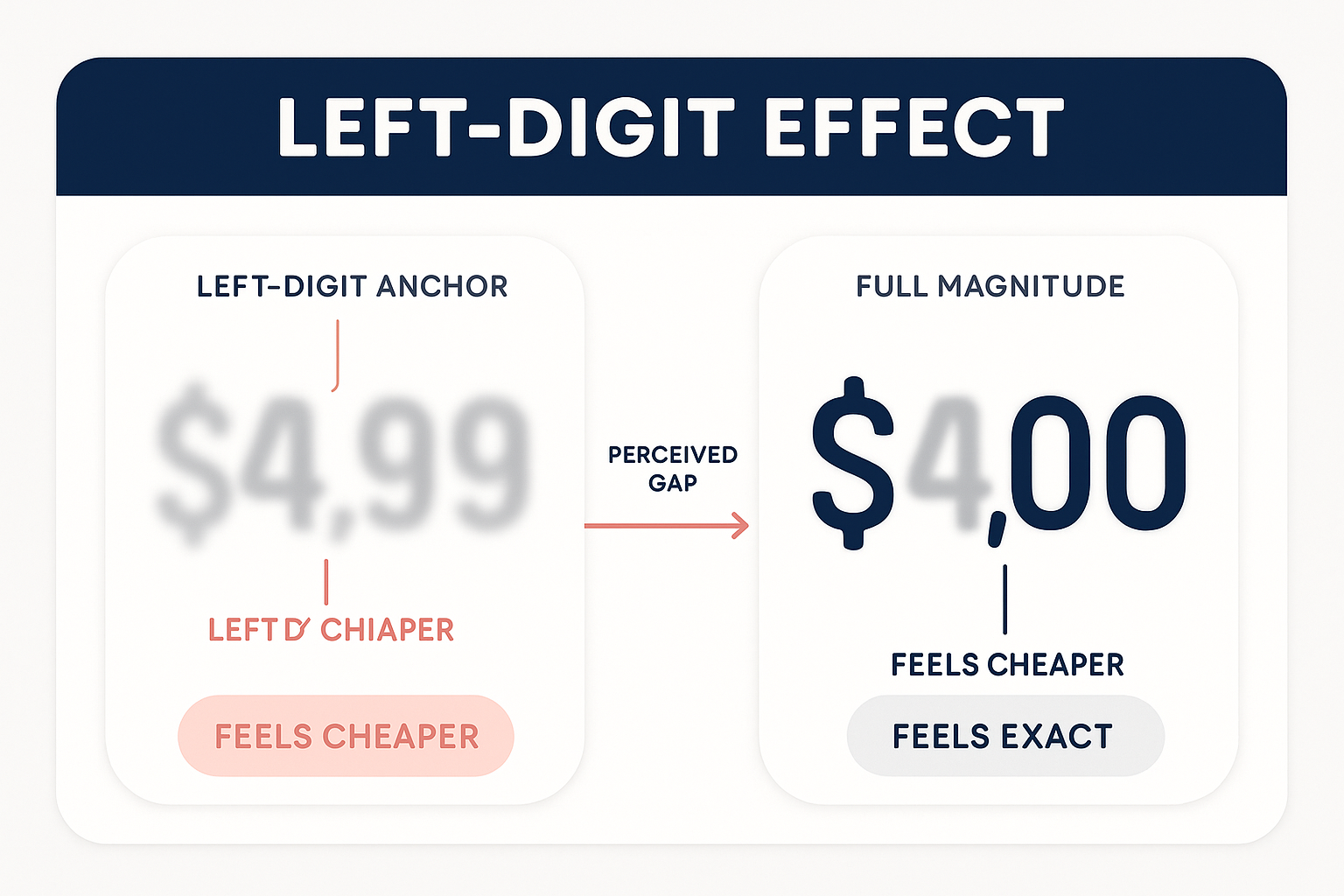
The brain doesn’t read a price the way a spreadsheet does. It grabs the leftmost digit, anchors on it, and encodes the whole price into that bucket. So $29.99 gets coded as “the 20s,” not as “one penny below 30.” The mechanism comes from Thomas and Morwitz in the Journal of Consumer Research (June 2005): buyers anchor on the left digit, then adjust, and the adjustment never fully catches up to the true value. The right-side digits are processed second, with less weight. The price feels like a 20-something number, because to the brain, that’s where the number lives. The anchor does the heavy lifting before the rest of the price is even read.
The Effect Fires Only When the Left Digit Changes
The effect has a hard boundary. It fires only when the leftmost digit actually changes. Drop from $3.00 to $2.99 and the anchor moves from the 3s to the 2s. That’s the whole job of the penny. Raise the price from $3.00 to $3.01 and the left digit stays put, so the brain reads the two prices as effectively the same. No flip, no effect.
Why It Persists on Mobile and Social Commerce
Online, the effect gets stronger, not weaker. Prices on a phone are scanned, not studied. Buyers on TikTok Shop and Instagram are scrolling with seconds of attention left, so the left-digit anchor fires before the full number registers. Mobile screens make the right digits even easier to skip. On a desktop checkout the same pattern holds: the brain locks onto the first digit and makes the call. The display format does the work before any rational comparison starts.
Charm Endings Win at the Moment of Comparison
Here’s the rule. Charm endings earn their keep at the moment of comparison, not in isolation. Place $29.99 next to a $30 alternative and the left-digit anchor does the persuasion. Display it alone and the trick barely registers. The same applies to your store: list prices so customers see them side by side, against a higher anchor. Then the left digit carries real weight.
When Does Charm Pricing Backfire?
The Premium-Positioning Problem
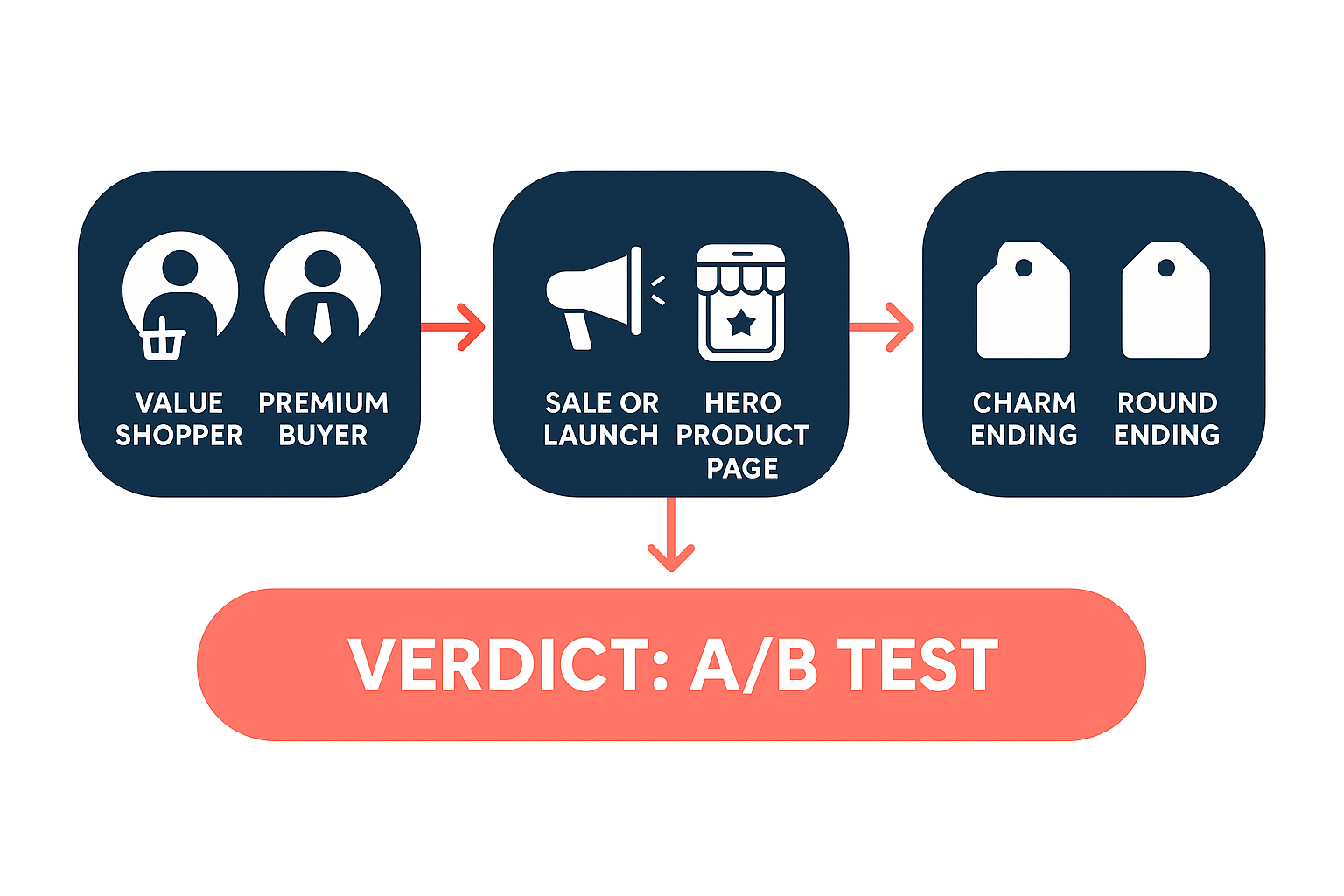
Price endings send a positioning signal before a shopper reads a single word on your label. Nine-endings read as value and discount cues. They whisper “deal” to price-sensitive buyers. Round numbers read as quality and confidence. They tell a different story: this product costs what it is worth. The same bottle at $29.99 and $30 pulls two different buyers. The first is comparing prices across stores. The second is comparing brands. If you are building a premium supplement line, the 9 can undercut that positioning before the product ever ships.
The Reversal Finding
That is not a hunch. Research reported by New Neuromarketing in February 2023, covering work by Ortega and Tabares (2023), found the effect can flip for prestige brands. For some higher-end products, round prices outsold 9-ending prices. The charm pricing lift is real, but it is not universal. Category and brand positioning decide which direction the effect runs. The same buyer who grabs a $19.99 protein tub may pass over a $199.99 practitioner-grade bundle. The ending that converts depends on the price tier you compete in.
What It Means for Practitioner and Clinic Lines
That reversal maps directly to supplements. Practitioner and clinic lines, high-ticket bundles, and medical-grade positioning all lean on trust and clinical credibility. A $97 price tag can feel off-brand for a product marketed through a licensed practitioner. A round $100 reads as deliberate. Every batch ships with a Certificate of Analysis, and that Rocktomic quality and COA documentation backs the premium story with lab proof, not price theater. For RocktomicRX, the medical-grade line for licensed practitioners, the price itself becomes part of the clinical impression.
A Band, Not a Guarantee
The premium pricing playbook for white label supplements applies here: test, then scale. The classic Anderson and Simester (2003) work documented real gains from 9-ending prices. The 8% to 24% range is a band, not a guarantee. Results vary by category, audience, and price point. Run a split test on your own store before you commit every SKU to one ending.
Where Should Charm Pricing Live in Your Store?
Start with the context that sells hardest, then layer the tactic down the funnel.
Comparison Contexts First
Collection pages, sale tags, bundles, and ads with crossed-out originals all frame the price as a deal. Anderson and Simester, 2003 found that reference-point comparisons push more buyers than the same prices shown alone. The original price acts as an anchor, and the charm price reads as a real discount. That’s why sale tags and bundle callouts move units. On a grid full of products, the crossed-out original does the persuasion for you.
Product Pages Second
On an isolated page, the shopper already knows the price, so the charm effect shrinks. Keep the number legible. Round dollars scan faster and look cleaner on a spec sheet, but the left-digit effect still nudges a few extra clicks. Favor the charm number when the page is busy, but never let it get buried in badges or copy. If the price is hard to parse, the shopper moves on.
Checkout Third
Checkout is where most brands trip. Average cart abandonment is 70.22% across 50 studies (Baymard Institute, September 2025). Extra costs at checkout are the top cause abandoners name. If a charm price hides fees until the last screen, the trade is wrong. The price promise has to hold through the final click, or the discount feels like bait. Show the full landed cost before the payment form, and charm pricing keeps its lift.
Landed-Cost Transparency
That promise starts with landed cost. Rocktomic runs on-demand fulfillment with the flat $2 per-item fee, which covers pick, pack, and label. The flat fee applies per unit, so the math stays predictable for any order size. What you quote on the tag is what the customer sees at checkout. No surprise handling fees, no per-order markup surprises. That fee holds on the Free $0 plan and the Scale $297 plan alike.
Channel Display
The same price has to render everywhere. TikTok Shop, Instagram, and Shopify must all show the same figure across devices and currencies. Rocktomic’s store integrations keep the display consistent, so a charm price never breaks into a different number mid-funnel. Shoppers compare tabs, and a mismatch kills trust. A price that shifts between platforms turns a charm number into a headache.
The Money Math: What the Penny Actually Costs
One SKU, one penny, two margins
Lock the example to one SKU: Sea Moss Capsules (ROC835). On the Scale plan, wholesale runs $5.34 per bottle. Add the flat $2.00 fulfillment fee and the all-in unit cost is $7.34. At the $35.97 MSRP, the listed margin is $30.63 per unit, or 85.2%.
That listed margin is the number most sellers quote. It is also the number that hides the real cost. The real decision is what happens one penny lower.
Drop the price to $29.99 and rebuild the unit math. Same wholesale. Same fulfillment. Same product. Only the price changes.
| Price point | Revenue per unit | COGS (wholesale) | Fulfillment | Contribution per unit | Margin % |
|---|---|---|---|---|---|
| $29.99 | $29.99 | $5.34 | $2.00 | $22.65 | 75.5% |
| $30.00 | $30.00 | $5.34 | $2.00 | $22.66 | 75.5% |
There is the entire trade-off in two rows. The penny costs exactly one cent of contribution per bottle, and the margin percentage barely moves. Both price points round to 75.5%. Per unit, the difference is noise. It only becomes real when volume enters the equation. Contribution is the number that funds your ads, covers refunds, and pays you.
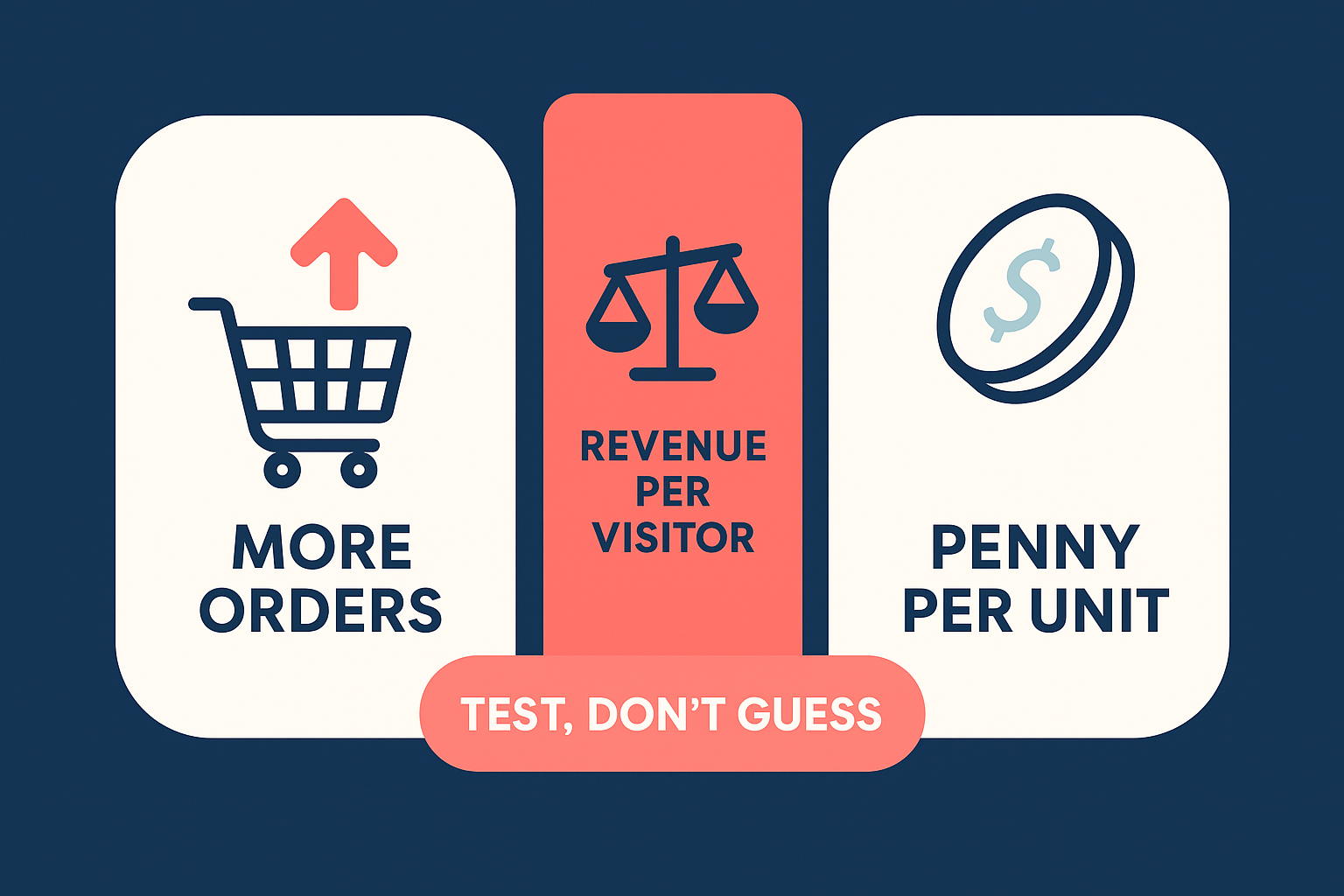
The trade-off, modeled across traffic
Volume is where charm pricing earns its keep. Model the same SKU across 1,000 visitors. This scenario is illustrative, not a forecast. It sets a round ending at 2.0% conversion against a charm ending at 2.4%, a conservative lift inside the researched 8-24% band.
| Price ending | Conversion | Orders | Revenue | Contribution |
|---|---|---|---|---|
| Round | 2.0% | 20 | $600.00 | $453.20 |
| Charm | 2.4% (a conservative lift inside the researched 8-24% band) | 24 | $719.76 | $543.60 |
| Delta | +0.4 points | +4 orders | +$119.76 | +$90.40 (+19.9% contribution) |
Read the delta row. The charm ending added four orders, $119.76 in revenue, and $90.40 in contribution on the same traffic. That is a 19.9% gain in contribution from a one-cent price change. Run the same model at any traffic level and the direction holds.
The rule that decides it
A charm price wins only if revenue per visitor rises. Here it climbs from $0.60 per visitor to $0.72. When that happens, the penny is the cheapest marketing spend in the store. No ad platform, no influencer post, and no email blast delivers $90.40 for a one-cent sacrifice per unit. The lift more than pays for the discount.
Run your own SKU through the supplement margin calculator, review how to calculate white label supplement profit margins, or study per-bottle profit unit economics before you set price points.
How Do You Test Price Endings Without Guessing?
Run a Controlled A/B Test
Pick one SKU and two endings. Run both price points for two to four weeks with traffic split evenly between them. A shorter window gives you noise, not signal. Track conversion rate, average order value, and contribution per visitor. Ignore clicks. A click that doesn’t convert tells you nothing. Contribution per visitor is the only number that folds price, conversion, and margin into a single decision. It tells you which ending actually makes money per visitor, which is the only result that matters.
Segment by Traffic Source
Cold paid social shoppers are more price-sensitive than your email list or your returning buyers. Slice the data by source before you crown a winner. If $29.99 wins on paid social but loses to $30 in email, you’ve found a targeting insight, not a universal pricing rule. Blend the sources and you’ll pick the wrong winner. That insight is worth more than the test itself.
Test the Ending Inside the Anchor
A price ending never sells in isolation. The context around it changes how it reads. A crossed-out original price makes a charm ending look like a deal. A good-better-best ladder resets what “expensive” means, so the same $29.99 reads differently next to a $49.99 option. Run the test with the anchor in place, because that’s how the product will actually be displayed.
Make the Test Affordable
Testing costs money, and your membership plan decides how much of that cost is fixed. Rocktomic’s Free plan at $0 per month gives you room to test on up to 10 white-label products with no monthly fee. The Scale plan at $297 per month includes the full 140+ SKU catalog and the lowest per-unit wholesale pricing, which funds meaningful tests without compressing your margins. Lower wholesale cost per unit means a winning ending produces more contribution per order, so the test pays for itself faster. For the full framework, start with the guide to supplement pricing strategy.
Frequently Asked Questions
What is charm pricing and why does it work?
Charm pricing sets a price just below a round number, such as $29.99 instead of $30.00. It works through the left-digit effect documented by Thomas and Morwitz in the Journal of Consumer Research (2005): buyers anchor on the leftmost digit, so $29.99 reads as twenty-something, not thirty. The ending also works as a learned deal cue. Pricing research roundups find roughly 60.7% of retail prices end in 9 (Capital One Shopping, January 2026).
Does .99 pricing really increase conversion rates?
The evidence is real but conditional. A widely cited analysis finds 9-ending prices lift unit sales by about 24% on average (Capital One Shopping, January 2026), and a Journal of Retailing field test by Schindler and Kibarian (1996) measured an 8% sales lift for .99 endings over .00. Anderson and Simester (2003) found 9-endings raised demand in three field experiments, strongest for new products. The lift peaks when shoppers compare prices.
When does charm pricing backfire?
Charm endings backfire when they conflict with positioning. Nine-endings read as value and discount cues, so they can cheapen a premium brand. New Neuromarketing (February 2023) reported the effect can even reverse for prestige tech brands. For supplement brands, round-number pricing on hero SKUs signals quality and confidence, which matters for premium or practitioner-oriented lines. Charm endings belong on value tiers, sale badges, and collection pages. Test per product.
Do round numbers ever outperform charm prices?
Yes. Round numbers win in three situations: premium positioning, high-ticket products, and trust-sensitive categories. Thomas and Morwitz (2005) showed the left-digit effect only occurs when the leftmost digit changes, so the perceived jump from $29.99 to $30.00 is far larger than from $30.00 to $30.01. For practitioner and clinic channels, clean round pricing communicates confidence. Some large retailers tested round-price models and reverted after sales fell, which shows the tactic is audience-dependent.
Where should charm pricing be used in a supplement store?
Use charm endings where comparison happens: collection pages, sale tags, bundles, and ads with a crossed-out original. Anderson and Simester (2003) found the effect strongest in comparison contexts. Where the shopper already knows the price, the lift is smaller. On product detail pages, keep the number legible and consistent, and never let a charm price hide extra costs at checkout. Unexpected costs are the top cause of cart abandonment (Baymard Institute, September 2025).
How much does a charm price cost per bottle in profit?
On the Scale plan, the charm price costs one cent. A brand pricing Sea Moss Capsules (ROC835) at $29.99 instead of $30.00 gives up $0.01 of contribution per unit, while wholesale stays at $5.34 and the flat $2.00 per-item fulfillment fee stays unchanged. The question is whether the penny buys a conversion lift. If it raises revenue per visitor, the penny is the cheapest marketing spend in the store. Model the trade-off before switching: a conversion lift that does not beat the contribution math is a loss.
What is the best price ending for supplement products?
For value-driven supplement brands selling on TikTok Shop and Instagram, 9-endings such as $29.99 or $39.99 trigger the left-digit effect and a deal cue. For premium or practitioner lines, round numbers like $40.00 or $90.00 signal quality. Rocktomic members control the retail price on every SKU, regardless of the suggested MSRP, so they can run different endings per tier. The Scale plan at $297 per month includes the full 140+ SKU catalog and lowest wholesale pricing, leaving room to test endings without compressing margins.
How do I test charm pricing without hurting margins?
Run a controlled A/B test on one SKU for two to four weeks, splitting traffic between a charm price and a round price. Measure conversion rate, average order value, and contribution per visitor, not just clicks. A free supplement margin calculator makes the trade-off legible: at a wholesale cost of $5.34 plus $2.00 fulfillment, the difference between $29.99 and $30.00 is one cent per unit, so any conversion lift wins. Rocktomic members can price-test on the Free plan and scale testing on the $297 Scale plan.
The Verdict: Test, Don’t Guess
Neither format wins outright. Charm endings win where buyers compare prices side by side and the conversion lift beats the penny. Round numbers win where credibility drives the sale. Test, don’t guess.
Run your own numbers in the free supplement margin calculator before you change a single price tag.
Then compare the Rocktomic membership pricing. The Free plan costs $0; Scale at $297 per month includes the full 140+ SKU catalog and the lowest per-unit wholesale that makes price testing profitable. Book a call with Rocktomic to map a testing plan for your store.
Last updated: July 4, 2026.