
TikTok Shop Unit Economics: How to Prevent Fees From Killing Your Supplement Profit
· 16 min read · By Rocktomic Labs Team
A 6% referral fee is the visible cost on TikTok Shop. The real margin killers sit underneath: seller-funded free shipping, affiliate commissions, refund administration fees, and fulfillment. On a white-label supplement with a $5.67 wholesale cost (ROC105) and a $35.97 retail price, the full stack leaves about $18 net before ads. That only holds if you price from landed cost, not wholesale.
TikTok Shop hit $33.2 billion in global GMV in 2024, with the US at $9 billion (Momentum Works, January 2025). US sales reached $15.82 billion in 2025, up 108% (eMarketer, December 2025). Whether TikTok Shop supplements are actually profitable in 2026 depends on this math.
What Are TikTok Shop Fees for Supplement Sellers?
TikTok Shop charges a 6% referral fee on most qualified US orders since April 1, 2024, with no monthly subscription. Refunds trigger an administration fee of 20% of the referral fee, capped at $5 per SKU, since May 15, 2025 (TikTok Shop Seller Academy, retrieved 2026-06-21).
Model your monthly revenue, repeat rate, and net profit as your supplement brand scales – using real catalog costs and fees.
Those are the platform-level costs. You also set your own affiliate commission rates, and under the Free Shipping program, sellers cover shipping. New sellers can get an introductory 3% referral rate for 30 days after a first sale made within 60 days of onboarding.
All platform figures in this guide are as of the retrieval date, June 21, 2026. TikTok Shop changes its fee schedule, so verify current terms before you price your products.
Last updated: June 21, 2026.
The Real Fee Stack: What TikTok Actually Deducts
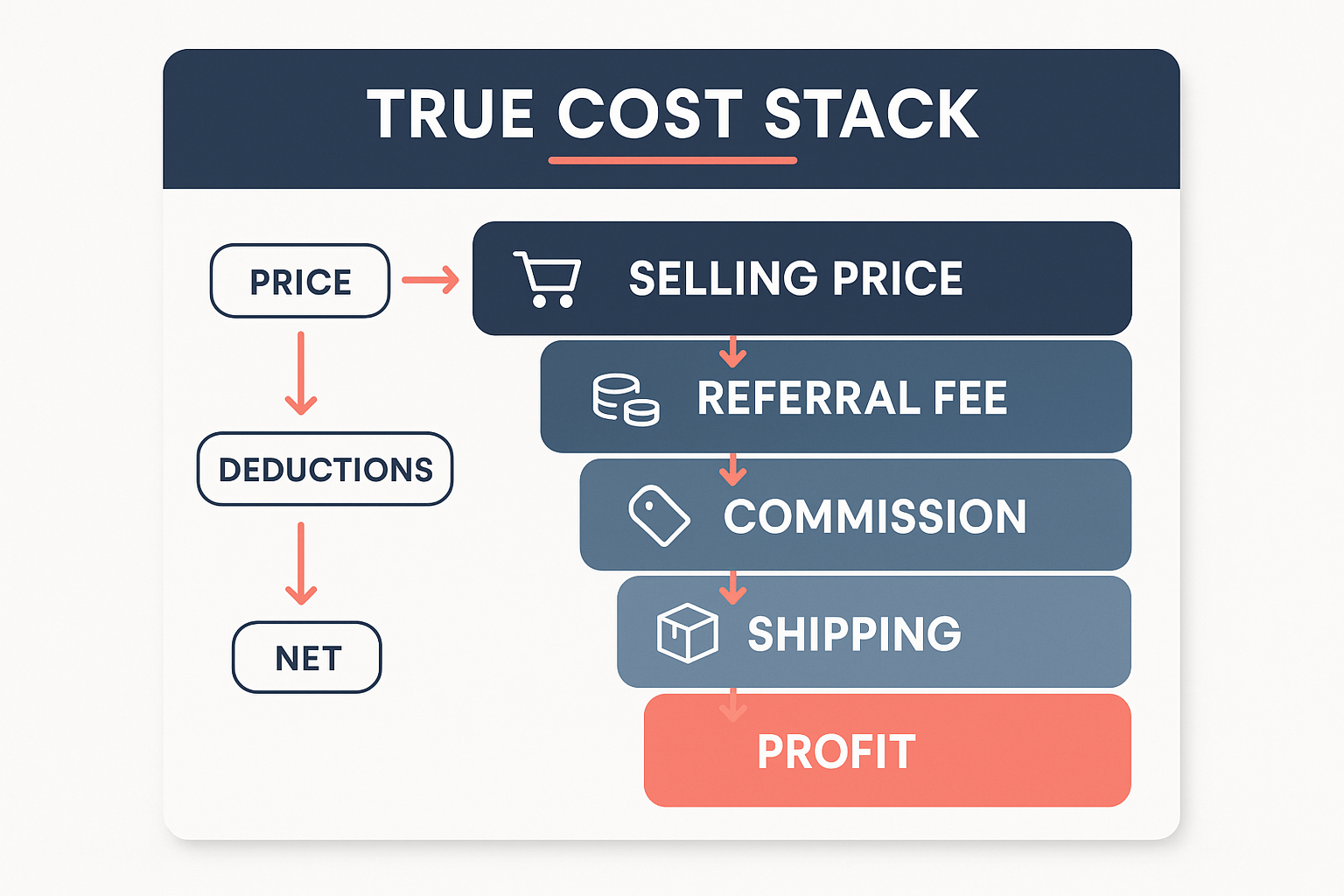
Every TikTok Shop order runs through a stack of deductions, and each layer hits at a different moment. Referral fees come out on delivered orders. Refund administration fees only land when a customer returns or cancels, sometimes weeks later. Affiliate commissions depend on how you set creator payouts. Free shipping costs hit when the buyer passes your threshold. Price against a single fee and the math breaks by month two.
| Fee layer | Who sets it | Typical rate | When it is charged |
|---|---|---|---|
| Referral fee | TikTok | 6% of customer payment plus platform discount minus tax | on delivered orders |
| Refund administration fee | TikTok | 20% of the referral fee capped at $5 per SKU | on returns and cancellations |
| Affiliate commission | seller | 1% to 80%, usually 10% to 30% | on affiliate-driven orders |
| Free shipping cost | seller | label cost of roughly $3 to $5 | on orders under the threshold |
| Fulfillment | seller | pick-pack-label cost | every order |
| Payment processing | included in the unified 6% US referral fee | not charged separately | not charged separately |
Inside the referral fee formula
The rate matters less than the formula. TikTok computes the referral fee as the rate times the customer payment, plus platform discount, minus tax. Platform-funded vouchers get added back into the fee base. A discounted order carries a proportionally larger fee weight. The deeper you discount to win followers, the more the stack eats.
The “Who sets it” column is where you find room to maneuver. TikTok controls the referral fee and the refund administration fee. You control affiliate commission, free shipping, and fulfillment. A 10% creator payout with a strict free-shipping threshold produces a very different stack than 30% commissions with free shipping on every order.
Fulfillment is the layer most sellers model wrong because they treat it like a percentage of revenue. It is not. On Rocktomic’s dropship model, fulfillment is a flat fee of about $2 per item. That predictability matters when you run flash promos, because the cost stays flat while the order value swings.
Add these layers before you set a price, not after your first payout surprises you. If you want the direct playbook, here is how to protect supplement margins from TikTok Shop fees.
Why the 6% Referral Fee Is Not Your Real Problem
The 6% referral fee is the headline number. It’s not the one that breaks your margin. Three other costs move more money, and two of them are yours to control.
Affiliate Commissions Run 15% to 30% in Beauty and Personal Care
Affiliate commissions are seller-set, and the benchmark band for beauty and personal care runs 15% to 30% (TikTok Shop Seller Academy, retrieved 2026-06-21). That’s two and a half to five times the referral fee on every affiliate-driven order.
You can’t fix a bad commission rate overnight. Lowering a rate that’s already live triggers a 30-day grace period at the old rate, so the number you launch with is the number that sticks (TikTok Shop Seller Academy, retrieved 2026-06-21). Set the rate before launch, and treat it as locked for the first month. Most creator-driven sales carry a commission, because the creator is the storefront. That makes the rate a pricing decision, not an afterthought.
Settlement Delays and Ad Spend Create the Real Gap
Cash moves slower than the sales feed suggests. Standard sellers wait about 15 days after delivery for settlement; new accounts can wait 31 days (TikTok Shop Seller Academy, retrieved 2026-06-21). In that window, your next ad round is already billing.
If you stock product in advance, those two to four weeks are working capital sitting in someone else’s account. Plan the restock schedule around settlement, not around the sales feed. Ad spend is the biggest seller-controlled variable on the sheet. A losing creative burns more in an afternoon than the referral fee costs in a month. Run small tests, cap the daily budget, and scale only what clears your target margin after commission, delivery, and settlement.
A Flat Fulfillment Model Keeps the Math Honest
Other platforms stack per-order fees, storage charges, and fulfillment line items on top of the percentage take, so the true cost per unit stays hidden until the payout lands. Rocktomic flattens that. Fulfillment runs about $2 per item for pick, pack, and label, and the Free plan costs $0 a month. You pay when an order ships, and you pay nothing when it doesn’t.
Your margin is decided by the numbers you control: the commission rate, the settlement timeline, and the ad bid. Price against those three, and the 6% fee stops being the story.
The Free Shipping Trap: What the New Rules Cost You
TikTok used to split your shipping bill. That ended on May 29, 2025, when TikTok discontinued the Co-Funded Free Shipping program and made sellers responsible for the label. Fulfilled by TikTok (FBT) sellers also lost the $0.75 per-item subsidy, per the TikTok Shop Seller Academy (retrieved June 21, 2026).
Most sellers still price as if TikTok covers the box. It does not. FBT orders get free shipping by default, with an opt-out that most stores never touch. Buyers see “free” at checkout, then the label lands on your P&L. That mismatch is where margin quietly disappears.
TikTok also replaced the broader co-funded promotion program with a managed Smart Promotion program in March 2026. This is not a return of the old subsidy. Smart Promotion carries a GMV-based service fee, so what you pay scales with what you sell. Verify the current rate in Seller Center before you enroll. Enroll blind and you’re paying a service fee on top of a label cost you already own.
The Margin Hit Shows Up Before Your Fees
A $3 to $5 per-order label cost on a $25 to $36 supplement erases 8% to 20% of gross margin if the price is not adjusted. That erasure lands before TikTok’s commission and before your wholesale cost. Low-ticket impulse buys are the default on TikTok Shop, and that’s exactly the cart size where a label decides between a profitable order and a quiet loss. A $4 label on a single bottle is the same as handing back part of your product revenue at the door.
The Pricing Fix
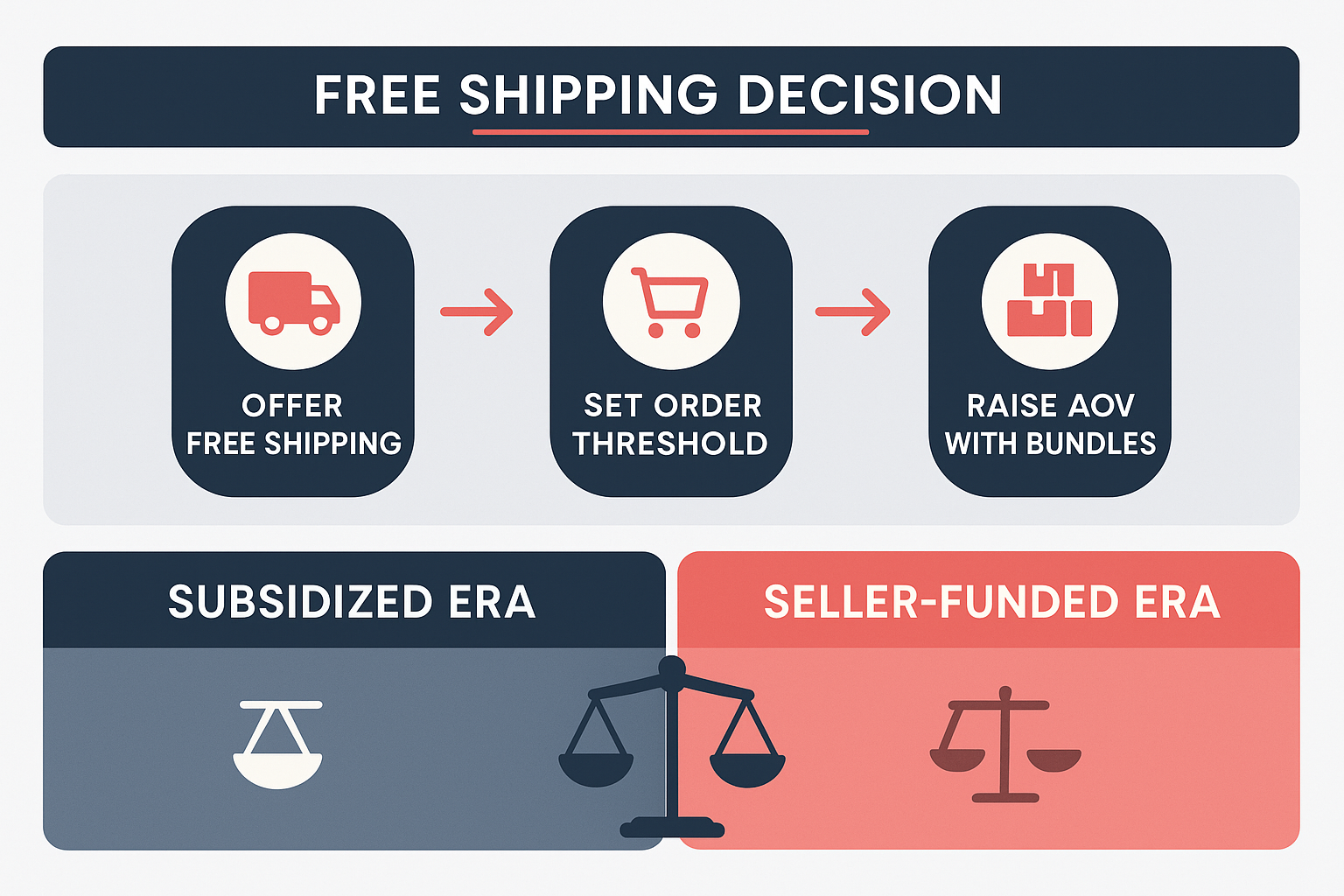
Set a $30 order threshold, so free shipping only kicks in above it. Treat shipping as a line item in your pricing model, not a rounding error. Then bundle to lift order value; a bigger basket spreads one label across more margin. These three moves restore the contribution you lost when the subsidy ended, and they keep working as Smart Promotion fees evolve.
Price the label into the bottle before you run another offer. For the full playbook on deals that do not drain your cash, see running TikTok promos without bankrupting your brand.
One Bottle, Every Fee: TikTok Shop Unit Economics
Take one SKU and run it through the whole TikTok Shop fee stack. This is the canonical example this article keeps coming back to, and it is locked to a single product: Best Sellers Blend (ROC105).
Best Sellers Blend lists at $35.97. On the Scale plan, wholesale cost is $5.67. That leaves a pre-fee margin of $30.30, or 84.2% of the sale. Both figures come from Rocktomic pricing. The platform numbers below match the TikTok Shop Seller Academy retrieval date cited in Part 1, so the entire set comes from the same snapshot.
| Line item | Amount |
|---|---|
| Retail price (seller’s choice) | $35.97 |
| Wholesale cost (COGS) | $5.67 |
| Fulfillment (flat) | $2.00 |
| TikTok referral fee (6%) | $2.16 |
| Affiliate commission (10% example) | $3.60 |
| Seller-funded shipping (economy label assumption) | $4.50 |
| Net before ads and refunds | about $18.04, roughly 50% of the sale |
The two cost lines are locked before you list a product. The $5.67 wholesale line comes from Rocktomic Scale plan pricing. The $2.00 fulfillment line is the flat fee you get with on-demand fulfillment at about $2 per item. Everything below that is the platform stack: referral fee, affiliate commission, and seller-funded shipping.
The table is the unit-level view. It shows what actually lands in your account before you spend a dollar on traffic. Refunds and chargebacks are not in it, which is exactly why the bottom line reads “net before ads and refunds.” Sellers who check the referral fee and stop there get blindsided by the affiliate commission and the shipping label, and their quoted margin drops from $30.30 to $18.04 before they ever buy traffic.
Break-even ROAS for this SKU
At about $18.04 net, one sale can absorb about $18 of ad spend before it turns negative. Break-even ROAS lands near 2.0x. Everything above 2.0x is profit.
Every SKU gets its own version of this table. The inputs shift with wholesale tier, retail price, and shipping choice, but the structure does not. Work the full formula in how to calculate break-even ROAS on supplement ads, then price your product with the supplement margin calculator before you launch.
The Pricing Playbook: How to Price White-Label Supplements for TikTok Shop
Pricing is where TikTok Shop profits are won or lost. The fee math from Part 5 only helps if you turn it into rules you apply to every SKU. These six rules do exactly that.
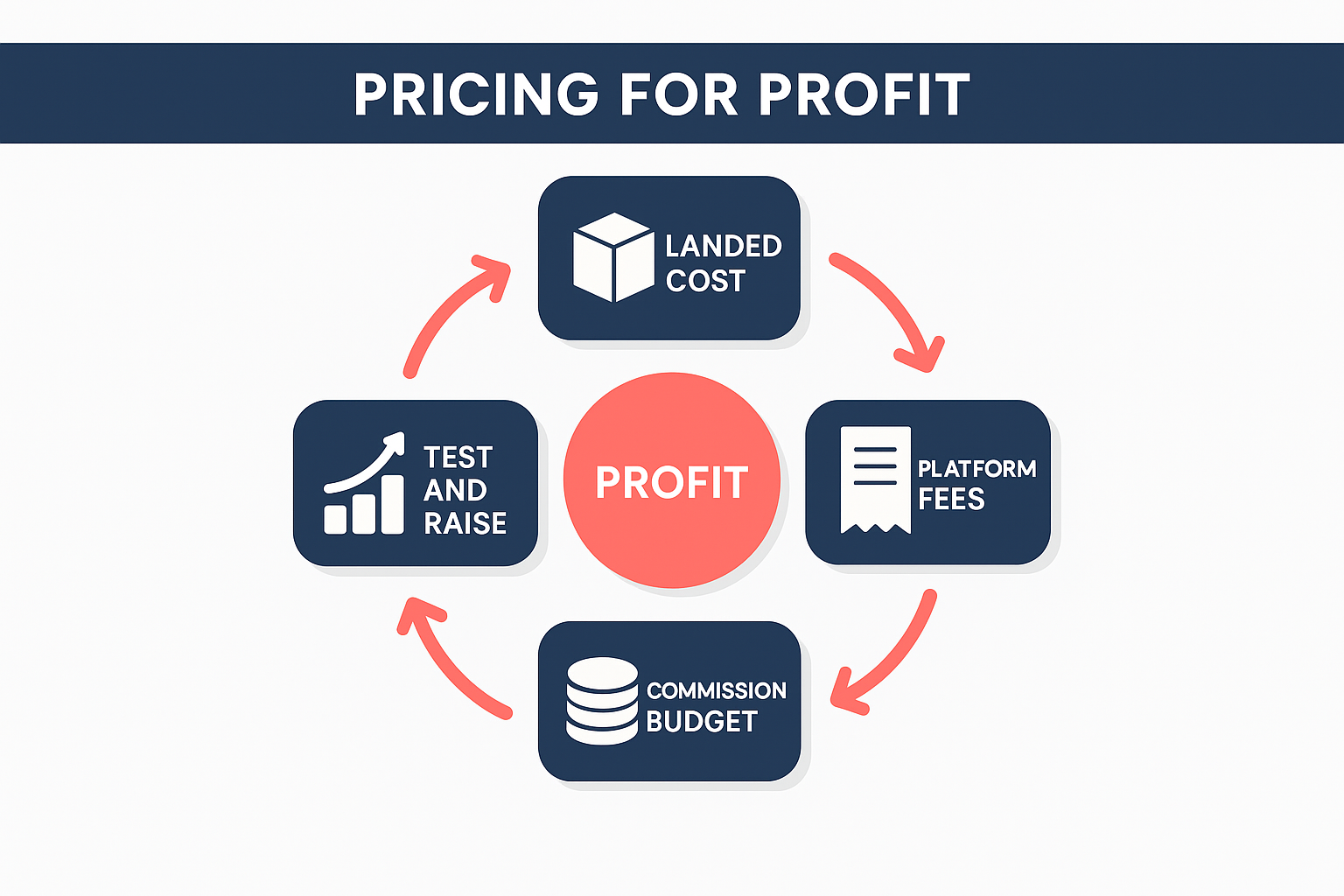
Rule 1: Price from landed cost, not from the market
Landed cost is wholesale plus fulfillment plus every fee layer: referral fee, payment processing, and any shipping you subsidize. Rocktomic’s flat fulfillment fee, about $2 per item, keeps that baseline predictable. Price from your landed cost, not from whatever a competitor posts.
Rule 2: Never stack seller discounts with platform vouchers
TikTok computes the referral fee on the pre-discount order value. Stack a seller discount on top of a platform voucher and you pay fee on money you never collected. Run promotions one layer at a time.
Rule 3: Hold an 8% to 12% margin reserve
Refunds happen, and TikTok charges a refund administration fee when they do. Keep 8% to 12% of projected margin in reserve so one bad return week doesn’t push a SKU negative.
Rule 4: Set commission budgets per SKU
Affiliate commissions come out of the same margin as fees. Only offer aggressive commissions on products that can absorb them. Thin-margin SKUs get capped budgets or no commission at all.
Rule 5: Use bundles and a $30 free-shipping threshold
A $30 free-shipping threshold gives customers a reason to add one more item. Bundles lift order value while keeping per-unit fulfillment near the same flat cost. Both moves raise average order size without raising the fee rate.
Rule 6: Reprice when TikTok changes fees
TikTok typically gives about 30 days notice before a fee change lands. Review your price list on that cadence and adjust before the change hits, not after.
Run your numbers through the profit projection tool before you launch a single SKU. It builds these rules into the math for you. Then connect the store with store integrations for TikTok Shop and Shopify. On the Scale plan, the lowest per-unit wholesale pricing gives every rule more room to work.
The Compliance Guardrail: Keep Your Shop Approved
Margin math only works on a shop that is still selling. TikTok Shop gates supplement categories behind documentation, and a shop that loses approval loses every fee-covered order. That is not a legal footnote. It is a revenue line.
Losing approval does not just pause a listing. It stops the orders that carry your TikTok fees, shipping subsidies, and wholesale cost. Every day your shop is dark is a day that margin sits at zero.
Your listing needs the documents TikTok Shop asks for, including a Certificate of Analysis. The faster you can produce one, the faster you get approved. Rocktomic attaches a COA to every batch and manufactures in GMP-certified US facilities, which shortens the gating document list. See Rocktomic quality and COA for what that looks like.
Keep claims functional and disclosed
Approval is only the first gate. Your product claims decide whether you stay approved. Under DSHEA and FTC rules, supplement marketing stays in structure/function language. Describe how a formula supports normal energy, focus, or recovery. Do not say it treats, cures, or prevents anything, and do not promise guaranteed outcomes.
Affiliate creators need proper disclosure when they post your products. A missing disclosure can put their content at risk, and your shop is the one with orders on the line.
This is not a compliance deep dive. It is the guardrail that keeps the fee math covered earlier alive.
Six Mistakes That Erase Supplement Margins on TikTok Shop
Run your margin once against wholesale cost and once against the full fee stack. You will see exactly where TikTok Shop eats the difference. These six mistakes cover almost every leak.
- Pricing off wholesale instead of landed cost. Wholesale is not your cost. The ~$2/item fulfillment fee, the platform referral fee, and payment processing all hit before an order ships. Fix: price from landed cost, not list price (Rule 1, Part 6).
- Offering free shipping under a $30 threshold with no price adjustment. A free shipping badge is a margin donation unless the item price funds it. Fix: keep the $30 threshold, raise the item price, and bundle so the subsidy comes out of a bigger cart (Part 4).
- Paying 20%+ affiliate commissions on thin-margin SKUs. A 20% commission on a low-margin product pays your affiliate before it pays you. Fix: budget commissions per SKU off that SKU’s landed cost instead of one blanket rate (Part 6).
- Stacking seller discounts on top of platform vouchers, which raises the referral fee base. Every discount you add shifts the fee base underneath you. How coupon codes destroy supplement margins shows the full math. Fix: never stack a seller discount onto a platform voucher (Part 2).
- Ignoring the refund administration fee and return shipping in the model. Refunds carry a fee and a shipping cost that most sellers never price in. Fix: keep an 8% to 12% reserve in the unit model so a bad week doesn’t wipe the month (Part 6).
- Scaling ads by ROAS instead of net profit after the full fee stack. A strong ROAS can still lose money once every fee lands. Fix: model net profit per unit before you add a single dollar of ad spend (Part 5).
Each fix is one line in your spreadsheet. Skip any of them and the fee stack decides your margin for you.
TikTok Shop Supplement Fees: Frequently Asked Questions
What fees does TikTok Shop charge supplement sellers?
TikTok Shop charges a 6% referral fee on most qualified US orders, in place since April 1, 2024. There is no monthly subscription fee. Supplement sellers set their own affiliate commissions and fund free shipping out of pocket. A refund administration fee of 20% of the referral fee, capped at $5 per SKU, took effect May 15, 2025. New sellers who make a first sale within 60 days of onboarding receive a 3% referral fee for 30 days (TikTok Shop Seller Academy, retrieved 2026-06-21).
How much does TikTok Shop take from a supplement sale?
On a $35.97 bottle, the 6% referral fee is about $2.16. A 10% affiliate commission adds $3.60. Seller-funded economy shipping adds roughly $4.50. With a $5.67 wholesale cost (ROC105) and the $2 flat fulfillment fee, the whole stack consumes about $18 of the sale before ad spend is even considered.
How does TikTok Shop’s free shipping program affect supplement margins?
TikTok Shop’s Co-Funded Free Shipping program ended May 29, 2025. Sellers now fund shipping costs entirely on their own. Fulfillment by TikTok (FBT) sellers also lost the $0.75 per-item subsidy. That shift moves $3 to $5 of shipping cost per order onto the seller. Raising prices or setting a $30 order threshold lets higher order value cover the shipping line instead of eating margin.
What is the TikTok Shop refund administration fee?
The refund administration fee is 20% of the original referral fee, capped at $5 per SKU since May 15, 2025. On a $35.97 supplement with a $2.16 referral fee, the refund fee works out to about $0.43. The full cost of a refund also includes the lost product, the outbound label, and any affiliate commission already paid to the creator, so prevention matters as much as the fee itself.
What affiliate commission should I offer creators for supplements?
Beauty and personal care affiliate benchmarks run 15% to 30% of order value. TikTok Shop lets sellers set the rate themselves, and lowering a rate triggers a 30-day grace period at the old rate. Budget commission as a fixed line item in unit economics. Testing 10% to 15% first keeps creator pay predictable; on the $35.97 bottle, 10% is $3.60.
How much does it cost to launch a white-label supplement brand for TikTok Shop?
Rocktomic’s Free plan costs $0 per month and charges only the flat fulfillment fee of about $2 per item when an order ships. It includes one sales-channel integration and up to 10 products. The Scale plan at $297 per month adds lowest per-unit wholesale, access to the full catalog, unlimited channels, and priority fulfillment. Dropship requires no inventory purchase and no minimum order quantity, so launch cost stays tied to actual orders.
What are real wholesale costs for white-label supplements?
On the Scale plan, the Best Sellers Blend (ROC105) carries a $35.97 MSRP and a $5.67 wholesale cost. That leaves a $30.30 margin before platform fees, which is where TikTok Shop fees come out. The flat $2 per-item fulfillment fee is separate, so landed cost stays predictable as order volume scales.
How do I price supplements for TikTok Shop profitably?
Price from landed cost: wholesale plus the $2 fulfillment fee, the 6% referral fee, affiliate commission, and realistic shipping. Retail should be set so the remainder clears the ad budget and profit target. Bundling two SKUs with a $30 free-shipping threshold raises average order value and makes shipping cost a smaller slice of each order.
Own the Math: Launch a Fee-Aware Supplement Brand
TikTok Shop is profitable for supplements when you price from landed cost and keep the full fee stack in the model. Watch shipping, commissions, and refunds as closely as the 6% referral fee.
Run your SKU through the supplement margin calculator, check Scale plan pricing for the lowest wholesale costs, or book a call with Rocktomic for a fee-aware launch plan.
Own your brand with zero inventory. Free is $0/month; Scale is $297/month for the lowest per-unit wholesale and the full catalog. Every batch is US GMP-manufactured with a COA.