
Mastering COGS: The Hidden Math Behind Dropship Supplement Profits
· 12 min read · By Rocktomic Labs Team
What Exactly Is COGS for a Dropship Supplement Brand?
Most supplement dropshippers calculate COGS by looking at wholesale price alone. That mistake can cost you 20% of your margin per bottle. The real formula is wholesale plus fulfillment fee. Here is the exact math with a real Rocktomic SKU.
Pick any product, set your monthly volume, and see your real per-unit and monthly profit on every plan – fulfillment, card processing, and membership all included.
COGS stands for Cost of Goods Sold. For a dropship supplement business, it is the wholesale price you pay the manufacturer plus every direct per-unit cost required to deliver that bottle to your customer. This includes the label printing, bottle, packaging materials, and pick-and-pack labor. It does NOT include marketing spend, platform subscriptions, or customer shipping charges. According to ShipFusion, a dropshipping business’ COGS consists of the wholesale price plus any shipping and handling costs incurred (June 2024) (source: ShipFusion, June 2024). Getting this number exact is the difference between a profitable brand and one that bleeds cash.
To see exactly how Rocktomic on-demand fulfillment works, consider a typical product. The wholesale price covers the product, bottle, label, and cap. Rocktomic then charges a flat per-item fulfillment fee for pick, pack, and labeling. That fee is your direct handling cost. Add them, and you have your true COGS per bottle. No hidden per-order charges, no pallet minimums.
The most common pitfall is forgetting that fulfillment costs exist. Many sellers see a wholesale price and a retail price, assume a healthy gross margin, and then discover their actual margin is much lower after paying fulfillment. That gap shrinks real profitability and leads to poor pricing decisions. Accurate COGS prevents that.
With your real COGS in hand, you can now build a profit margin formula that actually holds up in the real world. Use our white label supplement profit margin formula to see how an accurate COGS changes your bottom line. The next section breaks down exactly how to calculate contribution margin from this number.
Why Most Dropshippers Get Their COGS Wrong
Most supplement sellers look at the manufacturer’s wholesale price and call it their cost. They forget the fulfillment fee entirely. Some platforms bury fulfillment inside monthly subscription tiers, making per-unit costs invisible until the bill arrives. By then, the damage is done.
A Spark Shipping analysis (Spark Shipping, Feb 2026) found that the average dropshipping margin sits at just 10 – 30%. But supplement brands that properly account for every layer of COGS can exceed 60% gross margins. The difference is not a secret formula. It’s awareness of what you actually pay to get one bottle out the door.
When a platform charges a monthly fee for the privilege of seeing a wholesale price list, that fee gets spread across every unit you sell. If you sell only 50 units that month, the per-unit fulfillment cost is higher than if you sell 500. Most sellers never run that math. They see a “$0.50 per capsule” quote and think the margin is fixed. It isn’t.
True COGS includes the wholesale product cost, the fulfillment fee, the label, the packaging, any per-order transaction fees, and the share of your platform subscription. Miss one and your margin evaporates before you see it on a profit-and-loss statement.
Choosing a manufacturer that makes every cost line visible upfront removes the guesswork. That’s why white-label supplement makers turn to Rocktomic for transparent pricing with no hidden per-unit fees. With a $0 Free plan that shows exact fulfillment costs before any sale, you know your real COGS before you set a single price. Awareness is the lever that turns a 10% margin into a 60% margin.
The True COGS Formula: Wholesale + Fulfillment = Total Cost
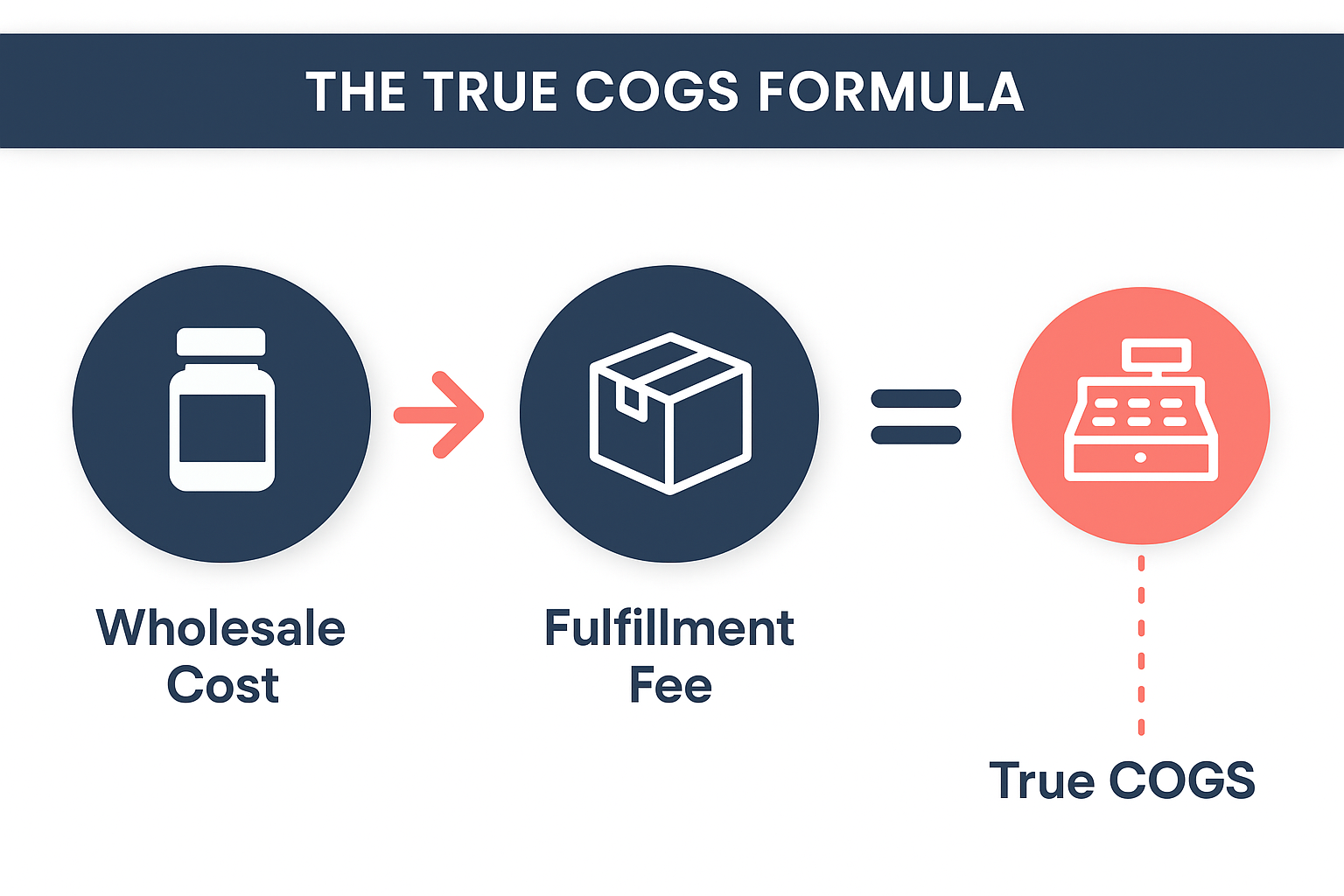
Here is the only formula you need: True COGS = Wholesale Cost + Fulfillment Fee. That is it. Wholesale price is what you pay the manufacturer for each bottle. The fulfillment fee is the cost to pick, pack, label, and ship that bottle to your customer.
Most beginners treat fulfillment as an operating expense – overhead, like rent or software. That is a mistake. Fulfillment fees hit your margin dollar-for-dollar, exactly the same way wholesale pricing does. If your wholesale is $8.45 and fulfillment is $2.00, your true COGS is $10.45, not $8.45. A seller who ignores the $2.00 is pricing their products into a loss before they ever run an ad.
The Flxpoint guide on dropshipping gross margins (January 2026) makes this clear: supplier-side shipping, packaging materials, and handling fees all belong in COGS, not in overhead. Whether you sell one bottle or ten thousand, that principle holds. (Flxpoint, Jan 2026).
That is where Rocktomic makes the math dead simple. Our flat ~$2 per-item fulfillment fee covers label printing, packaging, and pick-and-pack labor. No tiered surcharges, no handling add-ons, no per-order surprises. Your COGS stays predictable at any order volume. On the Free plan ($0/month) you get the same flat fee; on the Scale plan ($297/month) you get the lowest per-unit wholesale pricing. Either way, you know your true cost before you set a price.
To see how the fee works for your product mix, check our on-demand fulfillment at $2 per item page. One flat number, one clean formula, no hidden math.
Canonical Money-Math Example: Super Creatine Gummies (ROC943)
Pick one SKU. Run the numbers on that SKU. Then scale the formula to your whole catalog. Here is the exact math for a real product: Super Creatine Gummies 1000mg (ROC943) on the Scale plan.
| Line Item | Amount |
|---|---|
| Scale Wholesale Cost (ROC943) | $8.45 |
| Fulfillment Fee (flat per-item) | $2.00 |
| Total True COGS | $10.45 |
| Suggested MSRP | $29.97 |
| Gross Profit Per Bottle | $19.52 |
| Gross Margin Percentage | 65.1% |
Every line matters. The Scale wholesale cost is $8.45. Add the flat $2.00 fulfillment fee. Your true COGS lands at $10.45. At the suggested MSRP of $29.97, gross profit per bottle is $19.52. That is a 65.1% gross margin.
Compare that to general dropshipping averages. Spark Shipping (Feb 2026) put typical margins between 10% and 30%. Supplement dropshipping with Rocktomic on Scale blows past that range. The difference is not small. It is the difference between surviving and thriving.
A 2024 NIQ report cited by Shopify found that a 1% price increase can boost margins by about 11% when volume holds. Small improvements in COGS or price compound fast. That is why you run the numbers on your chosen SKUs before you set retail prices. Use the supplement margin calculator to plug in your own wholesale cost, fulfillment fee, and target MSRP. See the gross margin instantly.
Want to see how those per-bottle profits stack up across a month, a quarter, or a year? The profit projection tool lets you scale the math. Enter your order volume, and it shows revenue, COGS, and net profit over any period. No guessing. No spreadsheets. Just the real numbers behind your brand.
One SKU example does not prove a business model. But this one SKU – Super Creatine Gummies 1000mg (ROC943) – shows what is possible when COGS is accurate and margins are healthy. Test your own mix. The tools are free. The data is yours.
Membership Plan Impact on Your COGS (Free vs Scale)
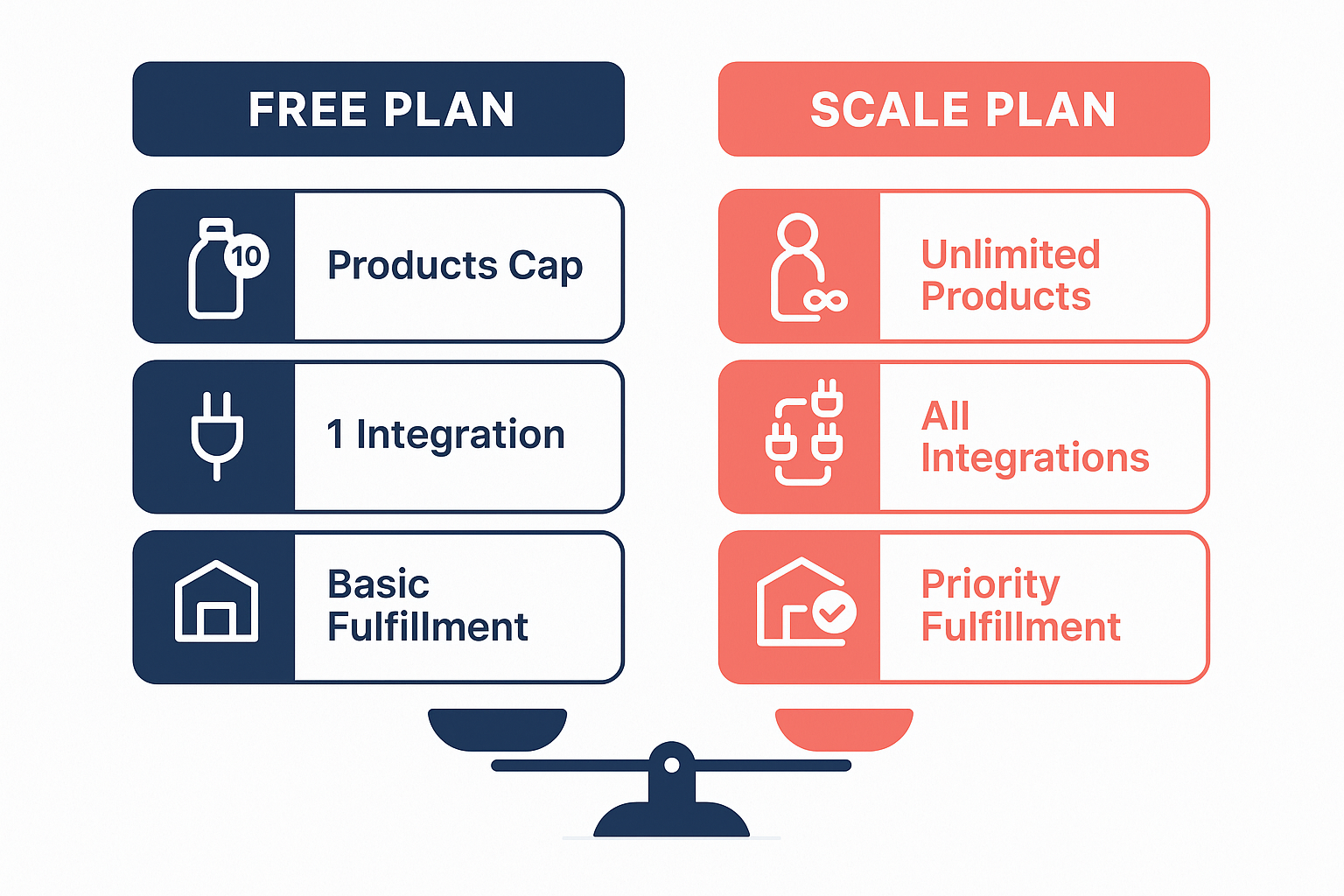
Your membership plan directly controls the wholesale price you pay per SKU, which is the biggest variable in your COGS. The Free plan costs $0 per month and gives you standard wholesale pricing on up to 10 products with one sales-channel integration. The Scale plan costs $297 per month and unlocks the lowest per-unit wholesale pricing across the full 140+ catalog, unlimited channels, and priority fulfillment. Using the same Super Creatine Gummies example, the Scale wholesale of $8.45 is only available on the Scale plan. On Free, that same product costs more per unit. The fulfillment fee stays flat at roughly $2 per item regardless of your plan, so the membership discount lowers every SKU’s COGS immediately. Bulk ordering (24-unit MOQ) drops the per-unit cost further still, available on both plans but with a larger absolute savings at Scale’s lower base price. The Free plan is ideal for testing one or two products with a single channel. The Scale plan delivers the lowest possible per-unit COGS across your entire line. Use the 2026 white label supplement cost breakdown to model how the $297 monthly fee compares against the COGS savings on your actual volume. At a few hundred units, Scale can pay for itself in reduced wholesale costs alone. The math is simple: lower per-unit wholesale minus a flat fulfillment fee equals a COGS that undercuts any Free-plan pricing on every product you sell.
Hidden Costs That Sneak Into Your Supplement COGS
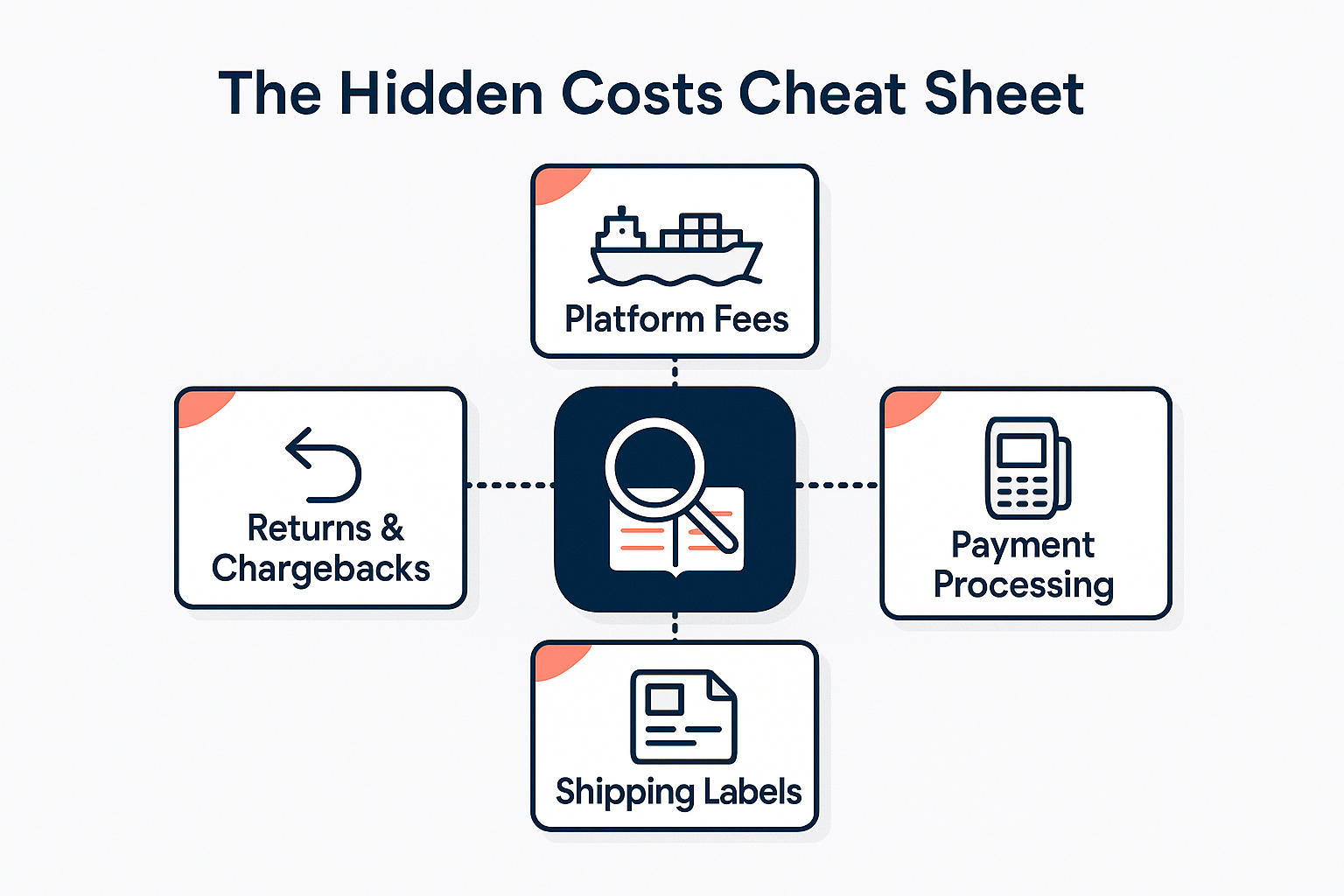
Wholesale cost and fulfillment fees are just the start. Five more cost layers eat into your net profit. None of these count as COGS under GAAP, but ignore them and your margin math will be wrong.
- Payment processing. Stripe, PayPal, and merchant accounts take roughly 2.9% + $0.30 per transaction. On a $69 sale that’s about $2.30 gone before you see a cent. That reduces net revenue directly.
- Platform transaction fees. Shopify charges 2.9% + $0.30 on its Basic plan; TikTok Shop takes a variable commission; marketplaces like Amazon take 15% or more. Each platform has its own cut.
- Shipping materials. Custom poly mailers, branded boxes, or branded inserts look professional but add $0.50 to $2.00 per order. Dropship suppliers ship in generic packaging unless you pay extra.
- Returns and chargebacks. Budget 2-5% of revenue depending on your product category. Chargebacks also carry a fixed fee ($15-$25) on top of the lost sale. These hit your bank account directly.
- Compliance label updates. FDA or FTC regulation changes can force label reprints. A new Supplement Facts panel or allergen warning means reordering labels for your entire inventory, even if product formula hasn’t changed.
Track these five costs separately from COGS. Subtract them from your gross margin to find true net profit per order. Without this step, you might think you are making 40% when you are actually making 25%.
How Rocktomic’s Flat $2 Fulfillment Fee Compares to Alternatives
Most fulfillment platforms don’t show the true cost until the first order ships. They layer a per-order fee ($3 – $8 per item), pick-and-pack surcharges, storage charges, and sometimes commission on every sale. That buried math turns a profitable product into a loss leader.
Rocktomic keeps it one line: a flat ~$2 per item with zero commission, zero storage, and zero monthly minimums. On the Free plan ($0/month) you get that same flat rate. On Scale ($297/month) the per-unit wholesale drops, but the fulfillment math stays identical.
Here’s the operator’s difference: when your COGS formula is wholesale + $2 = total cost, you know exactly where every dollar goes. No guessing, no surprise fees. You can price to market, run ads, and keep margin without a spreadsheet to catch hidden charges. The flat structure lets you scale from 10 units to 10,000 units without renegotiating a rate card.
And because Rocktomic owns no inventory until you sell, there’s no storage bill. You ship only what you sell. That’s the difference between a simple COGS calculation and a monthly puzzle of fees.
FAQ: Every Question About Dropship Supplement COGS
What exactly is COGS for a dropship supplement brand?
For a dropship supplement brand, COGS (Cost of Goods Sold) is the sum of the wholesale price you pay the manufacturer plus any per-unit fulfillment or handling fees. It does not include marketing, platform subscriptions, or shipping charges you pass to the customer. Getting this number exact is critical for setting a profitable retail price and filing accurate taxes.
How do fulfillment fees affect supplement COGS?
Fulfillment fees are a direct, per-unit cost that must be included in COGS. If your wholesale cost is $8.45 and the fulfillment fee is $2.00 per item, your true COGS is $10.45. Skipping the fulfillment fee inflates your perceived margin. Rocktomic charges a flat ~$2 per item for pick, pack, and label, making the math simple and predictable.
What is the difference between wholesale cost and total COGS?
Wholesale cost is the manufacturer price for the product itself. Total COGS is the wholesale cost plus any direct costs required to get the finished product to your customer, including fulfillment fees, label printing, and packaging materials. For dropship supplements, the gap between these two numbers can be up to 20% or more of the wholesale price.
How does the Rocktomic Free plan vs Scale plan change my COGS?
Both plans use the same flat ~$2 per-item fulfillment fee, but the membership level changes your wholesale pricing. The Free plan ($0/month) gives access to standard wholesale pricing on up to 10 products. The Scale plan ($297/month) unlocks the lowest per-unit wholesale pricing across the full 140+ product catalog, which directly lowers your COGS and increases per-bottle margin.
What hidden costs do supplement brands miss in COGS?
Commonly missed costs include: label design amortization, sample shipping for quality checks, packaging variations (e.g., custom boxes instead of standard mailers), and regulatory compliance label updates. None of these are fulfillment fees, but they should be factored into your breakeven analysis per SKU. Spread them across your first production run for an accurate per-unit cost.
What is a realistic supplement profit margin with Rocktomic?
Using a real product example: Super Creatine Gummies 1000mg (ROC943) has a Scale wholesale cost of $8.45. Add the ~$2 fulfillment fee for a total COGS of $10.45. At the suggested MSRP of $29.97, your gross margin is $19.52 per bottle, or 65.1%. This margin is significantly higher than the typical 15-30% average for general dropshipping categories.
How do I calculate my break-even retail price for a supplement?
Start with your total COGS (wholesale + fulfillment). Then add your desired gross profit per unit. A common approach is to set retail at 3x to 4x your total COGS. Using Super Creatine Gummies (ROC943): COGS of $10.45 x 3.0 = $31.35 retail. The suggested MSRP of $29.97 gives strong margin while staying competitive. Use a margin calculator to test different price points before launch.
Can I lower my COGS as my supplement brand grows?
Yes. Rocktomic’s Scale plan at $297/month drops your per-unit wholesale pricing below Free plan rates, immediately lowering COGS on every bottle. As volume increases, you can also move to bulk ordering (24-unit MOQ per SKU) for even lower per-unit costs. Custom formulation offers the lowest per-unit cost at higher MOQs. Each tier reduces your COGS and expands your margin.
Run Your COGS Before You Launch
Your margin is determined the moment you pick a SKU and a plan. Before you launch, open the supplement margin calculator, enter your wholesale cost plus the flat $2 fulfillment fee, and set a retail price that gives you at least 50% gross margin. That number decides whether your brand survives past month one.
When you are ready to lock in the lowest wholesale rates, upgrade to the Scale plan ($297/month). Own your brand with zero inventory, a $0/month Free plan entry, and US GMP quality with a Certificate of Analysis on every batch. No hidden fees, no bulk commitments.
Run your COGS now. Then check Rocktomic membership pricing and start building your supplement brand today.