
Per-Bottle Profits: Unlocking Unit Economics for Dropship Supplements
· 9 min read · By Rocktomic Labs Team
What Are Unit Economics for Dropship Supplements?
Most supplement dropshippers cannot tell you their exact profit per bottle until after they spend money on ads. That is backwards. Per-bottle unit economics is the single calculation that determines whether a brand scales or stalls. This guide breaks down the exact formula, the real wholesale costs, the hidden fees that kill margins, and a worked example showing how one SKU delivers $22.73 gross profit per bottle on a $29.97 MSRP – a 75.8% margin before marketing.
Pick any product, set your monthly volume, and see your real per-unit and monthly profit on every plan – fulfillment, card processing, and membership all included.
Per-bottle unit economics is simple: MSRP minus (wholesale cost + fulfillment fee). That one number tells you if your business model works before you spend a dollar on ads. Most dropshippers confuse revenue with profit because they only track top-line sales. Unit economics forces you to account for every direct cost tied to one bottle leaving the shelf.
Industry data from Finaloop (2025) shows top-quartile ecommerce brands achieve net margins above 20%, while median stores sit around 8% (Finaloop, 2025). The gap between those numbers is almost always poor unit economics – not poor products.
Getting unit economics right starts with controlling your two direct costs. Rocktomic’s on-demand fulfillment model charges a flat ~$2 per item, so your fulfillment cost is fixed and predictable. The Scale plan ($297/month) unlocks the lowest per-unit wholesale pricing across over 140 products, directly boosting your gross profit per bottle. To see how the full fulfillment chain works, read how Rocktomic on-demand fulfillment works.
What Goes Into the Per-Bottle Profit Formula?
Profit isn’t random. It follows a clear formula: Gross Profit per Bottle = MSRP − Wholesale Cost − Fulfillment Fee. Gross margin % is then gross profit divided by MSRP. Net profit subtracts everything else: Net Profit per Bottle = Gross Profit − Marketing CAC − Platform/Processing Fees.
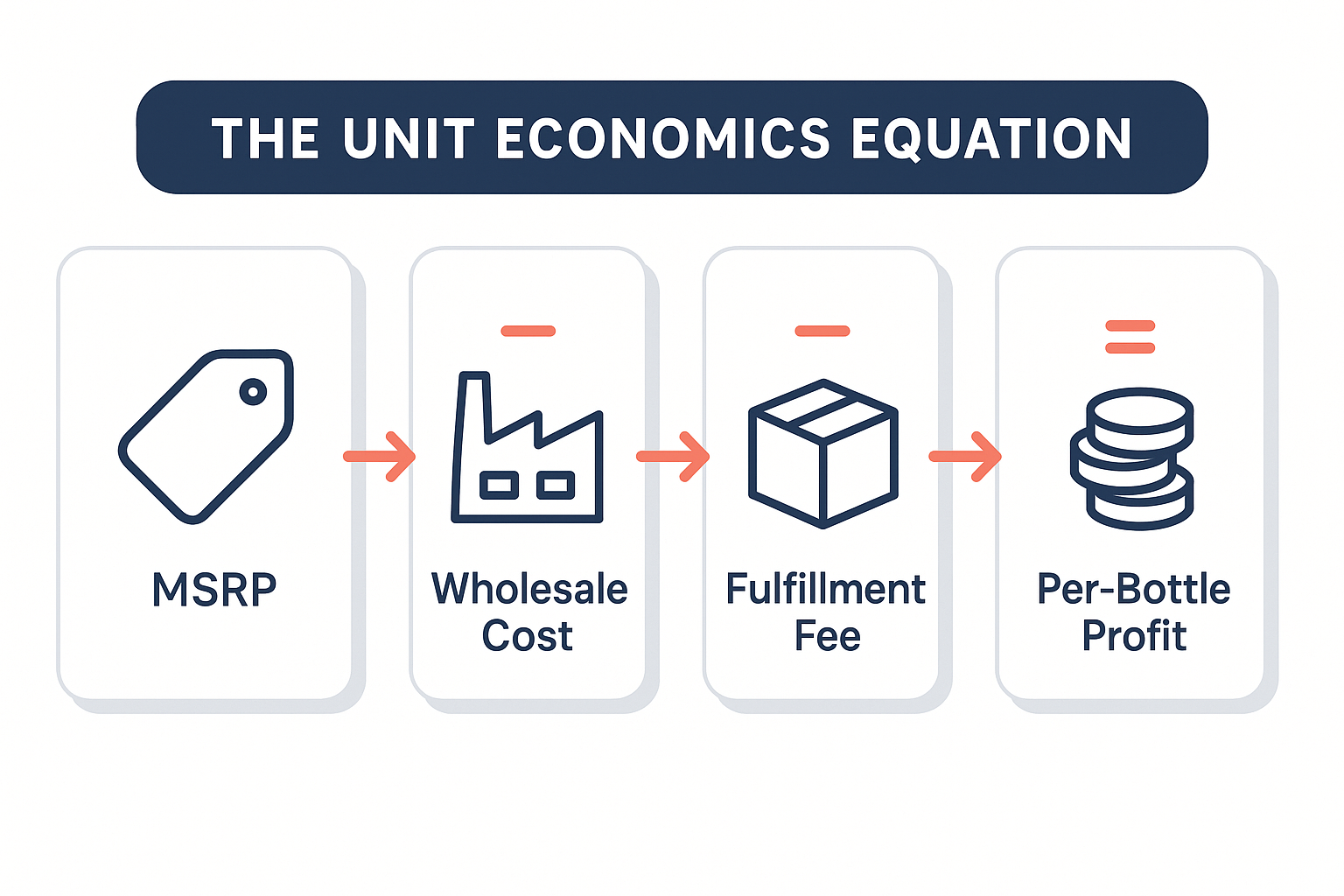
Each variable matters. MSRP is your price – set by you, not the manufacturer. Wholesale cost is the COGS: manufacturing, bottling, labeling one unit. Fulfillment is the flat pick-pack-label fee (about $2 at Rocktomic). Marketing CAC is what a customer costs you via ads. Platform fees include Shopify ($39/mo), payment processing (2.9% + $0.30 per transaction), and app subscriptions.
Once you map these numbers, you see real profit potential. For a deeper breakdown, read our white label supplement profit margin formula guide.
Canonical Worked Example: Ashwagandha (ROC822) Per-Bottle Math
Here is the exact per-bottle math for Rocktomic product ROC822 (Ashwagandha 60ct) on the Scale plan at $297/month. The brand sets the retail price.
| Line Item | Amount |
|---|---|
| MSRP (brand sets retail) | $29.97 |
| Scale Wholesale Cost (ROC822) | -$5.24 |
| Fulfillment Fee (pick, pack, label) | -$2.00 |
| Gross Profit per Bottle | $22.73 |
| Gross Margin % | 75.8% |
That $22.73 gross profit is before marketing and platform costs. If your brand spends $8 per customer acquisition (Meta or TikTok ads) and pays $2.50 in Shopify subscription plus payment processing per order, the net profit per bottle lands at $12.23. That is a 40.8% net margin – still solid by any ecommerce standard and far better than most apparel or electronics categories.
Now compare that to the old model: forced-pallet buys where you prepay $15,000 for inventory you might not sell for months, or per-order surcharge platforms that tack on $3-5 per bottle in hidden fees. With Rocktomic, there is no inventory prepayment and no per-order markup beyond the flat $2 fulfillment fee. You pay only when a customer orders.
Run your own numbers with the supplement margin calculator to see how different ad costs or retail prices change your bottom line.
Beyond COGS: The Hidden Costs That Kill Per-Bottle Profit
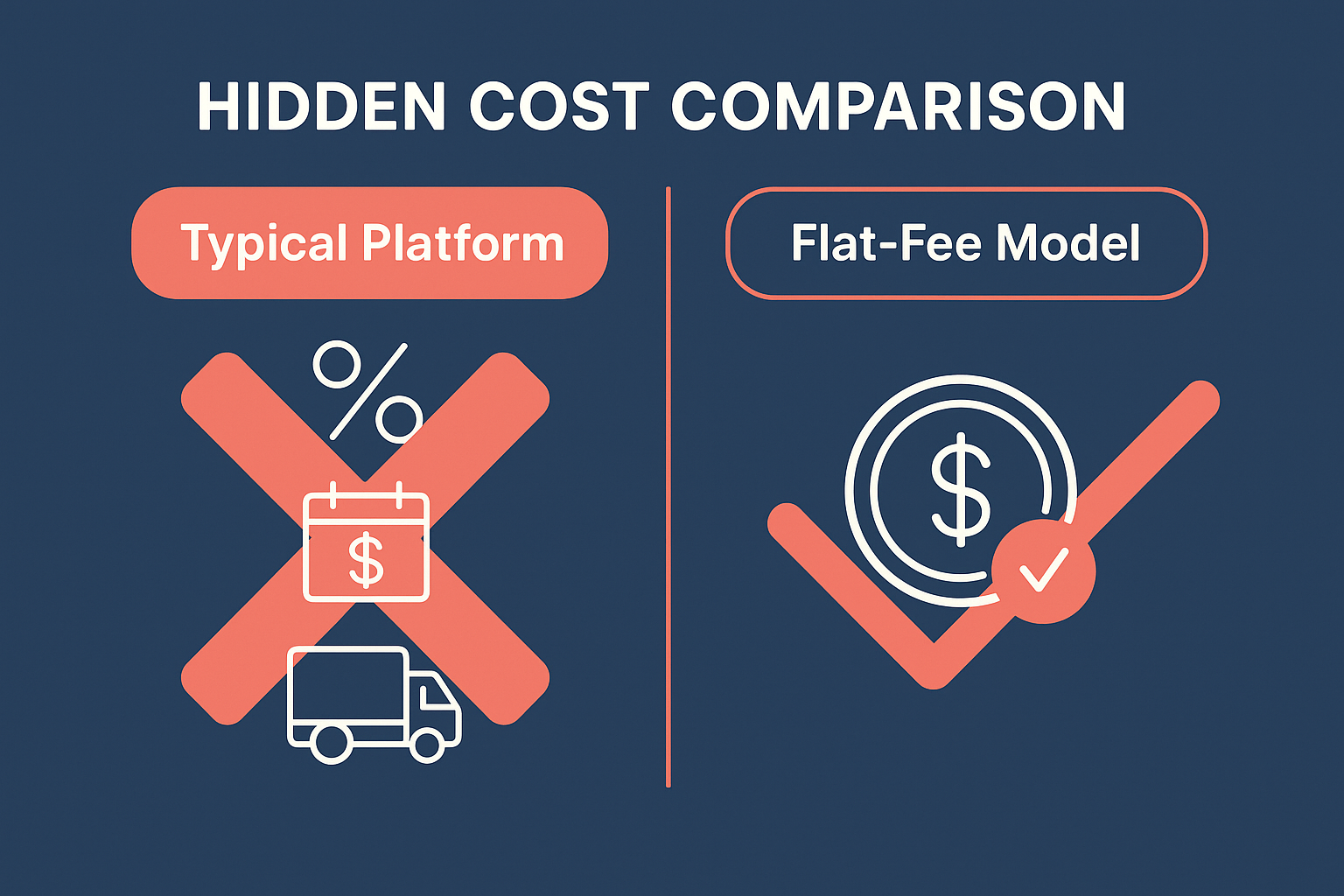
Most new operators treat the wholesale cost as their only expense. Reality is messier. Payment processing alone eats 2.9% plus $0.30 per transaction. Add platform subscriptions for your store, app fees for reviews, upsells, and email marketing. Chargebacks and refunds chip away another chunk. A manufacturer quote of $5.24 per bottle can balloon to $9-$10 in true landed cost per order once all variables are included. According to the InventoryReady guide to supplement costs, these hidden fees often catch first-time sellers off guard.
Why the flat $2 fulfillment model changes the math
The flat $2 per item fulfillment at Rocktomic eliminates warehouse overhead, storage minimums, and tiered shipping calculations entirely. No monthly storage fees, no pick-and-pack surcharges for small orders, no label setup charges per SKU. That predictability protects your margin on every single dropship order. For a complete walkthrough of every cost layer, see the dropship supplement COGS breakdown.
Free Plan vs. Scale Plan: How Membership Tier Affects Unit Economics
Your membership tier rewrites your per-bottle math. One plan costs nothing upfront but caps your reach. The other charges $297 a month but unlocks the lowest wholesale pricing and unlimited channels. Here is exactly how the two compare.
| Factor | Free Plan ($0/mo) | Scale Plan ($297/mo) |
|---|---|---|
| Monthly Fee | $0 | $297 |
| Products | Up to 10 | Full 140+ catalog |
| Sales Channels | 1 integration | Unlimited |
| Wholesale Pricing | Standard | Lowest per-unit |
| Fulfillment | $2/item | $2/item |
| Priority Fulfillment | No | Yes |
The Scale plan pays for itself after roughly 13 bottles per month on higher-margin SKUs, thanks to the wholesale spread. Beyond that point, every additional bottle earns at the lowest tier. For operators scaling across Shopify, TikTok Shop, and Amazon, unlimited integrations remove the per-channel friction that kills growth. Read the full white label supplement cost breakdown for a deeper margin analysis.
How Per-Bottle Economics Change Across Product Categories
Rocktomic’s 140-plus product catalog spans capsules, powders, gummies, liquids, and topicals. Each form carries a different wholesale cost structure, which means your per-bottle margin can swing dramatically depending on what you choose to sell.
Consider three best-selling examples from the catalog. Capsules – Ultra Test (ROC506) at a wholesale of $6.51 and an MSRP of $39.97 – deliver an 83.7% margin. Powders – Creatine Powder (ROC609) at $9.30 wholesale and $35.97 retail – still net a strong 74.1% margin. Gummies – Super Creatine Gummies (ROC943) at $8.45 wholesale and $29.97 retail – come in at 71.8%.
Higher wholesale costs on gummies and protein powders are offset by higher perceived value at retail. The real lesson: per-bottle margin dollar amount matters more than margin percentage. A $33.46 profit on Ultra Test is worth more than a 10% higher percentage on a cheaper SKU. Let the dollar sign guide your product mix, not the ratio.
The category shift is real. According to Grand View Research, 2026, consumer demand for gummies and powders continues to grow, but capsules remain the higher-margin workhorse for most operators.
How to Scale Unit Economics from Single Bottles to a Brand
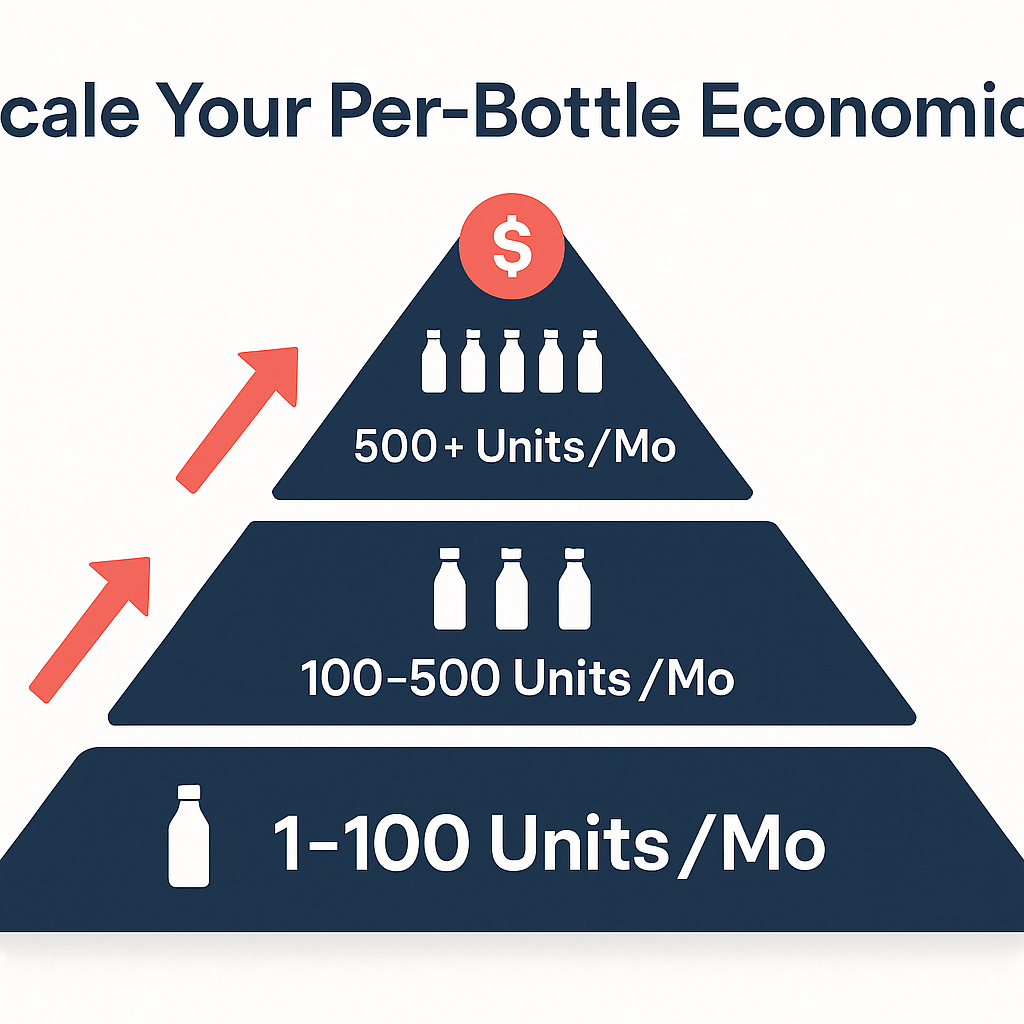
That $227.30 monthly gross profit on Ashwagandha at 10 bottles? At 100 bottles it becomes $2,273. At 500 it hits $11,365. The Scale plan’s $297/month fee turns into a rounding error before you cross 100 bottles.
Volume linearizes your fixed costs. But repeat purchase behavior is the true multiplier. Supplements are consumables with a natural 30-to-60-day reorder cycle. A customer you acquire once at $8 CAC who reorders six times per year drops that effective CAC to $1.33 per bottle by the sixth order. That is the unit-economics lever no single-bottle calculation captures.
Your job shifts from chasing one-off sales to building recurring revenue. Track not just per-bottle profit but customer-level unit economics over 12 months. Then project your supplement profits and see how fast those numbers compound.
Why Per-Bottle Unit Economics Determine Your Ad Strategy
Your per-bottle gross profit directly decides how much you can spend to acquire a customer. If that number is $22.73, you have room to bid $12 – $15 per acquisition and still keep healthy net margins. Drop it to $8 in gross profit, and your ceiling drops to $3 – $4 per acquisition – a range that strangles platform choice, creative testing, and scaling.
Brands that know their exact per-bottle unit economics bid aggressively on Meta and TikTok Shop because they see the break-even line clearly. Brands that guess often overbid and lose money on every sale they win. The math doesn’t lie: your ad budget is a function of your margin, not your ambition.
FAQ
What is the wholesale cost per bottle on the Free plan?
On the Free plan, wholesale pricing varies by product. An example for a popular supplement is about $8.50 per bottle. This is the base cost before the $2 per item fulfillment fee and any optional branding or store build-out packages.
Does the Free plan have a monthly fee?
No. The Free plan costs $0 per month. You pay only the ~$2 per item fulfillment fee when an order ships. There is no inventory holding cost, no monthly minimum, and no upfront purchase required for any of the 10 white-label products you can sell.
What does the Scale plan cost and what does it include?
The Scale plan is $297 per month. It gives you the lowest per-unit wholesale pricing, access to the full 140+ product catalog including Scale Exclusives, unlimited sales channel integrations, and priority fulfillment. It’s the primary conversion target for serious operators.
How much is the Starter Branding Package?
The Starter Branding Package is a one-time $497 fee. It includes 1 logo design, 10 product labels, and 10 3D mockups. This is an optional add-on for the Free plan; the Free plan remains $0/month without it.
What is the minimum order quantity for dropship orders?
For the dropship model, the minimum order quantity is zero. You pay nothing until a customer places an order. Rocktomic picks, packs, and labels each item and ships it directly to your end customer for a flat ~$2 per item fee.
How much does the Starter Online Store Build-Out cost?
The Starter Online Store Build-Out is a one-time $1,497 fee. This includes a fully built Shopify store with up to 10 products. It is an optional add-on and does not change the $0/month Free plan.
What is the Business-in-a-Box package and its price?
The Business-in-a-Box package bundles the Starter Branding Package and the Starter Online Store Build-Out for a one-time $997. That is the best-value option if you want both branding and a store. The Free plan remains $0 per month without any of these add-ons.
Do I need to buy inventory upfront for bulk orders?
For bulk orders, the minimum order quantity is 24 units per SKU. You pay for the product at the per-unit wholesale price (which is lower than dropship wholesale) plus the ~$2 per item fulfillment fee. No massive pallet buys required, unlike some manufacturers that force full container loads.
Start Building Your Per-Bottle Profit Math Today
You don’t need inventory, manufacturing MOQs, or a chemistry degree to launch. Rocktomic’s Free plan gets you started with 10 products and a $0 monthly fee. The Scale plan unlocks the full catalog at the lowest wholesale pricing for just $297 per month.
Run your own numbers with the margin calculator – pick a SKU, set your MSRP, and see per-bottle profit before you build a single product page. Want a walkthrough of which SKUs deliver the best unit economics for your audience? Book a call with our team.