
The 5 Hidden Costs Devouring Your Supplement Dropshipping Margins
· 10 min read · By Rocktomic Labs Team
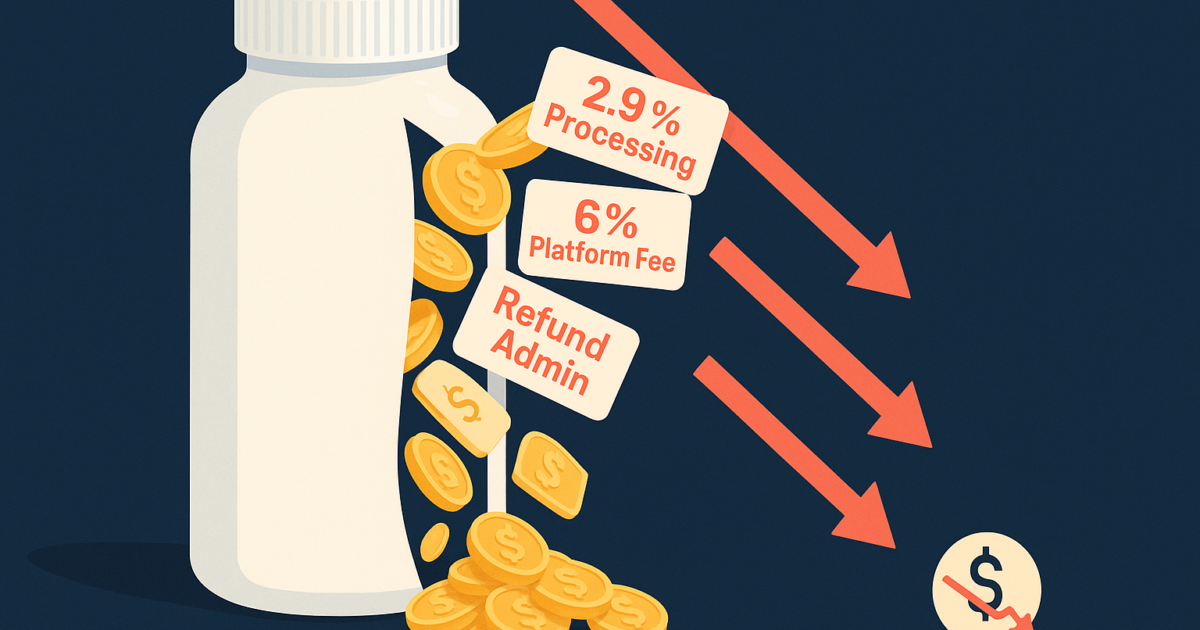
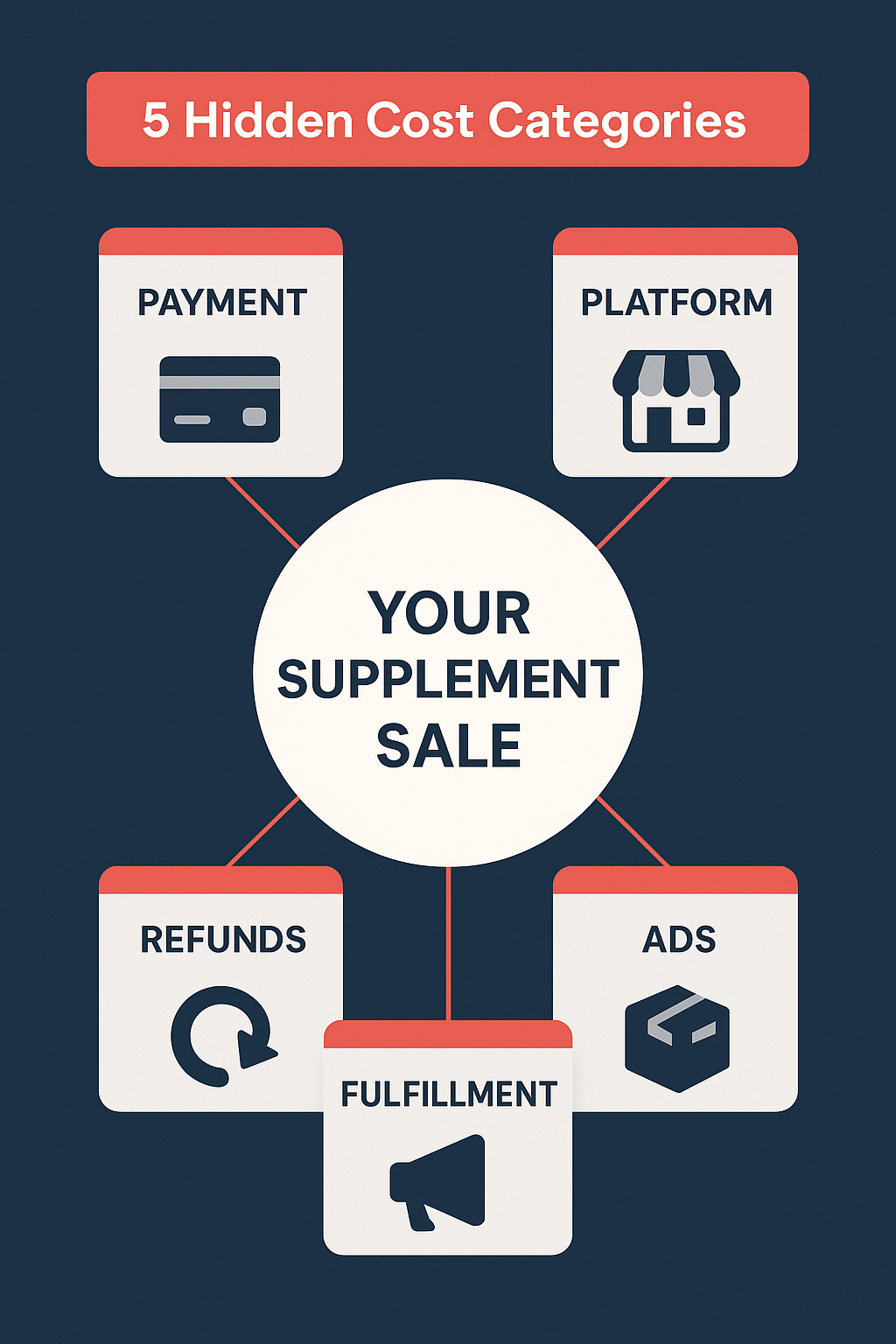
Most supplement dropshippers calculate profit by subtracting wholesale cost from retail price. That math misses five invisible cost categories that can slice 30-55 percent off net margin. Payment processing, platform referral fees, refund charges, advertising inflation, and fulfillment surcharges compound silently until a “profitable” product is actually losing money.
What are the hidden costs of supplement dropshipping?
The hidden costs are fees that do not appear on the product cost sheet but deduct from every transaction. They include payment processing fees (1.5-3.5 percent per transaction, with a 2.36 percent average swipe fee across Visa/Mastercard in 2025 per Swipesum), platform referral fees (TikTok Shop 6 percent, Shopify 2.9 percent plus $0.30), refund and chargeback costs (lost product plus admin fees), rising advertising costs (Amazon CPC hit $1.18 in early 2026, up from $0.97 in 2024 per Branvas), and mandated fulfillment surcharges (TikTok FBT at $3.58 per unit). Most sellers do not model these into their unit economics.
Pick any product, set your monthly volume, and see your real per-unit and monthly profit on every plan – fulfillment, card processing, and membership all included.
Hidden Cost #1: Payment Processing Fees Are The Silent 2.9 Percent Tax
Every credit card swipe carries three embedded fees: interchange (paid to the issuing bank), assessment (paid to Visa/Mastercard networks), and processor markup. For ecommerce, the all-in rate typically hits 2.9% plus $0.30 per transaction.
On a $29.97 bottle that means $0.87 in percentage fees plus $0.30 fixed — a $1.17 loss before any other cost. Over 1,000 orders that’s $1,170 in fees. More than three times the cost of Rocktomic’s Scale plan at $297/month. That silent tax compounds order over order.
The fix: negotiate lower rates, route cards through lower-cost networks, or switch to a processor that understands high-volume supplement sales. Every 0.5% saved on $100,000 in revenue puts $500 back in your pocket.
Hidden Cost #2: Platform Referral Fees Add 2 To 8 Percent Per Sale
Every sale on a marketplace like TikTok Shop comes with a built-in tax. For health and wellness products in the US, TikTok Shop charges a flat 6% referral fee, according to Dashboardly. New sellers get a promotional 3% rate for their first 30 days, but that reverts to 6% per Dashboardly. Shopify charges 2.9% plus $0.30 per transaction but no commission.
The true platform take-rate is higher because TikTok calculates fees on the discounted price, not the original price, and adds logistics surcharges. A Darkroom Agency breakdown of a $50k/month TikTok Shop brand found total costs consuming 67.75% of revenue once affiliate commissions (10-20%), fulfillment, ads, and returns were included.
Supplement brands using a direct-to-consumer model with flat fulfillment – like Rocktomic’s approximately $2 per item with no referral fee – keep the full MSRP minus wholesale cost and the single fulfillment fee. That margin stays in your pocket. No platform tax.
Explore sales channel integrations to see how you can bypass referral fees entirely.
Hidden Cost #3: Refunds And Chargebacks Double-Dip Your Losses
A refund does not just lose the sale. It loses the product, the outbound shipping, and often triggers an administration fee that cuts into your margin a second time, sometimes wiping out the profit from two or three good orders.
Take a $29.97 bottle. The customer returns it, and you absorb the $8.45 wholesale cost, the $3.58 FBT fulfillment fee, the outbound shipping, and roughly $0.36 in refund administration fee. TikTok Shop charges 20 percent of the original referral fee, capped at $5 per SKU (effective May 2025, per Dashboardly). Total loss per return: approximately $12.39 plus shipping.
Industry data cited by SellersCommerce shows return rates of 5 to 15 percent on marketplaces, meaning every 100 orders could incur $62 to $186 in hidden refund losses that never appear on your standard profit-and-loss statement.
Brands using a flat-fee fulfillment model with no per-order commission skip that refund administration fee entirely. That is one leak you can seal today without renegotiating a single contract.
Hidden Cost #4: Advertising Cost Inflation Is Bleeding Your Acquisition Budget
Customer acquisition costs have climbed steadily. A 2026 report by Branvas showed Amazon CPC reached about $1.18, up 22 percent from $0.97 two years earlier. Most Amazon sellers now spend 10 – 15 percent of revenue on PPC just to keep visibility. Facebook and Instagram CPMs averaged $10 – 15 in 2025, per AutoDS.
The real math on ad spend
Take a $29.97 supplement. At a 3x ROAS target, you spend $10 in ads to earn one sale. That consumes 33 percent of revenue before product or fulfillment costs.
Your only fix is to own the relationship. Rocktomic members on the Scale plan ($297/month) control their customer data, retarget directly, and avoid marketplace ad wars. Stop bleeding your acquisition budget on rented audiences.
Hidden Cost #5: Mandated Fulfillment Surcharges Add $3 To $4 Per Unit
Platforms are forcing sellers into their own logistics systems. TikTok Shop eliminated independent seller shipping for US sellers as of March 31, 2026 (Dashboardly). Fulfilled by TikTok (FBT) runs $3.58 per unit for single orders.
The Flat-Fee Alternative That Saves Thousands
Rocktomic charges a flat approximately $2 per item for pick, pack, and label shipping from its US GMP-certified facility. That $1.58 per-unit difference compounds: on 1,000 orders, you save $1,580 annually. No storage fees after 30 days (marketplaces charge $0.02 – $0.12 per cubic foot daily). Rocktomic’s on-demand model requires zero inventory storage. List products, customers order, we manufacture and ship. No warehousing, no dead stock, no storage bills.
Flat $2 per-item fulfillment eliminates this hidden surcharge entirely.
Money-Math: The True Cost Breakdown – One Product, Two Models
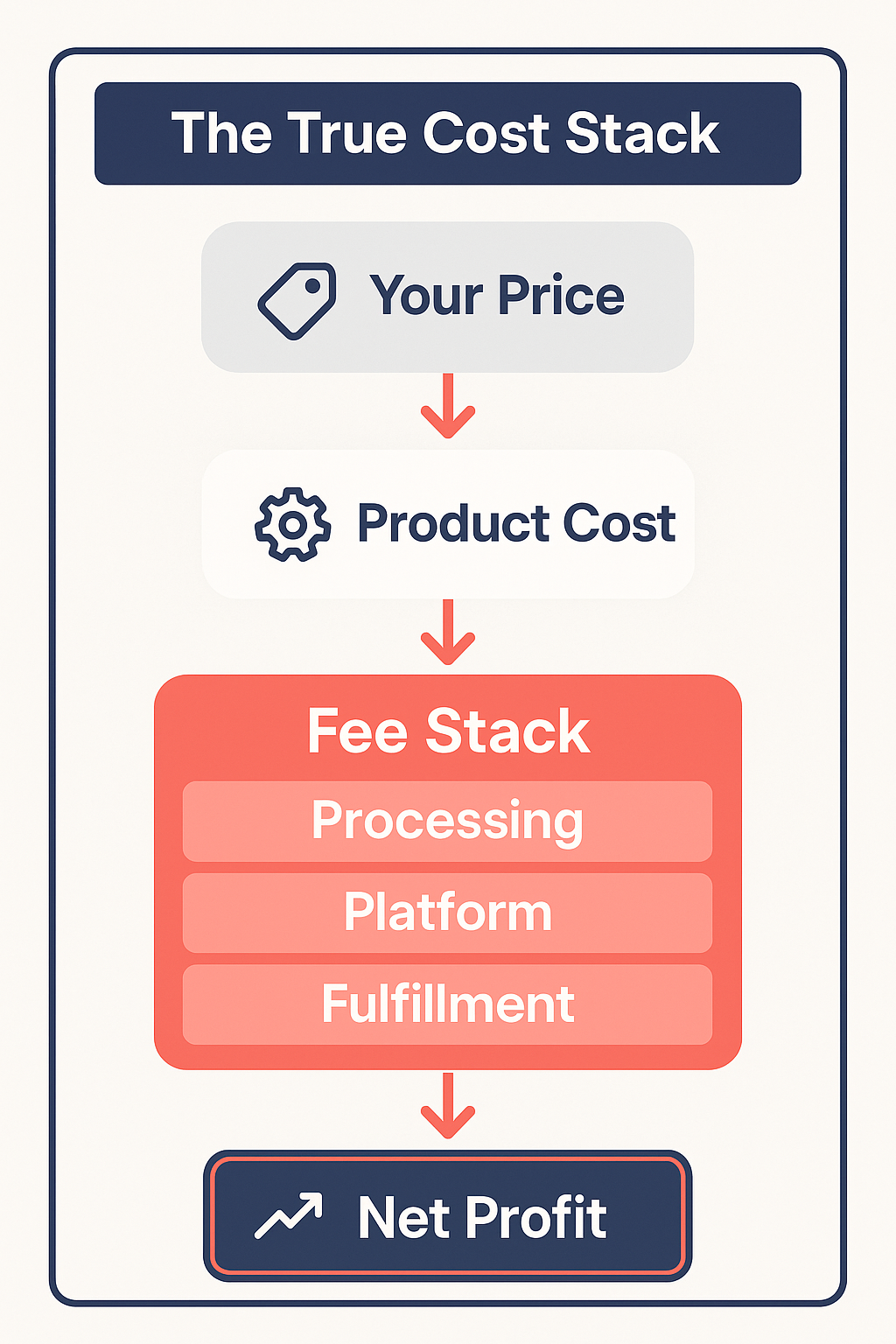
Marketplaces pitch volume, but the fee stack eats your margin. Take one canonical SKU: Super Creatine Gummies 1000mg (ROC943). MSRP is $29.97. Wholesale cost on the Rocktomic Scale plan ($297/month) is $8.45. Run that same bottle through two models to see exactly where the money goes.
| Cost Category | Marketplace Model (TikTok Shop) | Direct-to-Consumer (Rocktomic Scale) |
|---|---|---|
| MSRP | $29.97 | $29.97 |
| Wholesale COGS (ROC943) | $8.45 | $8.45 |
| Platform referral fee (6%) | $1.80 | $0.00 |
| Payment processing (2.9%+$0.30) | $1.17 | $1.17 |
| Fulfillment fee | $3.58 (FBT) | $2.00 (flat) |
| Estimated ad cost (30% CAC) | $8.99 | Varies (owned traffic) |
| Refund reserve (8% of COGS+fees) | $1.08 | $0.68 |
| Net profit per bottle | $4.90 | $17.67 |
| Net margin | 16.3% | 58.9% |
The marketplace model leaves you with $4.90 per bottle at a 16.3% margin. One chargeback or a bad ad day and you lose money. Rocktomic Scale keeps $17.67 per bottle at a 58.9% net margin — over 3.5x more profit. You avoid the 6% platform referral fee entirely and cut fulfillment costs by nearly half. That extra $12.77 per bottle funds real growth: your own ads, email capture, and higher customer lifetime value. You own the channel. The platform doesn’t.
Run your actual costs through the supplement margin calculator to compare the models head-to-head. For a deeper breakdown, read how to calculate white label supplement profit margins and mastering COGS for supplement dropship profits.
How To Plug Every Leak Today
Close each margin drain with these five actions:
- Audit your payment processing effective rate. If above 2.75% on interchange-plus pricing, switch processors (Swipesum flags this as the biggest hidden fee).
- Run the math on marketplace referral fees. If they eat more than you save in organic traffic, go direct.
- Price in a 5 – 8% refund reserve to cover chargebacks and returns.
- Set maximum CAC at 25% of MSRP. Pause any channel that exceeds it.
- Choose a fulfillment partner with flat, predictable fees.
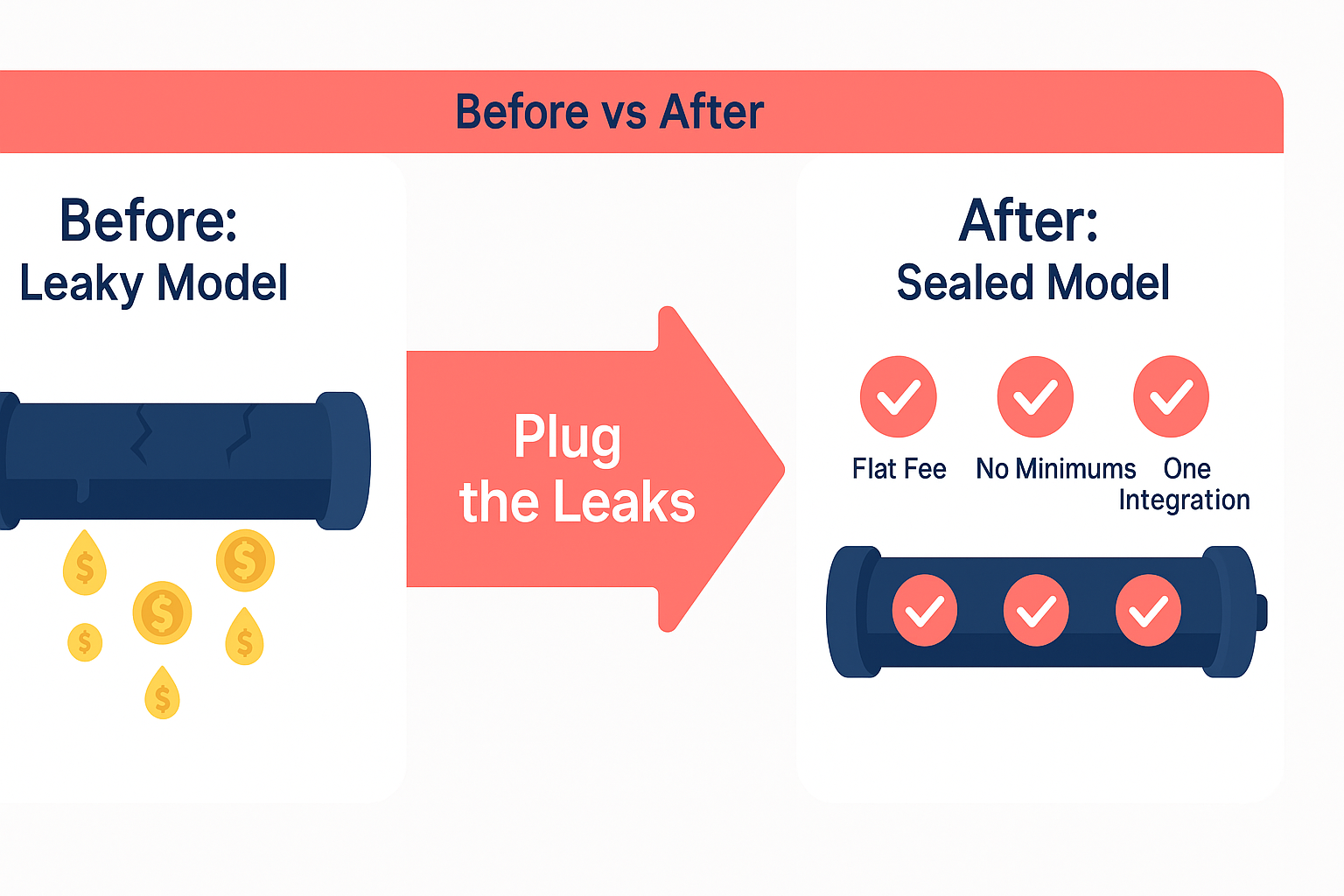
Rocktomic’s model eliminates the three biggest hidden costs: no platform referral fee, no inventory holding cost, and flat ~$2 per-item fulfillment. See how on-demand fulfillment works. Members on the Free plan ($0/month) can test up to 10 products with zero upfront purchasing; the Scale plan ($297/month) unlocks the lowest wholesale pricing and full 140+ catalog. For the full margin math, read our 2026 white label supplement cost breakdown.
Frequently Asked Questions About Hidden Costs In Supplement Dropshipping
What are the hidden costs in supplement dropshipping?
The five biggest hidden margin killers are payment processing fees (1.5 to 3.5 percent per transaction), platform referral fees (TikTok Shop charges 6 percent in the US; Shopify charges 2.9 percent plus $0.30), refund and chargeback costs (lost product plus a refund administration fee of 20 percent of the referral fee), advertising cost inflation (Amazon CPC reached $1.18 in early 2026, up from $0.97 in 2024), and fulfillment surcharges from mandated platform logistics like TikTok’s FBT at approximately $3.58 per unit.
How much do credit card processing fees cost supplement brands?
Credit card processing fees typically range from 1.5 to 3.5 percent per transaction for ecommerce businesses. The average effective swipe fee across Visa and Mastercard in 2025 was 2.36 percent, according to Swipesum data. On a $29.97 sale, that is roughly $0.71 per transaction before accounting for the flat per-transaction fee of $0.10 to $0.30 that most processors also charge.
What does TikTok Shop charge supplement sellers in 2026?
TikTok Shop charges US sellers a 6 percent referral fee on most product categories, including health and wellness supplements. There is no separate monthly subscription fee. However, the true cost is higher when you factor in mandatory fulfillment through Fulfilled by TikTok (FBT) at approximately $2.86 to $3.58 per unit, affiliate creator commissions (typically 10 to 20 percent), and a refund administration fee of 20 percent of the referral fee, capped at $5 per SKU.
How do refunds and chargebacks affect supplement dropshipping profit?
Every refund costs more than the lost sale. Sellers lose the product cost, outbound shipping, and on TikTok Shop also owe a refund administration fee of 20 percent of the original referral fee. For chargebacks, the merchant typically loses the product and the revenue and pays a chargeback fee of $15 to $25 on top. Industry data cited by SellersCommerce indicates Amazon return rates hover between 5 and 15 percent, making this a significant margin drain.
What is the true total cost of selling supplements on a marketplace?
A Darkroom Agency analysis found that a fashion brand generating $50,000 monthly on TikTok Shop paid 67.75 percent of revenue in combined costs: referral fees, transaction fees, payment processing, shipping, affiliate commissions, ads, content production, returns, and overhead. While supplement sellers face lower referral rates (6 percent versus 8 percent for fashion), the total cost of selling still runs 35 to 55 percent of revenue according to practitioner analyses.
How much does a Scale plan save on supplement wholesale costs?
Rocktomic’s Scale plan at $297 per month gives members the lowest per-unit wholesale pricing across the full catalog of 140+ products. For example, Super Creatine Gummies 1000mg (ROC943) has a Scale wholesale cost of $8.45 against an MSRP of $29.97, yielding a margin of $21.52 per bottle, or 71.8 percent before fulfillment. The flat $2 per-item fulfillment fee is the only per-order cost, with no platform referral fees or hidden marketplace deductions.
How do hidden fulfillment costs eat into supplement dropshipping margins?
Mandated platform logistics can add $3 to $4 per unit. TikTok Shop’s FBT fulfillment starts at $3.58 per single-unit order. By contrast, Rocktomic charges a flat approximately $2 per item for pick, pack, and label with no monthly minimum on the Free plan. Sellers on a Free plan ($0 per month) can sell up to 10 white-label products on one sales channel integration and pay only the $2 fulfillment fee when an order ships, with zero inventory holding costs.
What is the cheapest way to start a supplement brand without hidden fees?
The cheapest way is Rocktomic’s Free plan at $0 per month. Members pay no monthly fee, no per-order platform commission, and only the flat approximately $2 per-item fulfillment fee when orders ship. There is no minimum order quantity for dropshipping, no inventory purchase required, and no referral fee deducted from sales. The Free plan covers one sales-channel integration and up to 10 white-label products. The Scale plan at $297 per month unlocks the full 140+ product catalog and the lowest wholesale pricing.
Ready to build supplement margins that actually hold? Join Rocktomic’s Free plan at $0/month and start selling your own branded supplements with zero inventory, flat $2 fulfillment, and no hidden fees. Upgrade to Scale at $297/month for lowest wholesale pricing on 140+ products. Compare Rocktomic membership plans or use the supplement margin calculator to model your first product.