
The 7-Figure Secret to Supplement Claims That Actually Pass FDA Review
· 12 min read · By Rocktomic Labs Team
FDA Compliant Supplement Claims: The Answer-First Rule
There is one rule that decides whether your supplement label gets a warning letter or a sale: structure/function claims are allowed; disease claims are not. The FDA does not pre-approve supplement labels, but it enforces that boundary aggressively – issuing hundreds of warning letters every year to brands that cross it.
Answer three quick questions and get pointed to the supplement niche that fits your audience and your margins.
This guide gives you the exact language patterns that keep your claims compliant. You will learn how to write marketing copy that passes FDA review without sacrificing sales. No guesswork. Just the rules that let you sell volume and build a defensible brand.
What Is a Structure Function Claim?
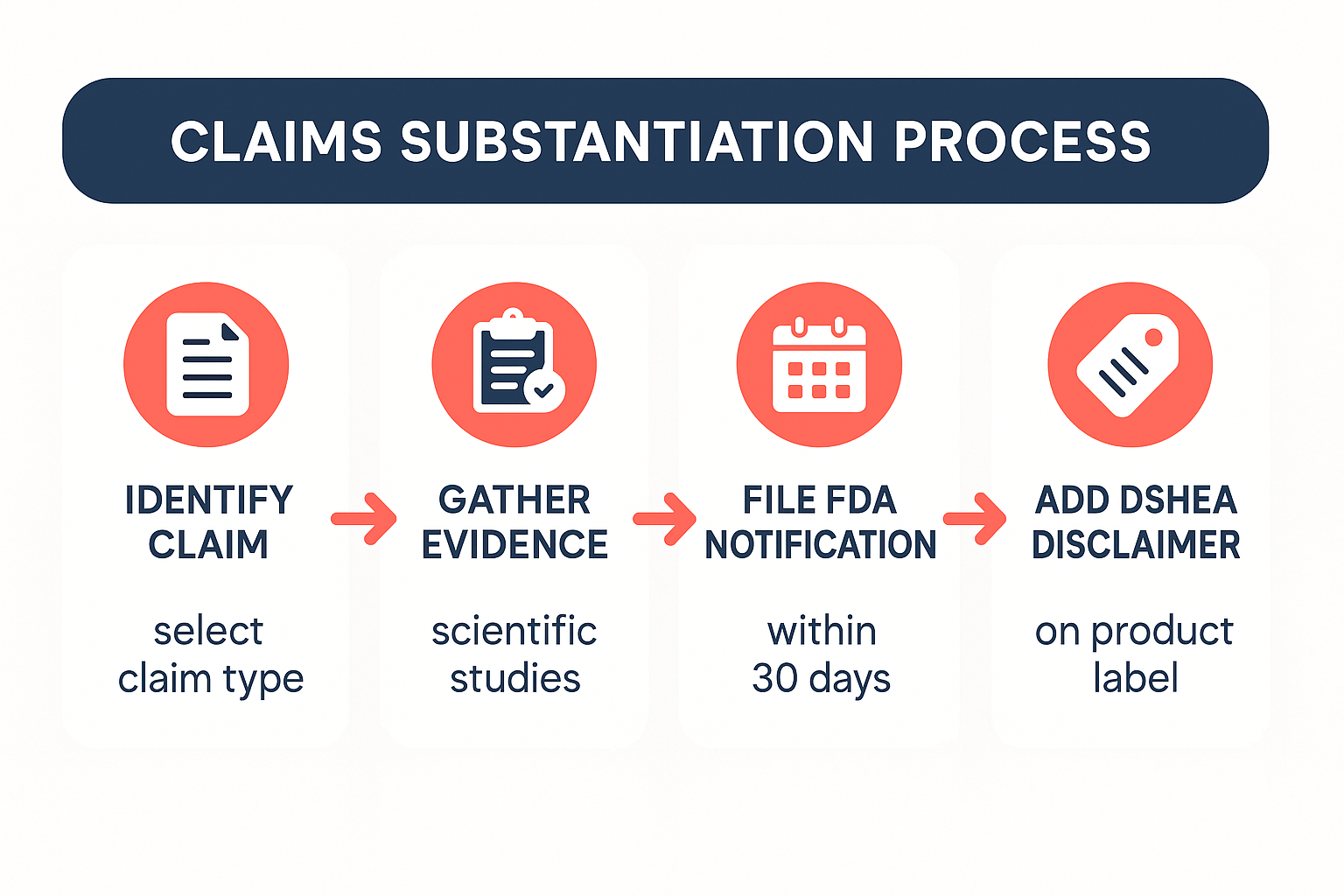
A structure/function claim describes the role of a nutrient or dietary ingredient in affecting the normal structure or function of the human body. This definition comes from the Dietary Supplement Health and Education Act (DSHEA) and 21 CFR 101.93. These claims do not require FDA pre-approval, but you must file a notification with the FDA within 30 days of first marketing your product.
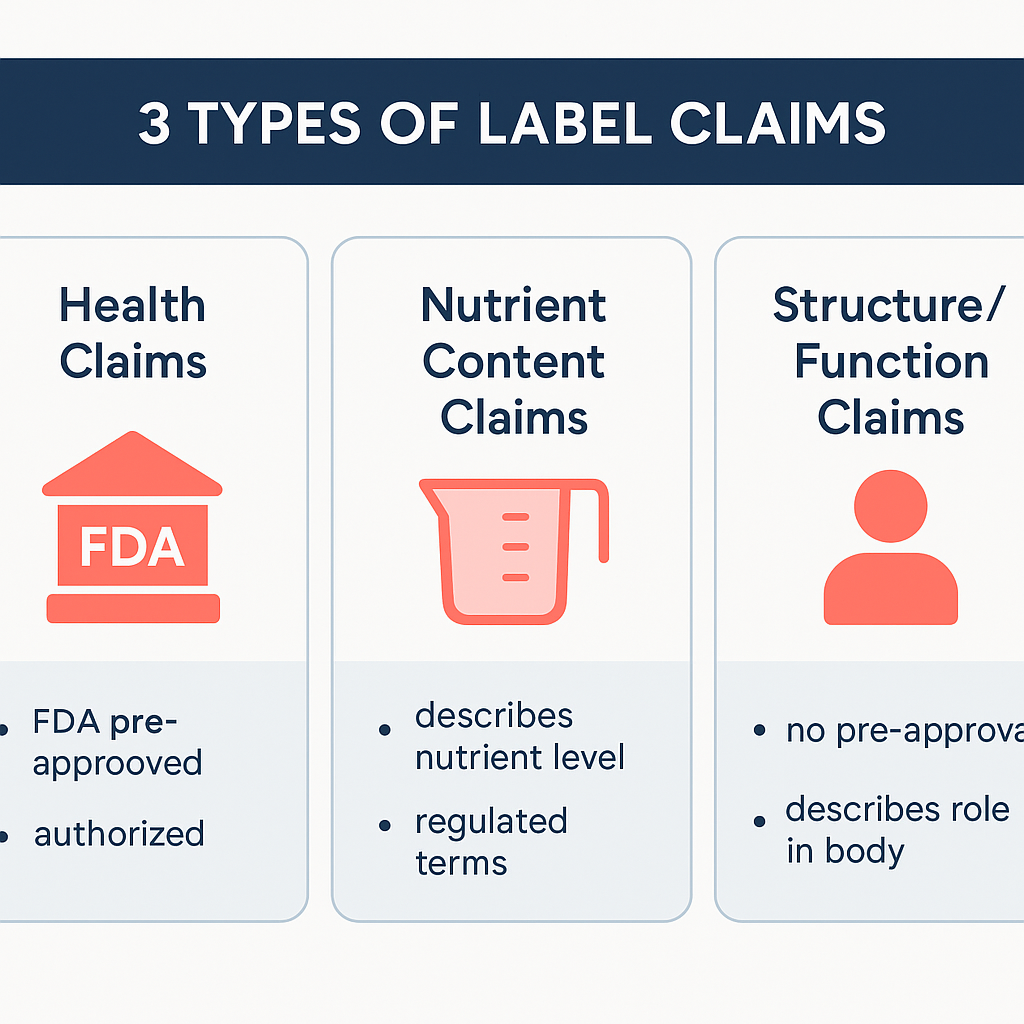
Examples of compliant structure/function claims include: “calcium builds strong bones,” “fiber maintains bowel regularity,” and “antioxidants maintain cell integrity.” These statements focus on the normal role of the ingredient, not disease treatment or cure.
There are three types of structure/function claims allowed under FDA rules:
- Structure/function claims – describe a nutrient’s effect on the body’s normal structure or function.
- General well-being claims – describe benefits related to a nutrient deficiency or general health.
- Nutrient deficiency claims – link a deficiency to a specific health condition.
Every batch you sell should carry a Certificate of Analysis proving purity and potency. Rocktomic provides COAs for every product to help you stay compliant and build trust. Learn more about Rocktomic quality and COA third-party testing.
For the full regulatory background, see the FDA’s Structure/Function Claims page.
What Is the Difference Between a Structure Function Claim and a Disease Claim?
A disease claim asserts that a supplement diagnoses, treats, cures, mitigates, or prevents a disease. Only FDA-approved drugs can make those. A structure-function (S/F) claim, by contrast, describes how a nutrient or ingredient affects the normal structure or function of the body – without mentioning a disease.
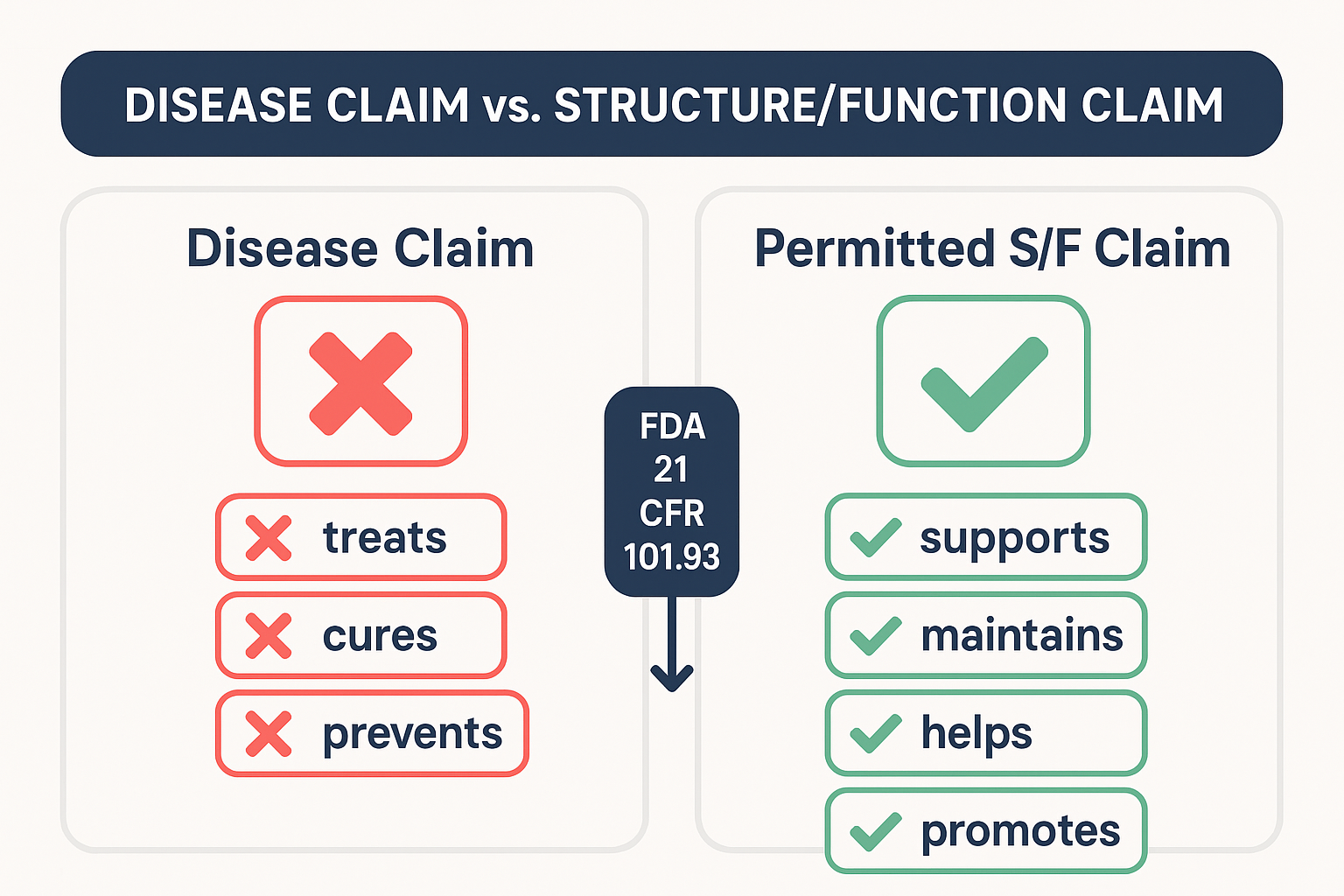
The FDA spells out seven types of prohibited disease claims in 21 CFR 101.93(g):
- Naming a disease (“cancer,” “diabetes”)
- Using the word “disease” or “diagnose”
- Suggesting a disease effect via the product name
- Citing a study that references a disease
- Using an image of a diseased organ
- Claiming the product belongs to a known disease-treatment class
- Listing a drug ingredient
Even if no disease word appears, the FDA evaluates the net impression – the overall message a reasonable consumer takes away. Context matters.
Example: “Supports healthy blood sugar levels” is a permissible S/F claim. “Reduces blood sugar in diabetics” crosses the line into a disease claim. One extra word changes everything.
For a deeper breakdown of how the FDA and FTC enforce these boundaries, see our FDA vs FTC survival guide for supplement startups.
What Substantiation Do You Need for Your Supplement Claims?
Before you write “supports joint health” or “promotes mental sharpness” on a label, the FTC and FDA want to see your backup. The legal standard is competent and reliable scientific evidence – in plain terms, enough solid science to back the specific claim. For health-related claims, that almost always means at least one well-designed human clinical trial.
The FTC Health Products Compliance Guidance (December 2022) makes one thing crystal clear: the evidence must exist before you make the claim. You cannot run a study after launch and retroactively justify a label. “We’ll prove it later” is a shutdown risk.
The strength of the required evidence scales with the strength of the claim. A vague structure-function statement (“helps maintain energy”) needs less rigor than a disease-risk reduction claim (“reduces risk of heart disease”). The higher the implied benefit, the heavier the burden.
FDA expects at least one “adequate and well-controlled study” for most health claims. That often means a double-blind, placebo-controlled trial with a statistically significant result. The study must be published in a peer-reviewed journal or otherwise available for third-party review.
Every brand builder should maintain a substantiation file. This file includes published studies, third-party test results, and Certificates of Analysis (COAs) for every batch. It lives as a living document, updated as new research or regulation emerges. Keep it ready – regulators can request it at any time.
Reference: FTC Health Products Compliance Guidance (December 2022).
DSHEA Disclaimer and FTC Advertising Rules
Every label that carries a structure/function claim must also carry a specific disclaimer. The exact text: “This statement has not been evaluated by the Food and Drug Administration. This product is not intended to diagnose, treat, cure, or prevent any disease.” No substitutions, no fine-print tricks.
The disclaimer must appear on each panel where the claim is made, or be linked with a clear symbol. That means if you put a claim on the front panel and the side panel, the disclaimer goes on both. It is federal law under DSHEA.
In December 2025, FDA issued a letter signaling potential rulemaking to remove the multi-panel requirement. Read the FDA letter here. If the rule changes, the disclaimer may only need to appear once per label. Watch this space, but do not change your labels yet.
The Disclaimer Does Not Shield False Claims
Adding the disclaimer does not make a false claim legal. The disclaimer exists to inform consumers that the claim has not been reviewed by FDA. It does not grant permission to exaggerate, mislead, or lie. FTC enforces that boundary hard.
FTC Has Primary Jurisdiction Over Advertising
FTC regulates supplement advertising, not FDA. The standard: advertising must be truthful, not misleading, and substantiated before publication. “Net impression” matters. That means FTC looks at the overall takeaway a reasonable consumer gets, not just individual words. A technically true statement can still be illegal if the net impression is misleading.
Since 1998, FTC has brought more than 200 cases for false supplement advertising. That is an active docket. You do not want to be case 201.
Recent Enforcement Example
In March 2025, FDA and FTC jointly sent warning letters to 10 companies for unproven diabetes claims. The claims used structure/function language that crossed into disease treatment territory. The disclaimer on the label did not save them. It never does.
If you are launching a supplement brand, you need to know these rules before you print a label or write a single ad. The DSHEA compliance playbook for supplement creators walks through each requirement with real examples. It covers how to claim without crossing the line.
Rocktomic members on the Free $0 plan get access to compliance resources. Scale $297 members get priority support and deeper guidance on labeling and advertising questions.
How to Write Compliant Claims for Your White Label Brand and Avoid Pitfalls
Every claim on your label, website, and social post is a potential FDA flag. Write them right the first time and you skip the warning letters. Here is the framework we use for every how Rocktomic on‑demand fulfillment works customer who launches a compliant white‑label brand.
Five‑Step Compliance Framework
- Use qualifying verbs only. Stick to “supports,” “maintains,” “promotes,” “helps.” Never write “treats,” “cures,” “prevents.” That one word choice separates a structure/function claim from an illegal drug claim.
- Pair the claim with an ingredient and a normal body function. Example: “Glucosamine HCl supports joint cartilage.” The ingredient + the healthy function. No disease implied.
- Include the DSHEA disclaimer on every label and every piece of marketing that makes a structure/function claim. (Part 5 of this series covered the exact wording – do not repeat it here.)
- Build a substantiation binder. Keep at least one human study or authoritative source for every claim you publish. Your COAs from Rocktomic are a start; pair them with a journal citation.
- Audit every sales channel. Your Shopify copy, TikTok caption, and Amazon bullet points must all say the same thing. A channel‑specific overpromise becomes the evidence the FDA uses against you.
Example: Joint Flex (ROC808)
Permitted claim: “Supports joint mobility and flexibility.”
Forbidden claim: “Reduces arthritis pain and inflammation.”
The first stays in the structure/function lane. The second crosses into disease treatment. Use the permitted version on your label, your product page, and any ad creative. Your white label supplement program for creators includes compliant label templates so you never start from scratch.
Six Common Pitfalls – and One‑Sentence Fixes
- Pitfall: Customer testimonial says “cured my insomnia.”
Fix: Remove the testimonial or redact every word that implies disease treatment; replace with “helped me sleep better.” - Pitfall: Citing a study about “osteoarthritis patients” on your Joint Flex page.
Fix: Only cite studies that reference “joint health in active adults” – never name a disease. - Pitfall: Product name like “ArthriEase” or “NeuroClear.”
Fix: Rename to a function‑first name such as “Joint Flex” or “Focus Support.” - Pitfall: DSHEA disclaimer printed in 6‑point font three panels away from the claim.
Fix: Place the disclaimer immediately below the claim in the same type size. - Pitfall: Social media post says “boosts metabolism” but label says “supports normal energy metabolism.”
Fix: Mirror the exact label language everywhere. - Pitfall: Launching without filing the 30‑day notification to the FDA for new structure/function claims.
Fix: Use Rocktomic’s compliance checklist – it reminds you to file the notification before your first sale.
Claims are not guesswork. Use the framework above, audit your copy, and lean on Rocktomic’s standard label text. Your brand stays safe while you scale.
Why Rocktomic Is Built for Compliant Supplement Brands
Rocktomic manufactures all 140+ products in GMP-certified US facilities. That certification means every production step follows FDA-enforced quality standards. You are not guessing what is in your bottles – you have a documented chain of custody from raw material to finished good.
Every batch ships with a Certificate of Analysis from third-party testing. This document proves potency, purity, and identity for each ingredient. It gives you independent verification to back up your structure/function claims when a regulator or customer asks for proof.
This documentation helps brand owners substantiate their claims with hard data. When the FDA reviews your marketing, you can point to a COA that shows exactly what is in the product. That is a competitive edge over brands that rely on supplier certificates alone. Independent testing turns a good claim into a defensible one.
Once your claims are compliant, use the supplement margin calculator to see your per-bottle profit.
Frequently Asked Questions About FDA Compliant Supplement Claims
What is a structure function claim?
A structure function claim describes the role of a nutrient or dietary ingredient intended to affect the normal structure or function of the human body. Examples include “calcium builds strong bones” or “fiber maintains bowel regularity.” Under DSHEA, these claims do not require FDA pre-approval, but the manufacturer must have substantiation and submit a notification within 30 days of first marketing.
What is the difference between a structure function claim and a disease claim?
A structure function claim describes how a product supports normal body functions (e.g., “supports immune health”), while a disease claim asserts that a product can diagnose, treat, cure, mitigate, or prevent a disease. Under 21 CFR 101.93, disease claims are prohibited for dietary supplements – only FDA-approved drugs can make them. The FDA examines overall context when determining the boundary.
What is a DSHEA disclaimer and where must it appear?
The DSHEA disclaimer states: “This statement has not been evaluated by the Food and Drug Administration. This product is not intended to diagnose, treat, cure, or prevent any disease.” It must appear on each label panel where the claim is made, or be linked with a symbol. In December 2025, FDA signaled it may relax the multi-panel requirement.
What substantiation is needed for supplement claims?
The FDA requires competent and reliable scientific evidence substantiating any structure function claim before marketing. The FTC applies the same standard to advertising. For most health-related claims, this means at least one well-designed human clinical trial, though the standard scales with claim strength. Both agencies expect objective, scientifically valid research.
What are the 7 types of claims prohibited for supplements?
Per 21 CFR 101.93(g), a claim is an unlawful disease claim if it: (1) names a specific disease; (2) uses the word “disease” or “diagnose”; (3) suggests an effect on a disease through product name; (4) cites published studies linking an ingredient to a disease; (5) uses pictures of diseased organs; (6) belongs to a class of products known for disease treatment; or (7) contains an ingredient regulated as a drug for treating disease.
How much does it cost to start a white label supplement brand on the Free plan?
Rocktomic’s Free plan costs $0 per month. Members pay only a flat $2 per item fulfillment fee when orders ship, plus wholesale product cost. There is no minimum order quantity for dropship. For example, a brand selling Ultra Test Natural Testosterone Support (ROC506) at an MSRP of $39.97 pays a Scale wholesale of $6.51 per bottle, plus the $2 fee, netting $31.46 per sale before marketing costs.
What does the Scale plan include for supplement brands?
The Scale plan is $297 per month and provides the lowest per-unit wholesale pricing across the full 140+ product catalog, including Scale Exclusives. It also includes unlimited sales channel integrations, priority fulfillment, and access to all categories. Brands on Scale see margins as high as 89.7% on select SKUs like Male Enhancement Or Boost (ROC502) at $5.17 wholesale.
How does zero-inventory dropship work for compliant supplement brands?
Rocktomic manufactures, warehouses, labels, and dropships each order on demand. Members own their brand without purchasing inventory upfront. On the Free plan ($0/month), brands can sell up to 10 white label products with one sales channel integration. Every batch ships with a Certificate of Analysis from GMP-certified US facilities, helping substantiate claims.
Launch Your Compliant Supplement Brand Today
You can own a compliant supplement brand with zero inventory and a $0/month entry. The Free plan gets you started with on-demand dropshipping and one sales channel. No upfront purchasing, no risk.
Use the supplement margin calculator to plan your numbers. Then compare Rocktomic membership plans and pick the tier that matches your volume. The opportunity is yours – first step costs nothing.
Last updated: July 2025.