
The Premium Pricing Playbook for White Label Supplements
· 19 min read · By Rocktomic Labs Team
The Premium White Label Supplement Pricing Playbook
Premium white label supplement pricing is not set by wholesale bottle cost. It is set by what the brand proves it is worth. That gap is the whole game. Rocktomic members retail the ROC840 formula at $59.97 while the wholesale cost runs $9.16 – a spread that only holds when brand signals justify the gap. This playbook covers the three pillars that close it: the value stack that builds perceived worth, the margin math that proves the model, and the launch checklist for charging a premium without a premium supply chain. Rocktomic members own the retail price on every SKU, so the premium belongs to the brand, not the manufacturer.
Pick any product, set your monthly volume, and see your real per-unit and monthly profit on every plan – fulfillment, card processing, and membership all included.
What Is Premium White Label Supplement Pricing?
Premium white label supplement pricing is a retail strategy: price your products above commodity market levels, then justify the gap with brand signals. Those signals are packaging, proof documents, category positioning, and founder credibility. The price customers pay is not what the product costs to make. It is what the brand makes them believe it is worth.
Premium is not the same as expensive. Expensive is a number with no story. Premium is a position backed by evidence: proof of manufacture, proof of testing, and a founder who stands behind the label.
Wholesale cost is fixed. Perceived value sets the price.
That distinction matters because of the core mechanism. Your wholesale cost does not move. Rocktomic manufactures, labels, warehouses, and drop-ships your product, and the per-unit cost of that work stays the same whether you sell at commodity levels or premium levels. The lever is not cost. The lever is perceived value.
This is why two brands can sell near-identical formulas at very different price points. One looks like a commodity. The other looks like a premium product. The difference is never the capsule. It is the packaging, the Certificate of Analysis, the positioning, and the person whose name is on the label.
The premium belongs to your brand
At Rocktomic, members control the retail price on every SKU. No one sets your pricing for you. No one discounts your product out from under your brand. When a customer pays a premium, that margin is yours to keep.
The money math that turns this framing into revenue is in Part 5 of this playbook. Hold the frame for now: cost is fixed, perceived value sets the price, and the gap is yours to claim.
Why the Cheapest White Label Supplement Usually Loses
The cheapest price in any category is not a position. It is a trap. A price-first brand competes with every other white label seller on price alone, burns margin on ads just to stay visible, and locks itself out of future price increases. Once customers know you as the cheap option, raising prices means losing them.
The price trap compounds
Low price attracts one-time bargain hunters, not repeat buyers. It forces thinner ad margins, smaller packaging budgets, and no room for the branding work that builds trust. Every competitor can match your price. Few can match a brand that stands for something.
The market data shows why this matters. NIQ’s 2025 Private Label & Branded Products report, surveying 17,000+ consumers between December 2024 and January 2025, found that 68% view private labels as good alternatives to name brands and 69% see them as good value. Consumers already trust private label. They will happily pay for one that looks premium. Source: NIQ, 2025.
Store brands keep growing. Kerry Group’s 2024 analysis of PLMA data reported store brand sales of $236.3 billion in 2023, an all-time high. Source: Kerry Group, 2024.
The market is growing. The price race is not.
Grand View Research sized the global dietary supplements market at $209.5 billion in 2025, with growth projected to $393.56 billion by 2033. Source: Grand View Research, March 4, 2026. More market size means more sellers entering. That makes a commodity price strategy even worse.
Premium brands do not win because they cost more. They win because price signals quality. A higher price, backed by strong packaging and a real brand, tells buyers this product is worth it.
Your supplier decides whether premium pricing is possible
The manufacturing model you choose sets your pricing ceiling. Suppliers that force pallet buys or charge per-order fees make premium margins impossible. Rocktomic starts at $0 per month with a flat $2 per item fulfillment fee, so the price lever stays in your hands. You set the retail price. You keep the difference.
Charge a price that funds branding, packaging, and customer acquisition. Compete on perceived value, not on being the cheapest label in the search results. The cheapest white label supplement usually loses. The best-positioned one wins.
What Actually Justifies a Premium Price on a White Label Product
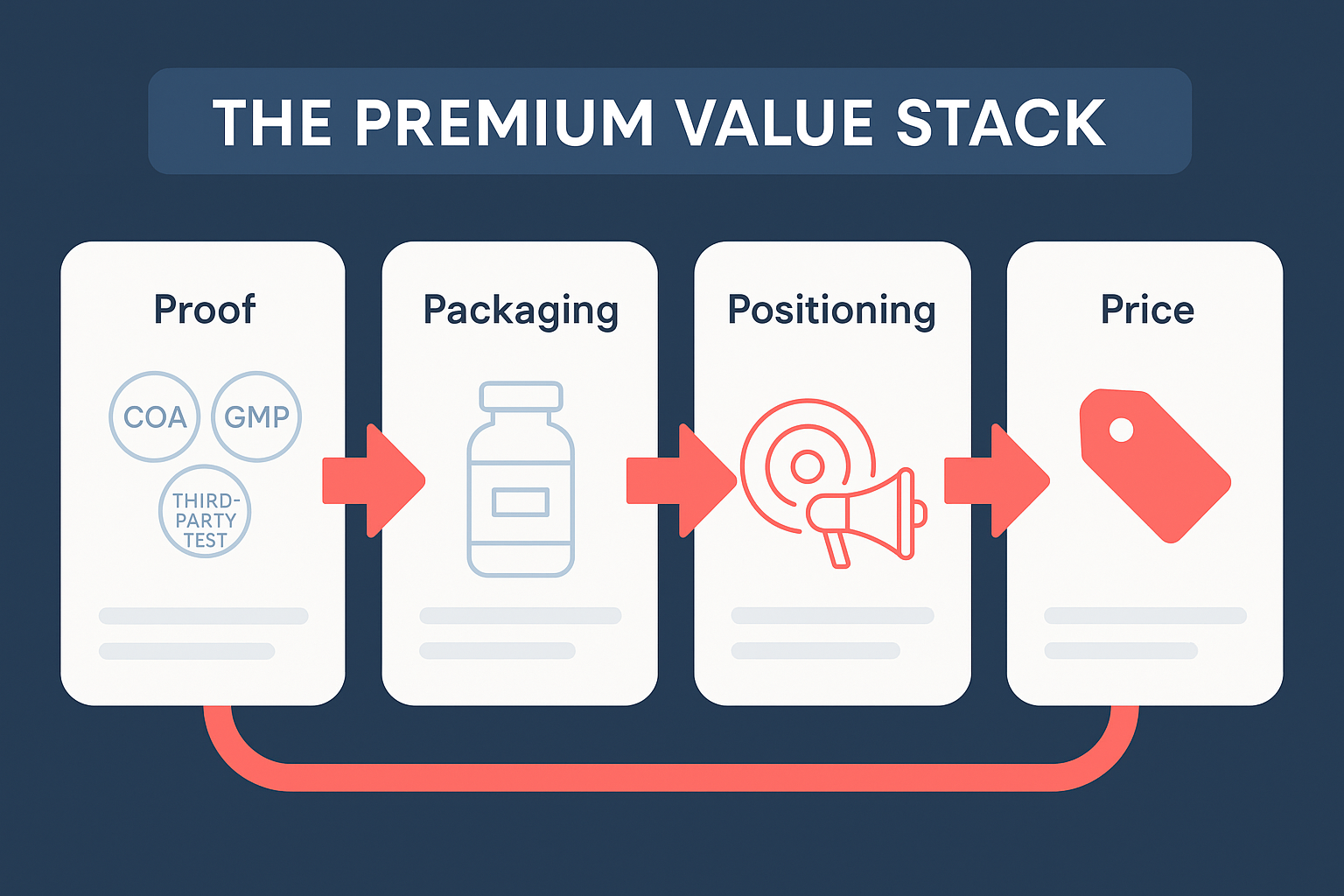
A premium price is never one thing. It’s a stack, and the layers have to be built in order: Proof, Packaging, Positioning, Price. Skip a layer and every price above it gets harder to defend. Build all four and the retail tag stops being a number the customer questions and starts being a number the customer expects. That sequence is what turns a commodity bottle into a brand.
Proof and Packaging: the layers customers can verify
Proof comes first because it’s the only layer that survives real scrutiny. A Certificate of Analysis on every batch, GMP-certified manufacturing, third-party testing. That’s not marketing copy. It’s evidence a buyer can check. Rocktomic’s 140+ products are US-manufactured, GMP-certified, and third-party-tested, and every batch ships with its own COA. Put that documentation where customers can find it. Start with Rocktomic quality and COA.
Packaging is where that proof becomes visible. Nearly 72% of American consumers say packaging influences their purchase decisions, per Makers Nutrition (April 2025). Two out of three buyers judge the product before reading a single claim on the bottle. A consistent label system and 3D mockups that show the bottle before it exists close that gap. The million-dollar label design guide breaks down why design carries that weight.
Positioning and Price: the layers that set the tag
Positioning decides who the product is for and what story it tells. It picks the category, names the audience, and frames the reason to buy. Same formula, two different positions, two very different price points. That’s where category and audience do the heavy lifting.
Price is the final layer, and here’s the honest definition: a justified premium is the gap between what your brand is worth and what it costs. When customers perceive the brand as worth more than it costs, you get pricing flexibility. When they don’t, you get price objections.
Rocktomic’s optional one-time launch packages make the packaging layer easy to start. The Starter Branding Package is $497 and covers one logo, 10 labels, and 10 3D mockups. The Business-in-a-Box is $997 and bundles that branding with a full store build-out, so the premium story carries from the label to the checkout.
The Premium Pricing Math: What Does One SKU Earn at Four Price Points?
Run one SKU through the full money math and premium pricing stops being theory. Ultra NAD+ Support Formula (ROC840) costs $9.16 at Scale wholesale. At the $59.97 MSRP, gross margin is $50.81, or 84.7%. That is profit before fulfillment. Subtract the flat on-demand fulfillment at $2 per item and net profit lands at $48.81 per unit, or 81.4%, before marketing. The $2 fee is the only cost between gross and net at this stage.
Now change one variable only: the retail price. The table below holds wholesale and fulfillment steady at $11.16 total cost per unit and lets the price do the work.
| Retail price | Wholesale (ROC840) | Fulfillment | Total cost | Net per unit | Net margin |
|---|---|---|---|---|---|
| $59.97 | $9.16 | $2.00 | $11.16 | $48.81 | 81.4% |
| $49.97 | $9.16 | $2.00 | $11.16 | $38.81 | 77.7% |
| $39.97 | $9.16 | $2.00 | $11.16 | $28.81 | 72.1% |
| $29.97 | $9.16 | $2.00 | $11.16 | $18.81 | 62.8% |
The Real Cost of a $10 Discount
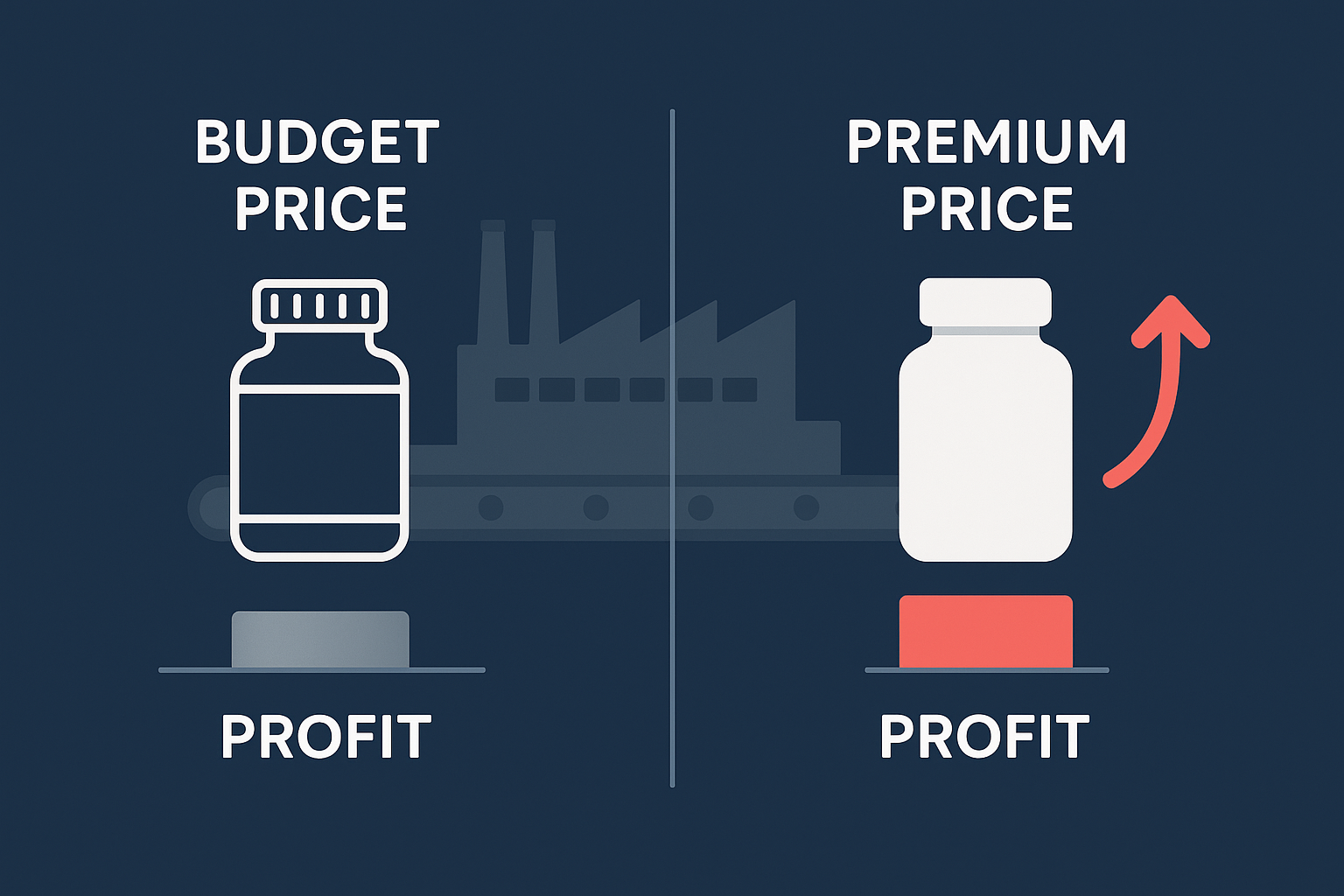
Every $10 of discount surrenders roughly $10 of net profit per unit. Drop the price from $59.97 to $39.97 and that is $20 gone from every sale. Go all the way down to $29.97 and the margin still reads as a solid 62.8%, but each unit now brings $18.81, roughly $30 less than the premium price.
To make the same gross profit, the discounted brand needs about 69% more units sold. That is the whole race-to-the-bottom trap: more orders, more fulfillment labor, more customer support, more ad spend, all to land on the same profit as fewer premium sales.
This is where the membership choice changes the math. The Free plan stays $0 per month with the $2 per item fee on every order that ships. The Scale plan at $297 per month earns the lowest per-unit wholesale across the full catalog, which widens the margins in the table above. At Scale pricing, a premium SKU does not need volume to thrive; it needs the discipline to hold the price. Before you commit, take a minute to compare Rocktomic membership pricing and see which cost basis matches your target price.
Run your own SKUs through the supplement margin calculator and check the full white label supplement profit margin formula. The math has no opinion about branding. It only rewards the price you set and the costs you control. Premium pricing is a decision you make before the first order ships, and it is the hardest one to reverse later.
How Do You Set Your Premium Price Anchor?
An anchor is a deliberate reference point. It doesn’t set your price. It sets the context your price is read in. A $59.97 hero product looks one way next to a $20 entry tub. Put it beside a $129 comparison SKU and it reads as the reasonable middle option. Same cost to you. Different perception to the buyer.
New shoppers don’t know the average price in your category. They know the number directly in front of them. Anchoring works because buyers evaluate prices in relation, not in isolation. A price only feels high or low next to another price.
Charm Pricing Makes the Number Feel Built
Charm pricing is the second half of the anchor. A 9-ending price like $59.97 feels deliberate. $60 feels rounded, guessed, and negotiable. That small difference signals the price was engineered on purpose, not pulled from the air. When your price ends in an odd digit, buyers treat the whole position as intentional. Intentional pricing supports a premium brand.
Odd endings do the heavy lifting on hero SKUs. Round numbers have their place, but they undercut the anchor on premium products. The full mechanics of price endings and tiered positioning live in the psychological pricing playbook.
Build the Anchor From Category Value First
The rule of thumb is simple: start with perceived category value. What do buyers already expect to spend on a product like yours? That expectation is your raw material. Build the anchor from it. Then test charm endings, bundles, and subscriptions on top of that anchor. The supplement pricing strategy guide walks through the full order of operations.
Don’t reverse the order. If you start with cost and mark up, your anchor lands wherever the math took you, not where the category will support it. The market is the reference point, not your bill of materials. Test one variable at a time, and give each test enough traffic to mean something.
Protect the Anchor
The anchor you set on day one is the ceiling you operate under. Discounts are a move you make once. Reserve them for launches and limited drops, where scarcity does the work. A brand that anchors at a discount price can never raise it later. Every future campaign fights against that first impression.
Discount depth becomes the new normal. Buyers remember the lowest number they saw, not the list price. When you do run a discount, tie it to a clock or a drop, not an open-ended sale. Protect the anchor and you protect every future launch.
Which Premium Trust Signals Must Your Brand Ship With?
Proof converts into price tolerance. Every certificate, badge, and test result you publish removes one more reason for a buyer to shop on price alone. A customer who can verify what is inside the bottle stops comparing your price to the cheapest bottle on the shelf. That shift from price-shopping to proof-shopping is what lets you charge like a premium brand instead of a commodity.
Part 5 covered the margin math that premium pricing produces. That math only holds when customers believe the product is worth it. Trust signals make the premium defensible.
Here is the checklist your brand should ship with on every single order.
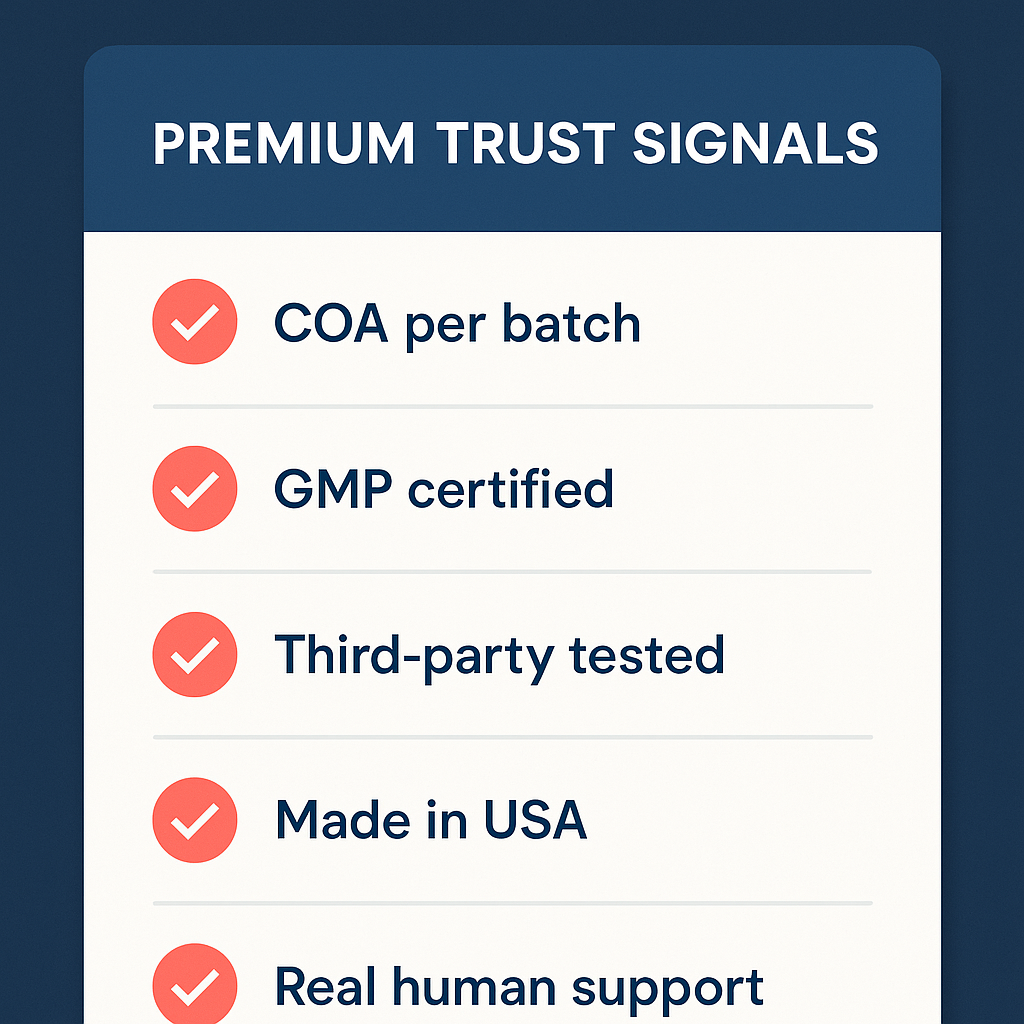
The Five Trust Signals That Justify a Premium Price
- Batch-level COA. A Certificate of Analysis for the exact batch in the customer’s hand, not a generic PDF from last year. The lot number on the label matches the lot number on the report.
- GMP certification. Proof the facility follows current Good Manufacturing Practices. This is the baseline for anyone who takes quality seriously.
- Third-party testing. An independent lab grading the product, not the manufacturer grading its own work.
- US manufacturing. A US-based facility and a supply chain a customer can trace to a named address.
- Real human support. A person who answers questions about ingredients, dosing, and shipping before and after the sale.
Each signal answers one customer objection. The COA answers “is this safe?” GMP answers “was this made properly?” Third-party testing answers “who checks the checker?” US manufacturing answers “where did this come from?” Human support answers “what happens if something goes wrong?”
Where Members Publish the Proof
Proof only works if customers can find it. Rocktomic members publish it in three places.
Product pages hold the highest-converting proof. The COA link, GMP badge, and testing details sit directly under the buy button. That is where price objections happen, so that is where the evidence lives.
Unboxing content turns customers into witnesses. One video showing the bottle, the label, and the lot number does more than a paragraph of marketing copy.
Social carousels put the documents in front of warm followers. A swipeable deck showing the COA, the facility, and the test results makes a higher price feel like the obvious choice.
What Rocktomic Ships With Every Batch
Every Rocktomic product is manufactured in a GMP-certified US facility, third-party tested, and ships with a COA on every batch. That includes all 140+ products in the catalog, from capsules to gummies to powders. See the Rocktomic quality and COA page for the full process.
You can publish this same proof stack on the Free plan at $0/month across up to 10 products and one sales channel. The Scale plan at $297/month adds the full catalog, unlimited sales channels, and priority fulfillment. The quality process is the same on both plans.
Premium pricing is a claim your customers will check. Arm them with the documents and they stop shopping on price.
Positioning Premium on TikTok Shop, Instagram, and Shopify
Price-first creative loses on short-form platforms. A video that leads with “cheapest greens on the internet” gets scrolled past in half a second. A video that leads with a founder story, a real routine, or a fast education bite holds attention long enough to justify a premium price. The creator is the positioning. That is the whole play.
Creator-led content carries the premium
On TikTok Shop and Instagram, buyers don’t compare spec sheets. They buy from faces they trust. Founder story, UGC from real customers, and short education loops about why your formula costs more all do the work that a sale tag would normally do. Lead with the why behind the price, not the price itself.
That content feeds the algorithm too. Longer watch time and saves push your video toward the buyers who actually pay premium prices.
Bundles and subscriptions lift AOV without markdowns
Premium brands don’t discount. They bundle. Pair your hero product with a smaller SKU, or push a subscription that locks in a consistent reorder. Average order value goes up, and you never train your audience to wait for a sale.
The price stays premium; the perceived value grows. You also smooth out revenue, because one-time buyers become repeat buyers.
Where Rocktomic fits
The Free plan runs $0 per month and includes 1 sales-channel integration plus up to 10 white-label products. That covers one storefront on Shopify, TikTok Shop, or Instagram. Scale at $297 per month removes the ceiling: unlimited sales channels and priority fulfillment. One short-form funnel can feed every storefront at once.
See which channels connect on the store integrations page.
The same creator-led logic works in any niche. For a deeper look at how positioning carries a premium in one category, read the premium pricing secrets for a specific category.
The Premium Pricing Launch Checklist
Premium pricing is not a one-time decision. It is a sequence. Run it the same way on every launch and the margin holds before the first order ships.
This checklist converts the value stack and anchor method into a repeatable launch sequence. For the full mechanics behind the steps, see how Rocktomic works, then work the table top to bottom.
| Launch Step |
|---|
| 1) Choose a hero SKU from the 140+ catalog. |
| 2) Assemble the proof stack (COA, GMP, third-party test). |
| 3) Set the anchor from category value. |
| 4) Design the label system. |
| 5) Publish proof on the product page. |
| 6) Launch with a bundle or subscription. |
| 7) Track net margin per unit monthly. |
Run the checklist on one hero SKU first. One product done right outsells a dozen half-branded SKUs, and it keeps the launch cheap while you validate the price. Pick the SKU with the clearest anchor and the strongest proof story.
You can start on the Free plan at $0/month and pay the flat fulfillment fee per item as orders ship. Move to the Scale plan at $297/month when you want the full catalog and lowest per-unit wholesale.
Step 7 is what keeps the premium price honest. Track net margin monthly, then repeat the sequence for the next SKU. The sequence is identical every time, so the second launch is faster than the first.
Premium White Label Supplement Pricing FAQ
These are the questions supplement founders ask most when they move from racing on price to selling on value. Each answer uses real numbers from the Rocktomic pricing model so the math is clear before a brand sets its own MSRP.
What is premium white label supplement pricing?
Premium white label supplement pricing positions a product at a higher retail price than typical commodity supplements while keeping wholesale costs low. The price reflects the brand, packaging, quality signals, and perceived value as much as the ingredients themselves. For a concrete example, the ROC840 formula carries a $9.16 wholesale cost and a $59.97 MSRP. That gap funds the brand, the marketing, and a healthy per-unit margin without relying on volume.
How does branding justify a higher price for white label supplements?
Branding shifts the buyer’s decision from cost to identity. A clean label, consistent visual system, professional packaging, and a clear story make the same formula feel like a premium product. Buyers pay for trust and the experience, not for the powder inside. Strong branding lets a brand charge $59.97 for a formula that costs $9.16 wholesale because the perceived value sits in the brand, not the bill of materials.
What proof signals support a premium supplement price?
Premium pricing needs evidence. U.S. manufacturing in GMP-certified facilities, third-party testing, and a Certificate of Analysis on every batch give buyers something concrete behind the price. These signals reduce risk, which makes a higher MSRP easier to justify. When a brand can show verification for every batch, the product stops looking like a commodity. The $59.97 price point becomes a quality signal instead of a barrier.
Can the same white label formula sell at different price points?
The same formula can sell at very different price points because the formula is only part of the offer. One brand positions the product as a commodity and prices it low; another wraps the ROC840 formula in stronger branding, better packaging, and proof signals and sells it at a $59.97 MSRP with the same $9.16 wholesale cost. Price follows positioning, not ingredients.
How do premium supplement brands avoid constant discounting?
Premium brands anchor value before price. They build the brand, show the proof, and set a consistent MSRP, then add value through bundles, education, or loyalty instead of cutting price. Discounting trains buyers to wait for sales; consistent pricing trains them to trust the price. The margin math makes this easier to hold. At a $59.97 MSRP with an 84.7% gross margin, a brand can absorb occasional promotions and still keep a healthy net without making discounts a habit.
What is the per-unit profit on a premium white label supplement?
With the right pricing structure, per-unit profit is substantial. The ROC840 example shows the math clearly. At a $9.16 wholesale cost and $59.97 MSRP, the gross margin is $50.81, which is 84.7%. After the flat $2 per-item fulfillment fee, the net is $48.81 per unit, or 81.4%. That net margin is what makes premium pricing attractive: every order is profitable without needing bulk volume.
What does it cost to launch a premium white label supplement brand?
Entry is low because the membership model removes inventory risk. The Free plan costs $0 per month, with a $2 per-item fulfillment fee charged only when an order ships. Optional done-for-you packages add polish: $497 for a Starter Branding Package, $1,497 for a full store build-out, or $997 for Business-in-a-Box, which bundles both. A brand can launch with zero upfront inventory and pay only for what sells.
How does the Scale plan protect premium supplement margins?
The Scale plan at $297 per month lowers the cost side of the margin equation. It gives the lowest per-unit wholesale pricing across the full 140+ catalog, including Scale Exclusives, which means the gap between wholesale cost and retail price stays wider. Unlimited sales channels, from TikTok Shop to Shopify, let a brand sell everywhere without per-channel limits. Priority fulfillment keeps orders moving. Lower cost per unit plus broader reach is how premium margins stay protected.
Run the Numbers on Your Premium Supplement Brand
Premium pricing is earned by proof, packaging, positioning, and a deliberate anchor, not by a premium supply chain. The ROC840 math proves the model, and the rest of this playbook gives you the packaging and positioning moves to back it up. Your job now is to run the numbers against your audience and your own retail price.
Start with the supplement margin calculator. Plug in the retail price your followers will actually pay, and it applies the ROC840 contribution structure to show what you keep per order. That number tells you exactly what premium positioning is worth to your brand.
Then compare membership pricing. Free costs $0 a month: one sales channel, up to 10 white-label products, and on-demand dropshipping with a flat fulfillment fee of about $2 per item. Scale costs $297 a month: the full 140+ catalog, lowest per-unit wholesale, unlimited channels, and priority fulfillment.
Both plans run on zero inventory with US GMP manufacturing and a Certificate of Analysis on every batch. No pallet buys, no warehouse lease, no inventory risk between you and your first sale. That is how a solo creator sells at a premium price from day one.
When you are ready to map your premium launch, book a call with Rocktomic.
LAST UPDATED: June 21, 2026.