
The Danger of Discounts: How Coupon Codes Destroy Supplement Margins
· 18 min read · By Rocktomic Labs Team
A 20% coupon does not cut profit by 20%. On a white-label supplement, it cuts per-unit contribution by roughly one third and forces a 44% or larger volume increase just to break even. Most flash sales fail that math. This guide shows the exact break-even formulas, the discount depths that turn profitable SKUs into loss leaders, and five promo models that build volume without giving away margin.
What is discount margin erosion in a supplement business?
Discount margin erosion is the gap between the discount percentage a brand advertises and the far larger share of per-unit profit it actually removes. Because COGS, fulfillment, and platform fees do not fall when the price falls, a 20% coupon can remove 30% to 50% of contribution. It is the single most common reason supplement brands report record revenue and shrinking profit.
Pick any product, set your monthly volume, and see your real per-unit and monthly profit on every plan – fulfillment, card processing, and membership all included.
For creators running a white-label supplement brand, contribution per unit is the number to protect before any promo goes live. Plan discounts against break-even volume, not gross revenue.
The 20% Illusion: A Coupon Cuts Profit, Not Revenue
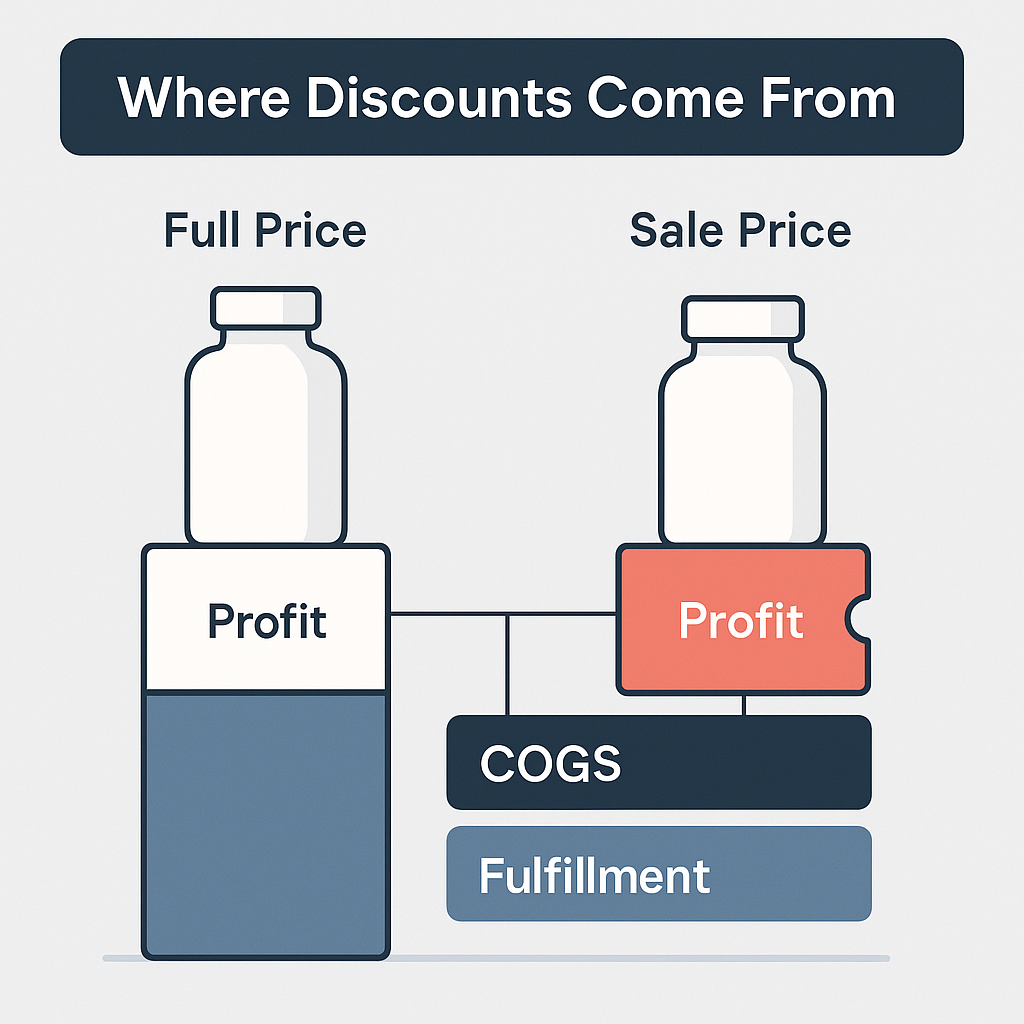
A 20% off coupon looks like a small cut. It isn’t a cut from revenue. It comes straight out of profit. Nothing else moved for that unit: the COGS is the same, the fulfillment fee is the same, and the discount is the only variable that changed. The discount eats 100% of the margin on the sale.
Here is what that looks like on one white-label bottle at Scale pricing. The COGS math for dropship supplements is fixed per unit. So is the flat $2 per item fulfillment. Neither one drops when you drop your price. The only number a coupon changes is the price the customer pays.
| Metric | Value |
|---|---|
| MSRP | $29.97 |
| Scale wholesale COGS | $8.45 |
| Gross margin | $21.52 (71.8%) |
| Flat fulfillment | $2.00 |
| Contribution after fulfillment | $19.52 (65.1%) |
That $19.52 is your contribution before marketing, payment processing, and anything else the brand has to cover. It is the real number, because it is what remains after the costs that show up on every single order. A discount gets deducted from this line, not from the sales price. Then the two rules of promo math apply.
Rule one: variable costs never move with price. Whether the customer pays full price or a discounted price, your COGS is still $8.45 and fulfillment is still $2.00. The cost stack is a fixed floor under every order.
Rule two: the discount is 100% profit. There is no cost sharing. Every dollar you take off the price comes dollar for dollar out of your contribution. A coupon is not an expense spread across the order. It is a direct transfer from your margin to the customer.
That is the 20% illusion. Top-line revenue barely moves, so the promo feels painless. Profit takes the entire hit. When discounts get treated as a revenue problem instead of a cost line, the brand quietly funds every sale out of its own margin.
The Break-Even Volume Formula Every Coupon Needs
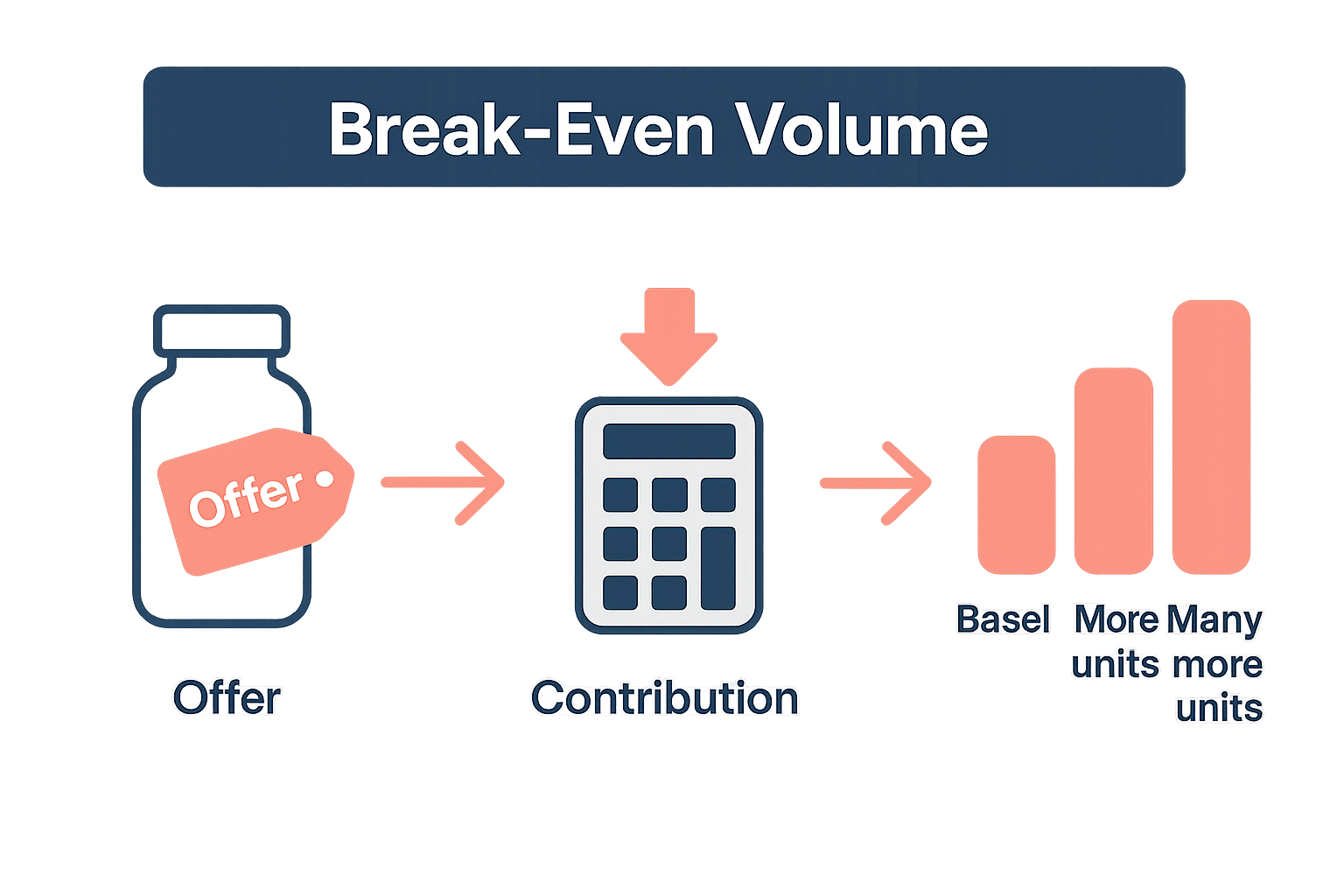
Every coupon is a volume bet. Before one goes live, you need the number that separates a winning promotion from a money-losing one. That number is break-even lift, and it comes from two ways of writing the same math.
The percent form is the fastest check:
Required lift % = Discount % / (Contribution margin % – Discount %)
The dollar form is exact and easier to trust with real numbers:
Required lift = (Full-price contribution / Discounted contribution) – 1
Both answer the same question: how many extra units must the discounted price sell to keep total contribution identical to selling at full price with no coupon?
Plug in ROC943 from Part 2. Full price is $29.97 and contribution is $19.52 per unit, a 65.1% margin after the $2.00 fee. Contribution here means what is left after product cost and fulfillment, before any marketing spend. Here is what each discount depth demands just to keep total contribution flat:
| Discount | Sale price | Contribution | Required lift |
|---|---|---|---|
| 10% off | $26.97 | $16.52 | 18.2% |
| 15% off | $25.47 | $15.02 | 30.0% |
| 20% off | $23.98 | $13.53 | 44.3% |
| 25% off | $22.48 | $12.03 | 62.3% |
| 30% off | $20.98 | $10.53 | 85.4% |
| 40% off | $17.98 | $7.53 | 159.2% |
| 50% off | $14.99 | $4.54 | 329.9% |
Watch how the curve bends. A 10% coupon needs volume up 18.2%. The 15% coupon needs 30.0%. Then the demands compound. A 30% coupon does not need a 30% bump; it needs 85.4% more units. At 40% off the lift is 159.2%, and 50% off demands 329.9% more volume. That last number is why flash sales quietly kill brands. Nobody plans for a 330% volume spike, and few products have the organic demand to find one.
The profit-elimination floor
There is a hard floor under every coupon. When the discount equals the contribution margin, the denominator in the percent formula hits zero and contribution per unit disappears entirely. ROC943 contributes 65.1% after the $2.00 fee, so a discount anywhere near that depth zeroes contribution on every sale. Volume cannot save you. More units at zero contribution is still zero contribution.
Run the math on your own products before you set a discount. Use the supplement margin calculator to confirm your contribution per unit, then extend the picture across a full month of orders with the profit projection tool. Both use your real COGS and the flat $2.00 fee, so the output matches your actual P&L instead of a guess. The numbers shift with every product, which is exactly why a formula beats a gut feeling.
Know the lift before you run the promo. The discount is the offer. The formula is the price of admission.
The Discount Depth Ladder: From Tolerable to Catastrophic
Retail math sets your ceiling before you ever run a promo. Supplement-focused stores average 42.1% gross margin, according to the WholeFoods Magazine 2024 Retailer Survey (March 11, 2024). That doesn’t leave much room for routine discounting.
A 25% blanket sale can erase a quarter of your margin on every unit that moves, and you rarely make it back on volume. Most brands never run this math before a sale goes live. So stop treating every coupon code like a growth tactic. Sort every promo into one of three tiers, and run each tier for what it is.
Tier 1: 10% or less – a campaign tool
Shallow discounts are the workhorse of a healthy promo calendar. At 10% off, you need only an 18.2% lift in unit volume to break even. An email blast, a creator code, or an abandoned-cart sequence can clear that bar. This tier is for customer acquisition and reactivation, not for moving slow SKUs.
Tier 2: 15-20% – event-only
This range demands a 30-44% volume lift just to stay whole. That is a holiday-weekend swing, not a Tuesday habit. Run these once or twice a year: Black Friday, a launch anniversary, a seasonal reset. The goal is urgency, not entitlement. Anything more frequent trains your audience to wait for the next code instead of buying now.
Tier 3: 25% or more – liquidation-only
At this depth the required lift runs from 62% to 330%, depending on your exact margin. Nobody sustains that on a bestseller. This tier exists for one reason: clear out dead stock, expiring batches, and SKUs you plan to retire. If you’re discounting a healthy product at 25% or more, you’re paying customers to take margin you already earned.
Treat the ladder as a guardrail, not a suggestion. A 42.1% average gross margin does not absorb habitual discounting. It rewards promos that are scheduled in advance, sized to the tier, and tied to a specific volume target.
Hidden Costs That Make Discount Math Worse
Stacked coupons are where the headline discount starts lying. Run a 10% creator code on top of a 15% sitewide sale and the two discounts layer instead of adding. The code applies to the already-reduced price, not the original one. Fifteen percent off leaves 85%. Ten percent off that leaves 90% of the rest. Multiply them: 0.85 x 0.90 = 0.765. The customer pays 76.5 cents per dollar, so the effective discount is about 23.5%, not 25%. The gap looks small on one order. Across a campaign it is real money, and it compounds once you add back fulfillment and ads.
Fees that don’t move when your price does
Payment processing fees are percentage-based, so they shrink with the price. The flat $2.00 fulfillment fee does not. Every discounted order still carries the same $2.00 cost. At the full $29.97 price that fee is 6.7% of the order. On a deeply discounted order it eats more than 10% of every dollar you collect. That’s the fee working against you twice: the discount lowers your revenue, and the fixed fee takes a bigger share of what’s left. The sale that looked thin in your promo graphic is underwater before it ships.
Ads still cost full price
Customer acquisition cost doesn’t read your promo calendar. The ad that bought a buyer at full price buys the same buyer at a discount. CAC holds its ground while your price falls. So a coupon campaign needs the full 44.3% lift plus the ad cost of acquiring those extra buyers. That extra volume has to come from somewhere, and you rarely find cheap traffic in the middle of a sale window. Run the promotion without it and you pay for the privilege of moving more product.
Some white-label platforms stack a per-order fee onto every discounted shipment, so the math gets worse with each sale you celebrate. Check the numbers in this white-label platform fee comparison before you schedule your next promo. And remember that the hidden costs that devour dropship margins do not pause for a sale. Set your break-even ROAS on supplement ads first. Most operators pick a discount, then hope the volume shows up. Run the math in the other direction, and the flash sale either earns its place or dies on the spreadsheet.
Flash sales do not end when the timer hits zero. They reset what a fair price means in the buyer’s head, and that reset is nearly impossible to undo. The one-time spike in revenue buys a permanent markdown in perceived value.
The mechanism is price anchoring. Your last sale price becomes the reference point, so the next full-price offer gets judged against the discount, not against the product’s value. The customer stops asking “is this worth it?” and starts asking “when does it go back on sale?” Every flash sale also cannibalizes full-price demand: the buyer who was already leaning yes simply waits, and the order you count as incremental is one you would have shipped at full margin anyway.
That wait-and-see behavior is expensive in a category built on repurchase. The Commerce Catalyst Supplements Benchmarks (May 25, 2026) report supplements at the highest repurchase rate of any consumer category, 37.7% within a 24-month window. Nearly four in ten buyers come back inside two years. Train those buyers to hold out for a coupon and you give up full-price repeat revenue across the whole relationship. The first sale is the cheap one; the repeat sale at full margin is where the brand gets built.
Three warning signs you are hooked on discounts
You do not have to guess whether your buyers are conditioned. Watch for these signals:
- Full-price conversion declines while traffic stays flat. More visitors, same or fewer orders at standard pricing.
- Email open rates spike only for subject lines with “sale,” “deal,” or a percentage off. Non-promotional sends go unread.
- Customers ask your support team when the next sale runs, instead of asking about the product itself.
Each signal points the same direction: your audience is shopping the discount calendar, not your catalog. Break the pattern before the coupon becomes the product. Protect the full price the way you protect the formula, because repurchase at full margin is the business.
The FTC Line: Fake Reference Pricing Is a Marketing and Legal Trap
A fake “was” price is the fastest way to turn a margin problem into a legal one. The FTC Guides Against Deceptive Pricing, retrieved June 2026, are blunt: you can’t advertise a discount from a former price unless that price was genuinely offered for a reasonable period in the regular course of business. The full text in 16 CFR Part 233 applies to every product you list, from a $29.99 tub to a $79 bundle.
Here’s how sellers get caught. You set an MSRP of $89.99, never sell a single unit at that price, and run a “60% off” sale at $35.99. That MSRP was never a real price; it existed only to make the discount look dramatic. The FTC calls that fictitious pricing, and it can trigger action under Section 5 of the FTC Act, which prohibits unfair or deceptive acts in commerce. The enforcement risk is real, and it lands on the brand, not on the discount code.
Creator codes don’t change that. When an influencer posts your coupon or quotes your “compare at” price, the pricing claim is still yours. Sponsored content doesn’t get a pass on deceptive pricing rules. The responsibility for an inflated strike-through price sits with the brand that set it, whether the code was shared by you or by a partner with a million followers.
The math-friendly fix: only mark down from a price you’ve actually charged. If a product has never sold at $59.99, don’t strike it through to $39.99. Run promos off real, realized prices, keep the discount window and the original price window documented, and treat the FTC guides as part of your pricing model. Compliant promo math protects your margin and your legal position at the same time. One is a P&L problem. The other ends with a demand letter.
Five Promo Models That Protect Supplement Margins
Discounts train customers to wait for the next sale. Value-add promos move the same volume without moving the price. Here are five models that keep contribution intact while the orders roll in. Each one gives the customer a reason to buy now, not a reason to demand a lower price next week.
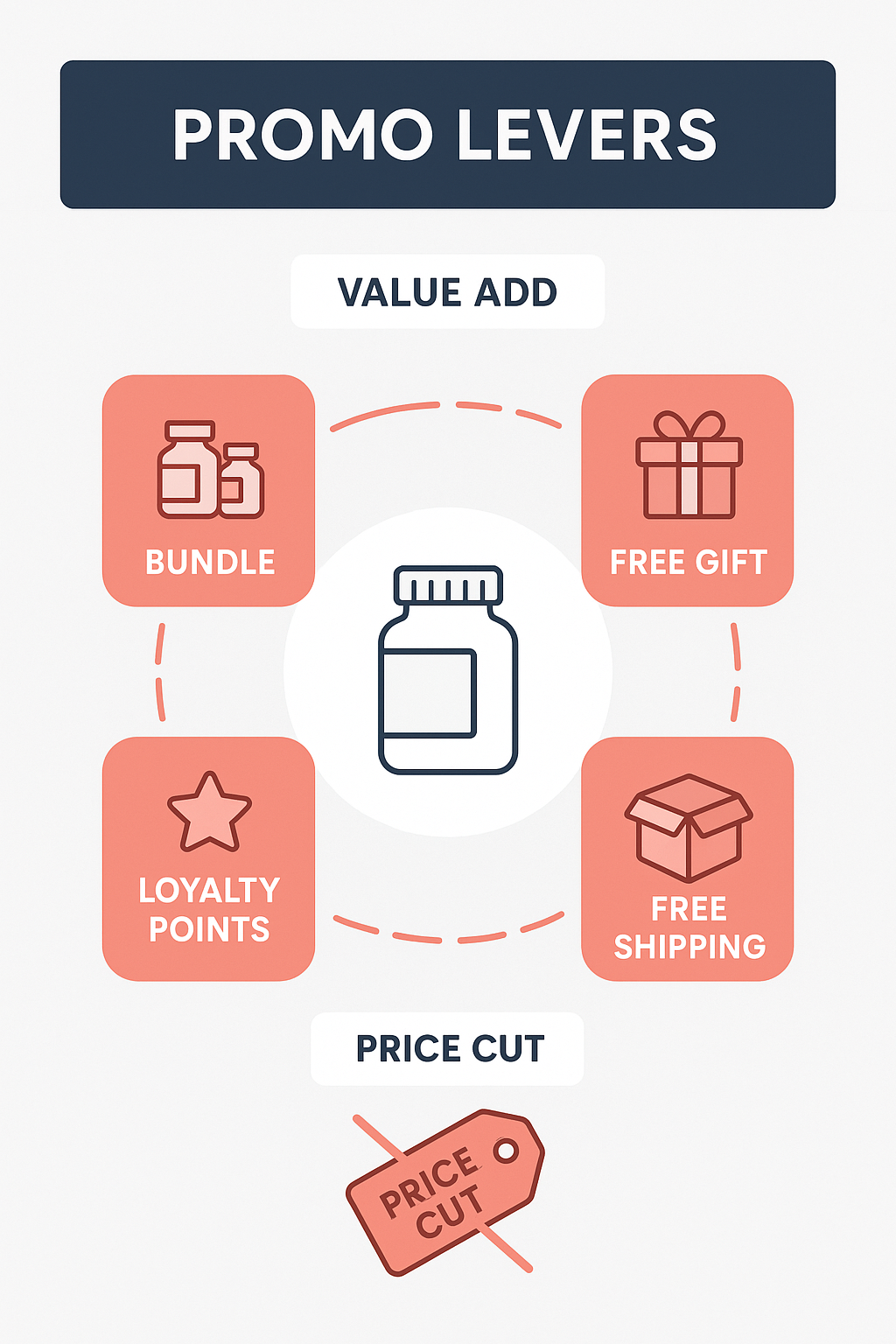
1. Bundles and 3-packs that discount only the incremental unit
A sitewide 15% off coupon cuts every unit you sell, including the ones that would have sold at full price. A bundle flips that math. The first unit is full price, the second gets a modest cut, and the third carries the deepest discount. The customer sees a deal, the average order value climbs, and your base unit keeps its full contribution.
Three-pack pricing works especially well for supplements because the category runs on repeat usage. If you want the full mechanics, review the bundle blueprint for raising AOV.
2. A free gift with a low-COGS item
A branded shaker bottle or a 5-count sample pack costs pennies to produce. Attach it to orders over a set value and the customer gets a tangible reward, not a percentage off. The perceived value is higher than the actual cost, and the price tag on your core product never moves. The gift costs you a dollar or less in product; a price cut costs you margin on every single unit in the cart.
3. A free-shipping threshold that raises AOV
Free shipping is a discount with a different name. The way to make it profitable is to set a threshold that pushes the cart up. “$75+ ships free” turns a $60 order into an $85 order, and the extra margin on that added unit covers the shipping cost.
Thresholds need the right math behind them. Check the free shipping trap for TikTok promos before you set yours.
4. Loyalty points or cashback with partial redemption rates
Points programs discount on a delay. Customers earn 5% back on a purchase, and only a portion of those points ever gets redeemed. The ones who do redeem come back to the store to spend more, which is exactly the behavior a loyalty program should drive. The redemption lag also keeps the cash in your account longer.
5. Segmented intent-based offers
Not every visitor needs a coupon. A first-time visitor lingering on a product page gets a 10-15% nudge to close the sale. A returning buyer with a full cart gets nothing, because the purchase was already going to happen. You spend the discount only where it changes behavior.
Each of these levers moves volume, and none of them requires slashing the price tag. The customer gets a reason to buy more, and your contribution stays where it belongs.
How Zero-Inventory Dropshipping Changes the Discount Math
Big discounts exist for one reason: dead stock. A brand that bought 5,000 bottles and watches them gather dust has one lever left, and it’s price. Cut 40% or 50%, move the units, take the loss. That’s not a marketing decision. It’s a warehouse problem wearing a marketing costume. The discount isn’t the strategy. It’s the cleanup.
Dropshipping removes that problem at the root. Product gets produced at order time, so there’s no inventory to liquidate. No pallets, no expiry clock, no storage fees. The only legitimate reason for a 40% or 50% discount disappears with it. A half-off sale from a zero-inventory brand isn’t a fire sale. It’s a choice. A clearance calendar makes no sense when there’s nothing to clear.
Discounts stop being damage control
That choice turns every promo into a pure acquisition decision. With the flat $2.00 per item fulfillment fee and a pay-when-it-ships model, you know every variable cost before the first order lands. Product cost. Fulfillment cost. Promo cost. All of it, up front. No surprises at month end. The margin math is done before the campaign goes live.
Model a launch promo at 15% off. You know exactly what each discounted unit contributes, and that number tells you the volume lift required to beat selling at full price. You can run that calculation before committing a dollar. If the lift isn’t there, skip the promo. If it is, run it, and treat every order as a customer acquired at a known price. Because every order carries the same flat fulfillment cost, the contribution per order stays predictable as volume rises.
That clarity is the whole point of how on-demand fulfillment works. You’re not gambling on sell-through. You’re paying for customer acquisition, not hoping to unload boxes.
FAQ: Coupon Codes and Supplement Margins
These are the eight discount questions that decide whether a coupon code adds profit or gives it away.
How much profit does a 20% discount really cost on a supplement?
A 20% discount comes out of profit, not revenue. On the Super Creatine Gummies 1000mg example (ROC943), the full-price contribution after the $8.45 wholesale cost and the $2.00 fulfillment fee is $19.52 on a $29.97 MSRP. At 20% off, the sale price drops to $23.98 and contribution falls to $13.53, a loss of roughly one third of per-unit profit. That means a brand must sell about 44% more units just to earn the same total dollars.
What is the break-even volume formula for a coupon code?
Required lift equals Discount percent divided by (Contribution margin percent minus Discount percent). For a product with a 65.1% contribution margin after fulfillment, a 20% coupon needs a 44.3% volume increase to keep total profit flat. A 30% coupon needs an 85.4% increase, and a 50% coupon needs about 330% more volume. If the promotion cannot realistically deliver that lift, the discount is a net loss even when revenue spikes.
Why do flash sales train customers to stop paying full price?
Frequent discounting anchors customers to the sale price. Once shoppers learn a brand runs 20% off every six to eight weeks, they wait for the next promotion instead of buying at full price. The real cost is not the margin on promo orders; it is the margin on the full-price orders that never happen. Supplements already carry the highest repurchase rate of any consumer category at 37.7% within a 24-month window (Commerce Catalyst, May 2026), so discount dependency erodes the most valuable behavior a supplement brand has.
What discount depth can a white-label supplement brand survive?
On the canonical ROC943 example, a 10% coupon needs an 18.2% volume lift, which most creators can reach with a planned campaign. A 20% coupon needs a 44.3% lift and should be reserved for major events such as a launch or holiday weekend. Discounts of 30% or more need 85% to 330% volume increases and generally only make sense for clearing dead inventory. A zero-inventory brand rarely has dead inventory, so deep discounts lose their only legitimate purpose.
Do affiliate and creator discount codes hurt supplement margins?
Yes, if they stack with other offers. A creator code at 10% stacked on a 15% sitewide sale applies cascading math, roughly 10% then 15%, which takes the effective discount to about 23.5%. On the ROC943 example, that reduces per-unit contribution to about $12.48 and demands a 56% volume lift. Brands should set a hard floor on stacked discounts and measure promo orders separately from full-price orders so affiliate codes never silently erode the baseline.
How much does it cost to run a zero-inventory supplement brand?
A brand can start on the Rocktomic Free plan at $0 per month and pay only the flat $2.00 per item fulfillment fee when an order ships. The Scale plan is $297 per month and adds the lowest per-unit wholesale pricing, unlimited sales channels, and the full 140+ product catalog. Because there is no inventory to buy, there is no capital tied up in stock, which means promotions are acquisition decisions rather than liquidation events.
How do fulfillment fees change discount math?
The flat $2.00 per item fulfillment fee does not drop when the price drops, so it takes a larger share of a discounted order. On ROC943, the fee is about 6.7% of the full $29.97 price but over 10% of a deeply discounted sale. Brands must include the fee in the contribution margin before running the break-even formula. One flat fee per item also makes the math identical across every SKU, which simplifies promo planning.
Which Rocktomic plan gives the lowest wholesale cost for promotions?
The Scale plan at $297 per month carries the lowest per-unit wholesale pricing, which directly improves discount tolerance. At Scale pricing, the Super Creatine Gummies 1000mg (ROC943) cost $8.45 wholesale against a $29.97 MSRP, leaving a $21.52 gross margin (71.8%). A lower COGS means a brand can absorb a deeper coupon before contribution turns negative. The Free plan at $0 per month is the entry tier, but Scale pricing is what makes aggressive promos survivable.
Run the Promo Math Before You Launch
Run the promo math before you launch. Put your coupon, your discount, and your fulfillment cost into the supplement margin calculator and see what a 20% off flash sale does to your contribution per unit. Compare Rocktomic membership pricing: the Free plan at $0 gets you started, and the Scale plan at $297 per month gives you the lowest wholesale costs, and book a call to map a launch promo that survives real volume.
Last updated: June 21, 2026.