
Made in the USA: The FTC Substantiation Trap You Must Avoid
· 18 min read · By Rocktomic Labs Team
FTC Made in USA Supplement Claims: The Substantiation Trap
The FTC holds unqualified Made in USA supplement claims to the “all or virtually all” standard under 16 CFR Part 323, and enforcement escalated through 2025 and 2026 with warning letters, a new executive order, and civil penalties that reached up to $53,088 per violation (Morgan Lewis, May 2025). Before you print labels, you need documented substantiation for every ingredient’s origin. US manufacturing alone is not enough.
What does Made in USA mean for supplements under FTC rules?
An unqualified Made in USA claim requires the product to be “all or virtually all” made in the United States, a standard the FTC finalized in 16 CFR Part 323 in July 2021 and restated in its July 2024 compliance guide (FTC, retrieved June 21, 2026). For supplements the test covers every input, including raw ingredients, not just final assembly. There is no bright-line percentage, so brands must document the full supply chain before making the claim.
Answer three quick questions and get pointed to the supplement niche that fits your audience and your margins.
That burden lands on the brand. A US facility that relies on imported raw ingredients does not automatically satisfy the all or virtually all test. You need documented evidence for every ingredient’s origin before a single label goes to print. The financial exposure of a false claim is quantified later in this article.
Who Regulates Supplement Claims: FDA vs FTC
Two agencies watch your label, and they do not share a fence. The FDA polices what goes on the package. The FTC polices what you say about it everywhere else, and both of them check the Made in USA line.
Under DSHEA, the FDA owns product labeling and safety. That covers the Supplement Facts panel, ingredient identity, and the claims printed on the bottle or box. The FTC owns advertising: social posts, paid ads, emails, and website copy. On U.S. origin claims, the two overlap. A Made in USA statement on a label is labeling, so the FDA can touch it. It is also a marketing claim, so the FTC polices it too.
What both agencies share is the sequence: substantiation must exist before the claim goes live. You cannot run the claim first and gather proof after a complaint lands. The proof has to predate the label.
| Agency | What it polices | Standard | Example enforcement lever |
|---|---|---|---|
| FDA | Product labeling and safety under DSHEA | Claims must be truthful and substantiated before they are made | Labeling enforcement under DSHEA |
| FTC | Advertising, including U.S. origin claims on labels | Unqualified Made in USA claims must meet the all or virtually all standard | Warning letters and civil penalties |
Here is the part founders miss: one product can draw both agencies at once. The FDA can flag a structure/function claim on your label while the FTC investigates the same statement in your TikTok caption or your Shopify product page. One error on one product means two enforcement tracks, two legal defenses, and two sets of documents to produce.
That is why a label fix alone never closes the file. If your ad copy repeats the claim, the FTC still has a case. And if your Made in USA line appears in the ad, the FTC applies the all or virtually all standard there as well, regardless of what the FDA does with the label.
Before you print anything, map who regulates which piece. For the full breakdown of how the two agencies divide jurisdiction and where they collide, see our FDA vs FTC jurisdiction explained guide.
The All or Virtually All Test: What Counts and What Breaks It
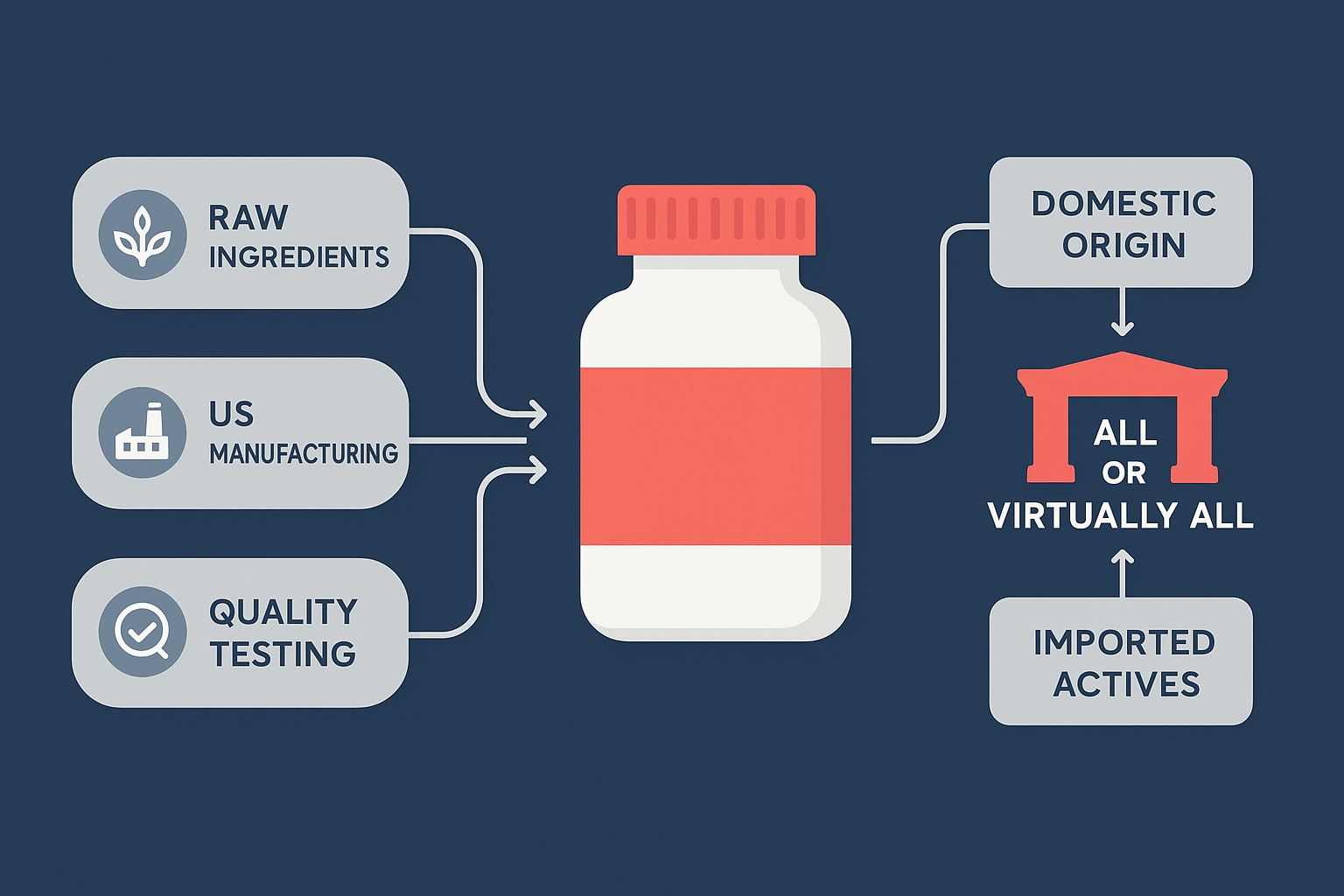
The FTC does not run a calculator on your batch. It runs a supply-chain audit before you print a single label. Final assembly in a U.S. facility counts toward U.S. content. Domestic processing steps, like encapsulation and blending, count. So do excipients sourced from U.S. suppliers.
Imported active ingredients weigh against an unqualified claim. A creator selling a greens powder with a proprietary blend from overseas cannot slap “Made in USA” on the front. The claim would need a qualifier, like “assembled in USA from imported ingredients,” and that qualifier has to be legible and close to the claim.
The term United States covers the 50 states, D.C., and U.S. territories. That definition comes from the FTC’s July 2024 compliance guide. A contract manufacturer in Puerto Rico still runs a domestic operation. The question is where the work physically happens, not where your LLC is registered.
A U.S. Customs substantial-transformation finding is not enough. Customs rules decide tariff classification and duty treatment. The FTC applies its own deception analysis when you market the product (FTC, July 2024). Passing customs clears you at the border. It does not clear you with the FTC.
There is no bright-line percentage for foreign content. The FTC has never published a fixed threshold that breaks a claim. Instead, it looks at the whole picture: ingredient origin, processing location, and how the claim appears on the label. One product might survive with a minor imported excipient. Another can fail because the key active comes from outside the United States.
That is why written origin documentation matters. Keep certificates for every raw material, invoices from suppliers, and batch records that show where each step took place. The FTC evaluates the full supply chain case by case. Your paper trail is the only way to show that the chain survived scrutiny.
Why Supplement Brands Are Uniquely Exposed to Made in USA Enforcement
Most founders assume a US factory line is enough. It isn’t. The all or virtually all test audits ingredient origin separately from final assembly, and most raw supplement ingredients are imported rather than produced domestically in commercially significant quantities. That single fact breaks the assumption that US manufacturing equals a compliant claim.
The July 2025 Warning Letters
In July 2025, the FTC sent warning letters to companies over Made in USA compliance. The core message: ingredients count toward the standard. A product blended and bottled in the US can still fail the test if its active ingredients came from overseas. The agency’s position was reported by NutraIngredients, July 10, 2025, and it put ingredient sourcing squarely inside the compliance review.
The pressure only increased. In 2026, U.S. policy directed the FTC to prioritize truthful Made in America advertising, including new attention to online marketplaces. That shift hits creator brands directly. Most supplement sellers operate through TikTok Shop, Instagram, and Shopify storefronts, which puts them in the path of marketplace-focused enforcement. A warning letter aimed at a product listing is far harder to bury than one mailed to a warehouse.
Two factors explain why supplements carry more exposure than most categories. First, the ingredient supply chain is global even when production is domestic. Second, the claim is printed on every label and repeated in every ad, which hands enforcement a ready paper trail. The dollar exposure from these enforcement actions is quantified later in this article, so read it before you approve your first label artwork.
Qualified Claims: What You CAN Say on a Supplement Label
Qualified claims are the safe path when any ingredient is imported. They tell the truth about foreign sourcing without abandoning the Made in USA conversation.
The FTC accepts these claims, but the standard is strict. The wording must match the supply chain, and the evidence must exist before the label prints. A qualified claim is not a fallback for lazy labeling; it is a precise statement of how the product was actually made.
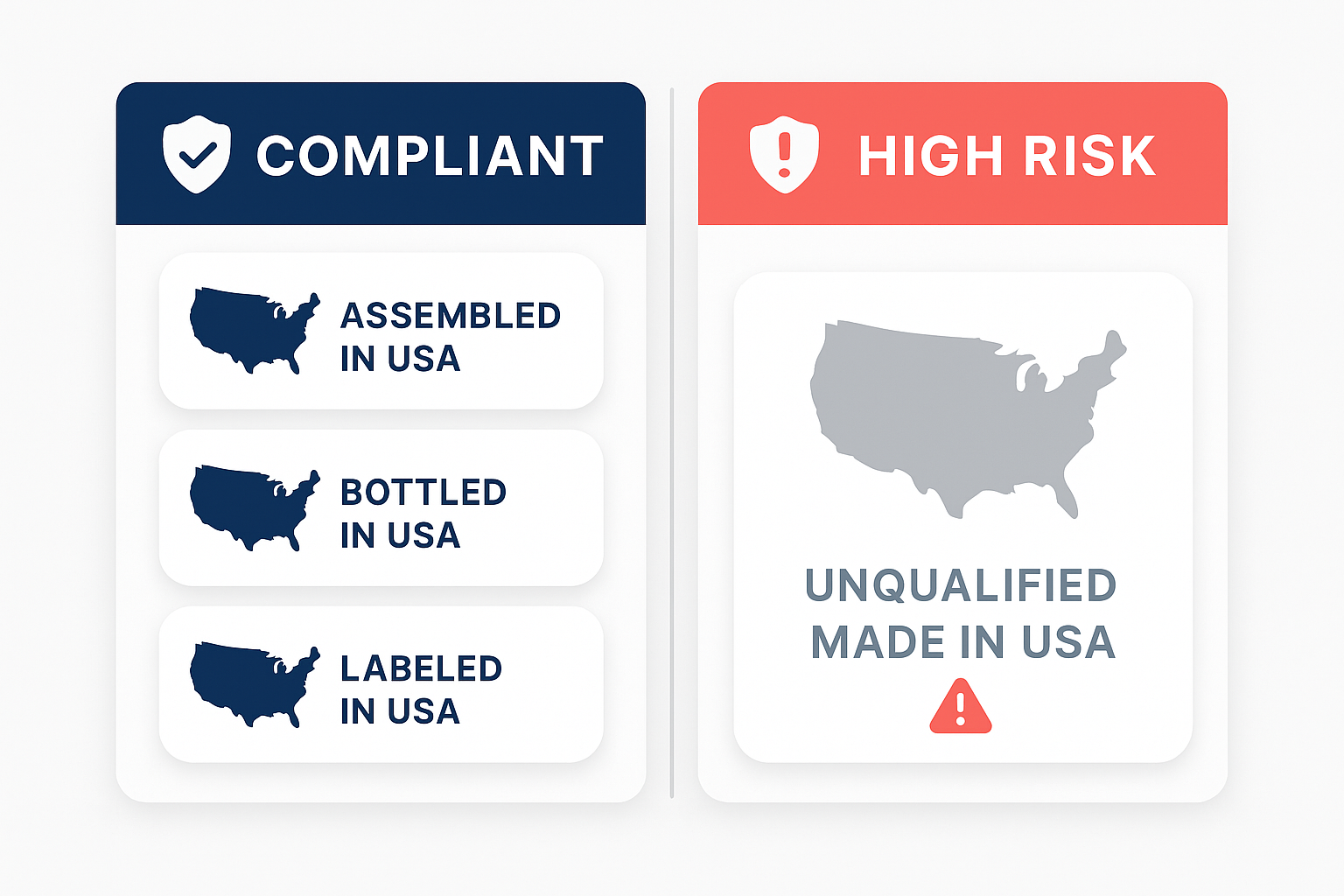
Four claim types cover the realistic labeling options. Here is what each requires and the evidence you need on file.
| Claim type | What it requires | Compliant example sentence | Substantiation needed |
|---|---|---|---|
| Made in USA (unqualified) | All or virtually all made in the United States | “Made in the USA from domestically sourced ingredients.” | Written country-of-origin documentation for every ingredient plus batch-level COAs |
| Made in USA with globally sourced ingredients (qualified) | Truthfully discloses imported content while US processing occurs | “Made in the USA from domestic and imported ingredients.” | Origin documentation showing the statement matches actual foreign content |
| Assembled in USA (qualified) | Last substantial transformation occurred in the US | “Assembled in the USA from imported ingredients.” | Evidence of last substantial transformation in the US |
| Bottled in the USA (qualified) | Process-specific claim limited to bottling | “Bottled in the USA from imported ingredients.” | Proof bottling occurred in the US without implying full domestic origin |
Qualified claims are accurate, specific, and still require prior evidence. They are a disclosure, not a loophole. A caveat on the label does not reduce the burden of proof; it only narrows what you are claiming.
Every Rocktomic batch carries a Certificate of Analysis, so the substantiation file starts at manufacturing, not at the first FTC inquiry. If you cannot document where an ingredient came from, no qualified phrase will save the claim. Update the wording whenever a supplier or sourcing country changes.
What the FTC Can Do: Penalties and Enforcement Milestones
Made in USA enforcement is a financial risk that scales with your catalog. One mislabeled product is a problem. The same error across ten SKUs, three sizes, and two sales channels becomes a compounding liability.
| Date | Milestone | Penalty or action | Source |
|---|---|---|---|
| July 14, 2021 | FTC finalizes the Made in USA Labeling Rule; rule effective August 13, 2021 | Civil penalty $43,280 per violation at that time | Federal Register, July 14, 2021 |
| May 2025 | FTC penalty ceiling updated | Up to $53,088 per violation | Morgan Lewis, May 22, 2025 |
| 2024 | FTC secures a civil penalty against a tractor manufacturer for misleading origin claims | $2,000,000 | Morgan Lewis, May 22, 2025 |
| July 2025 | FTC sends warning letters over Made in USA compliance; ingredients count toward the standard | Warning letters | NutraIngredients, July 10, 2025 |
Per-Violation Penalties Scale With Your Catalog
Each non-compliant label counts as a separate violation. Each size counts. Each sales channel counts. A multi-SKU error compounds fast. One bad origin claim across a ten-product line can become ten violations before you ever talk to a lawyer.
The 2024 tractor case shows how high this goes. The FTC secured a $2,000,000 civil penalty for misleading origin claims. At the May 2025 ceiling, two violations alone clear six figures before legal fees.
Marketplaces Can Delist You On Their Own Terms
The FTC is not the only gatekeeper. Marketplaces can delist brands on their own terms, independent of any FTC action. A warning letter or a penalty notice can trigger a platform review, and platforms enforce their own compliance standards. That review can pause sales while your inventory sits in a warehouse.
That makes compliance a unit-economics decision. A label mistake costs more than the documentation that prevents it. A Certificate of Analysis on every batch and a label review before print are cheap next to a five-figure per-violation penalty or the revenue loss of a delisted product.
Build Your Substantiation File Before You Print
The FTC requires substantiation before the claim goes on the label, not after. Evidence assembled in response to a warning letter does not count. Prior substantiation is the whole ballgame.
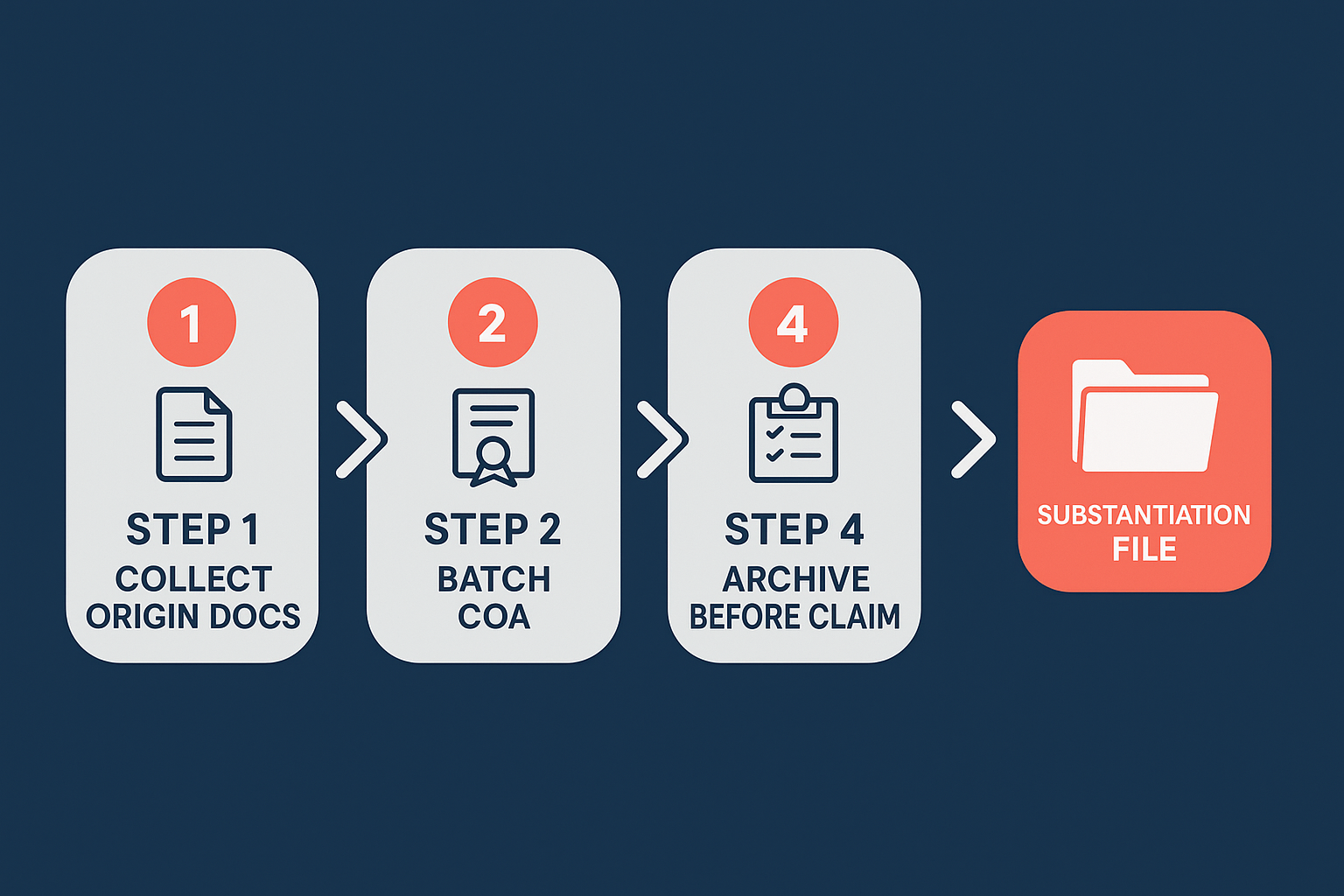
Step 1: Collect written country-of-origin documentation for every ingredient
Ask your manufacturer for written country-of-origin documentation for every ingredient in the formula, not just the finished product. That means sourcing certificates, bills of lading, and affidavits from each supplier in the chain. For a custom formula, request that origin data before you sign the formula agreement. Verbal assurances are not evidence. Build the paper trail before you order a single label.
Step 2: Pair every lot with a batch-level Certificate of Analysis
Obtain a batch-level Certificate of Analysis for every lot, not one generic document for the whole product line. See the Rocktomic quality and COA hub for what a proper COA includes. A COA proves identity, purity, and potency for that specific batch. It does not prove ingredient origin. That is the common mistake: brands show a COA and assume the Made in USA claim is covered. The COA tells you what is in the bottle, not where each raw material came from. You still need the written origin documentation from step 1.
Steps 3 and 4: Keep GMP records, then archive before you print
Step 3: hold onto GMP compliance records from the manufacturing facility. Audit results, batch production records, sanitation logs, and training files all count. These prove the product was made in a compliant facility, which is part of the Made in USA story. Step 4: archive every document before the claim goes live. Prior substantiation means the evidence exists at the moment of the claim, not the day a complaint arrives. Label the file by product and lot number so you can pull the right document in minutes. A slapdash folder is better than nothing, but not by much.
When the FTC asks questions, this file is what you hand over. Build it once, update it per batch, and the conversation stays short.
Audit Every Surface: Labels, Site, Ads, and Your Flag Emoji
Your substantiation file only defends the claims you can prove. The FTC judges what a reasonable consumer sees across every surface, not what your compliance binder says. Run a pre-launch audit across all of them.
Start With the Label
Check every origin line on the label. “Made in USA” on the front panel, the Supplement Facts panel, and the back panel each count as separate claims, and each needs documentation behind it.
Then audit the structure itself: where the origin line sits, how it interacts with the Supplement Facts block, and whether a flag graphic reads as part of the statement of identity. The bulletproof supplement label anatomy guide walks through the layout so you catch problems in the proof, not on the pallet.
Your Website and Ads Are Claims Too
Banners, product descriptions, ad creative, and social posts all fall under the same rules. A hero image with the flag plus a caption reading “proudly made in America” is an express claim. So is a line buried in a Facebook ad that says “manufactured in the USA.” If your documentation can’t back it, cut it before it goes live.
Creator and Affiliate Content Is Your Content
The FTC holds brands responsible for the claims their influencers make, even when the brand never wrote them. That unboxing video where a creator says your product is “made in the USA” still lands on your brand.
Put a claims script in every affiliate agreement, review posts before they publish, and hold creators to it. Our FTC guidelines for creators guide breaks down the obligations post by post.
Flag Imagery and Patriotic Symbols Are Claims
You don’t need the words “Made in USA” to make an origin claim. Flag imagery, map outlines, and patriotic symbols all signal domestic origin to a reasonable consumer, so the FTC treats them as claims. Audit packaging, banners, and social creative for any graphic that implies US manufacturing, and hold each one to the same documentation standard as a written claim. That includes the flag emoji in your bio.
The White-Label Documentation Trail
For creators building their own brand, the white-label program for brand builders supplies the documentation trail you would otherwise assemble yourself: US manufacturing, GMP certification, and a COA on every batch.
That turns the audit into a verification step instead of a research project. Confirm what the documentation covers, then make sure every surface says exactly that and nothing more.
Run the full audit once before launch. Re-run it whenever you change packaging, update a banner, or approve a new batch of affiliate content.
How a US-Based GMP Manufacturer Helps (and What It Does Not)
A US-based, GMP-certified manufacturer with batch-level Certificates of Analysis hands you the documentation trail you need to build a substantiation file. A substantiation file is the collection of evidence behind every claim on your label. Every claim should trace back to a document. That file is your defense when a claim gets questioned. The manufacturer’s job is to produce the raw evidence. Yours is to organize it.
Set the boundary in one line: manufacturing in the US does not by itself satisfy “all or virtually all,” because the FTC judges ingredient origin separately. Part 1 covered the full test. This part covers what a manufacturer can actually give you.
Rocktomic’s manufacturing is US-based and GMP-certified. Every batch gets third-party testing. Every batch ships with a Certificate of Analysis. Those are features, stated plainly, and each one maps to a document your compliance file should hold:
- US manufacturing documents where the finished product was made.
- GMP certification documents the quality system behind the process.
- Third-party testing and a batch-level COA document what is inside the bottle.
A Certificate of Analysis is proof of what your batch contains, not proof that every ingredient originated in the US. Ingredient origin is judged separately, so you still need supplier declarations and origin records before the finished product can qualify as “all or virtually all.”
That is the honest gap. A manufacturer like Rocktomic makes the file easier to build, but it never removes your responsibility to verify ingredient sourcing. Rocktomic produces the evidence. You keep the file. If the FTC ever asks, you answer with documents, not promises.
See how Rocktomic on-demand manufacturing works to understand where the documentation trail starts.
Made in USA Supplement Claims: 8 Questions Answered
What does the FTC’s all or virtually all standard mean for supplements?
The FTC defines an unqualified Made in USA claim under 16 CFR Part 323 as a product that is all or virtually all made in the United States. For supplements, that test covers every input, including raw ingredients, not just where the bottle was filled. The FTC finalized the labeling rule in July 2021 and clarified it in its July 2024 compliance guide. Brands cannot rely on a bright-line percentage; the agency evaluates the entire supply chain case by case.
Can a brand say Made in USA if only the manufacturing happens in the US?
No. Manufacturing in the US alone does not satisfy the all or virtually all standard because the test includes the origin of every ingredient. An FTC attorney confirmed in 2025 that Made in USA includes ingredients, and brands that import actives should use a qualified claim instead, such as Made in USA with imported ingredients. Brands should confirm each ingredient’s country of origin in writing with their manufacturer before printing labels.
What is the difference between Made in USA, Assembled in USA, and Bottled in the USA?
Assembled in USA and Bottled in the USA are qualified claims that describe specific steps rather than total origin. They are permitted when accurate and when the product’s last substantial transformation occurred in the United States. Made in USA is unqualified and demands the all or virtually all standard. A qualified claim must still be truthful and substantiated, and the FTC and US Customs consider these tests separately, so brands should verify both before printing.
Do U.S. flag graphics and map icons count as Made in USA claims?
Yes. The FTC treats U.S. flags, outlines of U.S. maps, and patriotic symbols as U.S. origin claims because they can imply domestic origin. That means a label with a flag graphic is held to the same substantiation standard as the words Made in USA. Brands should audit packaging, website banners, ads, and even creator content for flag and map imagery before launch, and qualify any imagery that overstates domestic content.
What evidence must a brand hold before printing a Made in USA label?
Before printing a Made in USA label, a brand should hold a documented reasonable basis: written country-of-origin documentation for every ingredient, batch-level Certificates of Analysis, GMP compliance records from the manufacturer, and evidence that each claim was substantiated before it was made. The FTC requires prior substantiation, not after-the-fact evidence. Brands that assemble this file before launch reduce the risk of warning letters, platform delisting, and civil penalties.
How much can the FTC fine a brand for unsubstantiated Made in USA supplement claims?
Civil penalties for Made in USA Labeling Rule violations were $43,280 per violation in 2021 and reached up to $53,088 per violation by May 2025, according to Morgan Lewis. In one 2024 case the FTC secured a $2 million civil penalty against a manufacturer for misleading origin claims. Because penalties scale per violation, a single misleading label printed across multiple SKUs compounds quickly, so compliance is cheaper than correction.
Does using a US-based GMP manufacturer guarantee the right to say Made in USA?
A US-based GMP-certified manufacturer gives brands the documentation trail needed to substantiate claims, but it does not by itself prove all or virtually all origin, because ingredient sourcing also matters. Rocktomic manufactures in the US, holds GMP certification, and provides a Certificate of Analysis with every batch. Membership starts at $0 per month with a ~$2 per item fulfillment fee, and the Scale plan at $297 per month adds the full 140+ catalog and priority fulfillment.
How does Rocktomic help creators launch a compliant supplement brand?
Rocktomic lets creators launch a supplement brand with zero inventory and no upfront purchasing. The Free plan costs $0 per month and covers up to 10 white-label products with on-demand dropshipping at about $2 per item. The Scale plan at $297 per month adds the full 140+ product catalog, unlimited sales channels, and lowest per-unit wholesale pricing. Creators keep the brand and customer relationship while Rocktomic handles manufacturing, warehousing, labeling, and shipping.
Own Your Brand Without Inventory Risk
Made in USA compliance is a documentation problem, not a marketing problem. The FTC expects proof behind every label claim, and the fix is a manufacturer that hands over origin documentation, batch COAs, and GMP records before you print a single label.
You can compare Rocktomic membership pricing to see the two plans side by side: Free at $0 per month and Scale at $297 per month. Then book a call with Rocktomic to audit the documentation trail of a real US-based manufacturer before you print labels. Verify the paperwork trail exists before you commit to claims on your packaging, not after. A label is easy to print. The documentation behind it is what keeps your brand defensible.
Last updated: June 21, 2026.